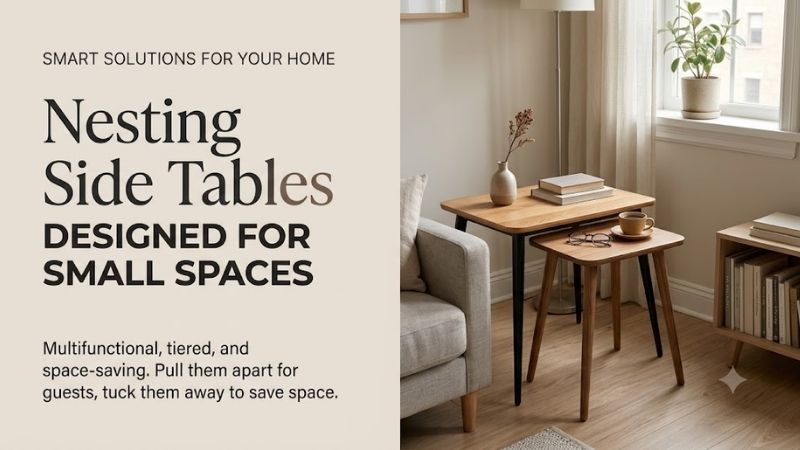
Nesting side tables for small spaces can provide extra surfaces without committing permanent floor area to several separate tables. However, the compact footprint depends on the actual nesting design, tabletop sizes, and leg clearance. This guide explains how to measure both arrangements, select suitable heights, and plan tables around sofas, beds, and apartment walkways.
Why Nesting Tables Work in Compact Homes
In a small room, the amount of furniture on the floor matters as much as the room’s total square footage.
A conventional side table occupies roughly the same footprint whether it is being used or not. A nesting set allows a second tabletop to be tucked beneath or partially beneath the first.
This can be useful when extra surfaces are needed only occasionally.
For example, one table may normally hold a lamp beside a sofa. When guests arrive, the smaller table can be moved beside another seat.
Afterward, it can return beneath the larger table.
However, this benefit disappears when both tables remain permanently separated. A nesting set should be purchased because its compact arrangement will actually be used.
Compare Small-Space Nesting Designs
| Design | Main space benefit | Main limitation |
|---|---|---|
| Fully nesting square tables | Small stored footprint | Larger table can still be wide |
| Compact round pair | Easier placement around furniture | Limited tabletop area |
| Narrow rectangular pair | Uses less room depth | May be difficult to reach from multiple seats |
| Metal-frame nesting set | Open visual appearance | Legs can obstruct nesting |
| Overlapping decorative set | Flexible styling | May not fully conceal smaller table |
| Three-piece nesting set | More movable surfaces | Additional pieces require storage |
Step 1: Measure the Available Floor Area
Start by recording the space beside the sofa, between seating pieces, or next to the bed.
Measure the actual width and depth that a table can occupy without interfering with walking or furniture access.
Then repeat the exercise for the expanded arrangement.
A table set that fits perfectly when nested may become inconvenient when both pieces are deployed.
Example: A Narrow Sofa-Side Space
Suppose the available space beside a sofa is 20 inches wide.
A Nathan James Lula larger table with an 18-inch diameter might fit, provided the surrounding access remains suitable.
An IKEA LACK table with a 21.625-inch-wide top would not fit inside the same strict 20-inch span.
This difference is meaningful even though both are marketed as flexible nesting furniture.
Consider the Table Legs
The tabletop may be only 18 inches wide, but angled legs or an offset frame can change the usable footprint.
Check the maximum assembled dimensions rather than relying on tabletop measurements alone.
Preserve Doors and Storage Access
A deployed nesting table should not block a doorway, cabinet, or sofa recliner.
If moving it into position requires obstructing the room’s main circulation route, it may not be an appropriate furniture solution.
Step 2: Understand Full Nesting Versus Partial Overlap
Not all nesting systems store identically.
Full Nesting
A smaller table can slide almost completely beneath a larger one.
IKEA LACK is an example of a simple design intended to permit compact nesting.
The smaller piece becomes less visually prominent when unused.
However, its height and support structure still occupy space beneath the larger top.
Partial Nesting
Some tables overlap only partway.
This can create an attractive stepped arrangement but may not reduce floor area as much as expected.
IKEA STOCKHOLM illustrates this design-oriented approach.
For a very small room, an overlapping arrangement can be less efficient than a fully nesting pair.
Side-by-Side Use
A set can also be useful when separated.
In a living room, each table may serve a different seat.
The drawback is that the household now has two pieces of furniture occupying floor space simultaneously.
The decision should be based on how frequently this layout is needed.
Step 3: Compare Real Product Dimensions
| Set | Larger-piece dimensions or footprint | Smaller-piece dimensions or footprint | Main implication |
|---|---|---|---|
| IKEA LACK | 21.625 × 21.625 in; 17.75 in high | 13.75 × 13.75 in; 13.75 in high | Affordable but broad square footprint |
| Nathan James Lula | 18-in diameter; 22 in high | 11.6-in diameter; 18.8 in high | Compact and relatively tall |
| IKEA SONHULT | 21.5-in square top | 27.5 × 15.75-in rectangular top | Shape and height flexibility |
| IKEA VITTSJÖ | Max length 35.375 in | Separate smaller nested piece | Better for wider seating areas |
| IKEA STOCKHOLM | Max length 28.375 in | Leaf-shaped overlapping piece | Decorative rather than maximum concealment |
Measurements describe documented configurations, not universal clearances.
Step 4: Match Table Height to the Seating
Height matters because a table that fits physically may be awkward to reach.
Sofa-Side Tables
A side table placed beside the sofa is often easier to use when its height coordinates with the seating arm or the occupant’s comfortable reach.
A 22-inch-high table may suit certain conventional sofas.
However, a very low lounge sofa may work better with a shorter surface.
Coffee-Table Arrangements
Lower nesting tables can provide surfaces in front of a sofa.
However, a short table may require bending forward to reach drinks or books.
The ideal height depends on the surrounding furniture.
Bedside Use
Nesting tables can serve as temporary bedside surfaces.
However, the primary table should work with the mattress height and provide a stable place for any intended lamp or accessories.
Small nesting pieces generally do not replace the enclosed storage of a conventional nightstand.
Step 5: Compare Top Shapes
Round Tables
Round tops eliminate projecting corners.
They can be useful where people move around a chair.
However, round tables provide less surface area than squares of the same maximum width.
Square Tables
A square top maximizes surface area within its width and depth.
A 20-inch square provides 400 square inches of tabletop area.
A 20-inch circle provides approximately 314 square inches.
That means the square offers about 27% more area.
However, its corners may interfere with circulation.
Rectangular Tables
A narrow rectangle can fit better along a sofa or wall.
It may provide useful space for books and accessories without projecting as far into the room.
Irregular and Leaf-Shaped Tables
Decorative shapes can make a room more distinctive.
However, they may provide less predictable storage and overlap.
Select them when the design benefit justifies the trade-off.
Step 6: Consider Materials and Weight
A table moved regularly should be manageable for the intended user.
Lightweight Engineered Wood
IKEA LACK uses a lightweight honeycomb construction.
This makes relocation convenient.
However, the table must remain within its intended loading limits.
Metal-Frame Tables
Metal supports can provide an open appearance and a different structural arrangement.
However, the furniture can still be heavy depending on the tabletop and frame.
Glass Surfaces
Glass can make a small room feel visually open.
However, glass requires appropriate impact precautions and maintenance.
Solid-Wood and Veneer Surfaces
Wood veneer can provide a natural appearance.
However, premium finishes may be less attractive to buyers who frequently move tables between rooms and risk bumping the edges.
Step 7: Plan How the Tables Will Be Used
One Everyday Surface, One Guest Surface
This is one of the most practical nesting-table arrangements.
Keep the larger table beside a sofa and deploy the smaller one only when necessary.
Two Separate Chairs
Each table can serve an armchair.
However, make sure the smaller table is tall enough for comfortable access.
Temporary Laptop Use
A nesting side table may hold a laptop or accessories when permitted by its load rating.
However, a small table is not automatically an ergonomic workstation.
The user’s typing posture and screen position still matter.
Decorative Use
Nesting sets can hold plants, books, and decorative objects.
However, the arrangement must remain stable and within published load limits.
Step 8: Evaluate Child and Pet Safety
A lightweight nesting table can be easy to move, which is convenient for adults but also makes stability important.
Children should not climb or sit on the tables.
Pets can bump into furniture legs or push objects from narrow tabletops.
Avoid heavy items positioned near the edge.
Check the manufacturer’s instructions for securing hardware and using the furniture on appropriate floors.
Glass tables need additional impact care.
Common Small-Space Buying Mistakes
Buying Based on the Nested Photo Alone
The fully separated layout may require much more floor area.
Assuming All Sets Fully Nest
Some decorative sets overlap only slightly.
Ignoring Table Height
A very short table may be inconvenient beside a sofa.
Choosing the Smallest Top Without Checking Usefulness
A narrow tabletop may fit the room but fail to hold the intended objects.
Forgetting the Base Footprint
Leg placement can affect both floor area and how the tables fit together.
Frequently Asked Questions
Are Nesting Side Tables Good for Small Spaces?
Yes, especially when the smaller table is used occasionally and can be stored beneath the larger one. However, the actual compactness depends on the design.
Which Shape Is Most Space-Efficient?
Square tables offer more tabletop area within a fixed maximum width, while round tables remove corners. Narrow rectangular tables may suit constrained spaces beside sofas.
Can Nesting Tables Replace a Coffee Table?
Some sets can, but their height and total tabletop area must suit the seating arrangement.
Are Two-Piece or Three-Piece Sets Better?
Two-piece sets can be easier to manage in very small rooms. Three-piece sets offer more surfaces but require more space when deployed.
Should I Choose Glass or Wood?
Choose based on cleaning, appearance, load requirements, and household conditions. Neither material is universally superior.
How Do I Know if the Tables Will Fully Nest?
Check the manufacturer’s photographs, assembly design, underside clearance, and published dimensions. The word nesting alone is not sufficient.
Conclusion
Nesting side tables for small spaces are most useful when their stored and expanded arrangements both work with the room. Compare actual footprint, table height, shape, leg clearance, material, and weight before purchasing. A compact round pair such as Nathan James Lula can work beside a sofa, while IKEA LACK offers a basic affordable option. Choose a set whose smaller surface can be stored easily and deployed without obstructing everyday movement.