A round coffee table for small spaces can make a living room easier to navigate while providing a useful surface for drinks, books, and daily accessories. However, a circular tabletop still occupies valuable floor area. This guide explains how to compare diameter, height, base design, storage, and room layout before choosing a compact table.
Why Round Coffee Tables Work in Compact Living Rooms
A round coffee table removes the projecting corners found on square or rectangular furniture.
This can be useful when the table sits between a sofa, armchair, and television cabinet.
People can move around its curved outline without navigating four prominent corners.
However, a round table is not automatically more space-efficient.
A large circular tabletop can project farther into the room than a narrow rectangular table, especially when the furniture arrangement follows a long wall.
For example, a 36-inch round table requires 36 inches of space in both principal horizontal directions. A 36-by-20-inch rectangular table projects only 20 inches in one direction.
The better choice depends on the shape of the available floor area.
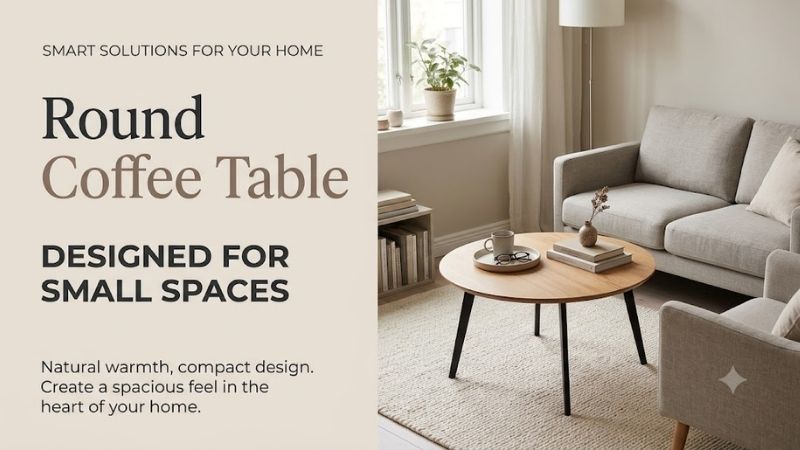
Compare Round Table Sizes for Small Spaces
| Diameter | Approximate tabletop area | Typical planning use |
|---|---|---|
| 20 inches | 314 sq in | Very compact seating corner |
| 24 inches | 452 sq in | Small sofa or loveseat |
| 28 inches | 616 sq in | Compact living-room centerpiece |
| 30 inches | 707 sq in | Medium-small conversation area |
| 32 inches | 804 sq in | Larger loveseat or sofa arrangement |
| 36 inches | 1,018 sq in | More generous living-room layout |
These dimensions are illustrative. Actual suitability depends on seating positions, door access, and nearby furniture.
Step 1: Measure the Entire Living Room
Begin by recording the dimensions of the room.
Identify the sofa, television unit, side tables, doors, and walkways.
Then measure the space between the sofa and opposing furniture.
The goal is to fit the coffee table without making ordinary activities inconvenient.
Account for Sofa Clearance
A table needs to be accessible from the seated position while leaving space for feet and movement.
A gap around 14–18 inches between the sofa and table is a common preliminary furniture-planning range, but it is not a universal safety requirement.
A household with mobility aids, children, or an unusual seating arrangement may need different clearances.
The important point is to test whether occupants can sit, stand, and walk comfortably.
Preserve Main Walking Routes
A central living-room route may need substantially more room than the narrow gap between a sofa and its coffee table.
Do not use a furniture-planning rule to justify blocking essential access.
Check door swing, passageways, and the route people actually take through the room.
Measure Before Ordering
A simple paper template or removable painter’s tape can help.
Mark the circular footprint on the floor.
This gives a better impression of the actual occupied area than comparing table photographs online.
Step 2: Choose the Right Diameter
The best diameter depends on both the room and the furniture surrounding the table.
Twenty- to Twenty-Four-Inch Tables
Small round tables can work in studio apartments and narrow sofa arrangements.
They provide enough space for a few drinks, a remote, or a small book stack.
However, they may not be reachable from several seats at once.
A table too small for the seating arrangement can lead to additional side tables and more overall clutter.
Twenty-Eight- to Thirty-Inch Tables
This range is a useful starting point for many compact living rooms.
A 28-inch table offers considerably more surface than a 24-inch model without expanding to the footprint of a large statement piece.
IKEA BORGEBY, at approximately 27.5 inches, illustrates this category.
Thirty-Two-Inch Tables
A 32-inch round table provides a substantial surface.
Threshold Castalia is an example.
It may work well with a three-seat sofa or with seating on multiple sides.
However, a narrow living room can feel crowded if the table projects too far toward the television cabinet.
Thirty-Six-Inch and Larger Tables
These can be attractive in spacious seating groups.
In a very small room, however, they may consume too much central floor area.
A larger diameter should be selected because the household needs its surface, not simply because oversized furniture looks impressive online.
Step 3: Compare Coffee-Table Height With Sofa Height
A coffee table should be comfortable to reach from nearby seating.
The ideal relationship depends on the sofa’s seat height, posture, and intended table activities.
Lower Coffee Tables
Tables around 14–16 inches high often suit contemporary lounge-oriented furniture.
Their low visual profile can make the room appear more open.
However, reaching a low table may be less convenient for people sitting upright on higher seating.
Moderate-Height Tables
A somewhat taller coffee table may be more accessible from conventional sofas.
However, height should not be selected independently of tabletop size and base stability.
A tall, narrow table may behave differently from a low, broad one.
Avoid Guessing From Pictures
Product photographs are often staged with furniture whose dimensions are not provided.
Compare the listed table height with the actual sofa-seat height.
If possible, simulate the relationship using a box or temporary surface before purchasing.
Step 4: Evaluate the Base Design
Two round coffee tables can have the same tabletop diameter but offer very different foot space.
Pedestal Bases
A central pedestal can create an uncluttered appearance.
It may also reduce the number of table legs near the seating area.
However, the pedestal’s diameter and weight influence how much space remains for feet.
The base must be stable according to the product’s design.
Three- or Four-Leg Bases
Legged coffee tables can offer a familiar appearance and support arrangement.
However, legs may obstruct the space beneath the table.
A model with a lower shelf can provide storage but may reduce the area available for feet or cleaning.
Drum-Style Bases
A drum coffee table uses a relatively solid-looking cylindrical structure.
It can create a strong visual statement.
However, it may appear bulky in a small living room, and some models are relatively heavy.
Open Metal Bases
Slim metal frames may make a table appear lighter.
This can be particularly useful when paired with glass or a thin tabletop.
However, the physical dimensions remain unchanged.
Visual openness and actual floor space are different factors.
Step 5: Choose the Right Material
Wood and Wood Veneer
Wood finishes add warmth and can coordinate with flooring or cabinets.
Veneer tables may offer a natural-looking surface over engineered components.
However, the finish needs appropriate protection against spills and heat.
Glass
Glass creates visual openness.
It can work well when a small room already contains bulky upholstered furniture.
However, fingerprints and smudges may be visible, and the surface requires suitable impact precautions.
Metal
Metal tables can offer slim structures and modern styling.
Their suitability depends on finish, construction, edge design, and weight.
Stone and Stone-Look Materials
Stone can create a premium appearance but may be heavy.
Marble-look surfaces may use engineered materials rather than natural marble.
Always confirm the exact composition, care requirements, and delivery weight.
Step 6: Decide Whether Storage Is Necessary
A small coffee table can provide extra functionality through a lower shelf or concealed compartment.
However, not every household benefits from additional storage.
Open Shelves
An open shelf can hold books, remotes, and small baskets.
It offers easy access.
However, visible clutter can make a compact living room appear busier.
Closed Storage
A table with drawers or a lifting top can conceal items.
However, opening mechanisms need clearance and may add cost.
Tables Without Storage
A simple pedestal table can feel visually cleaner.
It may be the better option when shelving and cabinets already provide enough household storage.
Choose based on the actual organization problem.
Step 7: Consider the Shape of Your Sofa
Straight Two-Seat Sofa
A compact round table can be a good match.
Its shape helps soften the arrangement, especially when surrounding furniture is rectangular.
Three-Seat Sofa
A slightly larger table may improve accessibility across the seating width.
However, if the room is narrow, a long oval table may provide better reach without excessive depth.
L-Shaped Sectional
A round table can work within the open area of an L-shaped sectional.
However, the chosen diameter must allow comfortable access to every seat and preserve foot space.
Curved Sofa
A round table can visually complement curved seating.
However, matching curved shapes is not enough: the actual distances between the tabletop and seats still matter.
Example: Planning a Coffee Table in a 10 × 12-Foot Room
Consider a hypothetical living room measuring 120 × 144 inches.
The sofa has a depth of 36 inches, and an opposing media cabinet projects 16 inches into the room.
That leaves 68 inches between the front of the sofa and the media cabinet along that dimension.
A 28-inch round table placed centrally within this space would leave a combined 40 inches on the two opposing sides.
If centered, that equals approximately 20 inches on each side.
A 36-inch table would leave 32 inches combined, or about 16 inches per side.
These calculations demonstrate the effect of table diameter but do not automatically establish a safe route through the room.
Actual access may require more space depending on door positions and circulation patterns.
Practical Compact-Room Examples
| Table | Published size | What to consider |
|---|---|---|
| IKEA BORGEBY | 27.5-inch diameter | Balanced surface and storage |
| IKEA VITTSJÖ | 29.5-inch diameter | Transparent visual effect |
| IKEA JAKOBSFORS | 31.5-inch diameter | Larger wood-veneer surface |
| Threshold Castalia | 32-inch diameter | Wood table with lower shelf |
| IKEA STOCKHOLM 2025 | About 35.4-inch diameter | Statement size, requires more room |
The table’s exact height, base design, and materials must also be considered.
Common Small-Space Mistakes
Assuming Round Always Means Space-Saving
A round table can still occupy more room than a narrow rectangle.
Choosing Diameter Based Only on Appearance
The surface must fit the actual seating arrangement.
Forgetting the Table Base
A bulky pedestal can interfere with foot space.
Choosing Storage You Do Not Need
Extra shelves or mechanisms may increase visual clutter and maintenance.
Ignoring Delivery and Assembly
A large stone or solid-looking table may be difficult to maneuver through an apartment.
Frequently Asked Questions
What Is the Best Round Coffee Table for Small Spaces?
A model around 24–30 inches in diameter is a practical starting point for many compact seating arrangements. However, the correct choice depends on the sofa, available floor depth, and walking routes.
Is a 30-Inch Round Coffee Table Too Large?
Not necessarily. A 30-inch table can work well in a modest living room, but it may be too large in a narrow space with a deep sofa and media cabinet.
Is Round Better Than Rectangular for a Small Room?
Round tables avoid projecting corners, while narrow rectangular tables can occupy less depth. Compare the complete floor layout.
Are Glass Tables Better for Small Apartments?
They can appear visually lighter, but their actual footprint is unchanged. Cleaning and material safety remain important.
Can a Round Coffee Table Work With a Sectional?
Yes, especially when the round table fits comfortably inside the seating arrangement. The diameter must preserve access and foot space.
Should I Buy a Table With Storage?
Choose storage when it solves an actual clutter problem. If you already have enough organization elsewhere, a simpler table may be preferable.
Conclusion
A round coffee table for small spaces works best when its diameter, height, base design, and materials complement the actual room. Measure the area between furniture, model the circular footprint, and preserve practical access before ordering. Small and medium tables can make a compact living room feel more flexible, while oversized models may consume unnecessary space. Select based on everyday usability rather than appearance alone.