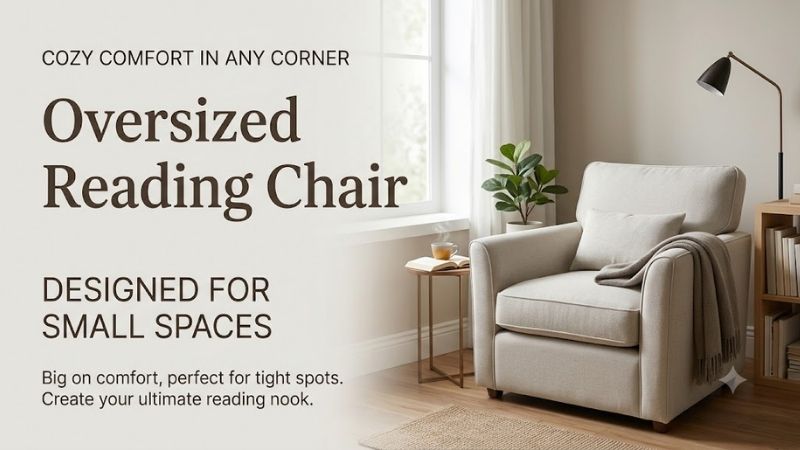
An oversized reading chair for small spaces can create a comfortable retreat without requiring a separate lounge room. However, broad cushions, thick arms, and deep frames can quickly overwhelm an apartment. This guide explains how to choose a genuinely roomy seat while preserving walking space, reading-light placement, and everyday comfort.
Can an Oversized Reading Chair Work in a Small Room?
Yes, but the chair needs to earn the space it occupies.
An oversized reading chair offers more flexibility for curling up, shifting position, or using additional pillows. In a compact room, however, those advantages compete directly with floor area needed for doors, storage, side tables, and walking routes.
The best solution is often a chair with generous usable seating width but relatively restrained exterior dimensions.
This is not the same as choosing the smallest possible chair. A compact accent chair may fit neatly but fail to provide the lounging comfort that motivated the purchase.
A small-space buying decision should balance comfort and room function instead of maximizing either one independently.
Compare Practical Reading-Chair Configurations
| Configuration | Main benefit | Main drawback | Suitable room |
|---|---|---|---|
| Wide chair-and-a-half | Generous seating area | Large fixed footprint | Compact living room with dedicated corner |
| Modular single-seat lounge | Broad cushion and flexible furniture system | Can be deep and low | Studio or open-plan apartment |
| Slim-arm oversized chair | More usable width within exterior dimensions | Fewer traditional padded-arm features | Narrow reading nook |
| Wing chair with ottoman | Upright support and movable legrest | Requires space for ottoman | Bedroom reading corner |
| Deep barrel chair | Relaxed curled-up posture | Curved frame can be bulky | Open corner |
| Conventional armchair with pillows | Smaller footprint | Less room for full-body lounging | Very tight room |
Start With the Usable Seat Width
The exterior width of a chair includes its arms and structural frame.
The usable seat width is the space available to the occupant.
This distinction can dramatically change the buying decision.
For example, IKEA SÖDERHAMN has an exterior width of approximately 41.375 inches and a usable seat width of 36.625 inches.
Its relatively slender arms leave a substantial seating area.
A chair with deeply padded rolled arms may occupy a similar total width while providing less room for the occupant.
Estimate Your Preferred Reading Posture
Consider how you normally sit when reading.
If you keep both feet on the floor, additional seat width may offer little benefit beyond ordinary comfort.
If you sit cross-legged, tuck one foot beneath the opposite leg, or lean sideways against an armrest, more width becomes useful.
Measure the amount of room required for your normal position using an existing sofa or cushion.
This provides a more relevant target than a generic label such as XL or oversized.
Avoid Oversized Arms That Consume Floor Space
Thick upholstered arms contribute to a cozy appearance but can reduce seating efficiency.
In a narrow room, a slimmer arm profile may allow the same usable seating width within a smaller exterior frame.
However, armrests also provide support for reading materials.
The best design is not necessarily armless; it is one whose arm proportions match the intended use.
Compare Seat Depth Carefully
Seat depth determines how far the occupant can sit back and how easily they can change position.
A deep cushion can feel inviting but may create an uncomfortable gap between the person’s back and the backrest during upright reading.
Deep Seats for Curling Up
Deep cushions allow more room to bring the legs onto the seat.
However, this requires sufficient usable width as well.
A chair that is deep but narrow may not support the preferred position.
The position of the back cushion also matters because loose cushions reduce usable depth when placed against the frame.
Shallower Seats for Upright Reading
A shallower seat may support an upright posture more naturally.
That can be preferable for someone who reads printed books, studies, or writes notes.
The buyer may not need the deepest available chair simply because reading is associated with lounging.
Why Exterior Depth Is Different
IKEA SÖDERHAMN illustrates this distinction.
Its overall depth is approximately 39 inches, but its stated seat depth is about 18.875 inches with the intended cushion arrangement.
The frame and cushions occupy a meaningful portion of the total measurement.
Never infer usable seat depth from the exterior depth alone.
Measure the Reading Corner Before Buying
A room can accommodate a chair mathematically yet remain difficult to use.
For example, a chair may fit between a bed and wardrobe but prevent wardrobe doors from opening completely.
The best small-space plan measures the chair alongside the surrounding activities.
Example: A 7 × 8-Foot Reading Area
Consider a hypothetical 84-by-96-inch area.
Suppose a reading chair measures 43 inches wide and 36 inches deep.
When placed along the 84-inch wall, the chair leaves 41 inches of wall span before accounting for furniture, trim, or required access.
However, if a 16-inch side table is placed beside it, only 25 inches remain along that wall.
The practical layout may be considerably tighter than expected.
A narrow wall-mounted shelf could preserve more space than a substantial side table.
These calculations are illustrative, not universal clearance recommendations.
Account for Doors and Drawers
Before ordering, check whether the chair obstructs doors, sliding storage, or furniture drawers.
An oversized chair should not require moving the entire reading setup every time storage is accessed.
Consider Visual Scale
A chair with a low back and slender legs can appear less imposing than a tall, heavily padded design of similar width.
However, appearance does not change the physical clearance.
Use visual balance only after confirming the chair fits properly.
Choose a Seat Height That Works for You
Oversized lounge chairs are often relatively low.
For example, the IKEA SÖDERHAMN Armchair has a seat height of approximately 15.75 inches, compared with UPPLAND’s 18.5 inches.
That difference can materially affect the experience.
A low seat may suit someone who enjoys reclining and rarely gets up.
A higher seat can be more convenient for someone who frequently stands to retrieve books, answer the door, or move between tasks.
There is no universally ideal height.
The user’s lower-leg length, cushion compression, and preferred sitting posture all matter.
Reading Support: Backrest, Arms, and Pillows
A large cushion does not automatically create a comfortable reading position.
A reader needs a way to support the back, forearms, and reading material.
High Versus Low Backrests
A high backrest may help support the upper torso during upright reading.
A low back can feel more relaxed but offer less contact behind the shoulders.
If you plan to read for extended periods, pay attention to where your upper back rests naturally.
Armrest Height
Appropriate armrests can help support a book or tablet.
However, arms that are too high may raise the shoulders, while arms that are too low may require additional cushions.
Use Pillows to Refine, Not Rescue, the Fit
A lumbar pillow or firm reading cushion can improve support in a deep chair.
However, needing several large pillows to compensate for uncomfortable seat geometry may suggest that the chair itself is unsuitable.
Reading Light and Furniture Placement
A chair can fit perfectly yet create a poor reading experience when lighting is inadequate.
Consider the position of the light source before finalizing the layout.
A wall-mounted or compact floor lamp can conserve space compared with a large side table and table lamp.
For print reading, adjustable directional lighting can help illuminate the pages without producing distracting glare.
The best position depends on handedness, page orientation, surrounding daylight, and whether the reader shares the room.
Electrical cables should remain outside walking paths and away from moving furniture components.
Upholstery for Small Homes
In a small apartment, the reading chair may also serve as television seating, guest seating, or a place to work occasionally.
This increases the importance of maintenance.
Removable Covers
A removable, appropriately washable cover can make a broad upholstered chair easier to maintain.
IKEA UPPLAND and SÖDERHAMN provide relevant cover-system examples.
However, washing requirements vary by fabric.
Chenille and Other Textured Materials
Chenille offers a soft appearance and distinctive texture.
However, cleaning requirements and snag resistance depend on the exact weave.
Do not assume all chenille upholstery is equally durable.
Light Versus Dark Colors
Light upholstery can visually soften a compact room but may show certain stains.
Dark upholstery may conceal some discoloration while making lint or light-colored pet hair more visible.
Choose according to the household’s actual maintenance needs.
Delivery and Assembly
A large chair may be harder to move through a doorway than its final location suggests.
Measure the narrowest part of the delivery route, including stairways and hallway corners.
Review boxed dimensions and the possibility of assembling the chair in the room.
Some models have separately attached arms or frames, while others arrive mostly assembled.
Do not assume that every chair-and-a-half can be disassembled for moving.
Common Buying Mistakes
Buying Based on the Word Oversized
The term does not guarantee a particular usable cushion width.
Ignoring Exterior Depth
A wide chair that projects too far into the room may obstruct circulation.
Choosing the Deepest Cushion Automatically
Deep seating can make upright reading uncomfortable.
Forgetting Light and Book Storage
A usable reading corner needs appropriate lighting and a convenient place for reading materials.
Assuming a Low Chair Suits Everyone
Seat height influences foot position and standing comfort.
Frequently Asked Questions
What Is the Best Oversized Reading Chair for a Small Space?
A wide chair with relatively efficient arm proportions and suitable depth is a strong starting point. IKEA SÖDERHAMN offers generous usable width, but its low seat and deep exterior footprint will not fit every room.
Can a Chair-and-a-Half Fit in a Bedroom?
Yes, if the room can accommodate its full width and depth without obstructing doors, wardrobes, and walking routes. Measure the finished chair rather than relying on photographs.
Is a Swivel Chair Better for a Small Reading Corner?
A compact swivel may be useful when the chair needs to face multiple directions, but its rotating body requires clearance. A stationary chair may fit better against a wall.
Should I Choose a Chair With an Ottoman?
An ottoman can provide separate leg support, but it also occupies floor space. In a narrow room, a chair wide enough to curl up in may be a more compact overall arrangement.
How Wide Should the Seat Be for Cross-Legged Reading?
There is no universal measurement because body proportions and preferred positions vary. Measure your own comfortable posture on an existing sofa and compare that space with the chair’s usable seat width.
Are Removable Covers Important?
They can be particularly useful in a small multipurpose room where the chair is used daily. Check fabric-specific laundering instructions before purchasing.
Conclusion
An oversized reading chair for small spaces works best when its usable cushion width justifies the overall footprint. Measure the entire room, compare seat height and depth, preserve essential access, and plan the lighting before buying. A broad modular chair, conventional chair-and-a-half, or supportive wing chair can all work depending on reading posture. Prioritize comfort and usability over the largest advertised dimensions.