Key takeaways
-
Actual pillow width, length, and contour height.
-
Your primary sleeping position.
-
Mattress firmness and any topper.
-
Whether the contour is fixed or adjustable.
-
Whether additional foam components need storage.
-
Whether the cover can be removed and washed.
-
Availability of compatible replacement covers.
-
Product return conditions.
-
Whether the pillow is intended for ordinary sleeping rather than brief therapeutic positioning.
Choose a cervical neck pillow for small spaces with the right dimensions, contour, support, washable cover, and storage needs for compact bedrooms and apartments.
A cervical neck pillow for small spaces should support your head and neck without taking up unnecessary room on a twin, full, or compact queen mattress. Fixed-contour foam, adjustable orthopedic pillows, and traditional neck-roll designs can all work, but their dimensions and fit vary. This guide explains how to select an appropriately sized cervical pillow, compare support shapes, and manage cleaning and storage in apartments, dorm rooms, and smaller bedrooms.
Why a Cervical Pillow Needs a Different Buying Approach
An ordinary pillow is often selected by softness, appearance, and size.
A cervical pillow requires more attention to geometry.
Many designs use a raised section beneath the neck and a lower region for the head. Others have two different neck-roll heights, side-sleeping zones, or adjustable compartments.
These features can change how the head rests relative to the shoulders.
A pillow with an unsuitable contour may cause discomfort even when its materials are expensive.
For small-space buyers, the challenge is finding a design that provides adequate support without unnecessary width, bulky accessories, or specialized storage requirements.
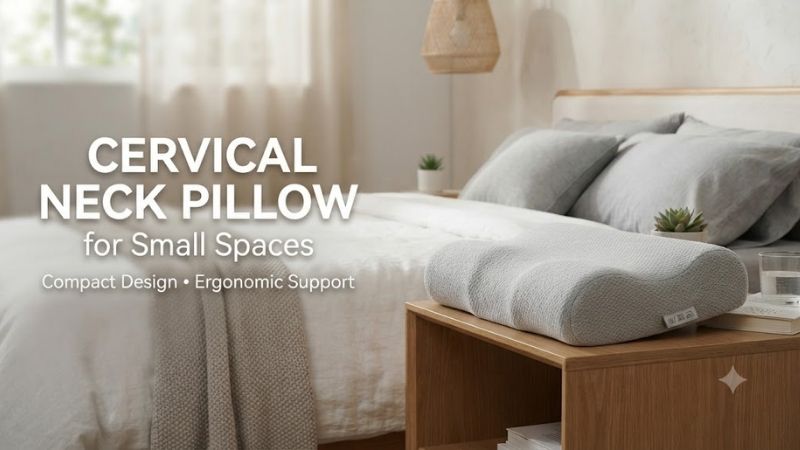
Choosing the Right Pillow Dimensions for a Compact Mattress
A cervical pillow does not necessarily use standard pillow dimensions.
Some orthopedic models are narrower or shorter than conventional pillows.
Others have familiar rectangular outlines but unusual internal shapes.
Standard Pillow Dimensions as a Reference
| Pillow category | Common dimensions | Practical consideration |
|---|---|---|
| Standard | 20 × 26 inches | Fits most twin and full mattresses |
| Queen | 20 × 30 inches | Additional width for movement |
| King | 20 × 36 inches | May be unnecessarily wide for a twin |
| Compact cervical contour | Manufacturer-specific | Check usable head and shoulder support areas |
| Cervical roll | Manufacturer-specific | May require another pillow or specific positioning |
The standard sizes are reference dimensions. Orthopedic products must be evaluated using the exact manufacturer’s measurements.
Why Exterior Size Is Not Enough
Two cervical pillows measuring approximately 24 inches wide may provide very different usable support.
One might have a recessed center with elevated sides.
Another may feature a continuous curved neck roll.
A third may have distinct areas for the shoulders or arms.
The meaningful question is whether the supporting contours align with the user’s body.
Twin and Twin XL Beds
A compact cervical pillow may be more convenient than an oversized king pillow on a narrow mattress.
However, choosing an extremely small pillow simply to save space can limit side-sleeping support.
A person who moves frequently may need a broader sleeping surface.
Full Beds Shared by Two Adults
Two compact cervical pillows may fit more comfortably than two large orthopedic models with extended arm wings.
But each sleeper’s requirements may differ.
One person may prefer a molded contour while the other uses an ordinary adjustable pillow.
Matching appearance should not take priority over individual comfort.
How to Evaluate Cervical Contour Height
Contour height is more important than decorative design.
A cervical pillow is intended to support the natural space beneath the neck without forcing an uncomfortable position.
Raised Neck Rolls
A raised roll contacts the cervical region while the head rests on a lower surface.
This can create a more structured sleeping position.
However, excessive roll height can tilt the head or produce pressure beneath the neck.
Dual-Height Contour Pillows
Some designs have two different roll heights.
The user can rotate the pillow to select one side or the other.
This offers limited adjustment without requiring loose filling.
It can be useful in a small bedroom because the pillow does not require storage for spare foam inserts.
Adjustable-Height Designs
Some cervical pillows use removable layers or inserts.
These allow more control over support height.
However, removed components need suitable storage.
For a dorm room or studio apartment, check whether the product includes a storage bag or whether components can be kept inside a small drawer.
Recessed Head Areas
A recessed center may help separate head support from neck support.
This can be useful for some back sleepers.
However, the head recess must be appropriate for the user’s anatomy and sleeping preferences.
Matching a Cervical Pillow to Sleeping Position
A pillow should be evaluated together with the mattress and sleeper.
Back Sleepers
Back sleepers generally benefit from a pillow that supports the neck without lifting the head excessively.
The chin should not be forced toward the chest.
A pillow that is comfortable for reading upright may be too tall for back sleeping.
Side Sleepers
Side sleepers need enough support to fill the gap between the head and mattress.
Shoulder width matters.
A contoured pillow with raised side regions may provide a more suitable surface than a low central head recess.
Combination Sleepers
Someone who alternates between back and side sleeping may benefit from distinct support zones.
However, the design must allow comfortable movement between those areas.
A strongly sculpted pillow can be restrictive for users who change positions frequently.
Stomach Sleepers
Stomach sleeping generally involves neck rotation.
A large neck roll or high contour can make positioning uncomfortable.
A low-profile alternative may be preferable, although persistent neck discomfort should not be managed solely by changing pillow thickness.
The Mattress Changes the Pillow’s Fit
A cervical pillow cannot be selected independently of the mattress.
Firm Mattresses
On a firm mattress, the shoulder may remain relatively elevated.
A side sleeper may need more pillow height to fill the gap between head and mattress.
Plush Mattresses
On a plush surface, the shoulder may sink farther.
The required pillow height may therefore be lower.
Mattress Toppers
A thick topper changes the sleeping surface.
Adding one can alter the fit of a pillow that previously felt comfortable.
Practical Fit Check
When lying in a normal sleeping position, the head should not be noticeably tilted to one side or pushed excessively forward.
The pillow should provide comfortable contact beneath the neck without creating localized pressure.
This is a practical comfort check, not a medical diagnosis of spinal alignment.
Comparing Cervical Pillow Materials for Small Spaces
Different fillings change the pillow’s weight, cleaning, storage, and shape retention.
| Material | Shape behavior | Small-space advantage | Main limitation |
|---|---|---|---|
| Molded memory foam | Fixed contour | No extra filling to store | Limited adjustability |
| Molded latex | Fixed, responsive contour | Consistent structure | Can be heavy and costly |
| Polyester fiberfill | Compressible structured cushioning | Familiar textile feel | May flatten |
| Adjustable shredded foam | Customizable filling | Can tailor loft | Extra material needs storage |
| Removable foam layers | Controlled height changes | No loose filling | Inserts require storage |
Molded Memory Foam
Molded memory foam is useful for shoppers who already know the contour height they need.
The main benefit in a small space is simplicity.
There are no loose filling pieces to manage.
However, a poorly fitting fixed contour may be difficult to correct.
Molded Latex
Latex generally rebounds quickly after compression.
It may appeal to people who prefer firm, responsive support.
A solid latex pillow can retain a consistent shape, but its weight and exact dimensions should be considered.
Fiber-Filled Cervical Pillows
Structured polyester-filled designs can offer cervical support through their stitching and internal shape.
They may feel more like conventional bedding than molded foam.
However, filling compression may change the support over time.
Adjustable Shredded Foam
Adjustable filling helps when the ideal contour height is uncertain.
But storing spare foam may be inconvenient in a compact room.
Select this construction when adjustability provides a meaningful benefit, not merely because the product includes more accessories.
Cooling and Ventilation in Small Bedrooms
Compact bedrooms may become warm due to poor airflow or high room temperature.
A cervical pillow should therefore be evaluated for both support and thermal comfort.
Ventilated Foam
Some molded foam pillows include perforations or channels.
These may facilitate airflow, depending on how the material compresses.
Latex Construction
Some latex pillows use ventilation holes.
However, latex material alone does not guarantee lower sleeping temperatures.
Removable Covers
A breathable-feeling, removable cover can improve maintenance convenience.
Nevertheless, the cover does not turn a dense pillow core into an actively cooled product.
Avoid Overheating Claims
The words cooling cervical pillow do not prove sustained temperature reduction.
If overheating is a significant concern, consider bedroom conditions and mattress construction along with the pillow.
Storage and Maintenance for Apartment Living
Cervical pillows can be awkward to store because of their sculpted contours.
Do Not Compress Molded Foam Excessively
Some molded pillows are not intended for repeated tight compression.
Follow the manufacturer guidance before placing a pillow in a vacuum storage bag.
Keep Spare Inserts Organized
For adjustable models, store unused foam layers or filling in a clean, dry container.
Avoid placing loose material on the floor or near pets.
Choose Covers That Are Easy to Replace
A specially shaped cervical pillow may require a proprietary cover.
Check whether replacements are available before purchasing.
Washing Requirements
Foam cores often have different care instructions from fabric covers.
A removable washable cover can simplify routine cleaning.
However, it does not make the foam core machine-washable.
Avoid Excessive Heat
Some foam materials can be damaged by unsuitable drying methods.
Follow the product-specific instructions.
Example: Choosing a Cervical Pillow for a Twin XL Dorm Bed
Consider a college student who sleeps on a twin XL mattress.
They frequently wake with mild neck stiffness, mostly sleep on their back, and have limited drawer space.
A compact dual-height contoured pillow may be a reasonable category to consider.
It allows the student to compare two neck-roll heights without storing bags of loose filling.
However, the actual contour must be comfortable.
A high roll that forces the head forward should not be selected merely because the design is labeled orthopedic.
If the student alternates between back and side sleeping, a model with suitable side-sleeping regions may be more practical.
Persistent or worsening neck pain requires appropriate clinical assessment rather than repeated purchases based on marketing claims.
Example: Two Sleepers Sharing a Full Bed
A full mattress measures approximately 54 inches wide.
Two large orthopedic pillows with extended side wings may occupy much of the available width.
Before purchasing, measure the products’ full exterior dimensions, including side extensions.
If the sleepers use different positions, selecting two different compact pillows may be preferable to buying a matching pair.
A comfortable sleep setup does not require identical pillows.
When a Cervical Pillow Is Not the Right Solution
Cervical pillows are often marketed for neck pain, headaches, or spinal correction.
These claims require caution.
A pillow may improve comfort by changing support and head position.
However, it cannot diagnose or correct every source of neck pain.
Warning Signs That Need Attention
Seek appropriate medical assessment for persistent or worsening neck pain, weakness, numbness, radiating arm symptoms, or concerning neurological changes.
Sudden severe symptoms, especially after an injury, require prompt assessment.
Do Not Force Adaptation
A new cervical pillow may feel unfamiliar.
Mild differences in sensation do not justify continuing with a product that causes increasing pain.
Stop using an uncomfortable configuration.
Avoid Universal Alignment Claims
A product advertised as providing perfect spinal alignment cannot guarantee that result for every person.
Body proportions and mattresses differ.
A Practical Small-Space Cervical Pillow Checklist
Before purchasing, confirm:
-
Actual pillow width, length, and contour height.
-
Your primary sleeping position.
-
Mattress firmness and any topper.
-
Whether the contour is fixed or adjustable.
-
Whether additional foam components need storage.
-
Whether the cover can be removed and washed.
-
Availability of compatible replacement covers.
-
Product return conditions.
-
Whether the pillow is intended for ordinary sleeping rather than brief therapeutic positioning.
Do not purchase solely because the pillow is labeled orthopedic or ergonomic.
Frequently Asked Questions
What Size Cervical Pillow Is Best for a Twin Bed?
A compact or standard-width design may work well, but adequate support and comfortable movement are more important than choosing the smallest model.
Are Cervical Pillows Good for Dorm Rooms?
They can be, provided they fit the mattress, have manageable cleaning requirements, and offer an appropriate contour for the sleeper.
Is Memory Foam Better for a Small Bedroom?
Molded foam requires no extra filling storage, but fixed height can be a disadvantage. Adjustable materials may offer better fit when support needs are uncertain.
Can a Cervical Pillow Help With Neck Stiffness?
An appropriately fitted pillow may improve positional comfort for some sleepers. It is not guaranteed to treat the cause of stiffness or pain.
Can I Use an Ordinary Pillowcase?
Some cervical pillows fit conventional cases, while others require specially shaped covers. Check the exact dimensions and manufacturer recommendations.
How Do I Know If the Neck Roll Is Too High?
If the pillow forces the head into an uncomfortable tilt or produces pressure or pain, the configuration may be unsuitable. Try an approved lower setting or another design rather than forcing continued use.
Conclusion
A cervical neck pillow for small spaces should provide comfortable support without taking up unnecessary mattress or storage space. Compact fixed-contour designs can simplify ownership, while dual-height and adjustable pillows offer more fitting flexibility. Measure the pillow’s support zones, account for mattress firmness, and choose a design that matches your normal sleeping position. Correct fit and manageable maintenance matter more than an orthopedic label or elaborate sculpted appearance.