Key takeaways
-
Confirm that the intended user can independently reposition and remove the blanket.
-
Select a comfortable weight rather than blindly following a formula.
-
Compare actual blanket dimensions with the desired coverage area.
-
Identify whether the weight comes from glass beads, pellets, or knitted material.
-
Read the exact care instructions for the selected weight.
-
Check whether your washer can handle the product if machine washing is permitted.
-
Verify shell fabric and optional cover materials.
-
Inspect available information about stitching and construction.
-
Review returns, warranty conditions, and replacement-cover availability.
-
Avoid medical claims unsupported by relevant evidence.
This weighted blanket buying guide explains weight, size, filling, fabric, washing, safety, and comfort so you can choose the right blanket for your needs.
Buying a weighted blanket involves more than following the familiar 10% body-weight guideline. The right blanket must feel comfortable, fit your sleeping area, distribute pressure appropriately, and remain easy to remove. This weighted blanket buying guide explains how to compare construction, size, materials, cleaning requirements, and safety before spending money on a product that may be difficult to return or maintain.
How to Choose a Weighted Blanket: Start With Five Decisions
A weighted blanket is a bedding product designed to apply distributed pressure across part of the body. Some adults enjoy this sensation because it feels secure or calming. Others dislike the restriction or warmth.
There is no single blanket weight or construction that works for everyone. The most useful buying process starts with the way you intend to use it rather than an advertised therapeutic benefit.
| Buying decision | What to check | Why it matters | Common mistake |
|---|---|---|---|
| Weight | Total pounds and independent removability | Determines manageability and pressure preference | Assuming heavier is better |
| Dimensions | Actual width and length | Affects body coverage and overhang | Buying by bed-size label alone |
| Construction | Glass beads, pellets, or weighted knit | Changes pressure distribution and bulk | Treating every weighted blanket as identical |
| Fabric | Cotton, polyester, viscose, or other textiles | Influences texture and insulation | Believing cooling claims without evidence |
| Maintenance | Full-blanket care, removable cover, washer capacity | Affects ongoing ownership cost | Assuming every weight is machine-washable |
For a first-time adult buyer, the best starting point is usually a manageable individual-size blanket with clear care instructions and a return policy that permits an appropriate evaluation of comfort.
A premium knitted blanket may be worth considering if decorative appearance and bead-free construction are important. A conventional quilted design may be more practical if compact storage and straightforward construction take priority.
Choosing the Right Weighted Blanket Weight
Weight is usually the first specification shoppers encounter, but it is also one of the most frequently oversimplified.
A blanket’s total mass does not directly tell you how much pressure any particular part of your body will experience. That depends on dimensions, construction, contact area, body position, and how the fabric drapes.
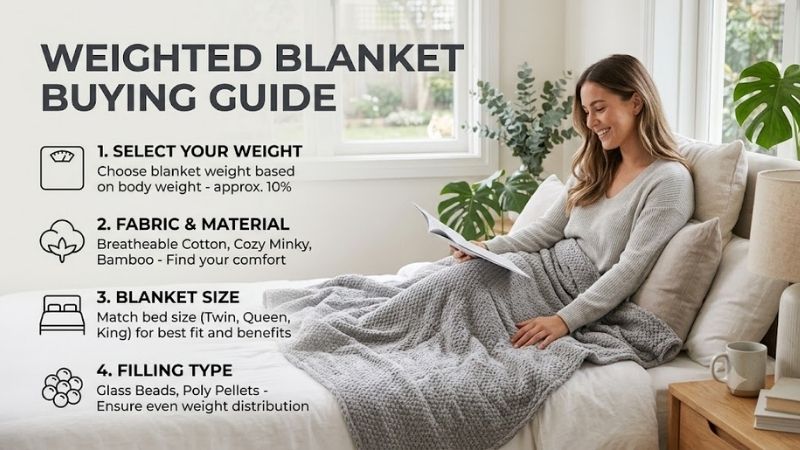
Understanding the 10% Body-Weight Guideline
Manufacturers frequently suggest selecting a blanket weighing approximately 10% of the user’s body weight.
For example, someone weighing 150 pounds may encounter a recommendation for a 15-pound blanket.
This is a conventional shopping reference, not a universally validated medical prescription or a guarantee of comfort.
Someone who finds that amount difficult to lift or unpleasant to sleep beneath may prefer substantially less weight or no weighted blanket.
An Illustrative Weight Comparison
| Adult body weight | Conventional 10% reference | What to evaluate before buying |
|---|---|---|
| 110 lb | 11 lb | Comfort with common 10- or 12-pound options |
| 130 lb | 13 lb | Whether a lighter available weight is preferable |
| 150 lb | 15 lb | Ability to move and remove the blanket independently |
| 175 lb | 17.5 lb | Differences between 15- and 20-pound options |
| 200 lb | 20 lb | Whether the pressure feels comfortable throughout use |
| 250 lb | 25 lb | Practical handling, mobility, and blanket dimensions |
The calculations are illustrative only. They do not establish that the corresponding blanket weight is appropriate or safe for an individual.
Why a Lighter Blanket May Be the Better Purchase
A lighter option may be easier to reposition when turning over.
It may also be easier to fold, store, carry, and clean.
These practical advantages matter for anyone who has difficulty handling heavy bedding or has never tried weighted pressure before.
A shopper choosing between a 15-pound and a 20-pound blanket should not automatically select the heavier model because it appears to offer more pressure.
If the lighter option delivers the desired comfort, increasing weight may add inconvenience without a meaningful benefit.
Why Heavier Is Not Necessarily More Effective
The purpose of a weighted blanket is not to maximize pressure.
Excessive weight can restrict movement or produce discomfort.
The blanket should never make breathing feel difficult, prevent a user from changing position, or require assistance to remove.
If a product causes distress or an uncomfortable sensation of being pinned down, it is not an appropriate choice.
When Weight Recommendations Need Individual Assessment
People with significant respiratory, circulatory, neurological, or mobility conditions should seek individualized clinical guidance before using weighted bedding.
The same caution applies to users who cannot communicate discomfort reliably or cannot remove a blanket independently.
Body-weight calculations alone cannot account for these circumstances.
Weighted Blanket Size: Why Width and Length Matter
Weighted blankets do not necessarily follow ordinary comforter sizing.
A queen comforter is often designed to extend over both sides of the mattress. A weighted blanket may be intended for one sleeper and have substantially less overhang.
Selecting by the words twin, queen, or king without examining dimensions can lead to an unsuitable purchase.
An Example: Two 15-Pound Blankets With Different Dimensions
Consider two hypothetical blankets, each weighing 15 pounds.
One measures 48 × 72 inches. The other measures 60 × 80 inches.
Their approximate surface areas are:
| Hypothetical blanket | Surface area | Total weight | Average weight per square foot |
|---|---|---|---|
| 48 × 72 inches | 24 sq. ft. | 15 lb | 0.625 lb |
| 60 × 80 inches | 33.3 sq. ft. | 15 lb | 0.45 lb |
These numbers describe average mass per area, not the actual force on a sleeper.
They illustrate why a smaller blanket can feel different from a larger blanket with the same total weight.
Real pressure also depends on draping, mattress contact, and the part of the blanket resting on the body.
Choose Individual Coverage Instead of Maximum Bed Coverage
A single adult sleeping on a queen mattress may not need a queen-size weighted blanket.
An individual-size product can provide coverage without extending excessively beyond the mattress.
This can make the blanket easier to handle and reduce the likelihood of it sliding toward an edge.
Why Excessive Overhang Causes Problems
A heavy blanket that hangs far beyond the mattress may pull downward under its own weight.
This can create unwanted shifting during the night.
An oversized blanket can also be difficult to recover after it falls beside the bed.
Check dimensions carefully when using a raised platform bed, a narrow mattress, or a bed positioned close to a wall.
Weighted Throws Versus Overnight Blankets
A weighted throw is generally designed for limited coverage, such as relaxing on a sofa.
It may be easier to handle than a full-length blanket.
However, a throw may not cover enough of the body for someone who wants overnight use.
Choose based on the intended activity rather than assuming every weighted product serves the same purpose.
Glass-Bead, Plastic-Pellet, and Knitted Construction
The internal construction affects more than appearance. It changes how weight is distributed, how the blanket drapes, and how practical it is to maintain.
Glass-Bead Weighted Blankets
Glass-bead blankets contain many small weighted beads held within stitched fabric compartments.
The small beads can create a relatively flexible weighted layer.
A well-designed compartment system helps keep the filling distributed instead of allowing it to collect along one edge.
What to inspect: Pocket stitching, filling containment, outer-shell material, care instructions, and evidence that the selected weight can be cleaned appropriately.
Main advantage: Conventional blanket drape with relatively compact construction.
Main trade-off: Damage to stitched pockets can allow filling to migrate or escape.
Plastic-Pellet Weighted Blankets
Some products use plastic pellets rather than glass beads.
Pellets can vary in size and density, influencing how the blanket feels.
A larger pellet may be more noticeable through thin fabric than smaller weighted filling.
However, finished comfort depends on the surrounding padding, stitching, and overall construction.
Main advantage: An alternative weighted filling system.
Main trade-off: Texture, bulk, and washing instructions vary considerably between products.
Chunky-Knit Weighted Blankets
A knitted weighted blanket achieves its weight through thick yarn rather than loose beads.
The open structure can provide spaces for air movement.
It also eliminates the specific problem of glass beads leaking from sewn compartments.
However, the thick knitted structure may occupy much more storage space.
Large loops can also snag on sharp objects or require careful laundering.
Main advantage: Bead-free construction with a decorative appearance.
Main trade-off: Bulk, handling, and potential snagging.
Which Construction Should You Choose?
| Priority | Construction worth considering | Important qualification |
|---|---|---|
| Compact folded storage | Quilted bead-filled | Still heavy even when compact |
| Bead-free design | Chunky knit | Often bulky |
| Traditional smooth surface | Glass-bead quilted | Check compartment quality |
| Decorative sofa use | Weighted knit | Confirm dimensions and safe handling |
| Easier surface cleaning | Removable-cover system | Insert care still matters |
| Warm sleeping environment | Open-knit or lighter cover | Not guaranteed to remain cool |
Fabric Materials and Temperature Comfort
The outer fabric influences how a weighted blanket feels against the skin, but manufacturers sometimes overstate its ability to regulate temperature.
A blanket cannot actively cool a room merely because it contains a particular fiber.
Cotton Shells
Cotton is common in quilted weighted blankets.
It provides a familiar textile surface and can be suitable for people who dislike plush synthetic fabrics.
However, cotton does not guarantee a particular level of airflow.
A tightly woven, heavily layered cotton blanket can still feel warm.
Polyester and Plush Covers
Polyester is used in smooth, textured, and fleece-like constructions.
Plush covers may appeal to users who prefer a cozy feel in cooler rooms.
They can be less appealing when someone already experiences excessive warmth at night.
Because polyester constructions vary, material names alone are insufficient for precise thermal comparisons.
Bamboo-Derived Viscose
Some manufacturers offer covers made from viscose derived from bamboo.
This material can provide a smooth, fluid surface.
However, claims that it naturally eliminates overheating or continuously cools the body require specific supporting evidence.
The finished weave, fabric weight, and surrounding bedding remain important.
Open-Knit Cotton
An open-knit blanket allows air to move through visible spaces in the construction.
This may be preferable to a thick plush cover for some sleepers.
However, open loops do not guarantee that the blanket will feel cool in a hot, humid room.
What Hot Sleepers Should Prioritize
A warm sleeper should compare overall thickness, outer fabric, internal padding, cover options, and surrounding bedding.
A lighter top layer and an appropriate bedroom temperature may matter more than marketing terms such as cooling, temperature-balancing, or breathable technology.
Does a Weighted Blanket Improve Sleep?
Research has investigated whether weighted blankets affect sleep quality, anxiety symptoms, and general well-being.
Some studies have reported benefits for particular adult groups.
However, findings differ across populations, and study quality and methods vary.
A review of 18 studies published in 2024 found more supportive evidence for adults than for children, while also identifying important limitations in the available research.
This does not mean every adult will sleep better beneath weighted bedding.
Comfort Is Different From a Medical Treatment
A person may enjoy the sensation of distributed pressure.
That can be a sufficient reason to purchase a blanket.
But a product should not be marketed as a guaranteed treatment for insomnia, anxiety disorders, or other health conditions.
Avoid Relying on Unverified Hormone Claims
Some advertisements suggest weighted blankets automatically increase certain hormones or reliably lower stress.
Such claims should not be accepted as universal clinical outcomes.
The practical buying decision should begin with comfort, manageable weight, safe use, and realistic expectations.
Washing and Maintenance: A Major Buying Factor
Weighted blankets introduce challenges that ordinary bed sheets do not.
The total weight, internal filling, and fabric construction affect which cleaning methods are appropriate.
Check the Exact Weight Configuration
A manufacturer may permit machine washing for a lighter blanket while requiring different care for heavier versions.
Do not assume one instruction applies to every weight in a product range.
Understand Washer Capacity
A dry 20-pound blanket already represents a substantial load.
Once wet, it can place additional demands on the machine.
A washing machine’s advertised capacity must be interpreted according to its manufacturer’s instructions, not merely the blanket’s dry weight.
If the care requirements and washer capacity are uncertain, do not attempt washing simply to see whether the machine can manage it.
Removable Covers
A removable cover can simplify routine cleaning.
This is particularly helpful when the weighted insert is difficult to launder.
However, attaching a cover to a heavy insert can be cumbersome.
Check whether the cover includes secure attachment points that prevent the blanket from bunching inside it.
Drying a Weighted Blanket
Follow the manufacturer’s exact drying instructions.
Some products require low-temperature settings or flat drying.
A blanket may feel dry on the surface while internal layers remain damp.
Never place incompletely dried bedding into enclosed storage.
Assess Long-Term Cleaning Cost
A low-priced blanket that regularly requires specialized laundering may cost more to maintain than expected.
Factor in whether you have a suitable washer, a practical drying location, and enough space to handle the product.
What to Look for in Quilting and Construction Quality
A weighted blanket should not be evaluated using fabric softness alone.
The internal construction is responsible for keeping the weight appropriately distributed.
Pocket Size and Stitching
Smaller stitched compartments can reduce the distance weighted filling travels.
However, the ideal pocket design depends on the fabric layers and filling.
Look for consistent stitching without loose threads or visibly damaged seams.
Edge Finishing
The blanket’s edges should be securely finished.
Weak edge construction may deteriorate under repeated handling.
Cover Attachment
For removable-cover models, check whether ties, loops, or other attachment points adequately secure the insert.
A cover that allows the weighted section to collect at one end can become uncomfortable.
Material Disclosure
A useful product description should identify the shell material, filling, available weights, and care instructions.
Vague descriptions make it difficult to compare products meaningfully.
Warranty and Returns
Weighted bedding preferences are subjective.
Review the return conditions, particularly whether opened or used bedding can be returned.
A trial policy can be more valuable than an additional decorative feature.
Choosing by Budget and Total Ownership Cost
The initial purchase price is only part of the comparison.
Consider the relationship between features, cleaning, durability, and how often the blanket will be used.
Entry-Level Quilted Blankets
A basic quilted design may provide all the construction features a first-time buyer needs.
Check whether its seams, materials, and care instructions are adequately documented.
Do not pay extra for unsupported therapeutic claims.
Midrange Removable-Cover Designs
A removable cover may justify additional cost when the blanket will be used frequently.
However, the convenience depends on how easily the insert and cover can be separated.
Premium Knitted Blankets
A knitted blanket may be more expensive because of its fabric quantity and construction.
Its decorative appearance and bead-free design can justify that cost for some buyers.
However, premium pricing does not guarantee better sleep or greater comfort.
A Practical Cost Comparison
Imagine choosing between two hypothetical blankets.
Blanket A costs $55 and requires cleaning arrangements you cannot manage at home.
Blanket B costs $90 and has a removable machine-washable cover, with the insert requiring less frequent attention.
The $35 initial difference does not determine which product is cheaper over several years.
Maintenance costs and how well each product meets your preferences matter.
These prices are illustrative, not live product quotes.
A Practical Weighted Blanket Shopping Checklist
Before purchasing, check each condition below.
-
Confirm that the intended user can independently reposition and remove the blanket.
-
Select a comfortable weight rather than blindly following a formula.
-
Compare actual blanket dimensions with the desired coverage area.
-
Identify whether the weight comes from glass beads, pellets, or knitted material.
-
Read the exact care instructions for the selected weight.
-
Check whether your washer can handle the product if machine washing is permitted.
-
Verify shell fabric and optional cover materials.
-
Inspect available information about stitching and construction.
-
Review returns, warranty conditions, and replacement-cover availability.
-
Avoid medical claims unsupported by relevant evidence.
If essential safety or care information is absent from the product listing, seek clarification before purchasing.
Weighted Blanket Safety: When Not to Use One
Safety must take priority over a preferred weight or appearance.
A weighted blanket should never prevent someone from moving independently or breathing comfortably.
Infants Must Not Use Weighted Blankets
Weighted blankets, weighted swaddles, and other weighted sleep products are not appropriate for infant sleep.
Infants require an approved, separate, firm, flat sleep surface without loose bedding or weighted objects.
Additional Caution for Children
Do not use adult weight formulas to select a blanket for a child.
Suitability for older children requires careful consideration of age, developmental ability, independent removal, and appropriate professional guidance.
Adults With Mobility Limitations
Someone who cannot easily reposition or remove the blanket may be at risk.
Do not use weighted bedding as a restraint or to prevent a person from getting out of bed.
Respiratory and Other Medical Concerns
People with relevant breathing difficulties, significant circulation problems, or other conditions that could make sustained pressure unsafe should consult a qualified healthcare professional.
Stop Using an Uncomfortable Blanket
Remove it if it causes breathing difficulty, overheating, distress, pain, or restriction of movement.
A blanket is not more effective merely because it creates stronger pressure.
Common Mistakes That Lead to Poor Purchases
Choosing the Heaviest Available Option
Weight should be selected for comfort and manageable handling, not maximum pressure.
Assuming Queen Means Queen Comforter Dimensions
Weighted blanket dimensions are often different from ordinary comforter measurements.
Always check inches.
Ignoring Cleaning Costs
A heavy insert may require a different cleaning method from its removable cover.
Paying Extra for Unsupported Cooling Claims
Fabric labels alone do not establish sustained cooling.
Choosing Premium Knit Without Considering Bulk
A beautiful knitted blanket may occupy considerable storage space.
Assuming a Weighted Blanket Will Cure Insomnia
Some people may experience benefits, but therapeutic outcomes are not guaranteed.
Frequently Asked Questions
What Weight Should My First Weighted Blanket Be?
The commonly quoted 10% body-weight guideline can be used as an initial reference, but it is not a prescription. Choose a manageable weight that feels comfortable and can be removed independently.
Is a 15-Pound Blanket Better Than a 20-Pound Blanket?
Neither is inherently better. Body size, blanket dimensions, physical ability, and individual comfort all matter. More weight is not automatically more beneficial.
Do Weighted Blankets Make You Hot?
They can. Insulation depends on construction, fabric, internal layers, and bedroom temperature. Open-knit products or lighter covers may feel more comfortable to some warm sleepers.
Are Glass-Bead Weighted Blankets Better Than Knitted Ones?
Glass-bead blankets provide a conventional quilted construction, while knitted options offer bead-free weight and a different texture. The better choice depends on comfort, maintenance, and storage preferences.
Can I Use a Weighted Blanket Every Night?
Some adults choose to do so when it remains comfortable and they can move freely. Regular use is not appropriate if the blanket causes distress, restricted movement, or breathing difficulty.
How Do I Know When to Replace a Weighted Blanket?
Inspect it for damaged seams, leaking filling, deteriorated fabric, broken cover attachments, and other defects. Stop using a damaged blanket that can no longer distribute its weight appropriately.
Conclusion
The right weighted blanket combines comfortable, manageable pressure with suitable dimensions, sound construction, and practical cleaning requirements. Start with a weight you can remove independently, compare actual blanket measurements instead of bed-size labels, and choose glass-bead quilting, removable covers, or knitted construction according to your preferences. Prioritize safety and long-term usability over maximum weight, exaggerated cooling claims, or promises of guaranteed sleep improvement.