Key takeaways
-
Studio apartments: Thin, fitted protectors with machine-washable construction.
-
College dorm rooms: Twin XL protectors with secure elastic skirts and straightforward washing requirements.
-
Small bedrooms with children: Waterproof protectors with reliable surface coverage and practical laundering instructions.
-
Guest beds: Fitted or zippered encasement protectors depending on the protection needed.
-
Murphy beds: Thin, flexible protectors compatible with the folding mechanism.
-
Adjustable beds: Stretchable protectors designed to tolerate repeated mattress movement.
-
Hot sleepers: Lightweight protectors with breathable surface fabrics and minimal unnecessary padding.
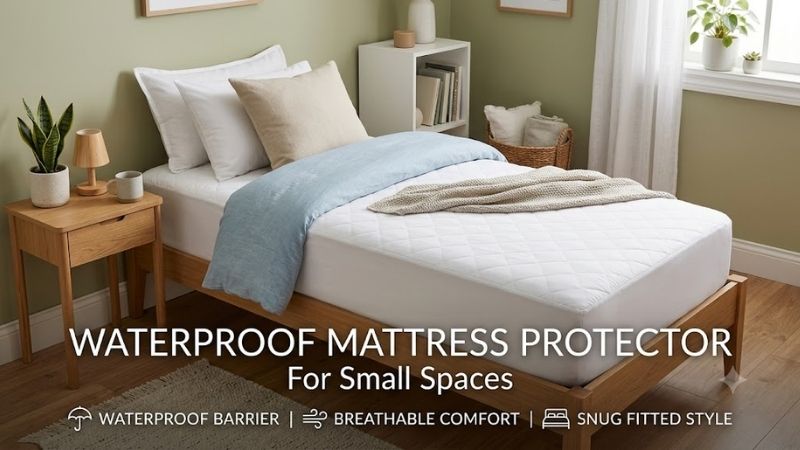
A waterproof mattress protector for small spaces helps guard against spills, sweat, and accidental moisture without adding unnecessary bulk to your bed. Whether you live in a studio apartment, dorm room, or compact bedroom, choosing the right protector means balancing waterproof protection, breathability, mattress fit, and easy cleaning.
Quick Answer: Which Waterproof Mattress Protector Is Best for Small Spaces?
For most small bedrooms, a thin, fitted waterproof mattress protector with a breathable fabric surface and a polyurethane waterproof barrier is a practical starting point.
This construction provides a protective layer without significantly changing the mattress’s feel or requiring extra storage space.
However, the best design depends on your sleeping environment.
-
Studio apartments: Thin, fitted protectors with machine-washable construction.
-
College dorm rooms: Twin XL protectors with secure elastic skirts and straightforward washing requirements.
-
Small bedrooms with children: Waterproof protectors with reliable surface coverage and practical laundering instructions.
-
Guest beds: Fitted or zippered encasement protectors depending on the protection needed.
-
Murphy beds: Thin, flexible protectors compatible with the folding mechanism.
-
Adjustable beds: Stretchable protectors designed to tolerate repeated mattress movement.
-
Hot sleepers: Lightweight protectors with breathable surface fabrics and minimal unnecessary padding.
A waterproof mattress protector should primarily protect your mattress. Cooling properties, cushioning, and specialty treatments are secondary considerations.
Types of Waterproof Mattress Protectors for Compact Bedrooms
Different protector designs offer different levels of coverage and convenience.
Understanding their construction helps you avoid buying a bulky product or one that does not protect the areas you need.
Fitted Waterproof Mattress Protectors
Fitted protectors resemble fitted sheets, with a waterproof sleeping surface and elasticized sides that wrap around the mattress.
They are generally easy to install and remove without moving the mattress away from the wall.
This makes them particularly convenient for small bedrooms where access to the sides of the bed is limited.
Advantages:
-
Easy to remove for washing.
-
Little additional bulk.
-
Compatible with many standard mattress configurations when correctly sized.
-
Usually simpler to handle than full encasements.
Limitations:
-
Waterproof protection may cover only the top surface.
-
Elastic skirts can loosen or slip if the pocket depth is incorrect.
-
Exposed mattress sides remain vulnerable to liquid entering from the edges.
Best for: Everyday spill protection in apartments, dormitories, and compact bedrooms.
Zippered Waterproof Mattress Encasements
A mattress encasement surrounds the entire mattress, typically using a zipper to close the protective cover.
Some encasements offer waterproof barriers on multiple surfaces, while others provide waterproof protection only in specified areas.
Check the manufacturer’s coverage description rather than assuming all six sides are waterproof.
A full encasement may be useful when comprehensive surface coverage is important or when the product is specifically designed to address certain allergen or pest-related concerns.
However, a waterproof claim alone does not establish bed bug protection. That requires an appropriately constructed and independently supported encasement design.
Advantages:
-
Covers the entire mattress exterior.
-
Can offer more complete protection than top-only designs.
-
Helps keep the mattress enclosed during normal use.
Limitations:
-
More difficult to install and remove.
-
Often requires lifting or moving the mattress.
-
Cleaning can be inconvenient in tight rooms.
Best for: Mattresses requiring extensive coverage, particularly when installation space is available.
Waterproof Mattress Pads
Waterproof mattress pads combine a protective barrier with some degree of cushioning.
They can be useful if you want modest surface softness and liquid protection in one product.
However, thicker quilting may influence mattress firmness, trap additional warmth, or require more washing-machine capacity.
For compact living situations, a thin waterproof pad is often more practical than a heavily quilted option.
Best for: Sleepers wanting light cushioning alongside moisture protection.
Limitation: Additional padding does not necessarily improve waterproof performance.
Waterproof Mattress Topper Covers
Some mattress toppers are compatible with specialized waterproof covers.
These protect the topper surface rather than necessarily protecting the underlying mattress from every possible spill.
If liquid protection for the mattress is essential, confirm that the full bedding configuration prevents liquid from reaching the mattress.
A topper cover should not automatically be treated as equivalent to a dedicated waterproof mattress protector.
Quick Comparison: Waterproof Protector Types
| Protector Type | Coverage | Space Efficiency | Cleaning Convenience | Best Use |
|---|---|---|---|---|
| Fitted waterproof protector | Usually mattress top | Excellent | Easy to moderate | Everyday apartment beds |
| Zippered encasement | Full exterior enclosure; waterproof coverage varies | Excellent once installed | Less convenient | Extensive mattress coverage |
| Quilted waterproof pad | Usually top surface | Good | Depends on thickness | Protection with light cushioning |
| Waterproof topper cover | Topper-specific | Good | Varies | Protecting a mattress topper |
| Waterproof flat underpad | Localized area | Excellent | Often easy | Targeted protection against occasional accidents |
For buyers with limited room and laundry access, a fitted protector generally provides the most convenient balance of protection and maintenance.
How to Choose the Right Mattress Protector Size
Accurate sizing is essential because a loose protector may wrinkle, shift, or allow liquid to reach unprotected areas.
Standard US Mattress Sizes
| Mattress Size | Standard Dimensions |
|---|---|
| Twin | 38 × 75 inches |
| Twin XL | 38 × 80 inches |
| Full | 54 × 75 inches |
| Queen | 60 × 80 inches |
| King | 76 × 80 inches |
| California King | 72 × 84 inches |
These are nominal US mattress dimensions. Actual mattress measurements may vary.
A protector should match your mattress’s width and length while accommodating its thickness.
Measure Mattress Depth Carefully
Mattress depth is the vertical distance between the top and bottom surfaces.
Measure the mattress itself and include any topper that the protector is intended to wrap around.
For example, a mattress measuring 12 inches deep with a separate 2-inch topper creates a combined profile of approximately 14 inches when the protector encloses both layers.
The protector must support the complete profile without excessive stretching.
Some manufacturers advertise pocket-depth ranges. Compare those ranges with your actual measurements.
A protector with a pocket that is too shallow may repeatedly come loose, while an excessively loose one can bunch beneath the fitted sheet.
Twin XL and Dorm Room Compatibility
Twin XL mattresses are common in college housing, although individual dormitory specifications vary.
A standard Twin protector is typically too short for a Twin XL mattress.
Before buying, confirm the bed size and mattress depth with the housing provider.
Also consider whether dormitory rules restrict certain mattress covers or require specific fire-safety compliance.
Adjustable and Split Mattresses
Adjustable beds require flexible protectors that can move with the mattress.
A tightly fitted protector with limited stretch may place stress on seams or interfere with the intended movement.
For split-king beds made from two Twin XL mattresses, individual Twin XL protectors are often more appropriate than one continuous king-size protector.
Always verify the mattress configuration and protector compatibility.
Waterproof Materials: What Actually Matters?
A mattress protector typically combines a textile surface with a waterproof membrane, coating, or barrier.
These components serve different purposes.
The surface fabric affects comfort, texture, and moisture handling, while the waterproof layer is responsible for preventing liquid penetration.
Polyurethane Waterproof Barriers
Polyurethane is commonly used in waterproof mattress protectors.
Depending on the construction, it can form a thin protective membrane beneath the fabric surface.
Some polyurethane membranes allow a degree of water-vapor transmission while resisting liquid water.
However, performance varies by formulation, thickness, lamination method, and testing conditions.
Do not assume every polyurethane protector offers identical breathability or waterproof durability.
Advantages:
-
Can be manufactured in thin, flexible constructions.
-
Often compatible with lightweight fitted protector designs.
-
May provide a quieter feel than certain stiffer barriers.
Limitations:
-
Repeated washing and inappropriate drying temperatures may damage some constructions.
-
Breathability varies.
-
Waterproof performance depends on seam construction and membrane integrity.
For many compact bedrooms, a thin fabric-and-polyurethane design is worth considering because it adds little bulk.
Vinyl and PVC-Based Barriers
Some waterproof bedding products use vinyl or PVC-based materials.
These materials can provide effective liquid barriers when appropriately constructed.
However, their feel, flexibility, noise, breathability, and care requirements differ from those of some polyurethane designs.
A particular vinyl product should not automatically be considered noisier or less durable without product-specific evidence.
Best for: Situations where the barrier’s verified durability, cleaning characteristics, and intended use meet the buyer’s needs.
Main consideration: Evaluate the entire product, not just the waterproof material name.
TPU Laminated Fabrics
Thermoplastic polyurethane, or TPU, is another material used in flexible waterproof laminates.
TPU membranes may be combined with cotton, polyester, or other fabrics.
Product descriptions sometimes use “TPU” and “polyurethane” interchangeably, but these labels alone do not establish specific performance differences.
Check published waterproof testing, care instructions, and fabric composition.
Cotton Surface Fabrics
Cotton provides a familiar fabric feel and can absorb moisture from the sleeping surface.
A cotton-topped waterproof protector may feel comfortable for shoppers who prefer natural-fiber contact surfaces.
However, cotton does not make a protector waterproof on its own.
The protective function comes from the underlying barrier.
Lyocell and Bamboo-Derived Fabrics
Lyocell and bamboo-derived viscose are used in some waterproof mattress protectors.
These fabrics may offer smooth textures and useful moisture-management properties, depending on their construction.
“Bamboo” is not proof of superior cooling or waterproof performance.
The exact fiber type, fabric structure, backing membrane, and independent evidence matter more than the marketing label.
Polyester and Microfiber
Polyester is used in many mattress protector surface fabrics.
It can offer low weight, wrinkle resistance, and practical laundering characteristics.
However, moisture management and comfort vary depending on fiber design, weave, finishes, and the other layers in the protector.
A tightly constructed polyester surface may feel different from a lightweight, knitted polyester fabric.
Material composition should be evaluated alongside the finished product’s construction.
Waterproof vs. Water-Resistant: Understanding the Difference
These terms describe different protection levels.
A waterproof mattress protector is designed to prevent liquid from passing through its protective barrier under specified conditions.
A water-resistant mattress protector is intended to resist or delay liquid penetration but may allow liquid through under sufficient exposure.
Neither term guarantees that an entire mattress will remain dry in every situation.
How Waterproof Protection Can Fail
Liquid may reach a mattress through:
-
Damaged or worn waterproof membranes.
-
Unprotected seams or stitching.
-
Exposed mattress sides.
-
Gaps where the protector pulls loose.
-
Liquid running beyond the protected area.
-
Barrier degradation after improper washing or drying.
For more demanding situations, examine whether the manufacturer publishes meaningful waterproof performance information and specifies which surfaces are protected.
Why Spill Duration Matters
A small spill removed promptly is different from prolonged exposure to a large amount of liquid.
Waterproof performance depends on the barrier, construction, pressure, and duration of exposure.
Do not assume that a protector marketed as waterproof has been tested for every possible household accident.
Are Waterproof Protectors Completely Leakproof?
No product should be treated as universally leakproof without considering its construction and tested limitations.
A high-quality waterproof barrier can protect against common spills, but installation, maintenance, and surface coverage remain important.
For recurring accidents, consider the convenience of having a second clean protector available.
Breathability and Cooling in Small Bedrooms
Small bedrooms can feel warm when ventilation is limited, but room size alone does not determine sleeping temperature.
Bedding materials, humidity, body heat, mattress construction, and ventilation all influence comfort.
A waterproof protector adds another material layer between the sleeper and the mattress.
Can a Waterproof Mattress Protector Trap Heat?
Yes, some protectors can reduce airflow or change moisture transfer compared with using a mattress without an additional barrier.
However, the extent of that effect depends on the membrane and fabric construction.
A thin protector with a suitable vapor-permeable membrane may be more comfortable for a hot sleeper than a thick design with a less breathable barrier.
That conclusion still requires product-specific assessment.
Is a Cooling Waterproof Protector Worth Buying?
A cooling waterproof protector combines protective construction with materials intended to improve temperature comfort.
Possible features include breathable knits, moisture-managing fibers, and phase-change materials.
Such features may improve the sleeping experience, but they do not establish sustained temperature reduction without credible evidence.
Prioritize waterproof reliability and mattress fit first.
What Should Hot Sleepers Look For?
Consider these characteristics:
-
A lightweight surface fabric.
-
Minimal unnecessary quilting.
-
A waterproof membrane with documented vapor-permeability information, where available.
-
An appropriate fitted-sheet combination.
-
Washing instructions that preserve membrane integrity.
Avoid assuming that thicker padding or gel-infused components necessarily improve overnight cooling.
Waterproof Mattress Protectors for Different Small-Space Needs
Small Studio Apartments
In a studio apartment, the bed may also serve as a sitting or lounging area.
This can increase exposure to everyday spills and general wear.
A thin fitted protector is convenient because it remains beneath the fitted sheet and does not require additional equipment.
Look for a secure attachment system and straightforward machine-washing instructions.
If frequent spills are likely to reach the mattress sides, investigate designs offering extended waterproof coverage.
College Dorm Rooms
Dorm rooms often offer limited storage and shared laundry facilities.
A lightweight, washable Twin XL protector is a practical option when that matches the supplied mattress.
Avoid purchasing a thick, heavily quilted protector unless additional cushioning is specifically needed.
Check laundering restrictions and confirm that the protector meets any applicable housing requirements.
Compact Guest Bedrooms
Guest beds may remain unused for extended periods.
A removable protector helps reduce exposure to accidental spills during use.
For easier cleaning between guests, choose a product with clear machine-washable care instructions.
If broader mattress enclosure is important, a zippered encasement may be appropriate, although removing it for washing can be inconvenient.
Bedrooms Shared With Children
Waterproof bedding can be particularly useful when spills or nighttime accidents are possible.
A fitted protector with suitable coverage is usually easier to remove than a full encasement.
A spare protector can simplify changing the bed after an accident.
For infant sleep spaces, use only products specifically approved for the exact crib or bassinet mattress and follow safe-sleep guidance. Adult mattress protectors should not be adapted for infant beds, and loose or padded accessories can create hazards.
Murphy Beds
Murphy beds introduce additional considerations because the mattress folds into a vertical cabinet.
Choose a thin protector that is compatible with the bed’s folding mechanism and retention system.
Thick quilted pads or poorly fitted covers can interfere with closing.
Check the manufacturer’s instructions before adding accessories, and do not exceed the specified bedding or mattress-thickness limits.
Bunk Beds and Loft Beds
Elevated beds require careful attention to mattress height and guardrail effectiveness.
Adding thick waterproof padding can increase the sleeping-surface height.
Choose a thin protector compatible with the bed manufacturer’s maximum mattress-thickness specification.
Do not use extra padding that reduces required guardrail protection.
How to Evaluate Fit and Construction Quality
An inexpensive protector that repeatedly shifts or develops leaks can be less useful than one with reliable construction and appropriate care requirements.
Inspect the Waterproof Coverage
Check whether the product protects the sleeping surface only or includes waterproof side panels.
A fitted protector may have a waterproof top with a non-waterproof skirt.
This distinction matters when liquids may reach mattress edges.
Examine Stitching and Seam Placement
Seams affect fit and durability.
Waterproof membranes can also be compromised by unsuitable stitching or poorly constructed connections.
When available, review manufacturer information about seam design and barrier coverage.
Do not assume decorative quilting improves liquid protection.
Consider Elastic Strength and Stability
Elastic skirts must hold the protector securely without excessive tension.
A proper fit helps reduce shifting during sleep.
For adjustable beds, compatibility with repeated bending is especially important.
Review Waterproof Testing Evidence
Reliable product documentation may describe test standards or performance conditions.
When comparing claims, consider whether a published test measures hydrostatic resistance, actual finished-product leakage, or another property.
Different methods do not necessarily produce directly comparable results.
A fabric-level waterproof test also does not establish the performance of every seam and finished-product component.
Evaluate Warranty and Care Restrictions
Some manufacturers specify that waterproof protection depends on proper laundering.
Check whether the warranty covers membrane defects and what exclusions apply.
Avoid assuming the warranty includes accidental mattress damage unless the terms explicitly provide such coverage.
How Much Should You Spend?
A useful budget depends on mattress size, coverage needs, material construction, and laundering frequency.
A simple fitted protector can be adequate when the goal is basic spill protection.
Premium features may be worth considering when they provide a meaningful benefit, such as verified material performance, more complete coverage, or better compatibility.
| Buying Priority | Features Worth Paying For | Features to Question |
|---|---|---|
| Basic protection | Reliable waterproof barrier, accurate sizing | Decorative quilting unrelated to protection |
| Hot-sleeper comfort | Lightweight fabric, supported breathability claims | Unsupported “instant cooling” claims |
| Frequent washing | Appropriate machine-wash instructions, durable construction | Vague durability guarantees |
| Full coverage | Verified waterproof surfaces and secure enclosure | Assuming all encasements are waterproof on every side |
| Small-space convenience | Thin construction, easy removal, secure skirt | Bulky padding that complicates laundry |
| Adjustable bed | Documented flexibility and compatibility | Generic “fits all beds” claims |
The most economical choice is not necessarily the product with the lowest purchase price.
Consider how easily you can wash it, whether it fits securely, and whether the protective barrier is likely to remain functional when maintained properly.
How to Install a Waterproof Mattress Protector
Correct installation helps the protector perform as intended.
Step 1: Check Mattress Dimensions
Measure the mattress width, length, and depth.
Confirm that the protector accommodates the entire mattress profile, including any topper that will sit underneath it.
Step 2: Inspect the Mattress Surface
Remove the bedding and inspect the mattress for moisture or damage.
If the mattress has been cleaned recently, allow it to dry fully according to the manufacturer’s instructions.
Do not enclose a damp mattress in a waterproof cover.
Step 3: Position the Protector
For a fitted protector, identify the waterproof sleeping surface.
Place it over the mattress and pull the elasticized skirt evenly around the corners.
For an encasement, follow the product’s instructions carefully to avoid overstretching the zipper or damaging the barrier.
Step 4: Smooth the Surface
Remove wrinkles and check that the protector lies flat.
A loose protector may bunch beneath the fitted sheet, reducing comfort and exposing parts of the mattress.
Step 5: Add the Fitted Sheet
Place the fitted sheet over the protector.
Ensure the sheet accommodates the combined thickness of the mattress and protective layers.
Step 6: Verify the Fit
Check that the protector remains securely positioned when you move on the mattress.
For an adjustable bed, operate the bed within its normal range while observing the protector for pulling, snagging, or interference.
Do not assume compatibility if the manufacturer has not approved the setup.
How to Wash and Maintain a Waterproof Mattress Protector
Good maintenance is essential because the waterproof barrier may be more sensitive to heat and chemicals than the outer fabric.
Follow the Product Care Label
Use the washing method specified by the manufacturer.
Do not assume that all waterproof protectors tolerate hot water, bleach, high-speed spinning, or high-heat drying.
Different membranes and laminated fabrics can have substantially different care limits.
Avoid Excessive Heat
Some waterproof membranes and adhesives can deteriorate under excessive drying temperatures.
If machine drying is permitted, follow the exact recommended setting.
Air drying may be appropriate for certain products, but it should not replace the manufacturer’s specific instructions.
Do Not Use Unapproved Chemicals
Fabric softeners, bleach, and other additives may be restricted by the care label.
Their effects depend on the fabric and barrier construction.
Avoid improvised waterproofing treatments or chemicals not approved for the product.
Clean Spills Promptly
When an accident occurs, remove the bedding and clean the protector as directed.
Inspect the mattress beneath it for moisture.
A waterproof protector should not be assumed to have prevented every possible leak.
Replace a Damaged Protector
Consider replacement when you notice:
-
Peeling or delamination of the waterproof layer.
-
Visible cracks or tears.
-
Persistent leakage.
-
Failed elastic or closures that prevent secure coverage.
-
Damage caused by heat or improper washing.
Do not continue relying on a compromised barrier for important liquid protection.
Common Buying Mistakes to Avoid
Mistake 1: Confusing Waterproof With Water-Resistant
A water-resistant fabric may slow liquid penetration without providing a reliable barrier.
For actual spill protection, choose a product explicitly designed and documented as waterproof.
Mistake 2: Ignoring Mattress Depth
Correct width and length are not enough.
A fitted protector must also accommodate the mattress’s thickness to remain securely attached.
Mistake 3: Buying an Unnecessarily Thick Protector
A waterproof protector does not need substantial cushioning to perform its primary function.
Extra padding can add warmth, increase mattress height, and complicate washing.
Mistake 4: Assuming All Sides Are Waterproof
Some fitted protectors have waterproof top panels and ordinary fabric side skirts.
Buyers needing broader coverage should verify which surfaces provide a waterproof barrier.
Mistake 5: Prioritizing Marketing Terms Over Evidence
Words such as “premium,” “hotel quality,” “cooling,” and “ultra-protective” do not establish waterproof performance.
Look for meaningful construction details, credible testing information, and transparent care instructions.
Mistake 6: Choosing a Difficult-to-Clean Design
An encasement may offer useful coverage but can be inconvenient to remove from a heavy mattress in a narrow room.
Choose a design compatible with your cleaning routine and physical access around the bed.
Mistake 7: Ignoring Material Noise and Texture
Some protective barriers may produce noticeable sounds or a different feel during movement.
Look for credible material descriptions and applicable independent observations.
Avoid assuming all polyurethane products are silent or all vinyl products are noisy.
Waterproof Mattress Protector Buying Checklist
Pre-purchase checklist
0 of 8 checked
If several requirements remain unresolved, confirm them before purchasing. Waterproof coverage, physical fit, and compatible care instructions should take priority over optional comfort features.
Frequently Asked Questions
Do waterproof mattress protectors make a small bed feel hotter?
Some can affect airflow and moisture transfer, especially when they use less breathable barriers or thick quilting. However, comfort varies by material and construction. A lightweight protector with a suitable vapor-permeable membrane may be a better option for hot sleepers than a thick waterproof pad.
Can a waterproof mattress protector fit a Twin XL dorm bed?
Yes, when it is specifically manufactured for Twin XL dimensions and accommodates the mattress depth. A standard Twin protector should not be assumed to fit a Twin XL bed. Confirm the dorm mattress measurements before buying.
Is a fitted waterproof protector better than a zippered encasement?
A fitted protector is generally easier to remove and wash, making it convenient for small apartments and beds placed close to walls. An encasement offers more extensive physical coverage, although waterproof protection varies by design. Choose based on the type of protection required and installation convenience.
Can I use a waterproof mattress protector with memory foam?
Yes, many protectors can be used with memory foam mattresses. Choose the appropriate size and review the mattress manufacturer’s requirements. A protector may influence surface breathability, but a thin fitted design usually changes cushioning less than a thick quilted pad.
How often should I wash a waterproof mattress protector?
Follow the manufacturer’s care instructions and adjust your cleaning routine to actual use, spills, and household needs. Clean it promptly after significant contamination. Frequent washing beyond the recommended conditions may accelerate wear in certain waterproof barriers.
Will a waterproof mattress protector prevent bed bugs?
Waterproof protection and bed bug protection are different functions. A waterproof fitted protector does not necessarily prevent bed bugs from accessing a mattress. Products intended for bed bug protection require suitable full-encasement construction, secure closures, and supporting evidence for their claims.
Conclusion
The best waterproof mattress protector for small spaces is a thin, securely fitted, easy-to-wash design that provides reliable protection without adding unnecessary bulk. For most studio apartments, dorm rooms, and compact bedrooms, a fabric-topped protector with a documented waterproof polyurethane barrier is a practical choice. Select a full encasement when broader coverage is essential, and prioritize compatible mattress dimensions, breathable construction, and durable care requirements. A properly fitted protector can help preserve your mattress while keeping everyday bedding maintenance manageable in a limited living space.