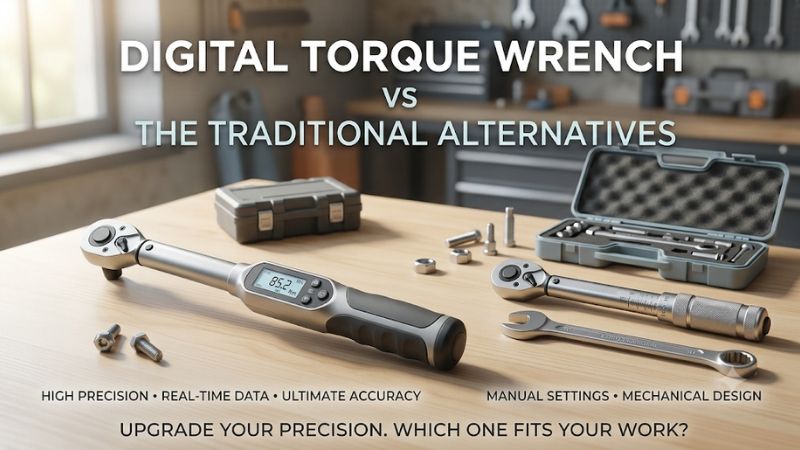
Comparing a digital torque wrench vs alternatives starts with the job. Electronic alerts can help when a screen is hard to see, while click and split-beam wrenches offer a simple mechanical signal. Use this comparison to weigh accuracy, access, angle measurement, and cost before choosing a tool for your garage.
Quick comparison
Choose a digital wrench if you regularly use numeric feedback, multiple units, or integrated angle measurement. A calibrated click or split-beam wrench is often sufficient for repeated torque-only work. Beam and dial tools are useful when you want to watch torque build and have a clear view of the scale.
| Tool | Best fit | Main benefit | Main condition |
|---|---|---|---|
| Digital torque wrench | Varied torque targets and some angle work | Numeric reading and model-dependent alerts | Check batteries, modes, and calibrated band |
| Micrometer click wrench | Repeated torque-only settings | Tactile mechanical cue | Read the scale correctly and follow storage directions |
| Split-beam wrench | Repeated mechanical work | Simple target setup on many models | Check operating direction and actual range |
| Deflecting-beam wrench | Visible live torque | Direct mechanical readout | Keep the pointer visible and aligned |
| Dial torque wrench | Visible torque and peak observation on suitable models | Continuous indication, with a memory pointer on some | Requires sight line and enough body clearance |
| Digital torque adapter | Occasional open-access checks | Reuses a suitable handle and sockets | Adds height between handle and socket |
| Torque screwdriver | Small fasteners at low torque | Controlled low-range work | Requires compatible bits and documented range |
Digital torque wrench vs click wrench
A digital wrench indicates the measured torque electronically. A micrometer click wrench provides a mechanical signal at a selected setting. Both can accurately serve a job within their documented ranges. The practical choice depends on how you want to set the target, detect the endpoint, and handle several different values.
Choose a click wrench for repeatable torque-only work
A click wrench often suits a homeowner who regularly tightens the same wheel or equipment fasteners. Set the value on the graduated handle, verify the scale and units, then pull until you feel or hear the designed signal. The simple feedback can be helpful when the tool is facing toward the floor.
Some click signals are easier to feel at higher settings than at the bottom of a tool’s range. Learn the response for your model on a suitable setup. A user who continues pulling after the click can still add torque. Choose a tool that gives clear feedback in your working position and hold it as directed.
Micrometer models can require a particular storage setting, and procedures vary. Read the instructions for the exact wrench. An inexpensive calibrated model that fits your wheel specification may be a better purchase than a more expensive electronic tool if the work always has the same target and never needs a record.
Choose digital when the approach or record matters
An electronic display can show the torque rising as you pull. A peak mode can retain the highest reading so you can see it afterward. Some digital tools add lights that indicate approach, audible patterns, and vibration. Those features can make it easier to control a slow final pull when you are working alone.
Numeric feedback also helps when you change targets frequently, such as when a project uses different jobs and units. Check the screen each time you select a preset. A misread menu or saved value can create a mistake as easily as a poorly read micrometer scale. Learn the alert sequence and keep a suitable spare battery if recommended.
Some work benefits from saved measurements, but a memory reading is only as useful as the way you associate it with a job. If your garage never needs that documentation, compare a simpler unit with reliable audio. The value of the digital tool comes from the interface you will actually use.
Digital torque wrench vs split-beam wrench
Split-beam wrenches give you a mechanical target signal with a different setting mechanism from a typical micrometer click wrench. They can suit a garage that wants quick setup and straightforward repeated pulls. Digital models earn the extra cost when their added range documentation, direction options, or measurement modes serve actual work.
Where a split-beam wrench makes sense
A split-beam wrench can be attractive for repeated jobs at moderate or higher targets. Some models can remain at a selected setting during storage, as documented by the manufacturer. This is useful when the same equipment returns for maintenance and you want a simple, battery-free tool with familiar tactile feedback.
Check whether the tool is rated only in the clockwise direction. A reversible ratchet head can be convenient for positioning and does not establish calibrated operation in reverse. If you service any left-hand threaded assemblies, confirm their direction requirements from service information and compare them with the tool’s stated accuracy.
A split-beam model can also be preferable when the final task takes place far from charging equipment or in a garage where the tools sit unused for long intervals. Mechanical tools still need verification if they are dropped, overloaded, or used in work that requires periodic checks. Read the exact manual for setting, storage, and service.
Where the electronic model adds more
Some electronic models publish accuracy in both directions and include separate feedback for approaching and reaching the target. Others offer calibration reminders or saved settings. For a buyer who frequently works across different machines and cases, those options can reduce setup effort and make a measurement easier to review afterward.
Compare the tolerances for the actual target rather than ranking the two tool types as categories. A mechanical wrench that covers a 100 ft-lb clockwise target within its stated specification is a valid choice. A digital wrench with a broad nominal range still needs a published accuracy claim that covers that same target and direction.
If the work includes occasional torque-angle stages, a mechanical wrench paired with an approved separate angle gauge can complete the procedure. A digital wrench with built-in angle may require fewer pieces and less setup. The better fit is the arrangement with enough working clearance and a clear method for zeroing and recording the rotation.
Digital torque wrench vs beam and dial wrenches
Beam and dial tools let you observe torque during the pull, like the trace mode on an electronic tool. Their displays depend on mechanical movement and a readable scale. These designs are worth comparing for bench work where you can stand in a consistent position and see the reading without changing your grip.
Deflecting-beam tools suit a clear view
A conventional beam wrench deflects under load and uses a pointer against a graduated scale. With a clear view, you can watch torque increase without using a battery or selecting a mode. Check the zero before loading it and view the scale from the proper angle to reduce reading error.
The main limitation is where the scale ends up during work. If it points down or lies close to a sidewall, you may have to tilt your head or shift your body to read it. That change can make the pull harder to control. A digital wrench with an audible alert or a click wrench with a clear tactile signal may be easier in that position.
A traditional beam tool is a useful option for occasional work when it sits in a reliable line of sight and the scale covers the target. Its simple design does not eliminate the need to follow the model’s operating instructions or verify its condition. Protect the pointer and check for damage before use.
Dial tools can make the rise in torque easy to watch
A dial torque wrench displays torque on a mechanical dial. Some models have a memory pointer that stays at the highest reading. That can be useful for seeing the peak after the load is removed, provided you reset the pointer before the next check and use the tool within its specified range.
Dial instruments vary considerably in housing and head shape. A clear face can help on a workbench, while a protruding dial may get in the way near a vehicle bracket. Check the size of the complete tool, including the socket, before choosing it for confined work. A digital display with a separate target cue can be easier to live with where the reading faces away.
For work centered on a documented inspection process, choose the instrument required by that process. A wrench that records peak measurement may be useful, but interpreting breakaway torque from a previously tightened fastener requires a procedure suited to that purpose. An existing peak reading does not by itself establish the original installed clamp load.
Digital torque wrench vs a digital adapter
A digital adapter fits between a compatible handle and the socket and gives an electronic reading. It can be a lower-cost route when you already own the handle and only need the function occasionally. Check the adapter’s range, accuracy, direction, and the extra stack height before buying it for a specific job.
Use an adapter where there is enough room
For an open tool setup, an adapter can provide a visible readout without forcing you to purchase a second dedicated wrench. Its separate body can be convenient for occasional work. Choose a suitable handle length and drive and check the instructions for how the adapter expects you to apply the load.
The adapter adds another junction to the assembly. In a cramped engine bay, that can prevent the socket from seating or put a large housing beside a cover. At an open wheel or workbench, the same geometry can be convenient. Measure the actual assembly instead of judging by the dimensions of the adapter alone.
Do not assume that a digital adapter includes angle measurement or supports the same units as a dedicated wrench. Check which modes are present and how clearly its alert works when the tool faces away. A compact output format can still provide everything an occasional buyer needs if it covers the target and fits the space.
Use a dedicated wrench where handling matters every day
A dedicated electronic wrench integrates the head, grip, display, and measuring system. That design can give you a lower-profile stack and a clearly marked grip position. If you perform repeated mid-range work, a tool you can seat and pull consistently may save more time than a cheaper adapter arrangement.
For comparison, set the actual socket on both candidates or build a mockup from product dimensions. Check whether the body hits a bracket during installation or removal. Confirm the direction of the display or buzzer, then repeat the return stroke with your usual hand position. Small differences in stack height become noticeable after several similar fasteners.
Factor in the extra cost if the adapter requires a new handle or a set of sockets you do not already own. Likewise, a dedicated wrench may require batteries or an added angle gauge. Compare the finished setup. That is the price difference you will actually pay for the advantage that matters.
Digital torque wrench vs torque screwdriver and an impact wrench
A torque screwdriver can be the better instrument for low-torque screws that use a bit holder. An impact wrench typically earns its place earlier in the workflow, when fasteners are being removed or run down under an approved procedure. Choose the final measuring tool around the torque specified for the assembly.
Use a torque screwdriver for appropriate light fasteners
A torque screwdriver offers an inline grip and can be easier to control at low values. This makes it useful for fasteners specified in inch-pounds or newton-meters within its rated band. Check the precise bit interface and mechanical design. Some tools release or slip at the target, while others indicate the measured value.
A compact digital torque wrench with a 1/4-inch square drive may still be the better choice for a low-range socket task. A screwdriver may need a bit-to-square accessory, and the added assembly may reduce clearance. Use the tool that gives correct engagement and rated performance for the actual joint.
For delicate assemblies, write the value and units where you can see them before starting. If the job calls for a pattern or multiple stages, follow it. A low-torque tool is useful only when it fits the exact setting and the bit can be kept fully engaged without an unstable angle or excessive force.
Use a measuring wrench for final torque checks
An impact wrench can remove fasteners quickly, and some models offer controlled rundown features. Tool setting, battery condition, joint stiffness, friction, and impact duration can all affect the result. Follow the work procedure for any powered stages, and use the prescribed calibrated instrument for final tightening where required.
A motorized digital torque wrench designed for rundown is a different product. In a documented example, Milwaukee’s M12 2465-20 spins the fastener down under motor power and calls for a manual finish to target. The distinction is useful if the same person performs a repeated sequence and needs records of final values.
Use a suitable removal tool for breaking fasteners loose. Preserve a precision torque wrench for its intended measurement work. Loading any precision tool outside its rated operation can affect its condition, and verification may be needed before it returns to safety-critical service.
Decide by job, space, and repeat frequency
The most practical comparison starts with your last few garage jobs. A single recurring wheel job, a series of cramped housing fasteners, and a torque-angle assembly favor different buying decisions. List the tool you used, the value required, and what made the procedure slow or difficult before spending money.
Routine wheel service with one verified target
If the vehicle specifies a torque-only process and you can reach the fasteners comfortably, a suitably calibrated click or split-beam wrench is an economical choice. A digital model may give a clearer warning before you reach the target, particularly if you like to watch the load build or check the peak afterward.
Use the vehicle or wheel manufacturer’s approved sequence, condition of threads, and specified torque. Choose a wrench with a confirmed accuracy band around that value. A broad scale and long handle can be useful, but you still need room to seat the socket and apply a smooth pull with the asset secured as directed.
For buyers deciding on a digital adapter, check the stack around the wheel recess and the outside diameter of the socket. An exposed wheel may leave plenty of room, while an inset lug can make the arrangement clumsy. If the everyday setup is quick to fit and use, a simpler instrument can serve the job for less money.
A mixed garage with many different torque targets
Record the smallest fastener target and your most frequently repeated higher value. A low-range electronic wrench plus a higher-range mechanical model can provide reliable coverage without buying two expensive electronics. Check whether a different combination would make more sense for your sockets and use of angle measurement.
A single high-range wrench can be tempting when storage is limited. Compare the manufacturer’s lower accuracy threshold with your lightest job. If the target falls below the documented band, an additional small tool is more useful than another high-end feature on the same body. Loan, rental, or qualified service can be options for rare work.
If you need repeatability across several people or workstations, a well-labeled mechanical tool with familiar settings can be easier to share. A digital model can help when your process requires saved values or confirmation of units. Set a consistent way to verify the selected setting before work starts.
A repair that specifies rotation after initial torque
An electronic torque-angle wrench can handle both parts if the model and setup support the procedure. A standard torque wrench and a suitable angle gauge can also work. Compare their available movement, repeatability of zeroing, and the extra clearance needed by a separate gauge and its reference arrangement.
Follow the service documentation for the exact joint and hardware. The specified angle can differ by stage or fastener. Some hardware requires replacement before use. A torque-only wrench can still be used for the initial stage if its range and documentation are suitable. Plan how you will perform the required turn before you complete that first stage.
If you often repeat angle work, a digital wrench may reduce setup. If you rarely need angle and have good access, an appropriate separate gauge can be an economical purchase. Each option can complete the job properly when the instructions and measured geometry support the chosen method.
Frequently asked questions
The useful comparison is between specific models that can handle a defined job. These questions cover common assumptions about accuracy, batteries, angle measurement, and whether it is worthwhile to keep two types in the same garage. Start with the service specification any time the fastener is safety-critical.
Is a digital wrench more accurate than a click wrench?
Compare the manufacturer’s accuracy conditions and any individual calibration records at the applicable target. A digital display can offer finer resolution or live feedback. A calibrated mechanical wrench can be accurate enough for the same job if its range, direction, and tolerance satisfy the work requirements.
Can a separate angle gauge replace a digital angle mode?
It can serve a prescribed angle stage if the gauge and setup are suitable for the application. A gauge needs enough physical room and the correct reference or zeroing method for its design. Compare the exact service procedure and tool instructions before choosing between the separate gauge and integrated measurement.
Which type is easier to use without seeing the display?
A click or split-beam wrench provides a mechanical cue you may be able to feel directly. A digital wrench can give sound or vibration depending on the model. Try the feedback pattern before the job, especially if shop noise or the way you hold the handle makes one signal hard to detect.
Should I own both a digital and a mechanical wrench?
Consider owning both if each has a clear job. A smaller electronic wrench can give useful feedback on varied light tasks, while a higher-range mechanical wrench can handle repeated torque-only work. Compare the overlapping and missing ranges before buying, and keep both tools verified according to their instructions.
Conclusion
Choose digital for live readings, alerts, and integrated angle when the work calls for them. Choose click or split-beam for straightforward repeated torque, and beam or dial for visible bench measurements. A suitable digital adapter can save money in open spaces if you already own the proper handle and sockets.
More from Amazon
Programs that pair well with the guide above. Offers and eligibility are set by Amazon and may change.
Collect the home and kitchen items you want in one registry that guests can shop from.
Create a wedding registrySet up recurring deliveries of everyday items on eligible products. Terms and savings are set by Amazon.
Explore Subscribe & SaveFree shipping on eligible items, Prime Video and more. Eligible new members can start with a free trial.
Start a Prime free trialAudiobooks and podcasts to listen to on the go. Eligible new members can start with a free trial.
Try Audible freeAs an Amazon Associate we earn from qualifying purchases.