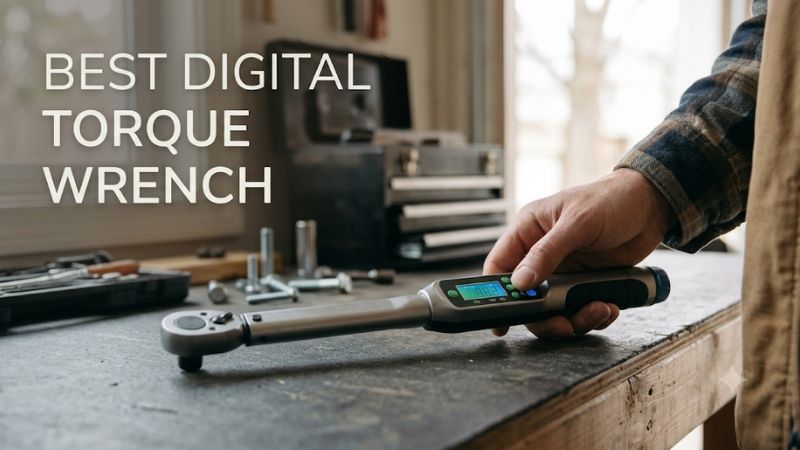
The best digital torque wrench matches the fasteners you service, gives you a clear signal when you reach the target, and fits with the socket installed. These seven picks cover compact tools for lower torque, flexible heads for crowded work, and longer wrenches for wheels and other higher-torque jobs.
Quick verdict
The GEARWRENCH 85195 is our first pick for mixed garage work when your main fasteners fit its accuracy band. Its 3/8-inch drive, 3-degree return arc, flex head, and torque-angle mode cover several common access problems. Choose the QUINN 64916 if your work calls for a 1/2-inch drive and torque-angle capability.
For smaller fasteners, the ACDelco Tools ARM601-3 is the lower-cost, shorter option. The GEARWRENCH 85194 adds a 1/4-inch drive and a slim flex head. The GEARWRENCH 85077 suits higher-torque work that calls for a torque value alone. TEKTON’s TRQ81122 earns a look for frequent work in both directions. The Milwaukee 2465-20 makes the most sense when motorized rundown and digital reporting will be used regularly.
Quick comparison table
A wrench’s advertised range and the band covered by a published accuracy claim can have different lower limits. This table shows the nominal range and the feature that distinguishes each model. Check the exact wrench’s accuracy conditions and the fastener specification before selecting a tool.
| Model | Drive | Published range | Best for | Main trade-off |
|---|---|---|---|---|
| GEARWRENCH 85195 | 3/8 in. | 10–100 ft-lb | Mixed work with access constraints | Published ±2% clockwise claim starts at 20% of full scale |
| QUINN 64916 | 1/2 in. | 12.5–250 ft-lb | Higher-torque work with angle measurement | 25.5-inch body needs room |
| ACDelco Tools ARM601-3 | 3/8 in. | 3.7–37 ft-lb | Short reach and lower torque | Stated accuracy starts around 7.4 ft-lb |
| GEARWRENCH 85194 | 1/4 in. | 2–20 ft-lb | Small sockets and crowded assemblies | 15.5-inch body still needs a sweep path |
| GEARWRENCH 85077 | 1/2 in. | 25–250 ft-lb | Higher-torque, torque-only work | Separate tool needed for prescribed angle turns |
| TEKTON TRQ81122 | 3/8 in. | 10–100 ft-lb | Documented dual-direction torque accuracy | 20-inch length and higher price |
| Milwaukee M12 FUEL 2465-20 | 3/8 in. | 10–100 ft-lb | Repeated rundown and reporting | Requires M12 power, and final torque is manual |
How we selected these wrenches
We compared manufacturer specifications, operating instructions, and US retailer listings. Selection focused on usable torque coverage, direction-specific accuracy, head geometry, feedback, and the extra equipment needed for each workflow. The recommendations reflect those documented features and practical fit.
There are no independent calibration results for the seven wrenches in this roundup. Accuracy figures refer to each manufacturer’s published conditions. A 3-degree return arc, for example, comes from the ratchet design and helps predict how much movement is needed to reset it. It cannot tell you whether a socket reaches a recessed bolt or whether you can pull on the specified handle position with a hose in the way.
Detailed product recommendations
Start with the torque specification for the work you do most often, then measure around the fastener with a socket in mind. The reviews explain which features are worth paying for in that context. A wrench that looks ideal on paper can still be impractical once you have to seat the socket and move your hand.
GEARWRENCH 85195 — Best overall for mixed garage work
The GEARWRENCH 85195 combines a 3/8-inch drive, a 10–100 ft-lb range, and a 120-position ratchet. The 3-degree return arc helps when the handle can reset through only a short movement. Its flex head helps route the handle around an obstacle while the socket remains aligned with the fastener.
Best for: Drivers who regularly work on accessible mid-range automotive fasteners and sometimes face cramped access or an angle requirement.
Key specifications: 10–100 ft-lb, a 3-degree ratcheting arc, flex head with up to 15 degrees of movement, and torque and angle functions. GEARWRENCH documents ±2% clockwise torque accuracy from 20% to 100% of full scale for this family.
Why we picked it: Someone buying one electronic 3/8-inch wrench often needs several benefits at once. This model covers a practical middle range and adds angle measurement and multimodal feedback. The features address distinct needs in the same garage. A fine ratchet helps near an obstruction, while the angle function handles procedures that call for rotation after initial tightening.
Practical use: Check whether your smallest recurring target is at least 20 ft-lb if you plan to rely on the published clockwise accuracy claim. A target of 12 ft-lb fits the nominal scale but falls outside that stated band. Use the marked grip position, seat the socket completely, and keep the head aligned through the pull. If a prescribed angle turn needs more space than the wrench can travel, consult its manual for the supported procedure before beginning that stage.
Pros: Fine return arc, flex head, and multiple ways to detect the target.
Cons: The published clockwise accuracy band excludes the lower part of its scale. A smaller wrench may suit light fasteners better.
Buy if your routine work clusters in the middle of the range and you can use the access features. Skip if most of your jobs land below 20 ft-lb.
QUINN 64916 — Best 1/2-inch option with angle
The QUINN 64916 covers a listed 12.5–250 ft-lb and includes torque and angle modes. Harbor Freight lists a 25.5-inch length and a 72-tooth ratchet with a 5-degree return arc. That combination gives a buyer useful leverage for higher targets and a clear reason to check handle clearance before ordering.
Best for: Open-access higher-torque work and buyers whose service procedures sometimes specify an angle stage.
Key specifications: 1/2-inch drive, 12.5–250 ft-lb nominal range, 72 teeth, and up to nine presets. The shared manual lists ±3% clockwise and ±4% counterclockwise torque accuracy. Follow the exact manual and calibration documentation for the unit you receive.
Why we picked it: It offers angle indication with a conventional hand-operated 1/2-inch ratchet. If your actual work includes a mix of regular higher-torque fastening and occasional service procedures with a specified turn, this can be a practical single-tool purchase for that group.
Practical use: A long handle can make a higher target easier to approach steadily, particularly when you can stand in a stable position. That same handle covers a wide path around the hub or workpiece. The ratchet’s ability to reset in a short arc helps after you have a working position. It does little if you cannot get your hand into that position. Check adequate socket seating, then rehearse the pull with the wrench unloaded.
Pros: Broad nominal range, angle mode, and presets.
Cons: Long body. Direction-specific accuracy differs.
Buy if you have room for the handle and a genuine need for angle mode at this drive size. Skip if light fasteners or a crowded engine bay dominate your work.
ACDelco Tools ARM601-3 — Best short wrench for lower torque
The ACDelco Tools ARM601-3 measures 12-3/8 inches long and covers a published 3.7–37 ft-lb. It uses a 3/8-inch drive and offers peak and trace modes. Its main appeal is straightforward numeric feedback in a smaller package for a buyer who already owns the appropriate lower-profile 3/8-inch sockets.
Best for: Lower-torque jobs where the shorter handle matters and the target falls within the documented accuracy band.
Key specifications: 3.7–37 ft-lb, 3/8-inch drive, 12-3/8-inch length, peak and trace modes, and four AAA batteries. ACDelco lists ±2% clockwise and ±3% counterclockwise from 20% of full scale through maximum, approximately 7.4–37 ft-lb.
Why we picked it: It gives buyers an economical way to avoid using a large wrench at a light target. The length also makes it worth considering when a short fixed body solves the access problem without adding a flex joint.
Practical use: Suppose one routine job specifies 11 ft-lb and another specifies 65 ft-lb. The ACDelco is a reasonable candidate for the first when the socket and installed access fit. The second needs another tool. For fasteners that call for only a few inch-pounds, it can still be too large or outside its documented accuracy band. Compare the value in the original unit before deciding.
Pros: Short body, accessible price, and useful live and peak readings.
Cons: Limited maximum and an accuracy floor above the lowest selectable value.
Buy if you can name several light jobs it covers within the published band. Skip if you need a general-purpose wheel or high-torque chassis wrench.
GEARWRENCH 85194 — Best 1/4-inch flex head
The GEARWRENCH 85194 is the 1/4-inch-drive member of the 120XP electronic flex-head family. It spans a nominal 2–20 ft-lb and pairs a slim head with a 3-degree arc. It is useful for buyers with small sockets who need more control over head clearance and handle position in a confined assembly.
Best for: Low-torque fastening where a 1/4-inch socket and a slim flex head improve access.
Key specifications: 2–20 ft-lb nominal range, approximately 15.5-inch overall length, about 0.4-inch head thickness, and torque and angle functions. The published ±2% clockwise claim for the family starts at 20% of full scale, which is 4 ft-lb or 48 in-lb on this model.
Why we picked it: The head dimensions are published, so buyers can compare the actual stack with the space around a fastener. That makes it easier to choose for a narrow opening than a tool marketed merely as compact.
Practical use: A stock 1/4-inch shallow socket on the 85194 can be a better physical fit than a larger head carrying a reducer. That advantage depends on whether the smaller socket reaches the fastener correctly. The longish handle still needs a path for your hand and can reach an obstacle outside your initial view. For recurring targets below 48 in-lb, look for a tool that publishes accuracy there.
Pros: Slim head, 3-degree arc, and useful flex adjustment.
Cons: Longer body than some fixed-head tools. The published accuracy floor matters on small fasteners.
Buy if the head and socket geometry solve your access problem. Skip if you primarily need torque below its documented band.
GEARWRENCH 85077 — Best for higher-torque, torque-only jobs
The GEARWRENCH 85077 is a 1/2-inch electronic wrench in the 25–250 ft-lb class. It has a conventional head and electronic target feedback, with no integrated angle mode. That straightforward configuration makes sense when your service information calls for torque alone and you already have working room at the fastener.
Best for: Open-access higher-torque jobs, including suitable wheel work when the vehicle’s specification falls within the applicable band.
Key specifications: 1/2-inch drive, nominal 25–250 ft-lb range, and 72-tooth ratchet. GEARWRENCH documents ±2% clockwise and ±3% counterclockwise from 20% to 100% of scale for this electronic series.
Why we picked it: In a garage where you want feedback without managing angle settings, a torque-only model is a good match. It can also be sensible when you already own an angle gauge or a second wrench for jobs that specify a turn.
Practical use: Look at the lowest target that matters. On a 250 ft-lb scale, 20% is about 50 ft-lb. Use that distinction when deciding whether the 85077 covers everything on a planned service. If your two jobs are 100 and 35 ft-lb, the same wrench has very different published accuracy coverage for those values. A second lower-range tool can cover the smaller job without compromising on documentation.
Pros: Straightforward operation, useful leverage, and documented direction-specific accuracy.
Cons: Fixed head and no onboard angle mode.
Buy if you want a dedicated higher-range electronic wrench for fasteners specified by torque. Skip if your main jobs routinely require an angle stage.
TEKTON TRQ81122 — Best for documented dual-direction accuracy
The TEKTON TRQ81122 is a 20-inch 3/8-inch electronic wrench with torque, angle, and torque-plus-angle modes. TEKTON publishes ±2% torque accuracy in either direction and lists calibration test points at 10, 60, and 100 ft-lb. That documentation is useful when the lower end of the range matters regularly.
Best for: Frequent mechanics who use both directions and value calibration details, presets, and history.
Key specifications: 10–100 ft-lb, 90-tooth ratchet, 15-degree flex head, lights, sound, vibration, 10 presets, 50-record history, and calibration reminders. Angle accuracy is subject to the manufacturer’s stated test conditions.
Why we picked it: The useful difference is the combination of two-direction documentation, published test points, and features for repeat work. These are practical reasons to spend more if a lower-cost tool leaves a gap at a frequently used target or direction.
Practical use: The 90-tooth ratchet provides a nominal 4-degree return increment. Its 20-inch length changes how much the handle tip travels compared with a shorter 3/8-inch wrench. In a tight bay, the extended body can place your hand beyond a bracket or simply run into the car body. Check that geometry before paying extra. Review the certificate supplied with your unit and keep it with your tool records.
Pros: Documented accuracy in both directions, multiple alert types, and useful recordkeeping.
Cons: Premium purchase cost and a longer body than many 3/8-inch tools.
Buy if you can use the documentation, memories, and dual-direction features. Skip if most jobs are simple and fit a less expensive wrench.
Milwaukee M12 FUEL 2465-20 — Best for repeated rundown and reporting
The Milwaukee 2465-20 adds a motor to a 3/8-inch digital torque wrench for powered rundown. The operator finishes to the target manually. Its ONE-KEY reporting features make it relevant to a workflow where saving and retrieving fastening results matters as much as getting the fastener to the desired value.
Best for: Repeated fastening work that can benefit from motorized rundown and job records.
Key specifications: 10–100 ft-lb nominal range, M12 platform, adjustable rundown, and ONE-KEY reporting. Milwaukee lists up to ±2% clockwise and ±3% counterclockwise accuracy over 20–100% of full scale.
Why we picked it: It solves a workflow problem that standard electronic hand wrenches leave to the operator. If you repeatedly run fasteners down and record results, consolidating the process can be valuable. For one home project each season, the battery and software features have less practical benefit.
Practical use: Confirm the service procedure permits the intended rundown method. Start the fastener correctly, apply the powered portion as directed, and finish by hand at the target. Plan for access around the motor and battery. A conventional hand wrench with a shallower head or narrower body may still be the better choice for a recessed fastening point. The 2465-20 package is tool-only.
Pros: Powered rundown, adjustable control, and downloadable reporting.
Cons: Added bulk and battery requirements. Final tightening still requires a manual pull.
Buy if you repeatedly use the rundown and reporting functions. Skip if your priorities are minimum size and low cost for occasional DIY work.
How to choose the right range and features
The most useful shortlist starts with three numbers from service information for your own projects. Write down the smallest target, your most common target, and the highest one you actually expect. Record the units and direction too. Those details show whether one wrench can cover the work with documented accuracy.
Compare the settings with the covered accuracy band
Many listings place the display range in the title and explain the accuracy band farther down. Put both on the same line when comparing models. If a 100 ft-lb wrench specifies accuracy from 20% of full scale, that statement starts at 20 ft-lb. Read the exact limits in the product instructions before buying.
Resolution is a separate issue. A screen that displays tenths of a foot-pound is giving you readout increments. Consider the published tolerance and its basis when the job has a small acceptable range. For work specified in inch-pounds, keep the original units if your wrench offers them. One foot-pound equals 12 inch-pounds, and confusing those scales can apply twelve times the intended value.
Pay for feedback you can use in position
A visible approach indicator helps you slow the pull when you can see the screen. Audible or vibration feedback can be more useful when the display faces the firewall or the wrench has to be held low. Check which alert represents approach and which indicates the actual target before working on the real joint.
When you reach the target, finish the pull according to the tool’s instructions and release smoothly. A digital alert depends on the operator’s response. Practice on a suitable setup if the tool or alert sequence is unfamiliar. The time you spend learning the feedback can matter more than an extra preset on the display.
Frequently asked questions
The last buying decision often comes down to whether a specific wrench can do one awkward job. These answers cover wheel fit, calibration paperwork, angle measurement, and common adapter choices. For every safety-critical joint, use the exact specifications and procedure for the vehicle or equipment being serviced.
Do I need a 1/2-inch wrench to tighten wheel fasteners?
Choose a wrench that covers the vehicle manufacturer’s torque specification and accepts a suitable socket. A 1/2-inch wrench is common because the drive and handle length suit many wheel applications. Check the manual for the correct torque, thread conditions, and tightening sequence for the exact vehicle and wheel assembly.
Is torque-angle mode useful for routine garage service?
It is useful when the procedure specifies an initial torque followed by a rotation in degrees. Use the prescribed sequence and replacements for any hardware specified as single-use. For jobs specified only by torque, a torque-only model may offer simpler controls and enough functionality for all the work you do.
What should I look for on a calibration certificate?
Check whether the document identifies the wrench, reports test values in the relevant direction, and clearly states the result and date. An individual record is more useful to a buyer who needs to document their tool’s performance. Review the manufacturer’s verification guidance after a drop, overload, or unusual readings.
Can I use a short socket extension?
A straight coaxial extension gives reach without moving the fastener’s center sideways relative to the drive. Check the wrench and socket instructions and keep the assembly aligned during the final pull. A crowfoot can shift the center of the fastener and may require a setting correction or an approved 90-degree orientation.
Conclusion
Choose the GEARWRENCH 85195 for mid-range work with limited access, the QUINN 64916 for higher torque with angle, and the ACDelco ARM601-3 for a shorter low-range option. The best fit is the wrench that covers your targets within its stated accuracy band and gives you room to pull safely.
More from Amazon
Programs that pair well with the guide above. Offers and eligibility are set by Amazon and may change.
Collect the home and kitchen items you want in one registry that guests can shop from.
Create a wedding registrySet up recurring deliveries of everyday items on eligible products. Terms and savings are set by Amazon.
Explore Subscribe & SaveFree shipping on eligible items, Prime Video and more. Eligible new members can start with a free trial.
Start a Prime free trialAudiobooks and podcasts to listen to on the go. Eligible new members can start with a free trial.
Try Audible freeAs an Amazon Associate we earn from qualifying purchases.