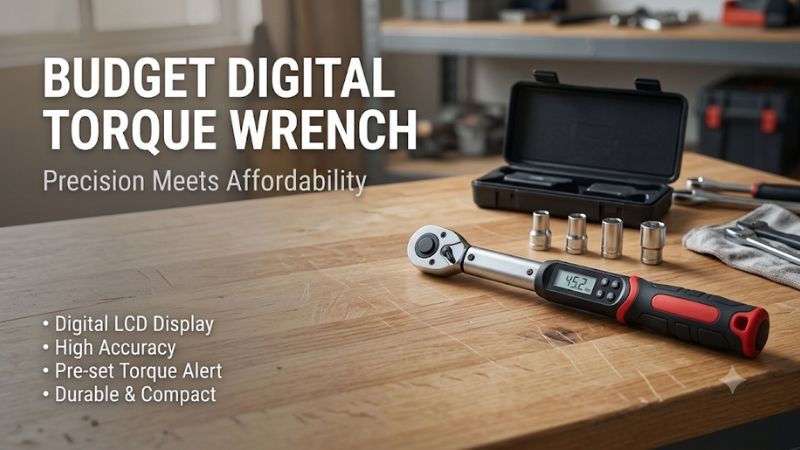
A budget digital torque wrench should cover the fasteners you service without making you pay for unused features. These seven options were listed below $200 in the US. Compare their supported accuracy bands, drive sizes, and torque-angle capabilities before choosing the one that gives you useful coverage.
Quick verdict
The ACDelco Tools ARM601-3 was the least expensive wrench in this group at $90.99 and is our low-torque pick. The GEARWRENCH 85195 offered the strongest feature mix for mid-range work at its checked $168.18 listing. For higher-torque jobs that require angle measurement, choose the QUINN 64916 at $179.99.
If you need only torque measurement at higher values, the GEARWRENCH 85077 was listed at $176. The ACDelco ARM601-4 costs less and may cover many moderate 1/2-inch jobs, provided the scale on the exact wrench matches the listing and your service specification. The QUINN 64915 and GEARWRENCH 85076 give buyers two further options for 3/8-inch work.
Quick comparison table
We used a $200 US item-price ceiling before tax, shipping, and accessories. Prices are snapshots of the listings reviewed and may change by retailer or location. Each entry is a complete electronic torque wrench. Lower-cost digital adapters require a separate handle and are discussed later as an alternative.
| Model | Listed US price | Drive and published range | Best reason to buy |
|---|---|---|---|
| ACDelco Tools ARM601-3 | $90.99 | 3/8 in., 3.7–37 ft-lb | Low-range work and a short body |
| ACDelco Tools ARM601-4 | $125.99 | 1/2 in., 14.8–147.5 ft-lb in matching current product and retail listings | Moderate 1/2-inch jobs |
| GEARWRENCH 85195 | $168.18 | 3/8 in., 10–100 ft-lb | Flex head, fine ratchet, and angle mode |
| QUINN 64915 | $169.99 | 3/8 in., 5–100 ft-lb | Mid-range torque and angle from Harbor Freight |
| GEARWRENCH 85077 | $176.00 | 1/2 in., 25–250 ft-lb | Higher-torque work with no angle requirement |
| QUINN 64916 | $179.99 | 1/2 in., 12.5–250 ft-lb | Higher-range torque plus angle |
| GEARWRENCH 85076 | $184.97 | 3/8 in., 10–100 ft-lb | Straightforward fixed-head operation |
How we compared prices and specifications
Summit Racing supplied the checked prices for both ACDelco models. The Home Depot supplied the GEARWRENCH prices, and Harbor Freight supplied the two QUINN prices. We compared the ranges, dimensions where published, and measuring functions against manufacturer documentation or the corresponding retail listing.
Price order can change independently of feature order. One retailer listing showed the GEARWRENCH 85195 flex-head angle model below the simpler 85076. That is a reason to price both exact models before purchasing. It is not evidence that a flex head generally costs less. Selection also accounts for the accuracy band, because a low-cost wrench cannot save money on a job it cannot credibly cover.
Detailed product recommendations
Read these picks against your next few projects and your existing sockets. Two wrenches with adjacent prices may serve different ranges, while some similarly priced models handle the same target with different head geometry or feedback. The best bargain is the wrench you can use correctly on work you actually do.
ACDelco Tools ARM601-3 — Best for lower torque
The ARM601-3 was listed at $90.99 and is the lowest-priced wrench shortlisted here. It measures 12-3/8 inches long and has a 3/8-inch drive. Its 3.7–37 ft-lb nominal measuring range serves lower-torque jobs where a conventional 100 ft-lb wrench may offer little useful accuracy coverage near the bottom.
Best for: DIY owners who already have suitable 3/8-inch sockets and routinely work on lower-torque fasteners.
Key specifications: 3.7–37 ft-lb, four AAA alkaline batteries, and peak and trace modes. ACDelco lists ±2% clockwise and ±3% counterclockwise from 20% to 100% of full scale, starting around 7.4 ft-lb.
Why we picked it: At the checked price, it is a way to buy a separate low-range wrench without paying for a higher-range flex-head tool. Its short body is another reason to consider it if space around the handle is limited.
Practical use: For an illustrative 15 ft-lb target, the value fits the published accuracy band. For 60 in-lb, which is 5 ft-lb, the tool can show the value without the same stated accuracy coverage. If your regular work includes several targets at the bottom of that range, a smaller instrument can be the better value despite a higher listing price.
Pros: Low listed price and manageable length.
Cons: Limited upper range. Published accuracy starts above the lowest displayed torque.
Buy if your targets commonly fall above 7.4 ft-lb and below the upper limit. Skip if the main job calls for higher torque or integrated angle measurement.
ACDelco Tools ARM601-4 — Best for moderate 1/2-inch jobs
The ARM601-4 listing showed $125.99 for the 1/2-inch wrench. The manufacturer’s product page and the US retailer listing both describe a 14.8–147.5 ft-lb configuration. An older manufacturer PDF gives conflicting range information, so confirm the exact instrument and documents before buying for a specific upper-end target.
Best for: Moderate-torque work with 1/2-inch sockets, after checking that the supplied wrench matches the listed configuration.
Key specifications: The matching retail and manufacturer pages show a 20–200 N·m measuring range, approximately 14.8–147.5 ft-lb. The product page lists ±2% clockwise and ±3% counterclockwise from 20% of maximum. For this configuration the band begins around 29.5 ft-lb.
Why we picked it: It costs less than the 250 ft-lb options reviewed and can be suitable if your highest regular target fits its confirmed band. The related ARM601-3 serves the lower end much more effectively.
Practical use: A wrench that tops out near 147.5 ft-lb should never be bought for a verified 150 ft-lb target. Also check the package, scale and calibration paperwork as soon as it arrives because the older PDF discrepancy affects purchase confidence. Stop and resolve any mismatch with the manufacturer before depending on that tool for a safety-critical joint.
Pros: Lower listed price than the higher-capacity 1/2-inch choices. Documents peak and trace modes.
Cons: Conflicting older documentation. Upper range excludes some higher-torque jobs.
Buy if the exact configuration and paperwork cover your requirements. Skip if you need extra high-end capacity or cannot confirm the version.
GEARWRENCH 85195 — Best mid-range feature value
At the checked $168.18 listing, the GEARWRENCH 85195 included features that are useful for work on crowded assemblies. Its 3/8-inch flex head offers a 3-degree ratchet arc, and the wrench supports angle measurement. The value depends on whether you need those functions and whether the listing holds when you buy.
Best for: Mid-range work where restricted access or an angle stage makes the extra features useful.
Key specifications: 10–100 ft-lb, 120 ratchet positions, 3-degree arc, up to 15 degrees of flex, and electronic target alerts. GEARWRENCH states ±2% clockwise from 20% to 100% of full scale for this family.
Why we picked it: At the prices checked, it cost less than the simpler GEARWRENCH 85076. That gave it a specific value advantage for buyers who needed flex and angle rather than just the lower initial price.
Practical use: Match it to targets of at least 20 ft-lb when relying on the published clockwise claim. If your usual work is tightly confined, consider the way the wrench and socket line up with the handle at the target. A flex head can help, while a shorter fixed wrench might still fit better in some directions. Review the operating instructions for angle zeroing before working on an actual joint.
Pros: Good combination of angle and access features at the listed price.
Cons: The rated band starts higher than the display minimum. Flex geometry is unnecessary for open-access work.
Buy if you can use angle mode or a fine flex head on regular jobs. Skip if your project mainly calls for low torque below its documented band.
QUINN 64915 — Best mid-range Harbor Freight option
The QUINN 64915 is a 3/8-inch digital angle torque wrench listed at $169.99. Harbor Freight gives it a 5–100 ft-lb nominal range, a 16.25-inch body, and a 5-degree ratchet arc. It can be practical for buyers who prefer to purchase locally and want a named model with an accessible manual.
Best for: Garage owners who want torque and angle modes in a moderately sized 3/8-inch wrench.
Key specifications: 5–100 ft-lb nominal range, 72-tooth ratchet, 5-degree arc, LED and audible indicators, and up to nine presets. The shared manual lists ±3% clockwise and ±4% counterclockwise torque accuracy.
Why we picked it: It offers an alternative to the GEARWRENCH 85195 at nearly the same checked item price. That leaves room to decide by local availability, physical fit, and which manual or alert pattern is easier for you to use.
Practical use: Compare the model’s documentation before depending on the bottom end of the nominal scale. When you need to do several similar fasteners, a preset can reduce repeated entry, but verify the saved unit and target before each group. In a confined setup, the 16.25-inch length can help you evaluate handle interference before the purchase.
Pros: Includes angle measurement and useful presets. Published overall length.
Cons: Counterclockwise tolerance differs from clockwise. Body and head still need room around the fastener.
Buy if a 3/8-inch angle wrench fits your projects and local pickup is useful. Skip if a slimmer flex head is the main requirement and other prices are comparable.
GEARWRENCH 85077 — Best higher-range torque-only wrench
The 1/2-inch GEARWRENCH 85077 was listed at $176 for this comparison. It covers a nominal 25–250 ft-lb and gives electronic target feedback on a standard ratchet head. It makes the most sense when your main jobs are in the higher torque range and your procedure calls for a torque value without an angle stage.
Best for: Higher-torque work with a sound working position and a torque-only specification.
Key specifications: 25–250 ft-lb class, 1/2-inch drive, 72-tooth head, and no integrated rotation-angle mode. The manufacturer’s published accuracy for this series is ±2% clockwise and ±3% counterclockwise over 20–100% of scale.
Why we picked it: It was listed for less than the QUINN 64916, albeit by less than $4. The more substantial purchasing distinction is the documented range and a straightforward interface for torque-only work. A larger range can also be useful if the ARM601-4’s confirmed scale ends below your actual target.
Practical use: Treat about 50 ft-lb as the lower end of the published percentage band on the 250 ft-lb scale. If most of your vehicle work sits comfortably within that band, a dedicated higher-range wrench can be a sound first purchase. Use the vehicle or equipment specification for the exact joint and make sure the socket and handle both have room.
Pros: Useful upper range and documented accuracy conditions.
Cons: Integrated angle mode is absent. Long body can be cumbersome in a crowded assembly.
Buy if your regular work is torque-only and needs the 1/2-inch high range. Skip if you need integrated angle for less than $5 more at the compared prices.
QUINN 64916 — Best higher-range wrench with angle
At $179.99, the QUINN 64916 was close in price to the 85077 and added angle measurement. Its published torque range spans 12.5–250 ft-lb and the body is 25.5 inches long. The handle can supply practical leverage at higher values, provided the job allows enough room for a controlled pull.
Best for: An affordable 1/2-inch electronic wrench for both torque-only and torque-angle work.
Key specifications: 1/2-inch drive, 72-tooth ratchet, 5-degree arc, torque and angle modes, and up to nine presets. The linked manual lists ±3% clockwise and ±4% counterclockwise torque accuracy.
Why we picked it: It is a reasonable price step when a prescribed angle procedure is genuinely part of your work. The comparison uses the public regular listing reviewed. A past member coupon was time-limited and is excluded from the price.
Practical use: Measure how far your hand must travel with the socket seated. Remember that higher torque and an angle stage can place different demands on available space. A target can be easy to reach on an open joint, while the subsequent controlled turn may require another stance or a distinct service-approved procedure. Consult the manual for zeroing and any permitted resets.
Pros: Higher torque capacity with an integrated angle function and useful presets.
Cons: Long handle. Accuracy claims differ by direction.
Buy if a high-range digital wrench with angle fits the jobs you perform. Skip if you mostly service light parts or work through small access holes.
GEARWRENCH 85076 — Best simple fixed-head 3/8-inch option
The GEARWRENCH 85076 is a traditional fixed-head electronic wrench with a nominal 10–100 ft-lb range. The checked listing showed $184.97. Its straightforward arrangement can suit a buyer who needs torque feedback on accessible mid-range bolts and prefers a standard ratchet head over an articulated design.
Best for: Mid-range torque-only work with a predictable, direct socket approach.
Key specifications: 3/8-inch drive, 10–100 ft-lb, 72-tooth standard head, and approximately 15.8-inch overall length. GEARWRENCH lists ±2% clockwise and ±3% counterclockwise between 20% and 100% of the scale.
Why we picked it: A documented fixed head and accuracy in both directions make it worth comparing even when another tool currently costs less. This is a layout choice, especially if you prefer a fixed head or already know it fits your application.
Practical use: If you expect to use this on targets near 12 ft-lb because the display starts at 10, account for the published accuracy floor of 20 ft-lb. For an accessible 40 ft-lb application, it fits that band. For work specifying an angle stage, use the approved separate measurement method or buy a wrench with appropriate angle functionality.
Pros: Simple fixed head and clear direction-specific accuracy information.
Cons: Pricier than the 85195 at the checked listing. No integrated angle mode.
Buy if you want a conventional head and its exact dimensions suit your jobs. Skip if the similarly priced flex-head or QUINN alternatives offer features you will use.
How to stay under budget without sacrificing fit
A wrench listed for $90 can be a poor purchase if it covers only one of the jobs you planned. Compare the manufacturer’s accuracy band, desired drive, and socket fit before judging the price. Then add batteries, sockets, and any angle tool or adapter you would need to complete the intended work.
Price the work you actually perform
List your typical jobs by their published units and values. An imaginary set of 9, 45, and 105 ft-lb jobs illustrates a common buying problem. A compact low-range wrench may cover only the 9 ft-lb target. A 100 ft-lb model may cover 45 but miss the upper target entirely.
Calculate the cost of useful coverage. For some buyers, a low-range digital wrench and a higher-range mechanical wrench are less expensive than two electronics. A second electronic tool may be worth it when you regularly need numeric feedback on both groups. Select the combination by the work and confirm the exact operating band of each piece.
Compare with a digital torque adapter
A digital adapter can cost significantly less than a complete wrench when you already own a compatible handle and sockets. Harbor Freight listed its QUINN 3/8-inch adapter at $39.99 and its 1/2-inch adapter at $49.99 when checked. Account for its range, drive, assembly height, and how you will see or hear it.
For occasional open-access use, an adapter can be a practical middle ground. In a tight bay, the extra height between handle and socket can make a dedicated wrench easier to use. Check whether the handle you own allows a steady pull at the intended target. The adapter alone does not give you leverage or guarantee access.
Allow for upkeep and replacement before buying used
A used electronic wrench can appear inexpensive while leaving questions about its calibration. Check for readable labels, intact sensors and battery contacts, mechanical play, and available service documentation. Ask whether it has been dropped or overloaded, and budget for a professional verification if its history is uncertain or the work is safety-critical.
Compare the verified used cost with the shelf price of a new tool. A new wrench may supply the exact manual and model identification you need. Decide how you will verify it over time. A bargain is more useful when you can identify the model, obtain the correct batteries, and get competent testing when needed.
Frequently asked questions
Prices fluctuate, but most budget questions come back to coverage and equipment you already own. These answers explain when two tools may cost less than one overly broad purchase, how to interpret an inexpensive display, and what to check before buying a model based on a single retailer listing.
Can a $100 digital wrench handle car wheels?
Price alone cannot answer that. Check the vehicle’s exact wheel fastener specification, then compare it with the wrench’s stated accuracy band and direction. The $90.99 ARM601-3 in this guide tops out around 37 ft-lb. Many wheel jobs require a different range. Verify the correct socket, sequence, and thread conditions too.
Do budget models with angle work for every torque-angle joint?
Check both the wrench instructions and the service procedure. Angle measurement needs correct zeroing and enough working room for the prescribed turn. The manufacturer may restrict how the wrench can be repositioned during measurement. Confirm which fasteners must be replaced and follow the specified stages and order.
Should I choose 10–100 or 25–250 ft-lb first?
Buy the range that covers your recurring fasteners under its documented accuracy conditions. A nominal 10–100 ft-lb wrench is more convenient for many moderate jobs. A 25–250 ft-lb model is useful when higher leverage and capacity are needed. Check the lower accuracy limit separately from the figure printed on the box.
Is a smaller number on the display a sign of better accuracy?
The smallest number the display can show is its resolution. Accuracy comes from the manufacturer’s specified tolerance in a stated range and direction, supported where applicable by an individual calibration record. Compare those conditions first. A fine display can be convenient for reading two close values but cannot establish reliability by itself.
Conclusion
Start with the ARM601-3 for lower torque, the GEARWRENCH 85195 for mid-range access and angle at its checked price, or the QUINN 64916 for higher torque with angle. Compare complete costs and confirm coverage at your real targets. A cheaper wrench earns its place when it fits the job.
More from Amazon
Programs that pair well with the guide above. Offers and eligibility are set by Amazon and may change.
Collect the home and kitchen items you want in one registry that guests can shop from.
Create a wedding registrySet up recurring deliveries of everyday items on eligible products. Terms and savings are set by Amazon.
Explore Subscribe & SaveFree shipping on eligible items, Prime Video and more. Eligible new members can start with a free trial.
Start a Prime free trialAudiobooks and podcasts to listen to on the go. Eligible new members can start with a free trial.
Try Audible freeAs an Amazon Associate we earn from qualifying purchases.