Key takeaways
-
Adjustable rail length: 20–30 inches
-
Height: 20 inches, measured from the mattress base
-
Depth: 18 inches
-
Product weight: 10 pounds
-
Advertised user weight capacity: 300 pounds
-
Compatible mattress thickness: 10–14 inches
-
Material: Powder-coated steel
-
Attachment: Bed-frame safety strap
-
Intended beds: Traditional nonadjustable beds
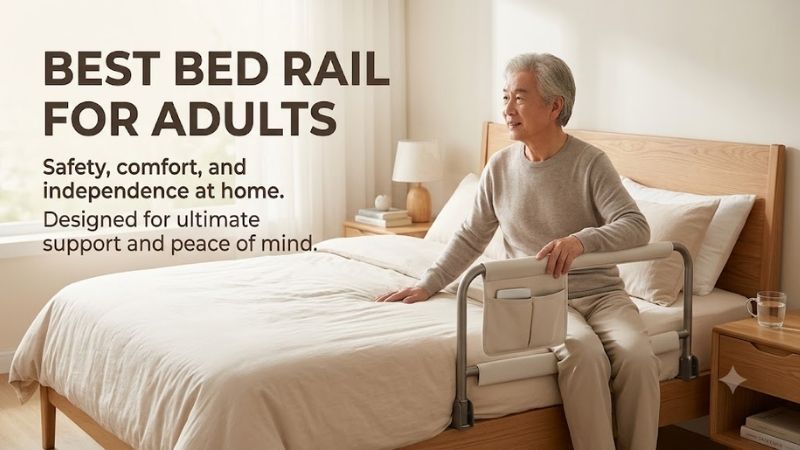
The best bed rail for adults depends on the person’s mobility, mattress, bed frame, and reason for needing assistance. Some rails provide a short handhold for getting out of bed, while others extend along the mattress edge to help reduce the chance of rolling out. Because improperly selected or installed rails can cause serious entrapment, asphyxiation, and fall hazards, safety compatibility matters more than convenience, price, or advertised strength.
First: What Type of Bed Rail Do You Actually Need?
A short bedside handle and an extended fall-protection rail are not interchangeable.
A person who can move independently but needs support while standing may benefit from a transfer handle.
Someone who rolls toward the edge of a mattress may need a longer protective arrangement, subject to professional assessment.
A person with cognitive impairment, uncontrolled movements, significant weakness, or difficulty repositioning may face additional risks from any portable bed rail.
These products should never be used to restrain a person in bed.
The FDA and CPSC document risks involving entrapment between the mattress and rail, within rail openings, and beneath rail components.
Quick Comparison of Six Adult Bed Rails
The following options are distinct designs within the Stander product range. Manufacturer documentation identifies compliance with ASTM F3186-17 for the referenced models; that is an important starting point, not a guarantee of safe use with every mattress or user.
| Product | Primary Function | Bed Compatibility | Main Advantage | Important Limitation |
|---|---|---|---|---|
| Stander Wonder EZ Adjust Bed Rail | Extendable fall barrier and transfer handle | Traditional beds | Extends 20–30 inches | Not for adjustable bases |
| Stander Wonder Pivot Bed Rail | Pivoting rail | Traditional beds | Moves down for access | Pivot clearance needed |
| Stander Click-N-Go Extendable Bed Rail | Removable extendable support | Traditional and specified wooden adjustable bases | Quick-release handle | Restrictive frame compatibility |
| Stander Wonder Bed Rail for Adjustable Beds | Extendable barrier | Specified wooden adjustable bases | Approved adjustable-bed design | Not for metal frames |
| Stander Wonder Mobility Rail | Transfer and mobility assistance | Specified conventional beds | Support handle for transfers | Not equivalent to a full barrier |
| Stander BedCane | Compact transfer handle | Compatible beds | Small bedside footprint | Limited fall-barrier coverage |
Stander Wonder EZ Adjust Bed Rail — Best Overall for Traditional Beds
Why We Selected It
The Wonder EZ Adjust combines two useful functions: an extended side rail and a support handle for bed transfers.
This makes it relevant to adults who need assistance when changing from a lying to a seated position and who may also require a longer barrier at the mattress edge.
The adjustable length is its principal distinguishing feature.
Verified Manufacturer Specifications
-
Adjustable rail length: 20–30 inches
-
Height: 20 inches, measured from the mattress base
-
Depth: 18 inches
-
Product weight: 10 pounds
-
Advertised user weight capacity: 300 pounds
-
Compatible mattress thickness: 10–14 inches
-
Material: Powder-coated steel
-
Attachment: Bed-frame safety strap
-
Intended beds: Traditional nonadjustable beds
The manufacturer states that this product passed ASTM F3186-17 testing.
How the Extendable Design Works
A shorter setting may provide easier access to part of the bedside.
Extending the rail increases the amount of mattress edge covered.
However, longer is not always better.
The appropriate length depends on where a person enters and exits the bed, their movement patterns, and their individual fall and entrapment risks.
The railing should never obstruct a needed exit route or become a restraint.
Installation Requirements
The supplied safety strap secures the rail to the bed frame.
It must be installed according to the manual.
Simply sliding the rail beneath the mattress without properly securing it is not an acceptable substitute.
A mattress that is too thin, excessively soft, or outside the approved range can create dangerous gaps.
Benefits During Transfers
A properly installed handle may provide a stable contact point when a person moves toward the edge of the bed.
However, the advertised weight capacity does not mean that the rail can safely bear every possible lifting or pulling force.
The user must follow the manufacturer’s intended loading and transfer instructions.
Advantages and Drawbacks
Pros
-
Adjustable 20–30-inch rail
-
Integrated support handle
-
Published dimensions and mattress limits
-
Manufacturer-documented ASTM testing
-
Included attachment strap
Cons
-
Not designed for adjustable bases
-
Requires compatible mattress and bed frame
-
Extended configuration may interfere with access
Buy If: You have a compatible traditional bed and need both a bedside handle and an adjustable-length rail.
Skip If: You use an adjustable bed, have an extra-soft mattress, or need a medical bed-specific solution.
Stander Wonder Pivot Bed Rail — Best for Easier Bedside Access
Why a Pivoting Rail Is Different
A conventional fixed rail can restrict access to the bed.
A pivoting model provides a mechanism for moving the barrier out of the way in an approved manner.
This can be useful when a caregiver needs access to the sleeping area.
The pivot feature does not remove the need for correct installation or individual safety assessment.
How It Supports Different Activities
When properly positioned and locked, the rail provides its intended support function.
When moved according to the instructions, it can create additional space for getting into and out of bed.
However, the moving mechanism introduces another part that must be checked.
Users and caregivers need to understand how to confirm that the rail is securely locked.
Important Compatibility Considerations
The Wonder Pivot is intended for compatible conventional bed arrangements.
Check the current manufacturer’s specifications for supported mattress thickness and frame requirements.
Do not assume compatibility with an adjustable base merely because the rail has moving parts.
Who Benefits Most
The pivoting design may suit someone who needs a protective side rail but also wants a clear entry and exit space.
A caregiver may appreciate the ability to move the rail rather than reaching over a fixed barrier.
Potential Disadvantages
The pivot path needs adequate space.
Nearby furniture may interfere with movement.
People who cannot operate the pivot mechanism independently must not be placed in a situation where the rail traps them or prevents necessary movement.
The manufacturer identifies ASTM F3186-17 testing for this product.
Pros: Movable barrier, caregiver access, traditional-bed application.
Cons: Requires mechanism checks, surrounding clearance, and a compatible installation.
Buy If: A fixed side rail would interfere with normal bed access.
Skip If: The user cannot safely manage the arrangement and appropriate caregiver support is unavailable.
Stander Click-N-Go Extendable Bed Rail — Best Removable Design
What Makes Click-N-Go Distinctive
The Click-N-Go uses a removable handle system that can provide more flexible access than a permanently fixed barrier.
Its extendable design supports different rail lengths.
This is particularly useful when access requirements change during caregiving.
Manufacturer Specifications
The published product information identifies:
-
Rail length: 23–30 inches
-
Rail height: 19 inches from the mattress base
-
Compatible mattress thickness: 10–12 inches
-
Product weight: 13.5 pounds
-
Advertised user weight capacity: 300 pounds
-
Material: Steel
-
Installation: Safety strap or approved hardware, depending on bed type
The manufacturer states that it passed ASTM F3186-17 testing.
Compatibility With Adjustable Beds
This product supports specified wooden adjustable bed bases as well as compatible traditional beds.
That is a meaningful advantage over the Wonder EZ Adjust.
However, the adjustable-base configuration requires the attachment method specified by the manufacturer.
It is not compatible with all metal bed frames.
Why Quick Removal Requires Care
A removable rail must be correctly reinstalled and locked before use.
The convenience of detachment does not justify leaving the rail loosely attached.
Users should check the mechanism for proper engagement whenever it has been removed.
Who Should Choose It
The Click-N-Go is particularly attractive for households that need both a rail and the ability to remove its handle for routine access.
It can also suit some adjustable bed setups that other portable rails do not support.
Pros: Extendable length, removable design, compatibility with specified adjustable bases.
Cons: Higher mechanical complexity, restricted bed-frame compatibility, careful reinstallation required.
Buy If: You need a removable rail and have a supported bed configuration.
Skip If: Your bed has an unsupported metal frame or mattress thickness.
Stander Wonder Bed Rail for Adjustable Beds — Best Specialized Adjustable-Bed Option
Why Ordinary Bed Rails May Be Unsuitable
An adjustable bed changes shape when the head or foot section rises.
This movement can change gaps between the mattress, frame, and rail.
A portable rail approved only for a stationary bed should not be assumed safe on a moving adjustable base.
Purpose-Built Construction
Stander’s Wonder Bed Rail for Adjustable Beds is intended for specified adjustable platform beds.
It uses an attachment arrangement appropriate to its approved installation method.
Published Specifications
-
Rail length: 23–30 inches
-
Height: 17.5 inches from the mattress base
-
Advertised weight capacity: 300 pounds
-
Product weight: 8 pounds
-
Supported mattress thickness: 10–12 inches
-
Frame compatibility: Specified wooden adjustable platforms
-
Attachment: Manufacturer-supplied hardware
The manufacturer states that the model passed ASTM F3186-17 testing.
What to Check Before Purchasing
The bed platform material is critical.
A model intended for attachment to wood cannot automatically be mounted to metal.
Drilling into a bed frame or modifying the supplied hardware outside the manufacturer’s instructions can compromise the installation.
Mattress Softness
An excessively soft mattress can increase the risk of gaps developing around a rail.
The manufacturer specifically warns against using certain configurations with extra-soft mattresses.
Advantages and Limitations
Pros: Designed for approved adjustable beds, published attachment requirements, extendable length.
Cons: Not universally compatible, unsuitable for specified metal frames, requires appropriate hardware installation.
Buy If: You have a supported wooden adjustable bed and need an approved rail.
Skip If: Your adjustable base does not match the manufacturer’s installation requirements.
Stander Wonder Mobility Rail — Best for Bed Transfers
Why Transfer Assistance Is a Different Goal
Some adults do not need a long side barrier.
Instead, they need a stable contact point while turning, sitting up, or standing from bed.
For those users, a mobility-focused handle may be more appropriate than an extended rail.
Design Purpose
The Wonder Mobility Rail is oriented toward supporting the movements involved in bed transfers.
Its support handle is intended to provide a grasping point.
However, it should not be treated as a replacement for a walker, transfer device, or caregiver assistance when those are needed.
Proper Use
The person should be able to understand and use the device appropriately.
A bed rail does not automatically make an unsafe transfer safe.
Muscle weakness, dizziness, balance difficulties, or other problems may require professional evaluation and additional assistance.
Installation and Safety
Stander identifies ASTM F3186-17 testing for this model.
The product uses a safety strap attachment arrangement, and its approved bed and mattress requirements must be followed.
Pros: Transfer-oriented design, practical support point, less emphasis on full-length barrier coverage.
Cons: Limited protection against rolling, not suitable as a restraint, requires appropriate user ability.
Buy If: The primary goal is assisting controlled movement into and out of bed.
Skip If: The user needs a larger protective system or cannot transfer safely without direct assistance.
Stander BedCane — Best Compact Bedside Handle
Why a Short Handle May Be Enough
For some adults, the most useful feature is a stable handhold beside the mattress.
A compact handle leaves more of the bed edge unobstructed than an extended rail.
This can be appealing to a person who remains independently mobile but needs help stabilizing during a transfer.
How It Differs From an Extended Barrier
A short handle does not provide the same mattress-edge coverage as an extendable rail.
It should not be selected for fall protection solely because it is advertised as a bed rail.
Match the device to the actual goal.
Installation Requirements
The BedCane requires proper attachment to a compatible bed.
The manufacturer identifies ASTM F3186-17 testing and provides guidance about soft-mattress entrapment hazards.
A mattress that compresses excessively near the edge may be unsuitable without an appropriate manufacturer-approved solution.
Ideal Buyer
The BedCane may suit someone who needs a smaller transfer-assistance device and can use it safely.
It may also be preferable in a narrow bedroom where a larger rail would obstruct movement.
Pros: Compact footprint, transfer-oriented function, less bedside obstruction.
Cons: Not an extended fall barrier, requires secure installation, suitability depends on mobility.
Buy If: You need a compact handhold for controlled bed transfers.
Skip If: You require a longer side-protection system.
The Most Important Safety Issue: Entrapment
A bed rail can reduce one kind of risk while creating another.
Entrapment can occur when a person’s head, neck, torso, or limbs become trapped between the rail and mattress or within the rail itself.
The hazard becomes especially serious if a person cannot reposition independently.
The federal requirements for adult portable bed rails are codified under 16 CFR Part 1270. They incorporate ASTM F3186-17 with modifications and address entrapment, stability, warnings, and other requirements.
Why Mattress Firmness Matters
A soft mattress can deform beneath a person’s weight.
As its edge compresses, a dangerous gap may form beside an otherwise properly installed rail.
This is why mattress compatibility is not limited to thickness.
The manufacturer’s specified firmness and installation instructions must also be considered.
Check the Entire Bed System
A rail should be evaluated together with the mattress, bed frame, platform, and intended user.
An aftermarket topper can change mattress height and edge compression.
An adjustable bed may move relative to the rail.
A damaged frame or missing attachment strap can undermine stability.
Who May Be at Greater Risk?
Adults who cannot reposition independently, have significant cognitive impairment, or experience uncontrolled movements may face increased danger.
A bed rail should not be used to contain or restrain a person.
When the need is related to a medical condition, a qualified clinician or occupational therapist can help assess whether a rail is appropriate.
How to Choose the Correct Adult Bed Rail
Identify the Main Function
Decide whether the rail is intended for transfers, repositioning, reducing rolling from the mattress edge, or a combination of these.
The product must be designed for the actual task.
Measure Mattress Thickness
Different rails specify different compatible mattress ranges.
The Wonder EZ Adjust, for example, is designed for mattresses 10–14 inches thick.
A 16-inch mattress should not be assumed compatible.
Verify Bed-Frame Construction
Traditional frames, wooden adjustable platforms, and metal adjustable bases may require different mounting methods.
Never assume that a product compatible with one is compatible with the others.
Review the Manufacturer’s Testing Claims
Look for clear identification of the applicable adult portable bed-rail standard and product model.
Do not rely on vague advertising terms such as hospital strength or universal safety.
Check for Recalls and Warnings
The CPSC recalled certain Medline Bed Assist Bar models in 2024 because of entrapment and asphyxiation hazards.
Other products have also been subject to safety warnings.
Recall status is model-specific, so review the exact product identity rather than assuming every product from a brand has the same status.
Frequently Asked Questions
Are Adult Bed Rails Safe?
They can be appropriate for some users when the exact product, mattress, frame, installation, and personal circumstances are suitable. They can also create serious entrapment hazards.
What Is the Difference Between a Bed Handle and a Bed Rail?
A compact handle primarily assists transfers. A longer rail provides additional mattress-edge coverage, but its appropriateness depends on individual risk.
Can I Use a Portable Rail on an Adjustable Bed?
Only when the manufacturer explicitly supports that particular adjustable-bed configuration.
Are Bed Rails Suitable for Dementia?
They require special caution. Entrapment, climbing, confusion, and restraint concerns may make them inappropriate. A professional individualized assessment is important.
Does a 300-Pound Weight Rating Guarantee Safety?
No. The rating applies under the manufacturer’s specified conditions. It does not eliminate installation, entrapment, or user-specific risks.
Can a Bed Rail Prevent Every Fall?
No. A rail can fail to prevent a fall or contribute to injury if the person climbs over it, becomes trapped, or uses it improperly.
Final Verdict
The Stander Wonder EZ Adjust Bed Rail is a strong option for compatible traditional beds when both a transfer handle and extendable rail are needed.
For approved adjustable wooden bases, the Wonder Bed Rail and Click-N-Go configurations deserve closer consideration. The Wonder Mobility Rail and BedCane focus more on transfer assistance.
No adult bed rail is universally safe. Selecting the correct product requires a compatible mattress and bed frame, proper installation, and an assessment of the individual’s ability to use it safely.