A retractable extension cord reel vs alternatives comparison starts with how often you need temporary power and how far the job moves. A spring reel suits a repeat route. A straight cord travels, a manual reel stores long cable, and a fixed outlet serves equipment that plugs in at the same place every day.
Retractable extension cord reel vs alternatives at a glance
Choose based on the work location, the device, and the way you put the cord away. A mounted reel returns a cable to one position. A portable cord can follow the job. A suitable permanent receptacle makes more sense when the place that needs power rarely changes.
| Option | Best use | Main trade-off |
|---|---|---|
| Spring-retracting reel | Frequent temporary connections from one mounted point | Requires a suitable mount, supply, and clear return |
| Straight extension cord | Occasional work at changing locations | Needs inspection, manual coiling, and storage |
| Manual wind-up reel | Portable long runs with organized storage | Takes time to wind, with possible wound-use limits |
| Passive storage hanger or spool | Stowing a compatible separate cord | Functions as storage between jobs |
| Plug-in power strip | Compatible low-load devices near a fixed supply | Shared rating and approved location |
| Added wall or ceiling receptacle | Repeated use at the same point | Requires properly planned electrical work |
| Cordless tools | Short mobile tasks away from supply | Battery cost, run time, and charging |
Use frequency to choose the basic setup
A cord used only for an occasional repair may be easiest to carry by hand. When you pull from the same place several times a week, a spring reel can reduce setup and storage steps. Equipment that stays connected throughout the day is a candidate for a fixed supply.
Write down the last few jobs. A garage task light might move from one side of a car to the other, while a bench charger stays in one place. A portable tool taken to a shed or another worksite needs a setup you can carry. The same room can benefit from different types of power solutions when its tools move differently.
Then consider how much time goes into storage. If your current method rarely leaves cable on the floor, a mounted reel may solve a small problem. If you repeatedly find a tangled cord under a cabinet, a manual hanger or reel may solve it at lower cost. A spring reel earns its place when temporary connection and connector return are part of the same frequent route.
Compare location and current first
Each powered option has limits on the assembly, connectors, and the environments where it can be used. Check the equipment manual for allowed gauge and length. Compare the exact product rating, sum simultaneous loads, and account for cord payout instructions.
For outdoor work, choose equipment whose entire arrangement is approved for the conditions, including where plugs and connections sit. A weather-resistant outer jacket is one part of that comparison. A garage-mounted reel can be suitable when kept completely within its approved dry location.
Also check grounding and suitable ground-fault protection. The product’s breaker and source protection perform different jobs. If an older garage has uncertain grounding or an outlet in an unsuitable location, ask a qualified electrician to assess it. Address the supply requirement before comparing winding mechanisms or cord storage.
How the other ways to supply power compare
The choices differ in mobility, storage, and the way they deliver electricity to the job. Compare the entire process from retrieving the product and connecting it to inspecting and putting it away. A solution should fit every stage of the work you repeat.
Retractable reel vs a straight extension cord
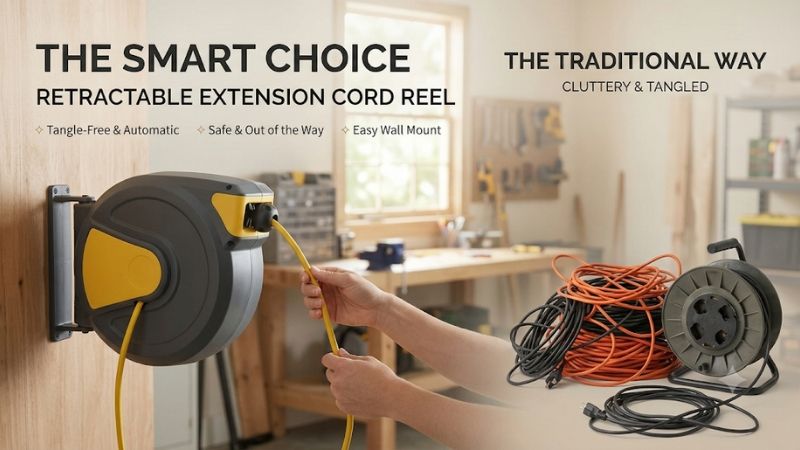
A straight extension cord is a good match for occasional work and jobs that start in different places. A spring reel makes a repeated route from the same anchor easier to manage. Compare the shortest permitted length for each task and where the connector will be accessible.
For work near a garage bench every afternoon, a mounted unit can put the same head within reach and return it to the wall. A straight cord is easier to move to another suitable receptacle or take to a different room. Keeping one properly sized portable cord can also help if a particular job requires a different jacket or a different rated length.
Check the total running load from the equipment manuals and labels. A straight cord may come in a configuration that meets an allowed higher load than the spring reels you are comparing. It still needs a suitable source and route, with dry or approved connections as appropriate. Put it away after use so a temporary run stays out of the aisle between sessions.
Choose a straight cord for occasional work at changing locations. Choose a spring reel where the same pull and return path serves several suitable tasks. Before purchasing either, confirm the maximum length allowed by the equipment and where the cable can run clear of traffic and areas where it could be pinched.
Retractable reel vs a manual wind-up reel
A portable manual reel lets you carry cable and wind it at the end of a job. A spring-retracting assembly returns it from a fixed location under the user’s control. Check which part supplies power and how the manufacturer rates wound and extended conditions.
When a job takes place in two parts of a garage on different days, a hand-wind model can travel to each area. It may have receptacles on the reel body or a connection at the far end, depending on the product. That difference changes where the tool has to plug in. Use the drawing or packaging to trace the lead and the working end.
Some manual reels and automatic reels require full extension for the intended load. Others list distinct capacities for coiled and uncoiled use. Follow the exact manual. When most of the line remains unused, a shorter assembly may be easier to deploy and store within its instructions. A manual handle can offer controlled return. Unplug and wind the cable as directed.
Choose a manual reel if portability and organized storage matter more than the time needed to rewind. Choose an automatic model if there is a suitable mounting and supply position and people routinely use the same route. Both need a clear cord path and an assembly rated for what you connect.
Retractable reel vs a passive cord hanger or spool
A passive cord organizer holds a separate extension cord when it is unplugged and stored. This is useful if you already have an appropriate straight cord and mainly need a reliable way to keep it off the floor between jobs. Pick a holder that fits the cord and its storage location.
A loosely coiled cable may already work for the tasks at hand. A wide hanger with a suitable mount can give it a home. Avoid tight bends and use the storage and inspection methods recommended by the cord maker. If you use a passive winding drum, disconnect the cord before putting it away and follow the instructions before using it next time.
This approach also lets you choose another cord for a different permitted task without moving the permanent position of a spring reel. Keep each cord identifiable by its marking and condition. A single convenient hanger can become cluttered if several similar cords are piled onto it. Give every frequently used cord enough room to be taken down and inspected easily.
Choose passive storage when the main problem is clutter after a task. A powered spring reel makes more sense when a fixed pull-down point reduces setup and return effort on a route you use often. Compare how many steps each option takes from a stored cord to the point where you connect the tool.
Retractable reel vs a plug-in power strip
A power strip gives compatible equipment several outlet positions near a suitable source. A spring reel carries temporary power from a mounted point toward work that moves. Compare equipment instructions, environmental approvals, and total current. Use the arrangement each product permits.
On a dry bench, a suitably rated strip connected directly where permitted may serve stationary low-load accessories with short leads. Give the label and instructions priority. A portable heater requires direct connection to a suitable outlet, and other equipment may specify direct connection as well. Check the combined rating if you expect to use several of the available positions.
For a movable assembly job, a strip at the back of a bench still requires a safe cord path. Use a direct approved connection for each product and avoid linking strips, reels, or extension cords to get farther from the source. A suitably located permanent outlet can solve the underlying connection problem when the bench is always in the same spot.
Check whether you need surge protection as a separate feature for compatible electronics. Ordinary strips and spring-loaded reels can have different functions even when the housings look alike. Read the exact product’s approvals and capacity. Buy the solution for the jobs it will serve and the way it connects to the source.
Retractable reel vs an installed receptacle
A properly installed receptacle is a better match when you need power in the same spot continuously or when equipment calls for direct connection. A reel gives temporary reach across a working area. Compare both against the existing branch circuit and the needs of the main load.
An air compressor or stationary tool may have specific circuit and connection requirements. Get those from its instructions. If a temporary cord route is prohibited or impractical, have a qualified electrician assess the location for a suitable permanent supply. Ask how the circuit is loaded and which protection is appropriate, especially in a garage.
An added outlet may also free the wall or keep the floor more accessible. On a bench that uses fixed devices, running a short lead from each permitted device can be simpler than pulling a long reel daily. If the work changes sides of the room, a properly located receptacle may benefit the main tools while a separate rated reel covers an occasional task.
Include the full cost in the decision. The reel may be affordable when there is an approved bracket location near an existing outlet. New electrical work costs more initially, but it can be the right investment when recurring temporary cords create a poor arrangement.
Retractable reel vs cordless tools
A cordless tool removes the cord during use and can be useful for short, mobile tasks. A reel lets you keep using equipment that takes mains power when its maker allows an extension. Compare the battery platform, expected run time, and electrical demands of the job.
Consider tightening or drilling a few fittings across a garage. A cordless option can follow the work without needing a clear route to a wall. Over a longer job, battery changes and charge time can influence the workflow. Buy for the expected duty and the battery system you already use. Plan a suitable charging location for that system.
For an allowed corded tool used frequently on the same side of a shop, a properly installed reel may suit the task without another battery purchase. A mixed kit can work well. Use cordless equipment where access moves and a suitable fixed or temporary powered connection where the tool and the job call for one.
Consider consumables and storage. A reel puts its cable away at the mount. A cordless kit needs chargers and batteries stored and used according to their instructions. Compare several actual jobs from setup through cleanup. Include the time spent finding a charged battery and the time spent setting up a suitable cord route so both options are evaluated across the same work.
Retractable extension cord reel vs alternatives for common jobs
Use the first three tasks that come to mind and identify which part causes trouble. A dark bench may need a better-placed source. A mobile task may only need an appropriate portable tool. A driveway-related job needs a power route and connections approved for the conditions.
One workbench used throughout the week
Check which devices stay at the bench and which move. A suitable fixed receptacle serves permanently located equipment. A short retracting reel can help when tools move along the bench or come out only for a project. Keep the intended connections within documented limits.
Start by tracing each device from its operating position. Nearby equipment could already be within reach of an appropriate outlet. A task light used in different places may benefit from temporary access. Review the combined load on the source if you plan to use more than one item at once.
A short reel is useful when its input reaches the suitable supply directly and the cord can be deployed as instructed. A straight cord with passive storage may handle the same setup with less purchase cost if you use it infrequently. Keep the cable and your feet clear of moving parts and fixtures. When several people share the bench, use a layout that lets everyone return the cord to the same place.
A garage door and driveway that share the work area
A doorway changes the cord route and can expose equipment to rain, pinching, or traffic. Find a properly rated supply and cord arrangement that maintains a safe path. Compare cordless options for quick work away from the garage and avoid routes that depend on a door staying clear.
If a dry indoor reel is mounted by the door, keep the assembly and its use within the maker’s approved conditions. When a job genuinely needs outdoor power, check the whole portable system, including the condition and suitability of plugs, connections, and appropriate ground-fault protection. A jacket code provides information about the cable within that larger setup.
Walk the path while the work is idle. Mark how people and equipment move toward the door. If a cable would cross a spot where a person, door, or tire can put pressure on it, use a different power layout. A few extra feet matter only if they give the cord a safe path and the tool still allows that length.
A long project that moves from zone to zone
Some projects begin near the bench and finish across the shop. Compare the longest permitted route, the amount of cable you need to deploy, and whether another suitable supply is already available. One longer reel may help when its route remains clear throughout.
A portable straight cord or manual reel may fit if you move to another approved supply partway through the job. It lets you keep the path short and portable. A spring reel suits the same route repeated day after day from a clear mounted position. Use the tool’s allowed cord length and gauge in either case.
List what needs to move after the work. You may have a cord, outlet block, several tools, and equipment left in use at the bench. Plan how to disconnect and put away each part. A clear arrangement gets the work done and makes cleanup predictable. If more than one work zone needs power at the same time, check the source’s total load instead of basing the plan on each outlet in isolation.
Choose based on the next three uses
A comparison is useful when it produces a specific purchase decision. Write down the device, its power instructions, the source, the route, and the storage position for your next three jobs. Pick the first option that satisfies those needs and leaves enough room to work.
For a hobby garage, that may be a short reel near one bench and a separate straight cord for occasional portable tasks. A dedicated workshop may get more from adding outlets and using a spring reel only for work that moves. A renter may find passive storage and an appropriately rated portable cord easier to manage.
Review the setup if your work changes. A new fixed tool, a different door, or a relocated bench can change the value of a reel. Read the exact equipment instructions and confirm the route before moving a cord or adding another device. Keep the power solution tied to the work and location.
The choice can also change by season. A cord stored indoors may be enough for an occasional covered bench repair. A warm-weather outdoor job can call for different environment ratings and routing. Recheck the manual and the suitable supply as the conditions change. If you keep solving the same problem by moving tools or changing connections, compare the total cost against a better location or fixed source. Record which arrangement worked so the next job starts with the same clear path.
Conclusion
Choose a spring reel for a repeat temporary route, a straight or manual-reel cord for changing locations, and a permanent receptacle for regular loads in one place. A cordless tool can simplify quick mobile tasks. Check the load, location, and pickup and return paths before choosing what to buy.
More from Amazon
Programs that pair well with the guide above. Offers and eligibility are set by Amazon and may change.
Collect the home and kitchen items you want in one registry that guests can shop from.
Create a wedding registrySet up recurring deliveries of everyday items on eligible products. Terms and savings are set by Amazon.
Explore Subscribe & SaveFree shipping on eligible items, Prime Video and more. Eligible new members can start with a free trial.
Start a Prime free trialAudiobooks and podcasts to listen to on the go. Eligible new members can start with a free trial.
Try Audible freeAs an Amazon Associate we earn from qualifying purchases.