Comparing a shop vacuum for sawdust vs alternatives helps homeowners choose the right system for woodworking cleanup and dust control. Conventional shop vacuums, HEPA dust extractors, cyclone collectors, ceiling-mounted air filters, and manual cleaning tools serve different purposes. Understanding their airflow, filtration, collection capacity, and limitations helps create a cleaner and safer workshop.
Quick Verdict: Which Sawdust Collection System Should You Choose?
A conventional shop vacuum is useful for collecting settled sawdust, small wood chips, and miscellaneous workshop debris.
It can also connect to certain portable woodworking tools when compatible hoses and adapters are available.
However, a shop vacuum is not necessarily the most effective solution for every dust source.
A purpose-built dust extractor is often more suitable for handheld sanders, track saws, and similar tools that generate fine particles.
A high-airflow dust collector is more appropriate for many stationary woodworking machines that produce large quantities of chips.
A cyclone separator can reduce filter loading by collecting some debris before it reaches the vacuum.
An ambient air filtration unit may help remove suspended particles that escape source collection, but it should not replace effective extraction at the machine.
Manual sweeping and compressed-air cleaning may be inappropriate for fine dust because they can resuspend settled particles.
The best workshop arrangement often combines different methods rather than relying on one machine.
Quick Comparison Table
| Equipment | Main advantage | Primary limitation | Best application |
|---|---|---|---|
| Shop vacuum | Versatile debris cleanup | Fine-dust performance varies | Floors and benches |
| HEPA dust extractor | Fine-particle filtration and tool connections | Higher equipment cost | Portable power tools |
| High-airflow dust collector | Bulk chip transport | Larger footprint and ducting | Stationary woodworking machines |
| Cyclone separator | Reduces downstream debris loading | Requires vacuum or collector | Pre-separation |
| Ambient air filtration unit | Captures some airborne particles | Does not collect dust at the source | Supplementary air cleaning |
| Manual cleanup | Low equipment cost | Can resuspend dust | Limited, appropriate tasks |
Shop Vacuum vs HEPA Dust Extractor
Different Intended Purposes
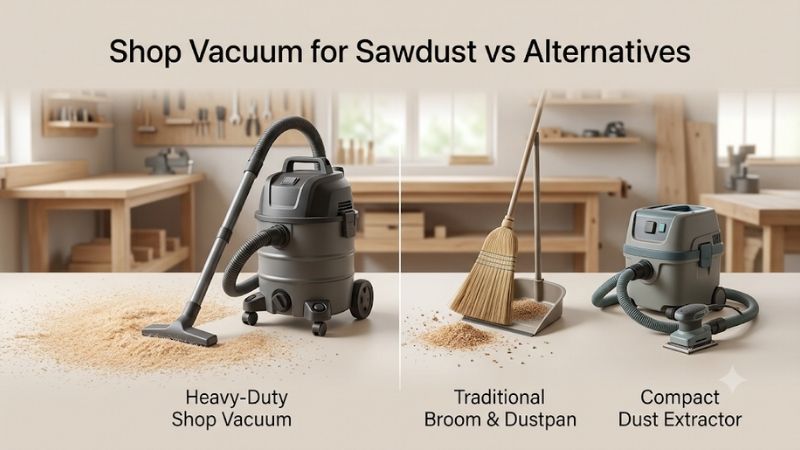
A general-purpose shop vacuum is designed to collect wet and dry debris from different surfaces.
It is useful for floors, workbenches, and general household cleanup.
A dust extractor is designed around controlled collection of dust from tools or other sources.
Many include specialized filters, bags, hoses, and automatic activation features.
Filtration Differences
Some ordinary shop vacuums use general-debris cartridge filters.
These may be suitable for visible sawdust but not necessarily for fine airborne particles.
A HEPA dust extractor emphasizes high-efficiency filtration.
However, the complete system must be properly sealed and used according to its intended application.
Tool Connections
Dust extractors often provide hose connections designed for handheld power tools.
The FEIN Turbo I, for example, includes a long hose and power-tool activation outlet.
The Bosch VAC090AH includes automatic filter cleaning and HEPA filtration.
Conventional shop vacuums may require additional adapters.
Automatic Activation
A tool-activation outlet can start the extractor when a compatible tool is operated.
This improves convenience.
However, electrical load limits must be respected.
Maintenance
General-purpose vacuums may require frequent filter cleaning when collecting fine dust.
Dust extractors may include automatic filter-cleaning systems.
However, filters and bags still require maintenance.
Cost
Purpose-built extractors can cost substantially more than basic shop vacuums.
The additional expense may be justified when fine-dust collection is a frequent requirement.
Which Is Better for Woodworking?
For general floor cleanup, a suitable shop vacuum can be practical.
For direct collection from sanders and similar tools, a purpose-built extractor is often preferable.
Shop Vacuum vs Dedicated Dust Collector
Airflow Requirements
A shop vacuum is designed to generate suction through relatively small hoses.
A stationary dust collector typically moves large volumes of air through larger ducts.
These different airflow characteristics make the systems suitable for different equipment.
Large Wood Chips
Planers and jointers can produce substantial quantities of chips.
A dedicated dust collector is often more suitable for moving this material through large hoses.
A small shop-vac hose may clog.
Table Saws
Table saw dust collection varies by machine design.
Some portable saws support shop-vac connections.
Larger cabinet saws often have dust ports intended for high-airflow collection.
Miter Saws
Miter saws generate dust in several directions.
A shop vacuum may capture some debris through the factory port.
However, additional collection measures may be required.
Duct Diameter
Dedicated dust collectors commonly use larger ducts than conventional shop vacuums.
Large ducts support the airflow required for bulky debris.
However, duct design and system resistance are important.
Filtration
Dust collectors also require appropriate filtration.
A machine that moves large volumes of air but releases fine particles back into the workshop may create exposure concerns.
Space Requirements
Dedicated collectors require storage space and possibly fixed ducting.
Shop vacuums are generally more portable.
Which Is Better for a Home Workshop?
A shop vacuum is practical for general cleanup and some portable tools.
A dedicated dust collector is more suitable for many stationary machines producing substantial chips.
Shop Vacuum vs Cyclone Separator
What a Cyclone Separator Does
A cyclone separator uses airflow movement to separate some particles before they reach the vacuum.
Larger debris falls into a collection container.
The remaining air continues toward the vacuum.
Why Cyclones Are Useful
Woodworking produces large quantities of chips and dust.
A separator can collect much of the bulk debris before it reaches the vacuum filter.
This may reduce filter loading.
Filtration Limitations
A cyclone does not replace a suitable final filter.
Fine particles may pass through the separator.
The vacuum must still contain these particles.
Airflow Resistance
A cyclone adds resistance to the system.
Poorly sized components can reduce collection performance.
Collection Capacity
A large separator container can reduce how often the vacuum drum must be emptied.
However, the separator itself needs storage space.
Maintenance
The container must be emptied before it becomes excessively full.
Hoses and fittings must be checked for leaks or clogs.
Which Is Better?
A cyclone separator is not a complete alternative to a vacuum.
It is an accessory that can improve a properly designed collection arrangement.
Shop Vacuum vs Ambient Air Filtration System
Different Collection Locations
A shop vacuum collects debris through a hose or nozzle.
An ambient air filtration system circulates workshop air through filters.
These systems operate at different points in the dust-control process.
Source Capture
Capturing dust at the tool is generally more effective than allowing it to spread into the room.
A source-collection system should therefore be the primary control where practical.
Airborne Dust
Some particles escape tool collection.
An appropriately designed air filtration unit may help remove a portion of the suspended dust.
However, it cannot guarantee that all particles are captured.
Filter Efficiency
Ambient systems use different filter types.
The filter’s efficiency, airflow, and placement influence performance.
Room Size
An air filtration unit must be suitable for the workshop volume.
Air circulation patterns also matter.
Placement
The unit should be positioned according to the manufacturer’s recommendations.
Poor placement may create ineffective circulation patterns.
Noise
Air filtration units can generate noise during continuous operation.
Consider sound levels and hearing protection.
Which Is Better?
A shop vacuum and ambient air filtration unit serve complementary roles.
The air filter should not replace effective source capture.
Shop Vacuum vs Manual Sweeping
Visible Debris
A broom can collect larger wood chips and ordinary debris.
However, sweeping can disturb fine dust.
Airborne Particles
Dry sweeping may resuspend settled fine particles.
This can increase airborne exposure.
A suitable vacuum can capture debris with less disturbance when correctly configured.
Cleaning Speed
A broom may be convenient for coarse chips across a large floor.
A vacuum can be more useful for corners, benches, and equipment.
Maintenance
Brooms require little equipment maintenance.
Vacuums require filter care and collection disposal.
Dust Disposal
Both methods can release dust during disposal.
Use an appropriate containment method.
Which Is Better?
A suitable vacuum is generally preferable when fine dust is present.
Manual methods may remain useful for limited coarse debris cleanup.
Shop Vacuum vs Compressed Air
What Compressed Air Does
Compressed air blows debris away from a surface.
It does not inherently collect the displaced particles.
Why Blowing Dust Is a Problem
Blowing sawdust can disperse fine particles throughout a workshop.
Some may remain airborne and be inhaled.
Machine Cleaning
Compressed air is sometimes used for specific equipment maintenance procedures.
However, it should not replace appropriate dust extraction.
Follow the equipment manufacturer’s instructions.
Electrical Equipment
Blowing dust into electrical components may move contamination deeper into the equipment.
Use appropriate maintenance methods.
Personal Safety
Compressed air can cause injury and should never be directed at the body.
Use only approved equipment and procedures.
Which Is Better?
For routine sawdust removal, a properly configured vacuum is generally preferable to blowing debris into the air.
Shop Vacuum vs Central Vacuum System
System Layout
A central vacuum uses a fixed collection unit connected to installed piping and inlets.
A portable shop vacuum moves with the operator.
Workshop Convenience
Central systems can reduce the need to move a vacuum across the floor.
However, they require installation and suitable duct design.
Airflow and Pressure
Central vacuum systems vary in capacity and intended applications.
A household central vacuum is not automatically suitable for woodworking chips or fine dust.
Filtration
The complete central system requires appropriate filtration.
Some arrangements exhaust air outside, but that introduces additional design and environmental considerations.
Maintenance
Fixed piping can be difficult to clear if large debris causes a blockage.
The collection unit also requires maintenance access.
Cost
Central systems generally involve greater initial installation effort.
A portable shop vacuum is simpler for most small workshops.
Which Is Better?
A portable shop vacuum offers flexibility.
A properly engineered central extraction system may be useful for dedicated workshops, but must match the equipment and dust hazards.
Compare Collection Methods by Woodworking Task
Random-Orbit Sanding
Sanding generates fine dust.
A purpose-built extractor connected directly to the sander is often the most suitable arrangement.
A conventional shop vacuum may be useful if the complete filtration and connection system is appropriate.
Miter Saw Cutting
A shop vacuum can collect some dust from the factory port.
However, capture efficiency varies.
Additional tool-specific collection measures may be required.
Table Saw Operation
Some portable table saws work with shop-vac connections.
Larger stationary saws often require higher-airflow dust collection.
Planer Operation
Planers produce large volumes of chips.
A dedicated dust collector is generally more suitable.
Router Work
Routers can generate chips and fine dust.
Use compatible shrouds and extraction systems.
Hand Sanding
Hand sanding can generate fine particles even without powered equipment.
Use appropriate source control and respiratory protection where required.
Workshop Floor Cleanup
A conventional shop vacuum with an appropriate filter and hose is useful for ordinary debris.
Workbench Cleanup
A smaller nozzle can collect dust from corners and around equipment.
Avoid blowing particles into the air.
Filtration and Health Considerations
Why Wood Dust Is Hazardous
Wood dust exposure can cause respiratory irritation and allergic effects.
Some exposures are associated with more serious health outcomes.
Fine-Particle Capture
Fine particles require appropriate filtration and a sealed collection path.
HEPA Claims
A HEPA filter is not sufficient if the vacuum leaks around the housing or seals.
Source Capture
Collect dust where it is generated whenever possible.
Respiratory Protection
Use appropriate protection when required.
Ventilation
Ventilation can support exposure control but should not replace effective extraction.
Dust Disposal
Empty bags and containers carefully to minimize resuspension.
Combustible Dust
Wood dust accumulation can create fire and explosion hazards under certain conditions.
Manage ignition sources and housekeeping carefully.
How to Choose the Right Setup
Identify the Dust Source
Different woodworking tools generate different debris.
Start with the machines you use most often.
Estimate Debris Volume
A small hobby project may generate limited sawdust.
A planer can produce substantial chips quickly.
Evaluate Fine-Dust Requirements
Fine dust requires suitable filtration and exposure controls.
Check Tool Ports
Measure the actual dust-port diameter.
Choose compatible hoses and adapters.
Consider Available Space
A small shop may benefit from a compact extractor.
A larger workshop may justify fixed collection equipment.
Compare Noise
Vacuums and collectors produce sound.
Consider prolonged exposure.
Evaluate Maintenance
Filters, bags, and drums require regular attention.
Consider Total Cost
Include the machine, hoses, adapters, bags, filters, and accessories.
Plan Future Expansion
A small vacuum may be sufficient now but unsuitable if larger stationary equipment is added.
Choose according to realistic future needs.
Common Mistakes When Comparing Systems
Assuming a Shop Vacuum Replaces Every Collector
Different machines require different airflow.
Using a Cyclone Without Final Filtration
A separator does not capture every fine particle.
Relying Only on Ambient Air Filtration
Source capture should remain a priority.
Choosing by Peak Horsepower
The marketing figure does not describe sustained vacuum performance.
Ignoring Hose Resistance
Long, narrow hoses and sharp bends reduce airflow.
Neglecting Filter Maintenance
Loaded filters reduce performance.
Using Compressed Air for Routine Dust Removal
Blowing can resuspend fine particles.
Failing to Consider Dust Exposure
A visually clean workshop is not necessarily free of airborne hazards.
Frequently Asked Questions
Is a shop vacuum better than a dust collector for woodworking?
A shop vacuum is useful for general cleanup and some portable tools. Dedicated dust collectors are often more suitable for large stationary machines.
Can a HEPA dust extractor replace a shop vacuum?
It may perform many ordinary cleanup tasks, but its advantages are most relevant to suitable fine-dust applications. Capacity and hose design may differ.
Does a cyclone separator remove all sawdust?
No. It separates some debris before the final vacuum or collector. Fine particles may remain in the airflow.
Do ceiling-mounted air filters replace dust collection?
No. They can supplement source capture but do not prevent dust from entering the workspace initially.
Is sweeping sawdust safe?
Dry sweeping can resuspend fine particles. A suitable vacuum is generally preferable when fine dust is present.
Can I use compressed air to clean woodworking tools?
Follow the equipment manufacturer’s instructions. Compressed air can disperse fine dust and should not replace appropriate collection methods.
Conclusion
Compare a shop vacuum for sawdust vs alternatives, including dust collectors, dust extractors, cyclone separators, air filtration systems, and traditional cleanup tools.
Comparing a shop vacuum for sawdust vs alternatives helps homeowners choose the right system for woodworking cleanup and dust control. Conventional shop vacuums, HEPA dust extractors, cyclone collectors, ceiling-mounted air filters, and manual cleaning tools serve different purposes. Understanding their airflow, filtration, collection capacity, and limitations helps create a cleaner and safer workshop.
Quick Verdict: Which Sawdust Collection System Should You Choose?
A conventional shop vacuum is useful for collecting settled sawdust, small wood chips, and miscellaneous workshop debris.
It can also connect to certain portable woodworking tools when compatible hoses and adapters are available.
However, a shop vacuum is not necessarily the most effective solution for every dust source.
A purpose-built dust extractor is often more suitable for handheld sanders, track saws, and similar tools that generate fine particles.
A high-airflow dust collector is more appropriate for many stationary woodworking machines that produce large quantities of chips.
A cyclone separator can reduce filter loading by collecting some debris before it reaches the vacuum.
An ambient air filtration unit may help remove suspended particles that escape source collection, but it should not replace effective extraction at the machine.
Manual sweeping and compressed-air cleaning may be inappropriate for fine dust because they can resuspend settled particles.
The best workshop arrangement often combines different methods rather than relying on one machine.
Quick Comparison Table
| Equipment | Main advantage | Primary limitation | Best application |
|---|---|---|---|
| Shop vacuum | Versatile debris cleanup | Fine-dust performance varies | Floors and benches |
| HEPA dust extractor | Fine-particle filtration and tool connections | Higher equipment cost | Portable power tools |
| High-airflow dust collector | Bulk chip transport | Larger footprint and ducting | Stationary woodworking machines |
| Cyclone separator | Reduces downstream debris loading | Requires vacuum or collector | Pre-separation |
| Ambient air filtration unit | Captures some airborne particles | Does not collect dust at the source | Supplementary air cleaning |
| Manual cleanup | Low equipment cost | Can resuspend dust | Limited, appropriate tasks |
Shop Vacuum vs HEPA Dust Extractor
Different Intended Purposes
A general-purpose shop vacuum is designed to collect wet and dry debris from different surfaces.
It is useful for floors, workbenches, and general household cleanup.
A dust extractor is designed around controlled collection of dust from tools or other sources.
Many include specialized filters, bags, hoses, and automatic activation features.
Filtration Differences
Some ordinary shop vacuums use general-debris cartridge filters.
These may be suitable for visible sawdust but not necessarily for fine airborne particles.
A HEPA dust extractor emphasizes high-efficiency filtration.
However, the complete system must be properly sealed and used according to its intended application.
Tool Connections
Dust extractors often provide hose connections designed for handheld power tools.
The FEIN Turbo I, for example, includes a long hose and power-tool activation outlet.
The Bosch VAC090AH includes automatic filter cleaning and HEPA filtration.
Conventional shop vacuums may require additional adapters.
Automatic Activation
A tool-activation outlet can start the extractor when a compatible tool is operated.
This improves convenience.
However, electrical load limits must be respected.
Maintenance
General-purpose vacuums may require frequent filter cleaning when collecting fine dust.
Dust extractors may include automatic filter-cleaning systems.
However, filters and bags still require maintenance.
Cost
Purpose-built extractors can cost substantially more than basic shop vacuums.
The additional expense may be justified when fine-dust collection is a frequent requirement.
Which Is Better for Woodworking?
For general floor cleanup, a suitable shop vacuum can be practical.
For direct collection from sanders and similar tools, a purpose-built extractor is often preferable.
Shop Vacuum vs Dedicated Dust Collector
Airflow Requirements
A shop vacuum is designed to generate suction through relatively small hoses.
A stationary dust collector typically moves large volumes of air through larger ducts.
These different airflow characteristics make the systems suitable for different equipment.
Large Wood Chips
Planers and jointers can produce substantial quantities of chips.
A dedicated dust collector is often more suitable for moving this material through large hoses.
A small shop-vac hose may clog.
Table Saws
Table saw dust collection varies by machine design.
Some portable saws support shop-vac connections.
Larger cabinet saws often have dust ports intended for high-airflow collection.
Miter Saws
Miter saws generate dust in several directions.
A shop vacuum may capture some debris through the factory port.
However, additional collection measures may be required.
Duct Diameter
Dedicated dust collectors commonly use larger ducts than conventional shop vacuums.
Large ducts support the airflow required for bulky debris.
However, duct design and system resistance are important.
Filtration
Dust collectors also require appropriate filtration.
A machine that moves large volumes of air but releases fine particles back into the workshop may create exposure concerns.
Space Requirements
Dedicated collectors require storage space and possibly fixed ducting.
Shop vacuums are generally more portable.
Which Is Better for a Home Workshop?
A shop vacuum is practical for general cleanup and some portable tools.
A dedicated dust collector is more suitable for many stationary machines producing substantial chips.
Shop Vacuum vs Cyclone Separator
What a Cyclone Separator Does
A cyclone separator uses airflow movement to separate some particles before they reach the vacuum.
Larger debris falls into a collection container.
The remaining air continues toward the vacuum.
Why Cyclones Are Useful
Woodworking produces large quantities of chips and dust.
A separator can collect much of the bulk debris before it reaches the vacuum filter.
This may reduce filter loading.
Filtration Limitations
A cyclone does not replace a suitable final filter.
Fine particles may pass through the separator.
The vacuum must still contain these particles.
Airflow Resistance
A cyclone adds resistance to the system.
Poorly sized components can reduce collection performance.
Collection Capacity
A large separator container can reduce how often the vacuum drum must be emptied.
However, the separator itself needs storage space.
Maintenance
The container must be emptied before it becomes excessively full.
Hoses and fittings must be checked for leaks or clogs.
Which Is Better?
A cyclone separator is not a complete alternative to a vacuum.
It is an accessory that can improve a properly designed collection arrangement.
Shop Vacuum vs Ambient Air Filtration System
Different Collection Locations
A shop vacuum collects debris through a hose or nozzle.
An ambient air filtration system circulates workshop air through filters.
These systems operate at different points in the dust-control process.
Source Capture
Capturing dust at the tool is generally more effective than allowing it to spread into the room.
A source-collection system should therefore be the primary control where practical.
Airborne Dust
Some particles escape tool collection.
An appropriately designed air filtration unit may help remove a portion of the suspended dust.
However, it cannot guarantee that all particles are captured.
Filter Efficiency
Ambient systems use different filter types.
The filter’s efficiency, airflow, and placement influence performance.
Room Size
An air filtration unit must be suitable for the workshop volume.
Air circulation patterns also matter.
Placement
The unit should be positioned according to the manufacturer’s recommendations.
Poor placement may create ineffective circulation patterns.
Noise
Air filtration units can generate noise during continuous operation.
Consider sound levels and hearing protection.
Which Is Better?
A shop vacuum and ambient air filtration unit serve complementary roles.
The air filter should not replace effective source capture.
Shop Vacuum vs Manual Sweeping
Visible Debris
A broom can collect larger wood chips and ordinary debris.
However, sweeping can disturb fine dust.
Airborne Particles
Dry sweeping may resuspend settled fine particles.
This can increase airborne exposure.
A suitable vacuum can capture debris with less disturbance when correctly configured.
Cleaning Speed
A broom may be convenient for coarse chips across a large floor.
A vacuum can be more useful for corners, benches, and equipment.
Maintenance
Brooms require little equipment maintenance.
Vacuums require filter care and collection disposal.
Dust Disposal
Both methods can release dust during disposal.
Use an appropriate containment method.
Which Is Better?
A suitable vacuum is generally preferable when fine dust is present.
Manual methods may remain useful for limited coarse debris cleanup.
Shop Vacuum vs Compressed Air
What Compressed Air Does
Compressed air blows debris away from a surface.
It does not inherently collect the displaced particles.
Why Blowing Dust Is a Problem
Blowing sawdust can disperse fine particles throughout a workshop.
Some may remain airborne and be inhaled.
Machine Cleaning
Compressed air is sometimes used for specific equipment maintenance procedures.
However, it should not replace appropriate dust extraction.
Follow the equipment manufacturer’s instructions.
Electrical Equipment
Blowing dust into electrical components may move contamination deeper into the equipment.
Use appropriate maintenance methods.
Personal Safety
Compressed air can cause injury and should never be directed at the body.
Use only approved equipment and procedures.
Which Is Better?
For routine sawdust removal, a properly configured vacuum is generally preferable to blowing debris into the air.
Shop Vacuum vs Central Vacuum System
System Layout
A central vacuum uses a fixed collection unit connected to installed piping and inlets.
A portable shop vacuum moves with the operator.
Workshop Convenience
Central systems can reduce the need to move a vacuum across the floor.
However, they require installation and suitable duct design.
Airflow and Pressure
Central vacuum systems vary in capacity and intended applications.
A household central vacuum is not automatically suitable for woodworking chips or fine dust.
Filtration
The complete central system requires appropriate filtration.
Some arrangements exhaust air outside, but that introduces additional design and environmental considerations.
Maintenance
Fixed piping can be difficult to clear if large debris causes a blockage.
The collection unit also requires maintenance access.
Cost
Central systems generally involve greater initial installation effort.
A portable shop vacuum is simpler for most small workshops.
Which Is Better?
A portable shop vacuum offers flexibility.
A properly engineered central extraction system may be useful for dedicated workshops, but must match the equipment and dust hazards.
Compare Collection Methods by Woodworking Task
Random-Orbit Sanding
Sanding generates fine dust.
A purpose-built extractor connected directly to the sander is often the most suitable arrangement.
A conventional shop vacuum may be useful if the complete filtration and connection system is appropriate.
Miter Saw Cutting
A shop vacuum can collect some dust from the factory port.
However, capture efficiency varies.
Additional tool-specific collection measures may be required.
Table Saw Operation
Some portable table saws work with shop-vac connections.
Larger stationary saws often require higher-airflow dust collection.
Planer Operation
Planers produce large volumes of chips.
A dedicated dust collector is generally more suitable.
Router Work
Routers can generate chips and fine dust.
Use compatible shrouds and extraction systems.
Hand Sanding
Hand sanding can generate fine particles even without powered equipment.
Use appropriate source control and respiratory protection where required.
Workshop Floor Cleanup
A conventional shop vacuum with an appropriate filter and hose is useful for ordinary debris.
Workbench Cleanup
A smaller nozzle can collect dust from corners and around equipment.
Avoid blowing particles into the air.
Filtration and Health Considerations
Why Wood Dust Is Hazardous
Wood dust exposure can cause respiratory irritation and allergic effects.
Some exposures are associated with more serious health outcomes.
Fine-Particle Capture
Fine particles require appropriate filtration and a sealed collection path.
HEPA Claims
A HEPA filter is not sufficient if the vacuum leaks around the housing or seals.
Source Capture
Collect dust where it is generated whenever possible.
Respiratory Protection
Use appropriate protection when required.
Ventilation
Ventilation can support exposure control but should not replace effective extraction.
Dust Disposal
Empty bags and containers carefully to minimize resuspension.
Combustible Dust
Wood dust accumulation can create fire and explosion hazards under certain conditions.
Manage ignition sources and housekeeping carefully.
How to Choose the Right Setup
Identify the Dust Source
Different woodworking tools generate different debris.
Start with the machines you use most often.
Estimate Debris Volume
A small hobby project may generate limited sawdust.
A planer can produce substantial chips quickly.
Evaluate Fine-Dust Requirements
Fine dust requires suitable filtration and exposure controls.
Check Tool Ports
Measure the actual dust-port diameter.
Choose compatible hoses and adapters.
Consider Available Space
A small shop may benefit from a compact extractor.
A larger workshop may justify fixed collection equipment.
Compare Noise
Vacuums and collectors produce sound.
Consider prolonged exposure.
Evaluate Maintenance
Filters, bags, and drums require regular attention.
Consider Total Cost
Include the machine, hoses, adapters, bags, filters, and accessories.
Plan Future Expansion
A small vacuum may be sufficient now but unsuitable if larger stationary equipment is added.
Choose according to realistic future needs.
Common Mistakes When Comparing Systems
Assuming a Shop Vacuum Replaces Every Collector
Different machines require different airflow.
Using a Cyclone Without Final Filtration
A separator does not capture every fine particle.
Relying Only on Ambient Air Filtration
Source capture should remain a priority.
Choosing by Peak Horsepower
The marketing figure does not describe sustained vacuum performance.
Ignoring Hose Resistance
Long, narrow hoses and sharp bends reduce airflow.
Neglecting Filter Maintenance
Loaded filters reduce performance.
Using Compressed Air for Routine Dust Removal
Blowing can resuspend fine particles.
Failing to Consider Dust Exposure
A visually clean workshop is not necessarily free of airborne hazards.
Frequently Asked Questions
Is a shop vacuum better than a dust collector for woodworking?
A shop vacuum is useful for general cleanup and some portable tools. Dedicated dust collectors are often more suitable for large stationary machines.
Can a HEPA dust extractor replace a shop vacuum?
It may perform many ordinary cleanup tasks, but its advantages are most relevant to suitable fine-dust applications. Capacity and hose design may differ.
Does a cyclone separator remove all sawdust?
No. It separates some debris before the final vacuum or collector. Fine particles may remain in the airflow.
Do ceiling-mounted air filters replace dust collection?
No. They can supplement source capture but do not prevent dust from entering the workspace initially.
Is sweeping sawdust safe?
Dry sweeping can resuspend fine particles. A suitable vacuum is generally preferable when fine dust is present.
Can I use compressed air to clean woodworking tools?
Follow the equipment manufacturer’s instructions. Compressed air can disperse fine dust and should not replace appropriate collection methods.
Conclusion
When comparing a shop vacuum for sawdust vs alternatives, choose a suitable shop vacuum for ordinary floor and bench cleanup, a purpose-built dust extractor for many fine-dust portable-tool applications, and a high-airflow collector for large stationary woodworking machines. Cyclone separators and ambient air filtration can supplement a well-designed system but should not replace correct final filtration or source capture. The best approach is to match collection equipment to each dust source while minimizing airborne exposure.
More from Amazon
Programs that pair well with the guide above. Offers and eligibility are set by Amazon and may change.
Collect the home and kitchen items you want in one registry that guests can shop from.
Create a wedding registrySet up recurring deliveries of everyday items on eligible products. Terms and savings are set by Amazon.
Explore Subscribe & SaveFree shipping on eligible items, Prime Video and more. Eligible new members can start with a free trial.
Start a Prime free trialAudiobooks and podcasts to listen to on the go. Eligible new members can start with a free trial.
Try Audible freeAs an Amazon Associate we earn from qualifying purchases.