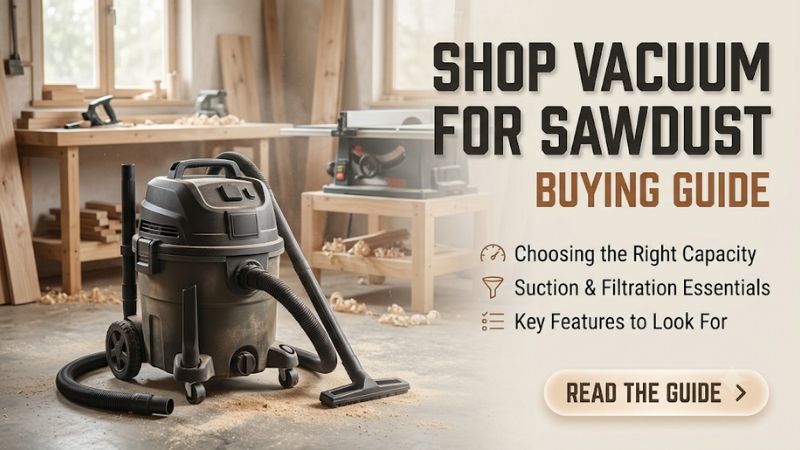
This shop vacuum for sawdust buying guide explains how to choose equipment for cleaning woodworking debris and controlling fine dust around power tools. Tank size, airflow, water lift, hose diameter, filtration, collection bags, and dust-separation accessories all affect performance. Understanding these characteristics helps homeowners build a cleaner workshop without relying on misleading horsepower claims.
What Should You Look for in a Shop Vacuum for Sawdust?
The most important question is how the vacuum will be used.
A woodworking hobbyist who primarily cleans visible sawdust from the floor may need a conventional wet/dry shop vacuum with a relatively large hose.
Someone using a random-orbit sander may require a dust extractor with appropriate filtration, a flexible hose, and automatic power-tool activation.
A workshop using a planer or jointer may require a larger high-airflow dust collector rather than an ordinary shop vacuum.
These tasks create different demands.
The ideal vacuum should provide adequate airflow through the actual hose and accessory, not simply advertise a large motor.
It should also capture particles without releasing unacceptable fine dust into the workspace.
The most important buying criteria are airflow, suction pressure, filtration, collection capacity, hose design, accessory compatibility, and maintenance convenience.
Understand Different Types of Woodworking Debris
Large Wood Chips
Planers, jointers, and certain cutting operations generate substantial quantities of wood chips.
These particles are relatively large and can quickly fill a vacuum drum.
A wide hose and high-volume collection system may be beneficial.
However, a conventional shop vacuum may not provide the airflow required by large stationary machines.
Check the woodworking equipment manufacturer’s requirements.
Ordinary Sawdust
Table saws, miter saws, and circular saws generate visible sawdust.
A suitable wet/dry vacuum can often collect settled debris.
However, some of the dust may become airborne before it reaches the floor.
Effective source capture is more protective than cleanup alone.
Fine Sanding Dust
Sanding generates fine particles that can remain suspended in the air.
A conventional vacuum with an unsuitable filter may allow some particles to escape.
This makes filtration and sealing important.
A purpose-built extractor may be more appropriate than a basic shop vacuum.
Engineered-Wood Dust
MDF, particleboard, and other engineered products can generate fine dust.
The material may also contain binders or coatings that create additional exposure concerns.
Follow the material manufacturer’s handling guidance.
Use appropriate extraction and respiratory protection.
Finished or Coated Wood
Sanding existing finishes can disturb paint, varnish, or other coatings.
Some older coatings may contain hazardous substances.
Do not assume ordinary sawdust controls are sufficient for every material.
Identify the coating before disturbing it.
Understand CFM
What CFM Means
CFM stands for cubic feet per minute.
It measures airflow volume.
Airflow is important for carrying chips and dust through a hose.
However, the number advertised by a manufacturer may be measured with minimal resistance.
Actual airflow at the tool can be lower.
Why Airflow Matters
Dust must be transported from the collection point through the hose to the vacuum.
Insufficient airflow can allow debris to settle inside the hose.
This can create clogs and reduce performance.
Airflow at the Tool
The relevant performance is airflow through the actual tool connection.
Long hoses, small ports, sharp bends, and loaded filters introduce resistance.
A high advertised CFM figure does not guarantee high airflow at every accessory.
Comparing CFM Ratings
Manufacturers may use different test methods.
Compare figures cautiously.
Look for credible independent measurements under similar conditions.
CFM and Large Woodworking Machines
Stationary machines with large dust ports often require much higher airflow than conventional shop vacuums provide.
A dedicated dust collector may be necessary.
Do not assume an adapter makes an undersized vacuum suitable.
Understand Water Lift
What Water Lift Measures
Water lift describes suction pressure under specified test conditions.
It reflects the vacuum’s ability to create a pressure difference.
Why Pressure Matters
Hoses and tools create airflow restrictions.
A vacuum must generate sufficient pressure difference to move air through them.
Water Lift Versus Airflow
High water lift does not automatically mean high airflow.
Both characteristics matter.
Small Tool Ports
A smaller dust port may create more resistance.
Vacuum designs with suitable suction characteristics can be useful for handheld tools.
However, the complete tool and hose system must be evaluated.
Interpreting Specifications
Do not rank vacuums using water lift alone.
Consider airflow, filtration, hose design, and intended use.
Why Peak Horsepower Can Mislead Buyers
What Peak Horsepower Means
Peak horsepower is a marketing specification used by some wet/dry vacuum manufacturers.
It is generally based on particular motor test conditions.
It does not represent sustained operating horsepower during ordinary vacuuming.
Why It Does Not Determine Suction
A vacuum’s collection performance depends on motor design, fan geometry, airflow path, filter loading, and hose resistance.
A larger peak horsepower label does not guarantee better pickup at the tool.
Better Performance Indicators
Airflow and water lift provide more useful information when measured consistently.
However, neither is sufficient alone.
Compare Complete Systems
A well-designed extractor with a suitable hose and filter may outperform a general-purpose vacuum for fine dust, even if its advertised horsepower is lower.
Choose the Right Tank Capacity
Small Portable Tanks
Two- to four-gallon vacuums are convenient for quick cleanup.
However, they fill rapidly with bulky debris.
Five- to Six-Gallon Tanks
These provide a practical compromise for small workshops.
They are manageable and relatively easy to store.
Nine- to Twelve-Gallon Tanks
Medium-capacity vacuums are useful for regular shop cleanup.
They reduce emptying frequency.
However, they require more storage space.
Sixteen-Gallon and Larger Tanks
Large drums suit substantial debris collection.
They may be less convenient in small workshops.
Usable Capacity
Nominal tank volume does not equal the volume available during operation.
Filters, bags, and automatic shutoff mechanisms affect usable capacity.
Choose the Correct Hose Diameter
Narrow Hoses
Narrow hoses are flexible and convenient for handheld tools.
However, they can clog with large shavings.
Intermediate Hoses
One-and-three-eighths-inch and one-and-seven-eighths-inch hoses provide compromises between flexibility and debris transport.
Large Hoses
Two-and-one-half-inch hoses are useful for bulky shop debris.
However, they are less convenient for lightweight sanders.
Hose Adapters
Adapters can connect different port sizes.
However, they do not create additional airflow.
A small port remains a restriction.
Hose Length
Long hoses increase working reach.
They also introduce friction and resistance.
Choose only as much length as needed.
Hose Material
A suitable hose should resist collapse and abrasion.
For certain dust-extraction systems, anti-static hose configurations may be relevant.
Use manufacturer-approved components.
Understand Filtration Systems
Standard Filters
General-purpose filters capture ordinary debris.
However, fine-particle performance varies.
Fine-Dust Filters
Fine-dust filters are intended for smaller particles.
Their performance depends on the filter and vacuum design.
HEPA Filters
HEPA filters are designed for high-efficiency particulate capture under specified conditions.
However, the complete system must be appropriately sealed.
Why Sealing Matters
Air can bypass a filter through gaps or damaged seals.
A high-efficiency filter is insufficient if contaminated air escapes elsewhere.
Collection Bags
Dust bags can reduce filter loading and simplify disposal.
However, they must be compatible with the machine.
Filter Loading
Dust accumulation increases resistance.
This reduces airflow.
Clean or replace filters as instructed.
Automatic Filter Cleaning
Some extractors periodically clear dust from filter surfaces.
This helps maintain performance under suitable operating conditions.
However, maintenance is still necessary.
HEPA Vacuum Versus Ordinary Shop Vacuum
Different Intended Uses
Ordinary shop vacuums are designed for general debris.
HEPA dust extractors emphasize fine-particle containment.
Filtration Claims
A HEPA replacement filter does not automatically certify the entire vacuum.
Look for documentation about the complete system.
Health Considerations
Fine wood dust can create respiratory exposure hazards.
Source capture is important.
When Specialized Equipment Is Necessary
Some materials and regulatory environments require specifically rated extraction systems.
Follow applicable workplace requirements.
Practical Home Use
A homeowner can improve dust control using appropriate filtration and bags, but should avoid assuming that any standard vacuum is suitable for hazardous particles.
Connecting Vacuums to Woodworking Machines
Random-Orbit Sanders
Sanding generates fine airborne particles.
A suitable extractor connected directly to the sander can improve capture.
Belt Sanders
Belt sanders can generate substantial dust.
Choose a suitable hose and collection system.
Track Saws
Track saws often include dust ports.
A compatible extractor can help collect cutting debris.
Circular Saws
Portable circular saws may produce dust that escapes around the blade.
Extraction effectiveness depends on the saw’s design.
Miter Saws
Miter saws can create challenging dust patterns.
A factory dust port may not capture everything.
Table Saws
Some portable table saws can use compatible vacuums.
Larger machines may need dedicated high-airflow collection.
Routers
Routers generate dust and chips.
Use compatible dust shrouds and hoses.
Planers and Jointers
These machines produce large volumes of chips.
Dedicated dust collectors are often more appropriate.
Evaluate Power-Tool Activation
How Automatic Activation Works
Some extractors include an electrical outlet for compatible power tools.
The vacuum starts when the connected tool is activated.
Why It Helps
Automatic activation reduces the chance of forgetting to switch on extraction.
Electrical Limits
The outlet has a maximum permitted load.
Do not exceed it.
Delayed Shutdown
Some extractors continue running briefly after the tool stops.
This can help clear remaining dust from the hose.
Cordless Tool Compatibility
Automatic activation through a standard power outlet does not necessarily work with cordless tools.
Specialized wireless systems may be required.
Understand Cyclone Separators
What a Cyclone Does
A cyclone separator removes some debris from the airflow before it reaches the vacuum.
Why It Helps
It can reduce filter loading and extend maintenance intervals.
Large Wood Chips
Cyclones are especially useful when collecting substantial chips.
Fine Dust
Fine particles may still reach the final filter.
A separator does not replace filtration.
System Resistance
A cyclone creates additional airflow resistance.
Poorly designed setups can reduce effective suction.
Container Strength
The collection container must withstand the pressure conditions.
An unsuitable bucket may collapse.
Space Requirements
A separator adds another container.
Evaluate storage space.
Corded Versus Cordless Vacuums
Corded Advantages
Corded models provide sustained power.
They are useful for long tool-connected extraction sessions.
Corded Limitations
Power cords create routing and trip hazards.
Use appropriate electrical connections.
Cordless Advantages
Cordless vacuums are portable.
They are convenient for quick cleanup.
Cordless Limitations
Battery runtime is finite.
Continuous extraction may require spare batteries.
Battery Platform Compatibility
Existing batteries can reduce purchase cost.
Use approved packs.
Which Is Better for Woodworking?
For continuous sanding and tool extraction, a corded extractor is often practical.
For mobile cleanup, cordless equipment can be convenient.
Noise and Workshop Comfort
Why Noise Matters
Vacuums can operate for extended periods during woodworking.
Noise affects comfort and exposure.
Decibel Ratings
Manufacturers may publish dB(A) values.
However, test methods differ.
Hearing Protection
Appropriate hearing protection may be needed when multiple machines operate together.
Vibration
Vacuum motors and airflow may create vibration.
Place the unit on a stable surface.
Location
Position the vacuum where it will not block walkways or interfere with tool operation.
Maintenance and Filter Care
Inspect the Hose
Check for clogs, cracks, and damaged connections.
Empty the Drum
Do not allow debris to obstruct the filter or airflow path.
Replace Bags
Follow the manufacturer’s replacement recommendations.
Clean Filters
Use approved cleaning procedures.
Avoid shaking dusty filters indoors.
Check Seals
Damaged seals can reduce suction and filtration effectiveness.
Store Accessories Properly
Keep hoses and nozzles organized.
Avoid sharp bends.
Wet Pickup
Use the correct filter configuration.
Do not collect wet debris using unsuitable dry-dust equipment.
Dust Safety in the Woodworking Shop
Source Capture
Collect dust where it is produced whenever practical.
Avoid Blowing Dust
Compressed air and blower ports can resuspend fine particles.
Maintain Ventilation
Appropriate ventilation can support dust control.
However, it is not a substitute for source capture.
Respiratory Protection
Use suitable respiratory protection when required by the material and exposure conditions.
Fire Risk
Wood dust accumulation can create fire hazards.
Avoid ignition sources.
Unknown Materials
Do not collect hazardous debris using an ordinary vacuum without verifying that the equipment is appropriate.
Clean Disposal
Use a collection method that minimizes dust release.
Common Buying Mistakes
Choosing by Horsepower Alone
Peak HP is not sustained operating power.
Ignoring Hose Compatibility
A vacuum that cannot connect properly to the tool may provide poor source capture.
Buying Too Large a Drum
Large models can be inconvenient in small shops.
Buying Too Small a Drum
Small models fill rapidly with shavings.
Ignoring Replacement Filter Costs
Filters and bags are recurring expenses.
Assuming HEPA Filters Make Any Vacuum HEPA-Rated
The complete sealed system matters.
Using a Shop Vacuum Instead of a Dust Collector
Some stationary tools need much greater airflow.
Neglecting Maintenance
Loaded filters reduce performance.
Frequently Asked Questions
What CFM should a shop vacuum have for sawdust?
The required airflow depends on the hose, tool, debris type, and dust-collection arrangement. Higher advertised CFM alone does not guarantee effective capture.
Does a larger shop vacuum collect more sawdust?
A larger drum holds more debris, but collection performance depends on airflow and suction.
Is a HEPA filter worth buying?
Appropriate HEPA filtration can be important for fine particles, but the complete vacuum system must provide adequate containment.
Can I use a shop vacuum with a router?
Yes, if the router has a suitable dust-collection connection and the vacuum meets its requirements.
Does a cyclone separator improve suction?
A separator may reduce filter loading, but it also introduces resistance. Its effect depends on system design.
How often should I replace vacuum filters?
Follow manufacturer guidance and replace filters when damaged, excessively loaded, or no longer effective.
Conclusion
This shop vacuum for sawdust buying guide recommends matching collection equipment to the dust source rather than choosing by tank size or peak horsepower alone. A conventional shop vacuum is useful for ordinary woodworking cleanup, while a purpose-built extractor with appropriate filtration is preferable for many fine-dust applications. Large stationary machines may require dedicated dust collection. Prioritize source capture, compatible hoses, correct filters, and safe disposal procedures.
More from Amazon
Programs that pair well with the guide above. Offers and eligibility are set by Amazon and may change.
Collect the home and kitchen items you want in one registry that guests can shop from.
Create a wedding registrySet up recurring deliveries of everyday items on eligible products. Terms and savings are set by Amazon.
Explore Subscribe & SaveFree shipping on eligible items, Prime Video and more. Eligible new members can start with a free trial.
Start a Prime free trialAudiobooks and podcasts to listen to on the go. Eligible new members can start with a free trial.
Try Audible freeAs an Amazon Associate we earn from qualifying purchases.