Key takeaways
- A dedicated white noise machine is worth considering when you prefer steady background sound and want simple, dependable playback without using a phone. It may make some intermittent noises less noticeable by reducing the contrast between those disturbances and the surrounding sound.
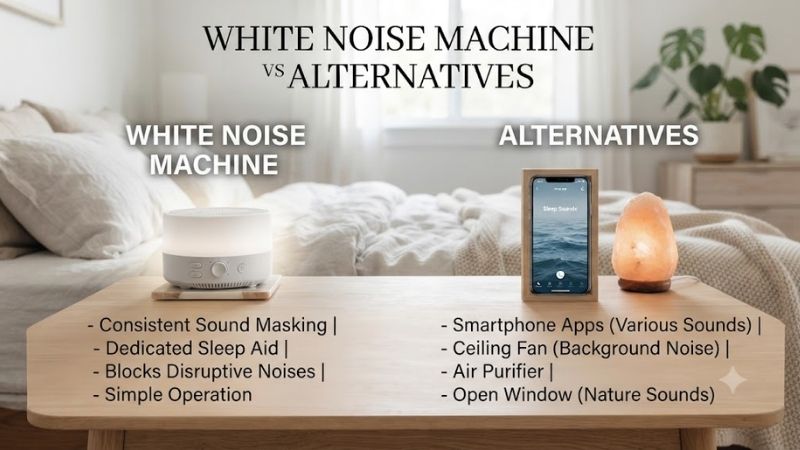
White noise machine vs alternatives is a comparison of different ways to manage disruptive bedroom sounds. Dedicated machines provide consistent background audio, while fans, smartphone apps, earplugs, headphones, and physical noise-control improvements work differently. This guide explains sound masking, comfort, cost, and safety so you can choose an approach that fits your room and sleeping habits.
Quick Verdict: Do You Need a Dedicated White Noise Machine?
A dedicated white noise machine is worth considering when you prefer steady background sound and want simple, dependable playback without using a phone. It may make some intermittent noises less noticeable by reducing the contrast between those disturbances and the surrounding sound.
However, a dedicated machine is not essential for everyone.
An ordinary fan may be sufficient if its sound is pleasant and its airflow is welcome. A smartphone app can be a low-cost way to discover preferred sounds. Earplugs may be more appropriate for someone who wants less sound entering the ears rather than additional background audio.
When loud traffic or neighbors are the main problem, improvements to doors, windows, or building acoustics may offer more meaningful results than increasing a masking machine’s volume.
| Alternative | Main function | Potential advantage | Main limitation |
|---|---|---|---|
| Dedicated white noise machine | Produces consistent masking audio | Simple controls and predictable use | Adds sound rather than blocking it |
| Room fan | Air movement and fan noise | Can provide two useful functions | Airflow, maintenance, and seasonal suitability |
| Smartphone white noise app | Plays or generates audio | Low initial cost | Notifications, battery, and speaker limitations |
| Earplugs | Reduce sound reaching the ears | No added room noise | Fit, hygiene, and hearing-alert considerations |
| Sleep headphones | Personal audio playback | Less sound shared with others | Comfort and listening-level concerns |
| Air purifier | Filters air and produces operating noise | Air filtration when appropriate | Sound is secondary and variable |
| Door and window improvements | Reduce sound transmission | Addresses part of the underlying problem | Cost and installation |
| Quiet-room strategies | Remove or relocate noise sources | Can reduce noise without extra audio | Not all sources are controllable |
The best approach depends on whether you want to mask noise, reduce your exposure to it, or make the source quieter.
How White Noise Machines Work Differently From Noise Reduction
White noise machines do not remove sound from the bedroom.
They add a relatively steady background signal that can make some unpredictable disturbances less prominent.
For example, a faint sound from an apartment hallway may stand out sharply against a quiet bedroom. Introducing a gentle, steady background may make that sound less noticeable.
However, the external sound still exists. A loudly closing door, barking dog, or construction tool can remain audible.
Masking Changes Perception, Not the Structure of the Room
Sound masking works by changing the acoustic background against which another sound is heard.
The effect depends on the frequencies, loudness, and timing of both signals.
A constant hiss might mask certain high-frequency noises but do relatively little for a deep, loud vibration. A lower-frequency sound profile may feel more comfortable to some listeners, yet it does not guarantee effective masking of every disturbance.
This is why buying the loudest available machine is not a reliable solution.
The right goal is comfortable masking, not overpowering every external noise.
Soundproofing Works at a Different Stage
Physical noise-control measures attempt to reduce how sound travels through walls, windows, doors, and other structures.
Properly installed weatherstripping or door seals may reduce sound passing through certain gaps.
However, low-frequency noise transmitted through the building structure can require much more substantial work.
A white noise machine cannot correct a major acoustic weakness in a wall. It may only make some resulting noise less noticeable.
White Noise Machine vs Room Fan
A fan is one of the closest substitutes for a dedicated white noise machine because it can create a continuous sound from physical airflow.
For someone who already enjoys sleeping with a fan, buying a second device may offer little benefit.
However, fan operation and dedicated sound production are not identical.
Sound Character
A physical fan produces noise through the motor, moving blades, airflow, and surrounding structures.
Some people enjoy this natural variation.
A dedicated digital machine may reproduce recorded fan sounds or generate noise electronically.
The experience can be similar, but the sound character depends on the device.
A mechanical white noise machine also uses a physical mechanism, although it may be intended primarily for sound rather than room ventilation.
Air Movement
A room fan creates airflow, which can influence thermal comfort.
That is an advantage when the room feels warm.
However, unwanted airflow may be uncomfortable in cooler conditions or when directed toward the bed.
A dedicated white noise machine separates the sound preference from actual air movement.
This can be useful when someone enjoys fan noise throughout the year but does not want an operating room fan every night.
Sound Consistency
Fan noise may change with speed settings, oscillation, or mechanical vibration.
A dedicated sound machine may provide a more stable electronically generated signal.
However, some digital devices use recordings with audible loops, so consistency cannot be assumed from the category alone.
Energy and Maintenance
A fan and a small sound machine may have different electricity requirements depending on their design and operating settings.
Do not assume one always consumes less power without comparing rated consumption.
Fans also require cleaning because dust can accumulate on grills and blades.
Which Is Better?
Choose a fan when you want both airflow and a comfortable background sound.
Choose a dedicated white noise machine when you want consistent sound independently of room temperature or air movement.
White Noise Machine vs Smartphone App
A smartphone app is often the easiest way to experiment with white, pink, or brown noise without buying separate hardware.
Many phones can play recorded ambient audio or generate background sounds through software.
However, the phone is also a communication device, which can complicate bedtime use.
Cost and Flexibility
A basic app may provide enough audio options to determine whether background noise feels comfortable.
This is especially useful for someone who has never used white noise.
Some apps include paid sound libraries or subscriptions, so the actual long-term cost varies.
Before purchasing a dedicated device, trying a simple app can help identify whether the concept is useful.
Notifications and Interruptions
A phone may receive calls, notifications, software updates, and other alerts.
These can interrupt the listening experience unless settings are managed carefully.
Some apps also behave differently when the phone locks, the battery becomes low, or another application begins playing audio.
A dedicated sound machine avoids many of these general smartphone interruptions.
Speaker Quality
A phone’s small speakers have limited acoustic capabilities, particularly at lower frequencies.
This can affect the sound of brown noise or deep fan simulations.
A dedicated machine may offer a different speaker profile, though a higher-priced sound machine is not automatically superior.
Keeping the Phone Away From Bed
Some people prefer a bedroom routine with fewer phone interactions.
A dedicated device with physical controls can support that preference.
However, it creates another object on the nightstand and requires its own power arrangement.
Which Is Better?
Choose an app when you want to experiment inexpensively or travel without extra hardware.
Choose a dedicated machine when you want predictable offline operation and easy bedside controls.
White Noise Machine vs Earplugs
Earplugs operate differently from white noise machines.
Rather than introducing more sound into the room, they reduce some of the sound reaching the ears.
That makes them especially relevant when the user dislikes background noise itself.
Passive Sound Reduction
Properly fitted earplugs can reduce exposure to certain environmental sounds.
The actual attenuation depends on earplug design, fit, frequency, and how they are inserted.
A product’s published noise reduction rating does not automatically equal the reduction achieved by every individual in normal use.
An incorrectly fitted earplug may provide much less attenuation than expected.
Comfort During Overnight Use
Some users find foam earplugs comfortable.
Others experience pressure, irritation, or difficulty keeping them in place.
Reusable silicone or other designs may feel different, but material preference is individual.
Earplugs should be kept clean and used according to their instructions.
Hearing Important Alerts
Reducing external sound can make alarms, caregiving needs, or safety signals harder to notice.
A person who must remain aware of certain sounds should consider this before using earplugs.
A white noise machine can also mask alerts when played too loudly, so neither approach is free of trade-offs.
Can You Combine Earplugs and White Noise?
Some people use both, but adding background sound while reducing sound at the ears is not automatically necessary.
The combination should be assessed for comfort and appropriate sound exposure.
Avoid continually increasing the volume to overcome the earplugs.
Which Is Better?
Choose earplugs when your main goal is reducing external sound and you tolerate them comfortably.
Choose a white noise machine when steady background audio feels preferable to quieter listening.
White Noise Machine vs Sleep Headphones
Sleep headphones allow personal audio playback closer to the listener’s ears.
They may be appealing in shared bedrooms where a room-wide sound machine would disturb another person.
However, placing a speaker near the ears changes both comfort and sound-exposure considerations.
Personal Listening
Headphones can provide a relatively private audio experience, depending on their design and volume.
That may be useful for roommates or couples with different sound preferences.
However, many products allow some audible leakage.
Privacy should not be assumed without considering the specific device.
Sleeping-Position Comfort
Over-ear headphones may be uncomfortable for side sleeping.
Specialized flat-speaker headbands can reduce bulk, but their fit and pressure still vary.
A product that feels comfortable while sitting may become irritating after several hours against a pillow.
Sound Exposure
Audio played directly near the ears should remain at a comfortable, conservative volume.
Continuous loud playback can introduce unnecessary hearing risk.
Do not use maximum output merely to drown out environmental disturbances.
Charging and Maintenance
Wireless headphones require charging and may include batteries near the head.
Fabric headbands may need regular cleaning.
Check product instructions and avoid damaged electrical components.
Which Is Better?
Choose sleep headphones when personal audio is important and the device is comfortable in your preferred sleeping position.
Choose a white noise machine when you want room-wide background sound without wearing equipment.
White Noise Machine vs Air Purifier
Air purifiers are sometimes used as background sound sources because their fans create a relatively steady noise.
However, their main function is air filtration rather than acoustic masking.
Air Filtration
A properly selected air purifier may help remove certain airborne particles under suitable operating conditions.
Its filtration effectiveness depends on the unit, filter, room size, operating speed, and maintenance.
A white noise machine does not provide this function.
Sound Behavior
Purifier noise can change substantially with fan speed.
Some automatic models adjust speed in response to sensed air conditions, potentially creating noticeable changes during the night.
For sound masking, a stable manual setting may feel more consistent, although the purifier should still be operated according to air-cleaning needs.
Space and Placement
Air purifiers usually require appropriate airflow clearances and may be larger than dedicated sound machines.
Placing one tightly against furniture to save space can impair its intended operation.
A compact white noise machine may be more convenient when only background audio is needed.
Which Is Better?
Choose an air purifier when air filtration is an actual household priority and its operating sound is comfortable.
Choose a dedicated machine when consistent background sound is the only goal.
White Noise Machine vs Physical Soundproofing
When outside noise is substantial, sound masking may become less effective or require uncomfortable volume.
That is a sign to investigate the source rather than automatically purchasing a more powerful speaker.
Door Gaps
Sound can pass through openings around doors.
Suitable sealing measures may reduce some airborne noise transmission.
However, sound can also pass through the door material itself.
A thin hollow-core door cannot necessarily be transformed into a highly sound-isolating barrier through weatherstripping alone.
Windows
Street noise may enter through glazing, frames, or poorly sealed gaps.
Improving seals or using more effective window assemblies may reduce transmission.
Ordinary curtains, even thick blackout curtains, should not be assumed to provide substantial soundproofing.
Shared Walls
Noise transmitted through a shared wall may require more extensive construction changes.
For renters, such work may be impractical.
A white noise machine can be a lower-cost comfort measure, but it does not eliminate the structural source.
Which Is Better?
Choose physical noise-control improvements when the primary problem is substantial transmission through the building and suitable modifications are possible.
Choose masking when disturbances are modest, intermittent, or impractical to eliminate.
Which Option Is Best for Different Noise Problems?
| Main problem | Option worth trying first | Why |
|---|---|---|
| Occasional faint hallway noise | Low-volume masking sound | May reduce perceived contrast |
| Preference for fan sound | Existing room fan | Avoids buying another device |
| Unsure which noise type is comfortable | Smartphone app | Low-cost experimentation |
| Wants less overall sound | Suitable earplugs | Reduces some sound reaching ears |
| Shared bedroom with different preferences | Personal audio with careful volume | Limits room-wide playback |
| Needs cleaner indoor air | Appropriate air purifier | Addresses filtration rather than only sound |
| Loud traffic through gaps | Window or door assessment | Addresses part of the noise source |
| Persistent sleep difficulty without clear noise cause | Appropriate sleep assessment | Background audio may not address cause |
What Does Research Say About White Noise for Sleep?
White noise is frequently promoted as a scientifically proven sleep aid.
However, the research is more mixed than the marketing suggests.
A 2020 systematic review examining continuous white noise and similar broadband sounds found very low-quality evidence supporting general sleep improvement. The review identified considerable variation between studies in sound characteristics, methods, and outcomes.
Some research suggests possible benefits in particular environments, while other findings raise questions about effectiveness or potential disturbance.
Why Evidence Is Inconsistent
Sleep studies use different participants, noise levels, playback durations, and outcome measurements.
A study involving a noisy clinical environment may not apply directly to a quiet home bedroom.
Some participants may prefer steady background sound, while others find continuous audio irritating.
The correct conclusion is not that white noise never helps. It is that universal benefits have not been established.
What This Means for Buyers
Treat a white noise machine as an optional comfort and masking tool.
If it helps you feel less distracted by intermittent noise at a reasonable volume, that may be sufficient to justify using it.
If you sleep better without additional audio, there is no reason to force yourself to use one.
Persistent insomnia, excessive daytime sleepiness, or symptoms suggesting another sleep disorder deserve appropriate evaluation.
Cost and Long-Term Value Comparison
A dedicated sound machine adds one purchase and may require power, charging, or replacement accessories.
A smartphone app may be less expensive initially, but certain subscriptions create recurring costs.
A fan may already be owned, while earplugs can involve repeated replacement or maintenance.
Physical improvements to doors or windows can cost more but address a different part of the problem.
A fair value comparison should consider the underlying need, not simply the device price.
For example, purchasing a premium sound machine to mask a rattling fan may be less useful than repairing or replacing the fan itself.
Common Comparison Mistakes
Assuming White Noise Cancels Sound
Ordinary sound machines mask certain disturbances but do not actively cancel or physically block them.
Increasing Volume Instead of Addressing the Source
A louder machine can become uncomfortable while the original disturbance remains.
Use the lowest comfortable masking level.
Buying Headphones Without Considering Sleep Position
A device that feels acceptable while awake may create pressure against the ear during side sleeping.
Using an Air Purifier Solely as an Expensive Sound Machine
An air purifier’s filtration capability is valuable when needed, but it is unnecessary if only background audio is desired.
Frequently Asked Questions
Is a White Noise Machine Better Than a Fan?
It depends on whether you want airflow. A fan creates physical air movement and sound, while a dedicated machine can provide similar background audio without changing airflow. Choose based on the preferred sound, room temperature, and convenience.
Is a White Noise Machine Better Than Earplugs?
They serve different purposes. A sound machine adds masking audio, while earplugs reduce some sound reaching the ears. Earplugs may be more appropriate when you want quiet; white noise may suit someone who prefers consistent background sound.
Are Phone Apps as Good as Dedicated Machines?
Apps can be entirely sufficient for many users, especially when trying different sounds. Dedicated devices may provide more predictable controls, fewer interruptions, and different speaker characteristics. Neither option automatically improves sleep.
Do White Noise Machines Help With Loud Neighbors?
They may make quieter or intermittent sounds less noticeable, but cannot reliably hide loud music, shouting, or structural vibration. Physical sound-control measures may be more effective when feasible.
Can I Use White Noise and Earplugs Together?
Some people do, but the combination is not automatically necessary. Keep sound at a conservative level and consider whether alarms or important alerts remain audible. Do not increase volume excessively to overcome the earplugs.
Which Alternative Is Best for a Shared Bedroom?
Personal audio or quiet passive sound reduction may be worth considering when one person dislikes room-wide noise. However, headphone comfort, volume, alarm awareness, and both occupants’ preferences matter.
Conclusion
A white noise machine is worth choosing when comfortable background sound helps make intermittent disturbances less noticeable. Fans provide a similar sound with airflow, apps offer inexpensive experimentation, earplugs reduce incoming sound, and sleep headphones provide more personal playback. When noise enters through major building gaps, physical improvements may be more effective than masking. Choose the least intrusive solution that addresses the actual noise problem.