Key takeaways
- Blackout curtains are a strong starting option for bedrooms where darkness and flexible installation matter. A sufficiently opaque fabric combined with adequate side, top, and center coverage can reduce substantial incoming light.
Bedroom blackout curtains vs alternatives is a comparison of light control, window coverage, installation, and everyday convenience. Blackout curtains can create a darker sleeping environment, but roller shades, cellular shades, blinds, shutters, and window films offer different advantages. This guide explains which options suit daytime sleepers, renters, compact bedrooms, and households concerned about insulation.
Quick Verdict: Are Blackout Curtains the Best Choice?
Blackout curtains are a strong starting option for bedrooms where darkness and flexible installation matter. A sufficiently opaque fabric combined with adequate side, top, and center coverage can reduce substantial incoming light.
However, curtains are not automatically superior to every alternative.
A fitted blackout roller shade can provide a compact appearance and straightforward daily operation. Cellular shades offer an additional insulation-oriented design. Shutters provide durable light adjustment, while blinds are useful when occupants want to control incoming daylight without fully opening the window treatment.
For highly light-sensitive sleepers, a layered system may outperform a single curtain or shade.
| Window treatment | Main advantage | Main limitation | Best starting buyer |
|---|---|---|---|
| Blackout curtains | Broad fabric coverage and decorative flexibility | Perimeter gaps and fabric bulk | Wants darkness and soft furnishings |
| Blackout roller shades | Compact, simple operation | Side gaps can remain | Wants minimal window treatment |
| Cellular blackout shades | Light control plus insulating cell structure | Fit and installation quality matter | Values energy performance |
| Roman blackout shades | Decorative folded fabric | Bulky folds and potential edge gaps | Wants tailored appearance |
| Venetian blinds | Adjustable daylight and privacy | Slat gaps limit full darkness | Wants daytime light control |
| Plantation shutters | Durable adjustable panels | Higher cost and frame requirements | Permanent homeowner installation |
| Window film | Changes glazing behavior without bulky coverings | Usually cannot provide adjustable complete blackout | Glare or privacy management |
| Layered shade and curtain | Addresses different leakage paths | Higher cost and complexity | Daytime sleeper needing stronger darkness |
The best choice depends on whether darkness, insulation, daytime flexibility, or visual simplicity is the primary goal.
Why Blackout Fabric Alone Does Not Guarantee a Dark Bedroom
The most important distinction in this comparison is between blocking light through a material and preventing light from entering around the window treatment.
A curtain fabric may be effectively opaque, yet noticeable light can still enter above the rod, beside the panels, or through the center opening.
Roller shades and cellular shades have similar installation-related concerns. The fabric itself may block transmitted light, but the housing and side clearances can leave visible strips.
Consequently, complete window coverage often matters more than one isolated material claim.
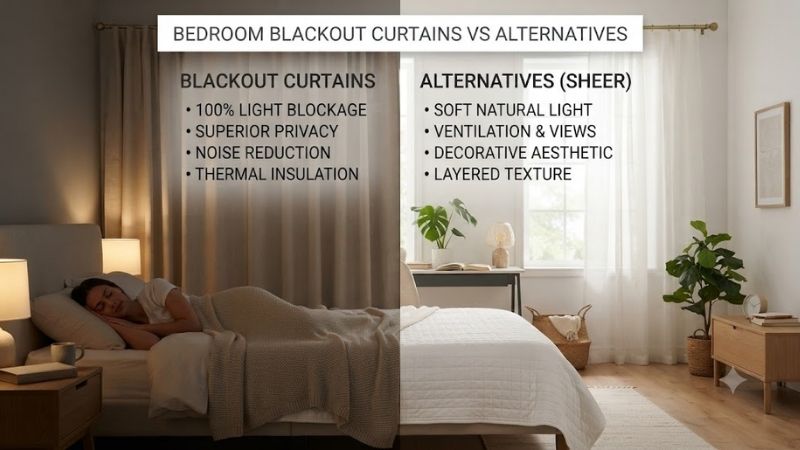
Fabric Opacity Versus Installed Darkness
Fabric opacity describes the amount of light transmitted through the material under particular conditions.
Installed darkness describes what reaches the room after the fabric, hardware, mounting method, and surrounding gaps are considered.
Those are different performance questions.
A manufacturer advertising 100% blackout fabric may be describing the panel material rather than guaranteeing total darkness in every bedroom.
A buying decision should consider both the material and the proposed installation.
Side Gaps Are Often the Weakest Point
Bright sunlight can enter through relatively narrow openings.
A curtain rod mounted exactly within the width of the window may allow light around the edges.
Similarly, an inside-mounted roller shade generally requires operating clearance, which can create side gaps.
Wraparound rods, wider outside mounting, suitable side channels, or layered window treatments can reduce some of these problems.
The appropriate solution depends on the window’s geometry.
Blackout Curtains vs Blackout Roller Shades
This is one of the closest comparisons because both options can use highly opaque materials.
Their main differences involve appearance, compactness, movement, and edge coverage.
Fabric Coverage
Blackout curtains can extend beyond the window frame when adequate wall space is available.
That makes it possible to cover more of the surrounding area.
A roller shade generally follows a defined rectangular path and may fit within or outside the window opening.
An inside-mounted roller shade can leave side gaps because the fabric is slightly narrower than the recess.
Outside mounting may reduce these gaps, but sufficient overlap is needed.
Space and Appearance
Roller shades occupy relatively little space when raised.
This makes them attractive for compact bedrooms, kitchen-adjacent sleeping areas, and windows above desks.
Curtains require space for fabric to hang and stack when open.
However, curtains can soften the appearance of a room and provide a decorative element that a simple roller shade does not.
Everyday Operation
A roller shade can be convenient when the user wants a clean, quick movement.
Curtains provide flexible panel opening but can require a longer rod and more handling.
Operating cords or chains deserve particular attention in homes with children. Cordless designs should be prioritized.
Which Is Better?
Choose blackout curtains when broad coverage and fabric appearance matter.
Choose a suitable blackout roller shade when a compact, minimal installation is the primary goal.
For demanding darkness, compare edge coverage rather than assuming either category always wins.
Blackout Curtains vs Cellular Shades
Cellular shades have a pleated structure that forms air pockets or cells.
These cells can reduce certain heat-transfer pathways through the window area.
Some cellular shades incorporate blackout materials, offering both light control and an insulation-oriented construction.
This makes them a particularly relevant alternative for bedrooms with uncomfortable window temperatures.
Thermal Performance
The cell structure creates spaces that can limit heat movement through the window covering.
The US Department of Energy has identified well-fitted cellular shades as a useful window-efficiency measure.
However, results vary with cell design, material, installation, window type, and climate.
A cellular shade should not be assumed to reduce heating or cooling costs by a particular amount in every household.
Darkness
Blackout cellular shades can offer strong fabric light blocking.
However, light may still enter around the sides or headrail.
Certain systems provide side channels or other features intended to improve coverage.
A cellular shade without appropriate edge management can still leave a bedroom brighter than expected.
Appearance and Maintenance
Cellular shades fold compactly when raised.
This can be convenient above desks or furniture.
However, their pleated structure may collect dust and require specific cleaning methods.
Replacing an unusually sized cellular shade can also cost more than purchasing standard curtain panels.
Which Is Better?
Choose cellular shades when insulation and compact appearance are important.
Choose blackout curtains when broader decorative coverage and flexible fabric replacement are priorities.
A combination may be worthwhile for a particularly bright or drafty bedroom, provided it can be installed safely.
Blackout Curtains vs Venetian Blinds
Venetian blinds use horizontal slats that tilt to control incoming light and privacy.
Their main strength is adjustability.
They are usually less effective at creating near-total darkness because gaps remain between slats or around cords and support components.
Daytime Light Control
Blinds allow a person to admit some daylight while reducing direct visibility.
For a bedroom used as a home office during the day, that flexibility can be useful.
Curtains generally offer less precise partial light control, although sheer-and-blackout layered systems can provide several modes.
Nighttime Darkness
Even when tilted closed, blind slats may allow light to pass through small openings.
This becomes noticeable when bright streetlights or early morning sunlight strike the window.
A person who sleeps during daylight hours may find ordinary blinds inadequate.
Cleaning
Slatted blinds collect dust across numerous horizontal surfaces.
Cleaning each slat can take time.
Curtains have different maintenance demands, including occasional fabric laundering.
Which Is Better?
Choose blinds when adjustable daylight is the priority.
Choose blackout curtains when stronger darkness and wider window coverage matter.
If you already own blinds, adding opaque curtains may be more economical than replacing the entire window treatment.
Blackout Curtains vs Roman Shades
Roman shades use fabric that folds into sections when raised.
They can offer a tailored appearance while incorporating blackout lining.
The key differences from curtains involve fabric movement and how much space the treatment occupies.
Appearance
Roman shades create a structured, decorative finish that suits certain bedroom styles.
Curtains generally form vertical folds and cover more wall area.
A Roman shade can be attractive where a narrow window does not have sufficient side space for curtain stacks.
Light Leakage
Blackout lining can reduce transmission through the shade fabric.
However, edge gaps may remain, particularly with inside mounting.
The shade’s folds and headrail arrangement also affect coverage.
Cleaning and Hardware
Roman shades can have more complex lifting mechanisms than a basic curtain panel.
Their care requirements depend on the fabric, lining, and hardware.
In homes with young children, cordless designs are particularly important.
Which Is Better?
Choose Roman shades for a tailored appearance and compact window coverage.
Choose blackout curtains for flexible drape and potentially broader overlap around the window.
Blackout Curtains vs Shutters
Interior shutters use rigid panels with adjustable louvers or solid sections.
They are often selected for permanent home installations where durability and architectural appearance matter.
Daylight Adjustment
Adjustable shutter louvers provide control over light and privacy.
This can be useful in bedrooms that serve several functions throughout the day.
However, gaps between louvers and around panels can allow light transmission even when closed.
Darkness
Ordinary louvered shutters do not necessarily provide complete blackout.
A strongly light-sensitive sleeper may still need an additional opaque window treatment.
Cost and Permanence
Shutters generally involve more significant installation and a higher initial investment than many standard curtain sets.
That can be worthwhile for homeowners who want a long-term architectural treatment.
For renters or people expecting to move, portable curtain hardware may be more practical.
Which Is Better?
Choose shutters for permanent styling and adjustable daylight.
Choose blackout curtains when strong darkness and easier replacement matter more.
Blackout Curtains vs Window Film
Window film is applied to glazing to alter how the window transmits or reflects light, heat, or visibility.
Some films reduce glare, some emphasize privacy, and others are designed for solar control.
However, these functions should not be confused with a removable blackout covering.
Glare Reduction
Certain window films reduce visible light and glare.
This can improve comfort in rooms exposed to strong sunlight.
However, a film that reduces incoming light may still transmit enough for a bedroom to remain bright.
Privacy
Reflective privacy films may behave differently during the day and at night depending on relative lighting conditions.
A film that limits visibility from outside during daylight may not provide equivalent nighttime privacy when the room is brightly lit.
Check the exact product’s performance description.
Complete Darkness
An opaque film can block more light, but it may also prevent useful daylight unless removed.
That is a major trade-off compared with curtains or shades that can be opened daily.
Which Is Better?
Choose appropriate film when glare or solar performance is the main objective.
Choose blackout curtains or shades when adjustable nighttime and daytime privacy and darkness are important.
Which Alternative Is Best for Shift Workers?
People sleeping during the day often need stronger darkness than those who simply want to reduce early sunrise glare.
For this use case, perimeter light leakage becomes particularly important.
A Layered Treatment Often Makes Practical Sense
Consider a hypothetical bedroom with a standard rectangular window.
An inside-mounted blackout shade may block transmitted light but leave narrow strips at the sides.
Adding sufficiently wide opaque curtains on a wraparound rod can cover much of the surrounding frame.
This can reduce the importance of any one treatment’s weakest edge.
However, the result depends on actual mounting, overlap, and room geometry.
Temperature Matters Too
Daytime sleeping may occur during warmer exterior conditions.
Blocking direct sunlight can help reduce some solar heat gain, but the room’s temperature still depends on the window, insulation, ventilation, and heating or cooling system.
Do not assume a curtain or shade can replace effective room-temperature control.
Choosing for Small Bedrooms and Rentals
A small room may not have enough wall space for a wide curtain rod, or a desk may sit immediately beneath the window.
In that situation, compact shades can be practical.
However, the decision should not overlook installation permissions or child safety.
Dorm Rooms
Dormitory housing may restrict drilling.
A compatible renter-friendly mounting solution can be considered, but the hardware must support the actual treatment.
Do not suspend heavy curtains from an inadequately rated tension rod.
Studio Apartments
A simple roller or cellular shade can keep the window visually compact during the day.
Curtains may provide a softer, more finished appearance.
Choose according to furniture placement and how often the window needs to be opened.
Homes With Young Children
Corded window treatments present strangulation hazards.
The CPSC recommends cordless coverings wherever young children are present.
This is a safety requirement to prioritize regardless of the desired darkness or decorative style.
Cost and Maintenance Comparison
| Option | Typical ownership consideration | Main maintenance issue |
|---|---|---|
| Blackout curtains | Panels can be replaced individually | Washing and backing care |
| Roller shades | Compact hardware system | Mechanism and fabric cleaning |
| Cellular shades | Specialized insulating structure | Dust and delicate pleats |
| Venetian blinds | Adjustable slats | Frequent slat dusting |
| Roman shades | Decorative fabric and lifting mechanism | Fabric and mechanism care |
| Shutters | Long-term rigid installation | Cleaning louvers and hardware |
| Window film | Applied to glazing | Installation quality and eventual removal |
A lower purchase price does not automatically mean lower installed cost.
Custom sizing, professional mounting, specialty hardware, and future replacement all affect value.
Common Comparison Mistakes
Assuming 100% Blackout Fabric Means 100% Room Darkness
Opaque material cannot stop light entering around the edges.
Evaluate the installed system.
Selecting Blinds for Daytime Sleep Without Checking Gaps
Ordinary slatted blinds allow some light between components.
A blackout shade or curtain may be more appropriate.
Buying Heavy Curtains Without Suitable Hardware
Lined fabric can be heavy.
The rod, anchors, and mounting surface must safely support the installation.
Ignoring Window-Covering Cord Safety
Decorative or convenient controls are not worth introducing an accessible strangulation hazard.
Prioritize cordless systems where children may be present.
Frequently Asked Questions
Are Blackout Curtains Better Than Roller Shades?
Blackout curtains can extend beyond the window frame and provide broad coverage, while roller shades offer a compact appearance. Either can work well if properly installed. Edge leakage, operating convenience, and room layout determine the better choice.
Are Cellular Shades Better Than Blackout Curtains for Insulation?
Well-fitted cellular shades have a specific insulating cell structure and may provide meaningful thermal benefits. Lined curtains can also influence window heat transfer. The relative result depends on installation, materials, and window conditions.
Do Blackout Blinds Block All Light?
Not necessarily. A blackout shade may use opaque fabric while still allowing light around the edges. Venetian blinds also have slat gaps that can remain visible when closed.
Is Window Film a Good Replacement for Blackout Curtains?
Window film may reduce glare and solar transmission but does not necessarily provide adjustable darkness or nighttime privacy. Curtains or shades are generally more practical when the occupant wants to switch between daylight and a dark bedroom.
What Is Best for a Bedroom With a Desk Under the Window?
A compact roller or cellular shade may be practical because it does not require long hanging fabric. If curtains are preferred, choose an appropriate length and mounting method that does not interfere with the desk or nearby equipment.
Do Shift Workers Need Both Blinds and Curtains?
Not always. A well-installed single treatment may be sufficient. However, a layered shade-and-curtain arrangement can help reduce different edge gaps when strong daytime darkness is needed.
Conclusion
Blackout curtains are a strong choice when broad coverage, bedroom styling, and flexibility matter. Roller shades suit compact windows, cellular shades add insulation-oriented construction, blinds provide adjustable daylight, and shutters offer a permanent architectural option. For demanding daytime sleep conditions, prioritize an installation that reduces edge leakage, whether using one treatment or a layered combination. Choose the safest practical system for the room rather than relying solely on blackout fabric claims.