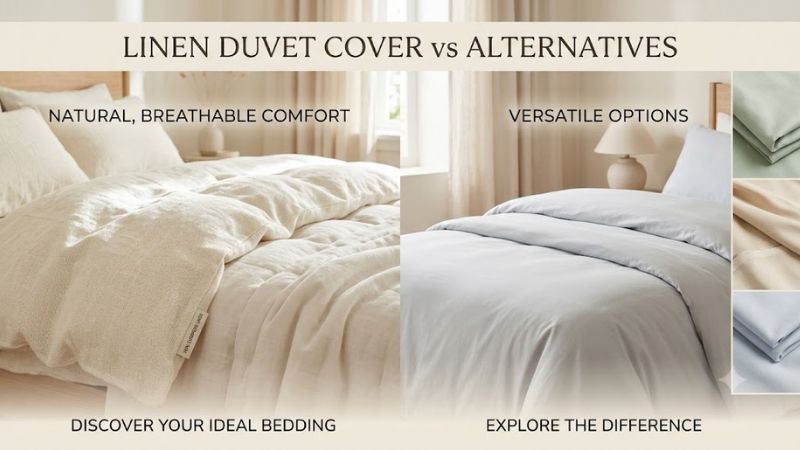
A linen duvet cover offers a distinctive combination of textured fabric, relaxed drape, and casual appearance, but it is only one of several worthwhile bedding materials. Cotton percale provides a crisper surface, cotton sateen creates a smoother finish, bamboo-derived viscose and lyocell offer flowing softness, and microfiber can make duvet covers more affordable. Each alternative changes how the bedding feels, looks, washes, and works with the duvet insert.
Quick Verdict: When Is a Linen Duvet Cover Worth Buying?
Choose a genuine flax linen duvet cover when you enjoy visible fabric texture, a naturally relaxed appearance, and bedding that does not need to look perfectly smooth. Washed linen can feel comfortable from the beginning, while firmer constructions may become more relaxed with laundering. However, linen often costs more than basic cotton or polyester alternatives and naturally develops wrinkles.
Cotton percale is a strong alternative for sleepers wanting crisp, structured bedding. Cotton sateen is more appropriate for those who prefer smoothness and subtle luster. Bamboo-derived viscose and lyocell are attractive when fluid drape is the priority, while microfiber offers a lower-cost alternative.
| Material | Typical surface | Main advantage | Main limitation | Best starting buyer |
|---|---|---|---|---|
| Flax linen | Textured and relaxed | Distinctive casual appearance | Wrinkling and often higher price | Prefers natural texture |
| Cotton percale | Crisp and matte | Structured, familiar cotton feel | Wrinkles and may feel firm initially | Likes crisp bedding |
| Cotton sateen | Smooth and lustrous | Soft, flowing cotton surface | Some constructions feel warmer | Wants smooth cotton |
| Bamboo-derived viscose | Silky and fluid | Smooth drape | Variable laundering requirements | Prefers soft, flowing bedding |
| Lyocell | Smooth and flexible | Comfortable regenerated-cellulose textile | Quality depends on construction | Wants a smooth alternative |
| Polyester microfiber | Smooth or brushed | Accessible pricing | Can feel less comfortable in warm conditions | Budget-focused buyer |
| Linen-cotton blend | Mixed texture and softness | Alternative balance of fabric properties | Blend ratio changes performance | Wants some linen character |
The table describes common textile characteristics, not guaranteed results for every product.
What Makes a Genuine Linen Duvet Cover Different?
Linen is produced from flax fibers. These fibers are processed, spun into yarn, and woven into textile fabric.
The finished material commonly has a more textured surface than smooth cotton sateen or regenerated-cellulose bedding.
However, not every linen product feels the same.
Fiber characteristics, yarn quality, weave density, fabric weight, and finishing influence the final result.
Genuine Flax Linen Versus Linen-Look Fabric
Retailers sometimes use the word linen to describe an appearance rather than actual fiber content.
A polyester product advertised as linen-look may imitate the visual texture of flax linen without containing flax fibers.
That does not automatically make it a poor product, but it should not be evaluated as genuine linen.
Check the fiber composition label.
A cover described as 100% linen should contain linen fibers rather than merely having a textured surface.
Washed Linen Versus Unwashed Linen
Washed linen has undergone finishing intended to relax the fabric.
It often feels softer when new than a comparable untreated construction.
Unwashed linen may feel firmer initially and change with normal laundering.
The appropriate choice depends on whether you enjoy a more substantial texture or prefer bedding that feels relaxed immediately.
Why GSM Matters
GSM means grams per square meter.
It describes fabric mass per unit area.
A heavier linen fabric generally contains more material per square meter than a lighter one, but the number does not establish quality on its own.
A heavy linen duvet cover may feel more substantial and take longer to dry.
A lightweight cover may be easier to handle, especially in warm bedrooms or small laundry setups.
The right weight depends on your preferences and the duvet insert.
Linen Duvet Cover vs Cotton Percale
Linen and cotton percale are often considered by shoppers who prefer bedding that does not feel overly silky.
However, the surface characteristics are different.
Cotton percale is generally crisp and structured, while linen has a more textured and relaxed character.
Texture and Sleeping Comfort
Cotton percale uses a balanced plain weave that produces a relatively uniform surface.
It may feel similar to a crisp cotton shirt.
Linen can have visible yarn variations and a less uniform texture.
Some sleepers enjoy these characteristics, while others find them rougher than expected.
A washed linen duvet cover may feel softer than untreated linen, but its texture usually remains distinguishable from percale.
Choose the material according to whether you want crispness or relaxed texture.
Warmth and Breathability
Both materials can be used in relatively lightweight bedding.
However, the duvet insert often contributes substantially more insulation than the cover alone.
A heavy winter insert can feel warm regardless of whether the cover is linen or percale.
When comparing thermal comfort, evaluate fabric weight, weave, and the complete bedding system.
Do not assume that linen always feels cooler because it is commonly associated with summer.
Wrinkling and Appearance
Cotton percale wrinkles, but it often retains a structured appearance when the bed is made.
Linen naturally develops a relaxed, creased look.
If you want a crisp, carefully finished bedroom appearance, percale may be preferable.
If you enjoy casual texture and do not want to worry about perfect smoothness, linen may offer the desired appearance.
Price and Value
Cotton percale duvet covers are available at many price points.
Genuine linen often costs more, although the difference depends on brand and construction.
Linen’s premium is most worthwhile when its appearance and tactile characteristics are important to you.
For someone primarily seeking practical, crisp bedding, cotton percale may offer better value.
Linen Duvet Cover vs Cotton Sateen
Cotton sateen provides a smoother contrast to linen.
Its weave creates longer yarn floats and typically a more lustrous surface.
A cotton sateen duvet cover may feel silky and drape more fluidly, while linen usually feels textured and relaxed.
Initial Softness
Cotton sateen often feels smooth immediately, particularly when the fabric has been appropriately finished.
Some linen covers become softer after washing, but the textured character remains part of their appeal.
If you dislike pronounced texture, sateen may be the safer purchase.
If you enjoy a more tactile surface, linen may be preferable.
How the Covers Drape
Sateen generally falls smoothly around the insert, creating a more polished appearance.
Linen may form larger folds and natural wrinkles.
The difference can influence how the bed looks even when both covers contain the same duvet.
A bedroom styled around polished, smooth surfaces may suit sateen.
A relaxed or rustic interior may suit linen.
Warmth and Comfort
Some cotton sateen constructions feel more substantial than lightweight percale.
However, actual warmth depends on fabric density and the duvet insert.
Linen is not automatically more breathable than every sateen cover.
For hot sleepers, compare the actual finished fabrics.
Durability and Snagging
The longer yarn floats associated with sateen can influence snagging behavior.
Linen has its own wear characteristics, affected by yarn and fabric construction.
Neither material is universally immune to pilling, abrasion, or tearing.
Choose a well-made product with clear care instructions.
Linen Duvet Cover vs Bamboo-Derived Viscose
Linen and bamboo-derived viscose are often marketed toward shoppers who value comfort and breathable-feeling bedding, but their textures are notably different.
Linen is made from flax fibers and has a characteristic textured surface.
Most silky bamboo-marketed bedding contains regenerated cellulose, commonly viscose or rayon derived from bamboo.
Smoothness Versus Texture
Bamboo-derived viscose often has a fluid, silky-feeling drape.
Linen generally feels more structured and textured.
Someone who dislikes fabric irregularities may find viscose more comfortable.
Someone who appreciates the tactile character of genuine flax may prefer linen.
The choice is primarily about finished feel.
Why Bamboo Claims Need Careful Evaluation
The US Federal Trade Commission has warned that regenerated rayon made from bamboo should not be marketed as if it were mechanically extracted natural bamboo fiber.
The manufacturing process changes the material.
Claims that the finished fabric automatically retains natural antibacterial or environmental properties associated with bamboo are not justified without evidence.
This matters when comparing premium linen with bamboo-marketed alternatives.
Maintenance
Viscose can require careful laundering, especially regarding high heat and aggressive handling.
Linen also requires product-specific care, but the appropriate method depends on construction and finishing.
Neither should be washed contrary to the manufacturer’s instructions.
Which Is Better for Hot Sleepers?
No universal result applies.
A lightweight viscose cover may feel comfortable against the skin.
A lightweight linen cover may provide a different surface sensation.
The duvet insert, room temperature, and fabric weight remain essential.
Linen Duvet Cover vs Lyocell
Lyocell is another manufactured cellulose fiber used in soft bedding.
It is often woven into smooth fabrics that differ substantially from flax linen.
The comparison is particularly relevant to shoppers who want a premium-feeling cover but are unsure whether they enjoy linen’s texture.
Fabric Feel
Lyocell can produce a smooth, flexible surface.
Linen usually has more visible texture and natural irregularity.
A sleeper who prefers fabric that drapes closely and smoothly may enjoy lyocell.
A person seeking tactile texture may prefer linen.
Manufacturing Differences
Some lyocell production systems use solvent-recovery processes that can reduce particular environmental impacts.
However, the finished product’s environmental performance depends on its actual production system.
A broad sustainability claim is not sufficient for deciding that lyocell is always environmentally superior to linen.
Moisture and Thermal Comfort
Both can absorb moisture, but fabric absorption does not establish how cool the finished cover feels.
Weave, fabric weight, and surrounding bedding affect the result.
Buying Value
Lyocell duvet covers can be expensive, especially in premium bedding collections.
If a shopper primarily wants softness, lyocell may be more suitable than linen.
If texture and casual appearance are the priorities, paying for linen may be more worthwhile.
Linen Duvet Cover vs Microfiber
Polyester microfiber is frequently used in inexpensive duvet covers.
It can produce a smooth or brushed fabric with relatively accessible pricing.
This makes it a meaningful comparison for shoppers deciding whether genuine linen justifies its premium.
Upfront Cost
Microfiber covers are commonly available at lower prices than genuine flax linen.
For guest rooms, temporary apartments, or households with limited budgets, this may be attractive.
However, exact prices depend on product quality, size, and construction.
Texture and Appearance
Microfiber may feel smooth or slightly fuzzy.
Linen offers a more textured, relaxed surface.
A polyester linen-look cover can resemble flax visually without reproducing its exact feel.
Warmth
Dense microfiber can feel relatively insulating to some sleepers.
However, not every microfiber construction is the same.
A lightweight microfiber cover may feel different from a thick brushed version.
The duvet insert still contributes substantially to total warmth.
Care and Longevity
Many microfiber covers are relatively straightforward to wash, but inexpensive products may pill or develop wear.
Linen also varies in durability.
A premium price is not sufficient evidence that a linen cover will always last longer.
Environmental Considerations
Polyester is commonly petroleum-derived and can shed synthetic microfibers during laundering.
Linen production has different agricultural and manufacturing impacts.
Neither material should be described as environmentally harmless.
Linen Duvet Cover vs Linen-Cotton Blend
A linen-cotton blend offers an alternative for buyers who enjoy some linen texture but want a different fabric feel or price.
The outcome depends on the proportions of the fibers and the textile construction.
Why Blend Percentage Matters
A cover containing 55% linen and 45% cotton may behave differently from one containing 20% linen and 80% cotton.
Both may be described as linen blends, but the actual feel can vary substantially.
Check the composition rather than relying on the category name.
Texture
Some blends retain visible linen texture while feeling somewhat smoother or more familiar than pure linen.
However, cotton content does not guarantee softness.
The weave and finishing remain important.
Care and Durability
Blended fabrics have their own laundering behavior.
Do not assume that adding cotton eliminates shrinkage or makes every blend easier to maintain.
When a Blend Is Worth Considering
A linen-cotton blend can be a practical compromise when pure linen feels too textured or expensive.
It is less compelling when the buyer specifically wants the characteristics of 100% flax linen.
How Duvet Inserts Affect the Comparison
The duvet insert is one of the most important but overlooked variables.
A duvet cover is a textile enclosure; its feel and temperature comfort are influenced by the insert inside.
Two covers cannot be compared meaningfully without considering that underlying layer.
Down Inserts
Down inserts can provide substantial loft and insulation depending on fill quality and amount.
A linen cover does not automatically make a heavy down insert suitable for warm weather.
Down-Alternative Inserts
Synthetic-filled inserts are available in various weights.
Their warmth and drape depend on construction.
A lightweight alternative may feel different under linen than a thick winter model.
Wool Inserts
Wool-filled duvets have distinct moisture and insulation characteristics.
However, finished performance depends on the wool fill, casing, and weight.
Lightweight Summer Inserts
When minimal warmth is desired, the insert’s lower insulation level may have more influence than choosing linen over cotton.
A Practical Buying Rule
If a duvet feels excessively warm, evaluate the insert before paying for a premium cooling-marketed cover.
Replacing a heavyweight insert with a suitable lighter one may be more meaningful than changing only the outer fabric.
Which Material Is Best for Different Sleeping Preferences?
| Main priority | Strong starting option | Why |
|---|---|---|
| Relaxed textured appearance | Linen | Natural texture and creasing |
| Crisp conventional bedding | Cotton percale | Matte, structured surface |
| Smooth cotton comfort | Cotton sateen | Fluid drape and softness |
| Silky-feeling surface | Bamboo-derived viscose | Smooth regenerated-cellulose fabric |
| Smooth premium alternative | Lyocell | Flexible, flowing texture |
| Low upfront price | Microfiber | Broad budget availability |
| Some linen character with a blend | Linen-cotton | Different fiber combinations |
No option should be selected without checking the actual product’s construction, size, and care.
Sizing: A Universal Problem Across Materials
The correct duvet cover size depends on the actual insert dimensions.
A queen-size label does not guarantee the same measurements across manufacturers.
Measure the Insert
Lay the insert flat and measure its width and length.
Compare those dimensions with the cover’s finished measurements.
Avoid Excessive Size Differences
A cover much larger than the insert can leave empty edges and allow the fill to shift.
A cover that is substantially smaller may compress the insert.
Account for Fabric Shrinkage
Some fabrics may change dimensions with laundering.
Follow the manufacturer’s sizing guidance rather than assuming that every cover arrives at its final dimensions.
Internal Ties
Compatible corner ties or other attachment points can help stabilize the insert.
However, they cannot fully correct a large size mismatch.
Cleaning and Practical Maintenance Comparison
| Fabric | Common ownership consideration | Main caution |
|---|---|---|
| Linen | Natural wrinkles and product-specific care | Possible shrinkage with improper handling |
| Cotton percale | Familiar laundering | Noticeable wrinkling |
| Cotton sateen | Smooth surface | Some constructions may snag |
| Bamboo-derived viscose | Soft drape | May require gentler washing |
| Lyocell | Smooth fabric and flexible drape | Follow specific heat and cycle requirements |
| Microfiber | Often straightforward maintenance | Pilling and synthetic-fiber shedding |
| Linen-cotton blend | Variable care requirements | Blend percentage changes behavior |
Why Care Labels Matter More Than Material Names
Two linen duvet covers may have different permitted washing temperatures.
Likewise, two cotton products may have different drying recommendations.
Textile finishing, dyeing, and construction can change the appropriate care procedure.
Always follow the specific label.
Washer Capacity
Large duvet covers can create bulky loads.
A heavyweight king-size linen cover may be inconvenient in a compact washer.
Do not choose a cover solely for its material without considering the laundering equipment available.
Drying
Fabric weight and environmental conditions affect drying.
Ensure the cover is completely dry before storage.
Long-Term Value: Is Linen Worth the Higher Price?
A premium material is worthwhile only when its benefits match the buyer’s preferences.
For someone who strongly enjoys linen’s texture and relaxed appearance, a well-made linen cover may provide years of satisfying use.
For someone who dislikes wrinkles or wants an immediately silky sensation, the same purchase may be disappointing regardless of price.
Compare the Complete Package
Some duvet cover sets include pillow shams, while others do not.
The included pieces affect the real value.
Evaluate Construction
Look for strong seams, reliable zippers or buttons, suitable internal ties, and accurate dimensions.
Consider Replacement Availability
Matching pillow shams and additional covers may matter when coordinating a bedroom.
Review Return Terms
Fabric texture can be difficult to judge online.
A reasonable return policy may be especially valuable when trying linen for the first time.
Common Comparison Mistakes
Assuming Linen Is Always Cooler
Fabric weight and the insert determine much of the warmth.
Linen alone cannot guarantee a cool night.
Comparing Linen With “Linen-Look” Polyester as the Same Material
The appearance may be similar, but the fiber composition is different.
Read the label.
Ignoring the Duvet Insert
A heavy insert can dominate the thermal behavior of the complete bedding system.
Treating Wrinkles as Poor Quality
Linen’s relaxed creasing is normal.
Wrinkles should not be confused with defects such as holes or failing seams.
Paying a Premium Without Knowing the Fabric Preference
A buyer who prefers smooth sateen may not enjoy linen’s texture.
Material preference comes before luxury branding.
Frequently Asked Questions
Is Linen Better Than Cotton for a Duvet Cover?
Neither is universally better. Linen offers distinctive texture and a relaxed appearance, while cotton provides a broad range of crisp and smooth constructions. Choose based on the finished fabric and your preferences.
Is Linen Cooler Than Bamboo-Derived Viscose?
Not consistently across every product. Fabric weight, weave, duvet insert, room temperature, and humidity influence thermal comfort. Smoothness should not be confused with guaranteed cooling.
Is Linen Worth the Extra Cost?
It can be when you specifically enjoy genuine flax texture and appearance. A premium is harder to justify when your main priorities are low price or immediate silky softness.
Which Wrinkles Less: Linen or Cotton Sateen?
Linen generally develops a naturally relaxed, wrinkled appearance. Cotton sateen often looks smoother, although both materials can crease depending on construction and laundering.
Are Linen-Cotton Blend Covers Better Than Pure Linen?
A blend may suit someone who wants a different balance of texture, softness, and price. However, properties depend on the blend ratio and finishing. A blend is not automatically more durable or easier to wash.
Can I Use the Same Insert With Linen and Cotton Covers?
Yes, provided both covers are appropriately sized for the insert and their attachment systems are compatible. Check actual dimensions instead of relying on matching king or queen labels.
Conclusion
A linen duvet cover is worth choosing when textured fabric and a relaxed appearance are your main priorities. Cotton percale offers crispness, cotton sateen and lyocell provide smoother alternatives, bamboo-derived viscose delivers a fluid drape, and microfiber can reduce upfront cost. Linen-cotton blends offer another option, but their characteristics depend on composition. Compare actual fabric weight, insert fit, construction, and cleaning requirements before paying more for a premium material.