Key takeaways
- Bamboo-derived viscose sheets are a strong choice for shoppers who want a smooth, fluid, silky-feeling surface and are comfortable following the fabric’s care requirements. However, they are not automatically superior to cotton, linen, or lyocell.
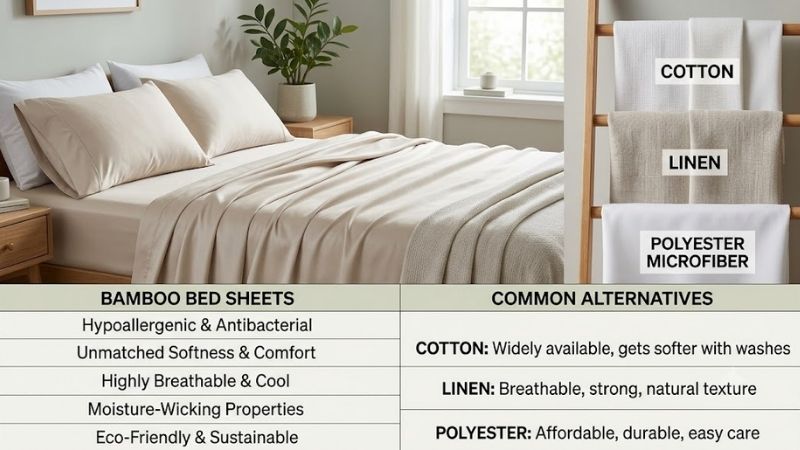
Choosing between bamboo bed sheets and alternative bedding materials can be confusing because many products are marketed using similar promises: softness, breathability, cooling comfort, and luxury feel. However, bamboo-derived viscose, cotton percale, cotton sateen, linen, lyocell, and polyester microfiber differ significantly in fiber construction, texture, laundering requirements, and long-term value.
This comparison examines the materials side by side to help you identify which bedding is most suitable for your preferences and budget. Instead of assuming one fabric is universally cooler or more durable, it explains the practical advantages and limitations of each option and provides specific buying recommendations for different types of sleepers.
Quick Verdict: Bamboo Sheets or an Alternative?
Bamboo-derived viscose sheets are a strong choice for shoppers who want a smooth, fluid, silky-feeling surface and are comfortable following the fabric’s care requirements. However, they are not automatically superior to cotton, linen, or lyocell.
Cotton percale is a better starting point for people who prefer crisp, structured bedding. Cotton sateen offers smoothness with cotton fiber. Linen appeals to shoppers who enjoy naturally textured, relaxed bedding. Lyocell is worth comparing for its smooth drape and manufacturing characteristics, while polyester microfiber can be attractive for a lower initial cost.
| Material | Typical feel | Main advantage | Main trade-off | Best starting buyer | |—|—|—|—|—| | Viscose derived from bamboo | Smooth, fluid, silky | Soft surface and flexible drape | Can require careful laundering | | Cotton percale | Crisp, matte, structured | Traditional airy-feeling bedding | Wrinkles and may feel firm initially | | Cotton sateen | Smooth, slightly lustrous | Silky cotton feel | May feel warmer in dense constructions | | Flax linen | Textured, relaxed | Distinctive natural texture | Wrinkles; can feel coarse initially | | Lyocell | Smooth, soft, fluid | Refined drape and alternative cellulose processing | Quality and sourcing vary | | Polyester microfiber | Soft, fine-textured | Often inexpensive and low-wrinkle | Heat and moisture comfort vary |
The best overall material depends on the finished fabric and the sleeper’s priorities, not simply the fiber label.
What Are Bamboo Bed Sheets Actually Made From?
Before comparing performance, it is essential to clarify what bamboo sheets means.
Most soft bamboo-marketed bedding sold in the United States is made from regenerated cellulose. Bamboo is used as the source of cellulose, which is processed into manufactured textile fibers.
Viscose and rayon made from bamboo are common examples.
The US Federal Trade Commission requires accurate labeling: textiles made from rayon or viscose using bamboo as the source should not simply be described as natural bamboo fiber.
This matters because properties of the original bamboo plant should not automatically be attributed to the finished bedding.
Bamboo-Derived Viscose
Viscose is manufactured by processing cellulose and regenerating it into textile fibers.
The resulting fabric can feel exceptionally smooth when woven and finished appropriately.
Many bamboo-derived viscose sheets use sateen construction, producing a flowing drape and soft surface.
However, the fabric’s quality depends on yarn construction, weave, finishing, and care.
Bamboo-Derived Lyocell
Lyocell is another manufactured cellulose fiber produced using a different processing method.
Some lyocell manufacturing systems recover and reuse much of the processing solvent.
However, the environmental impact of the finished product still depends on sourcing, energy use, chemical recovery, manufacturing practices, and transportation.
Why Labeling Changes the Comparison
A product labeled 100% bamboo may be less informative than one clearly identified as 100% viscose derived from bamboo.
Without accurate fiber information, comparing performance and care becomes difficult.
Material transparency should therefore be an early buying criterion.
Bamboo Sheets vs Cotton Percale: Softness or Crispness?
Bamboo-derived viscose and cotton percale represent two noticeably different bedding experiences.
The distinction comes partly from the fibers and partly from their common fabric constructions.
Bamboo-derived viscose sheets often use a smooth sateen-style weave, while cotton percale uses a balanced plain weave.
Texture and Drape
Bamboo-derived viscose commonly feels fluid and silky.
It tends to fall softly around the mattress and body.
Cotton percale has a crisper, more structured surface with a matte appearance.
Some sleepers associate this with freshly laundered hotel bedding.
Neither texture is universally more comfortable.
A person who dislikes fabric that slides or drapes closely may prefer percale. Someone who finds crisp bedding too firm may prefer viscose.
Temperature Comfort
Cotton percale is often associated with a lightweight, breathable feel.
Bamboo-derived viscose can also feel comfortable in warm conditions, but neither fabric guarantees superior cooling.
Actual performance depends on fabric weight, yarn density, weave, finishing, and the complete bedding system.
A lightweight cotton percale sheet may feel cooler than a thick viscose sateen product in one environment, while another construction may produce the opposite preference.
Wrinkling and Care
Cotton percale wrinkles readily, but many products have relatively straightforward laundering instructions.
Viscose can also wrinkle and may require gentler washing or lower drying temperatures.
The exact care label matters.
Who Should Choose Which?
Choose bamboo-derived viscose when smoothness and drape are your priorities.
Choose cotton percale when you want a crisp, matte, structured surface and enjoy traditional cotton bedding.
Bamboo Sheets vs Cotton Sateen: Two Silky Bedding Options
Cotton sateen is one of the most relevant alternatives to bamboo-derived viscose because both can offer a smooth, flowing surface.
The important difference is that cotton sateen uses cotton fibers, while bamboo-derived viscose is a manufactured cellulose textile.
Surface Feel
Cotton sateen often feels smooth and slightly lustrous.
Bamboo-derived viscose sateen can feel fluid and silky.
The two fabrics may appear similar in product photographs, but their hand-feel, weight, and response to laundering can differ.
Warmth and Breathability
Sateen construction can be relatively dense, depending on yarn and finishing.
A substantial cotton sateen sheet may feel warmer than lightweight cotton percale.
Bamboo-derived viscose sateen should not automatically be assumed cooler merely because of its plant source.
To compare two finished products, look at fabric weight, construction, and credible test information where available.
Durability
Cotton sateen and viscose sheets can both offer useful service lives.
However, snagging, pilling, abrasion, and shrinkage depend on yarn quality and construction.
A product’s price or fiber source does not establish longevity.
Which Is Better?
For shoppers wanting smooth bedding with cotton fiber, cotton sateen is a logical choice.
For those who specifically prefer the fluid feel of regenerated cellulose, bamboo-derived viscose may be more appealing.
Neither should be selected solely on a cooling claim.
Bamboo Sheets vs Linen: Smooth Luxury or Natural Texture?
Linen and bamboo-derived viscose differ substantially in the way they look and feel.
Linen is made from flax fibers and has a characteristic textured, relaxed appearance.
Viscose made from bamboo commonly feels smoother and drapes more fluidly.
Initial Softness
Bamboo-derived viscose sheets often feel soft when first removed from the package.
Linen may feel relatively firm or textured when new.
Some washed linen products have a softer initial finish, and linen can become more relaxed through use and laundering.
Visual Appearance
Linen naturally develops wrinkles and a casual texture.
This can complement relaxed bedroom design.
Viscose generally creates smoother folds and a more polished appearance.
Warm-Weather Comfort
Linen is often favored for warm-weather bedding, but the exact result depends on fabric weight, weave, and the surrounding environment.
Bamboo-derived viscose may feel cool during initial contact, but that sensation does not establish sustained cooling.
Neither fabric actively lowers bedroom temperature.
Care and Drying
Linen and viscose have different laundering requirements.
Certain linen products tolerate relatively straightforward machine washing, while some viscose products require gentler handling.
However, exact instructions vary.
Which Should You Buy?
Choose linen if you appreciate natural texture and do not mind wrinkles.
Choose bamboo-derived viscose if you prefer a smoother, silkier surface and are willing to follow the product’s care requirements.
Bamboo Sheets vs TENCEL Lyocell: What Is the Real Difference?
TENCEL is a trademark used for certain fibers produced by Lenzing. It should not be treated as a generic synonym for every lyocell textile.
Lyocell itself is a manufactured cellulose fiber category.
Bamboo-derived viscose and lyocell are both regenerated cellulose textiles, but they use different manufacturing processes.
Fiber Source
Bamboo-derived viscose uses bamboo as its source of cellulose.
TENCEL-branded lyocell is commonly associated with responsibly sourced wood pulp, according to the manufacturer’s product descriptions and sourcing programs.
However, lyocell can also be produced using different cellulose sources.
Always check the exact fiber claim.
Manufacturing Process
Conventional viscose production and lyocell production differ chemically.
Certain lyocell manufacturing systems recover a substantial proportion of their processing solvent.
This can be relevant to environmental comparisons.
However, a lower-impact manufacturing claim should be evaluated using credible evidence for the actual supply chain.
Texture and Comfort
Both materials can produce smooth, draping fabrics.
The difference between two finished sheet sets may depend more on weave, yarn construction, and finishing than on fiber category alone.
Durability and Care
Lyocell is often marketed for strength and moisture management.
However, finished fabric performance varies.
A poorly constructed lyocell sheet is not guaranteed to outperform a well-made viscose product.
Which Is Better?
Choose based on documented material sourcing, fabric feel, construction, and care requirements.
Do not assume that every lyocell product is environmentally superior or that every bamboo-derived viscose sheet is cooler.
Bamboo Sheets vs Microfiber: Premium Feel or Budget Convenience?
Polyester microfiber is common in inexpensive sheet sets.
Its very fine synthetic fibers can create a soft surface, but the fabric behaves differently from regenerated cellulose and cotton.
Initial Cost
Microfiber sheet sets are often available at lower prices than premium viscose, linen, or long-staple cotton products.
This makes microfiber relevant to guest rooms, temporary apartments, and budget-conscious households.
Texture
Microfiber can feel soft and smooth.
However, it usually does not reproduce the same fluid drape as every bamboo-derived viscose fabric.
Some sleepers prefer microfiber’s familiar, lightweight feel, while others dislike its texture.
Moisture and Heat Comfort
Polyester is relatively hydrophobic compared with cellulosic fibers.
Fabric construction and finishing influence moisture movement.
Some microfiber sheets may feel less comfortable in warm or humid conditions, although not every product behaves identically.
Static and Maintenance
Synthetic fabrics can develop static under certain conditions.
Microfiber may also retain certain odors or oils differently from cellulosic textiles.
Follow the care label and avoid excessive dryer heat.
Which Is Better?
Microfiber may offer better initial value when budget and easy maintenance matter most.
Bamboo-derived viscose may be preferable for someone specifically seeking smooth drape and a regenerated-cellulose fabric.
Full Comparison: Which Material Performs Best for Your Priorities?
| Buying priority | Most relevant starting option | Why | Qualification |
|---|---|---|---|
| Crisp bedding | Cotton percale | Balanced plain weave | Fiber and finishing still matter |
| Silky, fluid texture | Bamboo-derived viscose or lyocell | Smooth regenerated-cellulose fabrics | Not all weaves feel alike |
| Smooth cotton surface | Cotton sateen | Sateen weave with cotton fiber | May feel warmer when dense |
| Textured relaxed look | Flax linen | Characteristic natural surface | Wrinkles are normal |
| Lowest initial cost | Polyester microfiber | Widely available budget options | Comfort and durability vary |
| Easy-care priority | Selected cotton or microfiber sets | Many conventional care options | Always check the label |
| Environmental documentation | Product with credible sourcing/process evidence | Verifiable practices matter | Plant names alone prove little |
| Hot sleeping | Lightweight suitable construction | Weight, weave, and bedding system matter | No universal cooling winner |
Thread Count: Can You Compare These Materials Fairly?
Thread count describes yarns counted within a defined area of woven fabric.
It can be useful when comparing similar fabrics, but it is not a universal quality score across different fiber categories.
A 300-thread-count cotton percale sheet should not automatically be considered better or worse than a linen product with a much lower thread count.
Linen is often evaluated through fabric weight and construction, while regenerated cellulose sheets can use various yarn and weave structures.
Very high advertised thread counts may also involve counting practices that make comparisons difficult.
For a meaningful buying decision, prioritize fiber composition, weave, fabric weight, finishing, and construction quality.
Durability: Which Sheets Last Longer?
Durability depends on multiple characteristics, including fiber strength, yarn construction, weave density, laundering, abrasion, and finishing.
No material category guarantees a particular lifespan.
Cotton Percale
Well-made cotton percale can provide durable everyday bedding.
Its crisp feel may become more relaxed with repeated washing.
However, lightweight or poorly constructed products can still develop wear.
Cotton Sateen
Cotton sateen can be durable, but its longer surface floats may influence susceptibility to snagging in some constructions.
The actual result depends on yarn and fabric quality.
Linen
Well-made linen can offer excellent service life, but not every linen product is equally strong.
Lightweight or loosely constructed fabric may behave differently from heavier linen.
Bamboo-Derived Viscose
Viscose sheets can provide satisfactory service when well made and properly maintained.
However, some constructions require more careful laundering and handling.
Microfiber
Microfiber may resist some forms of wrinkling, but pilling, static, or fabric wear can affect long-term satisfaction.
The lowest purchase price does not necessarily mean the lowest cost over time.
Environmental Claims: What Should Buyers Believe?
Environmental marketing is a major source of confusion in bamboo bedding.
Bamboo grows quickly, but the growth characteristics of the plant do not establish the environmental impact of converting it into viscose fabric.
The FTC specifically warns against unsupported claims that processed bamboo rayon retains the plant’s natural antibacterial properties or is automatically environmentally friendly.
Cotton, linen, lyocell, and polyester each have different environmental considerations involving agriculture, processing, energy, water, chemicals, and product lifespan.
The most credible comparisons rely on documented sourcing and manufacturing information rather than broad labels such as green, natural, or eco-friendly.
Practical Buying Scenarios
Scenario 1: A Hot Sleeper Who Dislikes Crisp Sheets
This buyer may enjoy the smooth surface of viscose or lyocell more than cotton percale.
However, the final choice should focus on lightweight construction and the overall bedding system rather than assuming bamboo-derived fibers guarantee cooling.
A thin, breathable-feeling sheet used with an excessively insulating comforter may not resolve the underlying temperature problem.
Scenario 2: A Shopper Who Wants Traditional Hotel Bedding
Cotton percale is a strong starting point.
Its crisp, matte feel differs from the softer drape of bamboo-derived viscose.
A quality percale set may be more satisfying than a silky material even when the latter is advertised as luxurious.
Scenario 3: A Person Who Dislikes Wrinkles
Cotton sateen or certain microfiber constructions may be worth considering.
However, no product should be assumed completely wrinkle-free unless its finishing and performance support that claim.
Linen is usually less suitable for someone who strongly dislikes a relaxed, wrinkled appearance.
Scenario 4: A Shopper With a Limited Budget
Microfiber or affordable cotton may provide reasonable value.
If bamboo-derived viscose is preferred, compare actual package contents and care requirements rather than buying the lowest-priced product using the word bamboo.
Scenario 5: A Sustainability-Focused Buyer
The buyer should seek verifiable fiber composition, manufacturing practices, and relevant certifications.
Choosing bamboo solely because the plant grows quickly is not sufficient.
Common Comparison Mistakes
Assuming Bamboo Means Natural Bamboo Fiber
Most silky bamboo-marketed sheets contain regenerated cellulose.
Accurate fiber identification matters.
Comparing Different Weaves as if They Were Fibers
Percale and sateen describe weave structures.
Cotton, linen, polyester, and viscose describe fiber categories.
A comparison should distinguish these concepts.
Believing Cooling Claims Without Evidence
Surface sensation, moisture handling, and sustained temperature comfort are different properties.
A fabric name cannot establish all three.
Choosing Based Only on Thread Count
Thread count does not provide a universal comparison across fiber types and constructions.
Ignoring Laundry Requirements
A fabric that requires care you cannot provide may be a poor long-term purchase.
Frequently Asked Questions
Are Bamboo Sheets Better Than Cotton?
Not universally. Bamboo-derived viscose often provides a smooth, fluid feel, while cotton percale offers crispness and cotton sateen offers a smooth cotton surface. The better choice depends on texture preference, construction quality, and laundering needs.
Are Bamboo Sheets Cooler Than Linen?
There is no universal winner. Both can be comfortable in warm conditions, but fabric weight, weave, mattress, bedding layers, humidity, and airflow affect the result. Neither material actively cools the bed.
Is Bamboo Viscose the Same as TENCEL Lyocell?
No. Both are manufactured cellulose fibers, but viscose and lyocell use different production methods. TENCEL is also a trademark for certain fibers, not a generic label for all lyocell products.
Do Bamboo Sheets Last Longer Than Microfiber?
Not necessarily. Durability depends on construction, abrasion, laundering, and product quality. Compare the actual finished sheet sets instead of assuming one material category always lasts longer.
Which Fabric Is Best for Sensitive Skin?
Comfort is individual. A smooth surface may feel pleasant, but no material is automatically hypoallergenic or guaranteed to prevent irritation. Detergents, dyes, finishes, and personal sensitivities also matter.
Are Bamboo Sheets Worth the Extra Cost?
They may be worthwhile when you strongly prefer their smooth feel and the product has clear material information and suitable care requirements. They are less compelling when you prefer crisp cotton or prioritize the lowest possible purchase price.
Conclusion
Bamboo-derived viscose sheets are worth choosing for their smooth texture and fluid drape, but they are not automatically cooler, stronger, or more sustainable than alternatives. Cotton percale is better suited to crisp-sheet enthusiasts, cotton sateen offers silky-feeling cotton, linen provides natural texture, lyocell offers another regenerated-cellulose option, and microfiber can deliver budget convenience. Choose the finished fabric that matches your comfort preferences, care routine, and expectations rather than relying on the material name alone.