Key takeaways
-
Minimum actual vertical clearance beneath the bed.
-
Available width and depth between supports.
-
Exterior storage-unit dimensions, including wheels.
-
Space available for full drawer extension.
-
Floor type and caster compatibility.
-
Stated load capacity.
-
Material suitability for the intended contents.
-
Whether a cover or lid is included.
-
Ease of cleaning.
-
Compatibility with the specific bed frame.
-
Whether the product can be reused after moving.
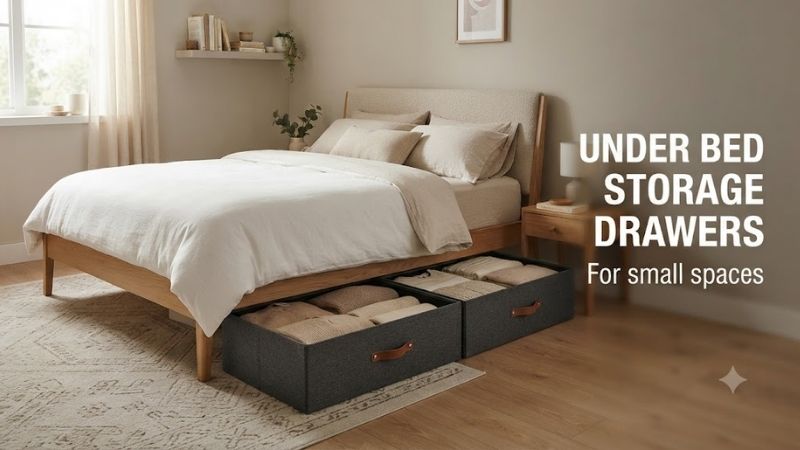
Under bed storage drawers for small spaces can turn unused floor area into practical storage for clothes, shoes, bedding, and accessories. However, the biggest container is not always the best choice. A drawer that fits beneath the bed may still be difficult to pull out, obstruct bedroom furniture, or perform poorly on carpet. This guide explains how to measure usable clearance, choose drawer construction, plan organization, and avoid common purchasing mistakes in studios, dorms, and compact bedrooms.
Why Under-Bed Storage Works Differently in Small Bedrooms
In a large bedroom, under-bed storage may serve as occasional overflow space. In a studio apartment or dorm room, it can function as an essential part of daily organization.
That difference changes which features are useful.
A container holding winter blankets only needs to be accessed occasionally, while a drawer storing everyday shoes or clothing may be opened several times per week. The latter requires more convenient access and reliable movement.
A product with slightly less capacity but smoother access may provide better practical value than a larger container that must be removed completely from beneath the bed.
Storage Capacity Is Not the Only Priority
Total volume is useful, but accessibility matters.
A wide box can hold numerous items, yet its contents may become difficult to reach when stacked beneath other belongings.
Dividers, shallow compartments, and drawer-style access can make a smaller unit more useful.
The goal is to reduce clutter, not simply relocate it beneath the mattress.
Your Bed Frame Determines the Available Space
Two mattresses of the same size can have very different storage potential.
A platform bed may sit close to the floor. A metal frame may provide generous clearance but include center support legs. A storage bed may already contain built-in drawers, leaving little additional room.
Measure the actual frame rather than assuming mattress size indicates storage capacity.
Measure Your Under-Bed Clearance Correctly
The most important measurement is the usable vertical distance between the floor and the lowest obstruction along the container’s intended movement path.
Do not measure from the floor to the top of the mattress or decorative frame.
A product that is half an inch too tall may become unusable, even when the advertised capacity seems ideal.
Step 1: Measure Vertical Clearance
Use a tape measure to check the floor-to-frame clearance at several locations.
Measure near the sides, center, and any areas where the container must pass.
Beds and floors are not always perfectly level.
A low cross brace or decorative panel may create a smaller opening than the rest of the under-bed area.
Step 2: Measure Depth
Determine how far the container can slide beneath the bed before encountering a center support, leg, motor, or another obstruction.
A long drawer may fit through the opening but collide with a support halfway underneath the mattress.
Step 3: Measure Available Width
Measure the uninterrupted space between support legs and other structural components.
For a larger bed, the center leg may divide the area into separate usable zones.
In that situation, two smaller containers may be more practical than one large box.
Step 4: Measure Pull-Out Clearance
A drawer needs room to open.
A storage box may fit beneath the bed but become impossible to remove because a nightstand, wall, or dresser stands too close.
Measure the open floor area beside the bed as carefully as the space beneath it.
Step 5: Allow a Practical Clearance Margin
A container should move without scraping against the bed frame.
A small clearance margin accommodates uneven flooring, wheel movement, and normal manufacturing tolerances.
Do not purchase a container whose stated exterior height exactly matches the measured opening.
Example: Fitting Storage Beneath a Low Platform Bed
Imagine a hypothetical platform bed with 8 inches of usable vertical clearance.
A rolling organizer advertised as 7.1 inches high would leave approximately 0.9 inch of nominal clearance.
That may provide sufficient room in some installations, but only if the floor is level, the advertised dimensions include wheels, and no lower obstruction exists along the sliding path.
A container measuring 8 inches high would leave no margin.
It would be a poor choice even if the bed and organizer appeared to match in product photographs.
The example illustrates why the actual exterior dimensions matter more than broad descriptions such as low profile or fits most beds.
Which Under-Bed Drawer Design Works Best?
| Storage design | Main advantage | Small-space limitation | Best use |
|---|---|---|---|
| Rolling fabric organizer | Lightweight and flexible | Less rigid protection | Shoes, clothing, accessories |
| Rolling plastic box | Wipe-clean and contained | Wheels may struggle on carpet | Seasonal items and everyday storage |
| Rigid covered rolling box | Structured organization | Greater weight | Folded linens and clothing |
| Sliding plastic drawer | Access contents without moving entire housing | Requires drawer extension space | Small clothing items and accessories |
| Furniture-style drawer | Integrated appearance | Bed-frame compatibility | Coordinated bedroom furniture |
| Divided shoe organizer | Keeps pairs separated | Less adaptable to bulky items | Shoes and small accessories |
Rolling Storage Boxes for Everyday Access
Rolling boxes are useful when the entire container can be pulled into the room for loading or retrieval.
They are particularly practical for belongings that need occasional rearrangement, such as seasonal clothing or spare bedding.
Advantages of Wheels
Wheels reduce the need to drag the container’s base directly across the floor.
On suitable hard flooring, this can make a loaded organizer easier to move.
However, the quality of the wheels, their diameter, and the floor surface affect performance.
A low-cost container with very small casters may become frustrating on thick carpet.
What to Check Before Buying
Review the exterior height, including casters.
Check whether the product offers a comfortable handle and whether the wheels can support the stated load.
A product described as rolling may have a different wheel configuration from another similarly priced organizer.
When Wheels Are Unnecessary
For belongings accessed only a few times per year, a basic nonrolling storage box may be sufficient.
However, a box without wheels should not be treated as equivalent to a drawer when frequent access is important.
Sliding Drawers for Small Accessories
Sliding drawer containers use an inner drawer that moves within an outer housing.
This differs from rolling storage, where the entire box travels across the floor.
A sliding drawer can be useful for small clothing items, cables, craft supplies, or accessories that require frequent access.
Why Smaller Compartments Improve Organization
A large empty container can quickly become cluttered.
When socks, belts, scarves, and other accessories share one space, the owner may need to remove several items to find one.
Smaller drawers or internal dividers reduce that problem.
Extension Clearance
The inner drawer needs space to open.
A sliding unit installed beneath a bed close to a dresser may be difficult to use even when it fits perfectly while closed.
Measure the drawer’s extension distance.
Why Drawer Stability Matters
An overloaded drawer may bind or tilt during movement.
Use the product within its stated loading limits and avoid placing heavy items at the far front if the design is not intended to support them.
Furniture-Style Drawers for Coordinated Bedrooms
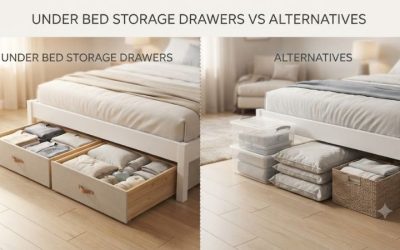
Furniture-style under-bed drawers use rigid panels and finished fronts intended to match particular bed frames.
They can make stored belongings less visible and provide a more integrated appearance.
However, these products are often less universally compatible than independent rolling organizers.
Why Bed Compatibility Matters
A drawer developed for a specific frame may rely on the frame’s height, leg placement, and side opening.
A matching exterior finish does not guarantee mechanical compatibility.
Check the exact bed model and supported drawer configuration.
Storage Advantages
Furniture drawers are convenient for folded sheets, clothing, and extra linens.
Their open-top interior often makes it easier to view contents once the drawer is pulled out.
However, open furniture drawers may offer less dust protection than containers with fitted lids or covers.
When to Avoid Furniture-Specific Drawers
Renters who frequently move may prefer independent storage boxes.
A matching furniture drawer could become unusable after changing to another bed frame.
This reduces long-term flexibility even when the initial appearance is attractive.
What Materials Are Best for Small-Space Storage?
Different materials create distinct trade-offs in weight, durability, cleaning, and moisture resistance.
Plastic Storage Drawers
Plastic containers are generally easy to wipe clean.
They can be useful for shoes, accessories, and other belongings that may leave dust or residue.
However, plastic thickness and construction quality vary. A lightweight drawer may crack or deform when overloaded.
Plastic does not automatically provide airtight or waterproof storage.
Polyester Fabric Organizers
Fabric organizers are often lightweight and relatively easy to move.
Some include rigid support structures, adjustable dividers, and clear covers.
They can be useful for clothing and shoes.
However, fabric walls provide less impact protection than rigid containers, and exposed edges may wear when dragged against rough surfaces.
Engineered-Wood Drawers
Particleboard, fiberboard, and related engineered materials can provide a furniture-like appearance.
They are useful when the storage unit is intended to remain visible.
However, exposure to standing water or persistent moisture can damage some engineered-wood products.
Metal Frames
Metal supports can add rigidity to textile organizers or rolling drawer systems.
But metal components can bend, loosen, or corrode depending on their construction and environment.
The complete product matters more than the presence of one strong-looking material.
Organizing Shoes Beneath a Bed
Shoes are a common under-bed storage category because many pairs can fit within a shallow container.
However, footwear varies significantly in height and shape.
Low-Profile Shoes
Flats, sandals, and some sneakers may fit comfortably in shallow organizers.
A divided interior helps keep pairs together.
Tall Shoes and Boots
Boots and high-top footwear may be too tall for low-profile drawers.
Do not force them into containers that crush or deform the footwear.
Clear Covers
A transparent top can make it easier to identify pairs.
This is especially useful when several organizers are stored beneath one bed.
Cleaning Before Storage
Footwear should be clean and dry before being placed inside an enclosed organizer.
Damp shoes can create odor and moisture problems.
Storing Clothing and Seasonal Bedding
Under-bed storage works well for items that are not needed every day.
However, textiles should be clean and thoroughly dry before storage.
Seasonal Clothes
Fold garments according to fabric requirements.
Group similar items to make retrieval easier.
A container holding winter clothing should be labeled clearly if it is not transparent.
Spare Bed Sheets
Keep matching fitted sheets, flat sheets, and pillowcases together.
This reduces time spent searching for the correct set.
Blankets and Duvet Covers
Lightweight blankets and duvet covers may fit into shallow containers.
Bulky comforters require greater vertical space and may not be suitable for low-clearance storage.
Avoid Excessive Compression
Compressing fabrics too tightly can create deep creases or stress delicate items.
Follow any fabric-specific storage instructions.
Under-Bed Storage in Different Small-Space Homes
Studio Apartments
A studio often requires furniture to serve several purposes.
Under-bed drawers can reduce the need for a separate dresser or storage chest.
However, daily access should remain convenient.
Choose drawers that can open without moving other furniture.
College Dorm Rooms
Dorm beds may provide usable clearance, but actual frame heights vary.
Some institutions offer adjustable bed frames, while others do not.
Measure the bed after installation rather than relying solely on generic dorm furniture information.
Children’s Bedrooms
Under-bed storage can help organize toys and clothing.
However, drawers should not contain accessible hazardous materials or objects unsuitable for the child’s age.
Rolling containers and heavy drawers should also be assessed for safe operation.
Guest Bedrooms
Guest rooms may use under-bed storage primarily for spare linens.
A covered rolling box can provide useful dust protection without requiring daily access.
Murphy Beds
Foldaway beds may have moving mechanisms and clearance restrictions.
Do not place storage beneath a Murphy bed unless the manufacturer permits that arrangement.
The storage must not interfere with the folding mechanism.
How to Prevent Dust, Moisture, and Odors
Under-bed areas can accumulate dust because they are often difficult to clean regularly.
A covered container may reduce dust exposure, but it does not eliminate the need for cleaning.
Dust Protection
Lids and zippered covers can help protect stored textiles.
However, ordinary covers are not necessarily airtight.
Moisture Control
Do not place damp clothing or bedding into enclosed containers.
Persistent bedroom humidity should be addressed at the room level.
Cleaning the Floor
Choose storage arrangements that allow periodic cleaning beneath the bed.
A large collection of heavy containers may make this task unnecessarily difficult.
Avoiding Odors
Store clean belongings and ensure adequate drying.
Fragrance products do not correct moisture-related problems.
A Practical Small-Space Buying Checklist
Before purchasing, confirm:
-
Minimum actual vertical clearance beneath the bed.
-
Available width and depth between supports.
-
Exterior storage-unit dimensions, including wheels.
-
Space available for full drawer extension.
-
Floor type and caster compatibility.
-
Stated load capacity.
-
Material suitability for the intended contents.
-
Whether a cover or lid is included.
-
Ease of cleaning.
-
Compatibility with the specific bed frame.
-
Whether the product can be reused after moving.
Common Buying Mistakes
Choosing the Largest Container That Fits
A large box may maximize volume but make organization and access difficult.
If small belongings are retrieved frequently, two divided containers can be more practical than one oversized unit.
Ignoring Carpet Thickness
Small wheels may roll poorly on thick carpet.
Check the wheel design and consider a sliding unit or alternative storage arrangement when necessary.
Forgetting Furniture Clearance
A storage drawer may fit beneath the bed but be blocked by a dresser or nightstand.
Always measure the pull-out route.
Overloading Lightweight Organizers
Fabric and plastic storage systems have different load limits.
Do not treat a container intended for clothing as suitable for heavy books or tools without supporting specifications.
Frequently Asked Questions
What Type of Under-Bed Drawer Is Best for a Studio Apartment?
A rolling or sliding organizer is often practical when it can be accessed without moving other furniture. The best choice depends on floor type, available clearance, storage contents, and how frequently the drawer is opened. A covered box may suit seasonal bedding, while divided drawers can work better for daily accessories.
How Much Clearance Do I Need Under the Bed?
The requirement depends on the exact product’s exterior height, including wheels, handles, and covers. Measure the lowest obstruction beneath the frame and allow some practical movement clearance. Do not choose a product whose advertised height exactly matches the available opening.
Are Rolling Drawers Better Than Fabric Storage Bags?
Rolling drawers generally provide easier access and more structure. Fabric bags may be less expensive and more flexible for occasional storage. If you need drawer-like access every day, a rolling or sliding design may offer better practical value.
Can Under-Bed Drawers Work on Carpet?
Some can, but movement depends on wheel diameter, total load, and carpet pile. Small casters may struggle on thick carpet. Review the product’s floor-use guidance rather than assuming every wheeled organizer performs equally well.
Can I Store Shoes Under My Bed?
Yes, provided the footwear is clean and dry and the container has appropriate dimensions. Divided organizers help keep pairs together, while transparent covers improve visibility. Tall boots and bulky shoes may require storage with greater vertical clearance.
Can Under-Bed Storage Cause Mold?
Moisture problems can develop when damp belongings are enclosed or the room has persistent humidity. Clean, dry textiles and appropriate room conditions are essential. A sealed-looking container is not a substitute for moisture control.
Conclusion
The best under bed storage drawers for small spaces provide convenient access without wasting clearance or obstructing bedroom furniture. Rolling boxes are useful for clothing and bedding, sliding drawers suit smaller frequently used items, and divided fabric organizers can keep shoes organized. Measure vertical clearance, support locations, floor type, and pull-out space before buying. Choose the smallest practical configuration that stores your belongings safely and remains easy to use.