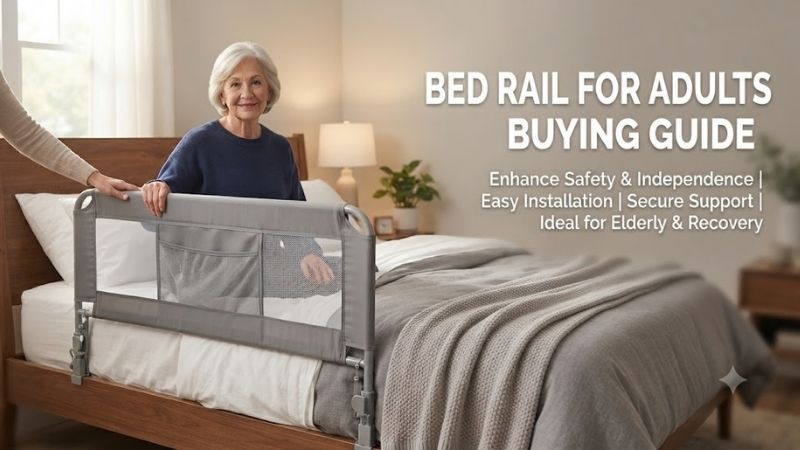
An adult bed rail can provide a useful handhold during transfers, assist with repositioning, or help reduce certain risks near the mattress edge. Yet portable bed rails can also create serious hazards, including entrapment, asphyxiation, and falls. The correct choice depends on more than rail length, weight capacity, or price. This bed rail for adults buying guide explains the available designs, applicable US safety requirements, compatibility checks, and circumstances in which a different support solution may be more appropriate.
What Is an Adult Portable Bed Rail?
An adult portable bed rail is a product installed on, against, or adjacent to an adult bed to provide assistance with movement, entering or exiting the bed, minimizing the possibility of falling, or related purposes.
This category includes more than traditional long side rails. Compact bed canes, transfer handles, assistive bars, and related devices may also fall within the relevant safety requirements.
That is important because a shopper may assume a small bedside handle is exempt from bed-rail safety concerns.
In reality, compact devices can create gaps between the mattress and support structure, particularly when they are inadequately retained or used with incompatible bedding.
Adult Portable Bed Rails Versus Hospital Bed Rails
Adult portable bed rails intended for consumer use are not the same as integrated hospital-bed side rails.
The US Consumer Product Safety Commission regulates covered consumer adult portable bed rails under 16 CFR Part 1270.
The FDA oversees medical-device bed rails within its jurisdiction, including relevant hospital-bed systems and medical-purpose products.
Products designed for different bed systems should not be treated as interchangeable.
Why the Product’s Intended Use Matters
A bed cane intended for transfer support should not be assumed to provide the same protective function as an extended side rail.
Likewise, a longer barrier should not automatically replace a transfer aid.
The correct product must match the actual movement or safety problem being addressed.
Understand the Main Adult Bed Rail Categories
| Product category | Intended function | Potential advantage | Main concern |
|---|---|---|---|
| Bed cane | Compact transfer support | Accessible handhold | Limited barrier coverage |
| Transfer-assist rail | Bed entry, exit, repositioning | Mobility-oriented design | Requires appropriate user strength |
| Fixed-length side rail | Specified mattress-edge support | Predictable geometry | Can obstruct access |
| Extendable rail | Variable edge coverage | Multiple permitted positions | More parts and configurations |
| Pivoting rail | Side support with movable access | Easier caregiver access | Locking and operating clearance |
| Adjustable-bed rail | Support on approved adjustable platforms | Designed for specified frame movement | Strict bed compatibility |
These categories describe intended functions, not a safety ranking.
A longer, heavier, or more complicated design is not automatically safer.
The US Safety Standard for Adult Portable Bed Rails
For covered consumer adult portable bed rails manufactured after August 21, 2023, the federal mandatory standard is codified at 16 CFR Part 1270. It incorporates ASTM F3186-17 with CPSC modifications.
The requirements address retention, structural integrity, entrapment hazards, openings, warnings, and other safety considerations.
A newer ASTM edition may exist, but shoppers should distinguish the publication of a voluntary standard from the edition incorporated into the applicable federal rule.
What the Standard Covers
The standard addresses whether the rail remains in its installed position under specified testing.
It also examines potential entrapment zones and whether product openings can create dangerous conditions.
A product must include appropriate labeling and warnings.
These requirements reflect the fact that a bed rail is part of a combined sleeping environment rather than a standalone object.
Why Compliance Claims Need Verification
A seller may describe a product as ASTM tested, hospital quality, or safety certified.
Those phrases do not provide enough information by themselves.
Look for the exact model, applicable standard, manufacturer identification, instructions, and relevant compliance documentation.
Do not rely solely on a marketplace listing’s headline.
What a General Certificate of Conformity Means
For applicable consumer products, manufacturers or importers are required to certify compliance with relevant federal safety rules through a General Certificate of Conformity.
The existence of appropriate documentation is useful when evaluating a product.
However, documentation does not remove the need to confirm that the specific bed and mattress are compatible.
Entrapment: The Most Important Risk to Understand
Entrapment is one of the most serious hazards associated with adult bed rails.
It can occur when a person’s head, neck, chest, or another body part becomes trapped within the rail or between the rail and mattress.
The danger can become life-threatening when the person cannot reposition or escape.
This is why bed rails should not be purchased solely on the basis of convenience or a low price.
Entrapment Within the Rail
Some rails contain openings that can capture body parts.
Applicable safety standards evaluate defined opening and entrapment conditions.
A visually simple rail is not automatically safe. Opening dimensions and structural behavior matter.
Entrapment Between the Rail and Mattress
A gap may develop when the mattress compresses or the rail moves away from the sleeping surface.
A person’s body can become trapped within that space.
Proper retention and mattress compatibility are critical.
Entrapment Beneath Rail Components
Some designs create additional openings beneath the rail or near support sections.
These areas must be considered as part of the complete installed system.
Simply checking the visible top bar is not enough.
Entrapment Near the Headboard and Footboard
A rail positioned close to the headboard or footboard may create a separate trapping space.
Placement instructions are therefore essential.
CPSC consumer guidance recommends keeping at least 12.5 inches between portable adult bed rails and the headboard or footboard, while also keeping nearby furniture away.
Why Mattress Compression Changes the Risk
A mattress may appear to fit closely against the rail when unoccupied.
Once a person lies near the edge, the mattress can compress, changing the gap.
Extra-soft mattresses and thick toppers can be particularly important compatibility considerations.
A rail should not be considered safe solely because it looks secure during a brief visual inspection.
How to Choose the Correct Rail for the Intended Function
Before comparing products, identify the actual difficulty the person experiences.
Different problems may require different solutions.
Difficulty Moving From Lying to Sitting
A compact transfer handle may provide an appropriate grasping point for an adult who can move independently but benefits from added support.
However, the device does not replace the physical strength needed for the movement.
If the person cannot sit safely without substantial assistance, a simple bed cane may be insufficient.
Difficulty Standing From Bed
Standing requires coordination, leg strength, balance, and an appropriately positioned support point.
A transfer rail may help some people stabilize during this process.
But a person who becomes dizzy when standing or has significant weakness may require additional evaluation and assistance.
The rail’s advertised weight capacity does not guarantee that every transfer maneuver is safe.
Rolling Toward the Mattress Edge
A longer rail may be considered in certain situations, but preventing a fall should not be approached as a simple matter of adding a barrier.
The user’s ability to understand the rail, reposition, and exit bed safely is crucial.
Some people may attempt to climb over an extended rail, potentially increasing injury risk.
Repositioning on the Mattress
A rail with appropriate grasping areas can provide leverage for some users who remain able to reposition themselves.
However, the position of the handle, mattress height, and user’s arm strength matter.
A professional mobility assessment may be needed when the person has significant functional limitations.
Matching the Bed Rail to the Mattress
A portable bed rail must work with the mattress’s actual thickness and compression characteristics.
A product that fits one mattress may become unsuitable after the mattress is replaced.
Mattress Thickness
Manufacturers often state minimum and maximum mattress thicknesses.
These requirements influence both the rail’s effective height and the way it sits against the mattress.
Do not assume that a product described as universal fits every modern mattress.
Mattress Firmness
Firmness affects how the mattress edge responds to body weight.
A soft edge may compress enough to create a gap even when unloaded measurements seem acceptable.
Some manufacturers specifically restrict use with extra-soft mattresses.
Memory Foam Mattresses
Memory foam mattresses can vary considerably in edge support.
Some have reinforced edges, while others compress more deeply near the perimeter.
Material category alone does not establish compatibility.
Follow the rail manufacturer’s requirements for the specific mattress configuration.
Pillow-Top Mattresses and Toppers
A thick pillow top or separate topper changes total mattress height and compression.
If a topper is added after a rail is installed, reassess the setup rather than assuming the original fit remains valid.
Air Mattresses and Specialized Surfaces
Air-filled or specialized pressure-management surfaces can behave differently from conventional mattresses.
A portable rail should be used only when the manufacturer explicitly supports the mattress type and the overall arrangement has been assessed appropriately.
Bed Frame Compatibility
Mattress compatibility is only part of the installation.
The frame must also provide suitable support and allow the retention system to be installed as intended.
Conventional Bed Frames
Some portable rails are designed for ordinary fixed bed frames.
The manufacturer may specify required attachment points or permitted under-mattress support arrangements.
Do not omit the retention system even if the mattress appears to hold the product in place.
Platform Beds
A solid platform or recessed frame may interfere with straps and supports.
Some portable rails are compatible with particular platform configurations; others are not.
Check the exact requirements.
Adjustable Bed Bases
An adjustable bed changes its geometry during use.
A rail intended only for fixed beds may create changing gaps when the mattress moves.
Use only products approved for the particular adjustable-base construction and attachment method.
Metal Versus Wooden Frames
Some specialized rails require attachment to a wooden platform.
Others use different systems.
Do not substitute screws, drill into unsupported materials, or modify hardware to create compatibility.
Understanding Weight Capacity and Structural Support
A product’s advertised weight capacity can be useful, but it is often misunderstood.
A rail rated for a particular load does not mean it can safely support every lifting angle, transfer maneuver, or user behavior.
Static Versus Dynamic Loading
A person lightly stabilizing themselves with a rail creates different forces from someone suddenly falling against it or pulling forcefully while standing.
The manufacturer’s intended loading conditions matter.
Why Higher Capacity Is Not Automatically Better
A higher published weight rating does not eliminate entrapment hazards.
It also does not guarantee compatibility with an adjustable bed or an extra-soft mattress.
Safety requires evaluating the whole installation.
Handhold Position
A properly placed handle should be usable without requiring awkward reaching or excessive twisting.
The person’s height, strength, and movement pattern influence appropriate placement.
A clinician or occupational therapist can help determine whether a device supports the intended transfer safely.
Who May Be an Appropriate Bed Rail User?
A portable rail is not suitable for everyone.
The decision should consider mobility, cognition, physical strength, medication effects, and the ability to escape a hazardous position.
Adults With Mild Mobility Limitations
A person who understands the rail’s function and can move independently may benefit from an appropriately selected transfer device.
However, the rail should be installed correctly and used only for the manufacturer’s intended function.
Adults With Significant Weakness
Someone who cannot reposition independently may face elevated entrapment risk.
A rail should not substitute for necessary caregiver assistance.
People With Dementia or Confusion
Confusion, restlessness, or difficulty understanding a barrier can make portable rails hazardous.
A person may attempt to climb over the device or become trapped.
These situations call for individualized professional evaluation rather than automatically installing rails.
People Taking Sedating Medications
Medication effects can influence awareness, balance, and movement.
Someone who becomes disoriented or has reduced mobility during the night may face additional risks.
A healthcare professional should consider these factors when evaluating the overall sleeping arrangement.
Fall-Prone Adults
Repeated falls may result from several causes, including dizziness, weakness, medication effects, or room hazards.
A bed rail is not guaranteed to prevent future falls.
Appropriate assessment should consider the actual cause and whether a different intervention would be safer.
Installation: A Step-by-Step Safety Review
Installation should follow the exact product manual. The following framework helps buyers understand the issues that must be addressed; it does not replace manufacturer instructions.
Confirm Product Identity
Verify the model number, required components, and current recall status.
Do not assemble a product using instructions from a different model simply because it looks similar.
Confirm Mattress and Frame Compatibility
Check mattress thickness, firmness restrictions, frame type, and any adjustable-base limitations.
Do not proceed if the setup falls outside the approved specifications.
Install Every Required Retention Component
Use the manufacturer-supplied strap, hardware, or other specified retention system.
Do not substitute household materials.
Check Placement Clearances
Follow the instructions concerning distance from the headboard, footboard, and surrounding objects.
Keep furniture away from the rail to avoid hazardous trapping spaces.
Evaluate the Complete Sleeping Arrangement
Check the rail’s position relative to the mattress, the person’s entry and exit route, and any relevant movement of the bed frame.
A casual hand-pull test does not substitute for verified compatibility.
Reassess After Changes
Replacing the mattress, adding a topper, moving the bed, or changing the frame may affect the installation.
Reevaluate the arrangement whenever relevant components change.
Alternatives to Adult Bed Rails
A bed rail is not the only way to address transfer difficulties or bed-related falls.
In some situations, alternatives can provide a better balance of access and safety.
Lower Bed Height
Lowering the sleeping surface may reduce the distance of a fall.
However, an excessively low bed can make standing more difficult.
Appropriate height depends on the person’s physical abilities.
Different Transfer Aids
Some users may benefit from a professionally selected transfer device that does not create a rail along the mattress edge.
The correct option depends on the movement being assisted.
Environmental Adjustments
Improving lighting, removing clutter, positioning furniture appropriately, and ensuring clear walking routes can address some risks.
These changes may be valuable alongside or instead of a portable rail.
Clinical Assessment
An occupational therapist, physical therapist, or other appropriate healthcare professional can help evaluate transfers, mobility, cognition, and the bedroom setup.
This is particularly important when the person cannot reposition independently or has experienced repeated falls.
How to Compare Bed Rails Before Buying
| Criterion | What to verify | Why it matters |
|---|---|---|
| Intended function | Transfers, repositioning, or edge support | Prevents choosing the wrong device |
| Safety documentation | Exact applicable standard and model | Addresses mandatory product requirements |
| Mattress thickness | Published compatibility range | Influences effective fit |
| Mattress compression | Softness restrictions | Helps prevent hazardous gaps |
| Bed-frame type | Fixed, platform, adjustable, wood, metal | Determines approved mounting |
| Retention system | Complete straps or hardware | Keeps rail in intended position |
| Placement requirements | Headboard, footboard, furniture clearance | Reduces trapping risks |
| User suitability | Mobility, cognition, ability to reposition | Critical for individual safety |
| Recall status | Exact model | Identifies known hazards |
| Replacement parts | Approved hardware availability | Supports proper maintenance |
Common Bed Rail Buying Mistakes
Assuming All Adult Rails Are Universal
Portable rails are not interchangeable across every mattress and bed frame.
A product designed for a conventional bed may be unsuitable for an adjustable platform or thick soft mattress.
Review exact compatibility rather than relying on universal marketing.
Buying the Longest Rail for Maximum Protection
A longer rail may cover more of the mattress edge but can obstruct access or encourage climbing.
The correct length depends on the person’s assessed needs, not maximum coverage.
Ignoring Cognitive Ability
A person who cannot understand the device or reposition independently may face greater danger.
Do not treat a bed rail as a method of restraining someone in bed.
Skipping Retention Hardware
A rail that appears stable beneath a heavy mattress can still shift.
Install every required component.
Using Pillows to Fill Gaps
Soft household objects are not substitutes for correct fit or compliant construction.
An incompatible arrangement should not be used.
Frequently Asked Questions
Are Adult Bed Rails Safe?
They can be appropriate for some users when the exact product meets applicable requirements, fits the mattress and frame, and supports the person’s abilities. However, bed rails can cause serious injury or death through entrapment, falls, or improper use. Product compliance and individualized assessment are essential.
What Is the Difference Between a Bed Cane and a Bed Rail?
A bed cane generally provides a compact handhold for transfers or repositioning. A longer bed rail may provide additional mattress-edge coverage. Both can fall within adult portable bed-rail safety requirements, and neither is universally safer. The choice depends on the intended function.
Can I Use an Adult Bed Rail on an Adjustable Bed?
Only when the exact model is approved for the particular adjustable bed configuration and can be installed using the specified attachment system. Adjustable bases change the relationship between the mattress and rail, so fixed-bed compatibility should not be assumed.
Do Bed Rails Prevent Falls From Bed?
They may help reduce certain risks for appropriately selected users, but they cannot prevent every fall. A person may climb over the rail, fall while transferring, or become trapped. Fall prevention should be based on individual assessment rather than the assumption that a longer barrier provides complete protection.
What Safety Standard Should a Consumer Bed Rail Meet?
Covered US consumer adult portable bed rails manufactured after August 21, 2023 are subject to 16 CFR Part 1270, which incorporates ASTM F3186-17 with modifications. Verify the exact product’s compliance documentation and current recall status, and distinguish consumer products from medical-device or hospital-bed systems where different requirements may apply.
Should Someone With Dementia Use an Adult Bed Rail?
This requires significant caution. People with cognitive impairment, confusion, restlessness, or reduced ability to reposition may face heightened entrapment and fall risks. Rails should not be used as restraints. A qualified professional should assess whether a rail or another sleeping arrangement is appropriate.
Conclusion
The best adult bed rail is the one that safely matches the user’s specific mobility needs, mattress, and bed frame—not necessarily the longest or highest-capacity model. A compact transfer handle may suit some independently mobile adults, while longer rails require careful consideration of access, falls, and entrapment risks. Verify applicable compliance, complete retention hardware, mattress compatibility, and recall status, and seek individualized professional guidance when mobility or cognitive limitations increase the risk of injury.