Key takeaways
-
An overly firm mattress that needs additional surface cushioning.
-
A guest-room mattress that feels uncomfortable but remains structurally sound.
-
A mattress that transfers less of the desired responsive sensation than the sleeper prefers.
-
A bedroom where a removable comfort layer is preferable to replacing the entire bed.
-
A sleeper who wants natural latex rather than conventional memory foam.
Is a Budget Latex Mattress Topper Worth Buying?
A budget latex mattress topper is worth considering when your existing mattress still provides adequate support but feels too firm, creates pressure around your shoulders or hips, or lacks the responsive cushioning you prefer.
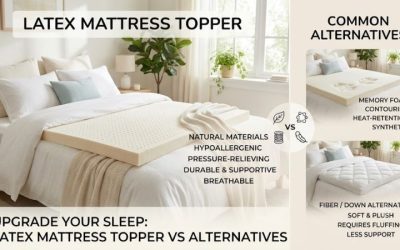
Latex foam differs from traditional memory foam because it typically responds more quickly to movement. Instead of allowing your body to sink slowly into the material, latex compresses and rebounds with a noticeably springier feel.
This responsiveness can make it easier to change sleeping positions, particularly for people who dislike the slow-moving sensation of memory foam.
However, latex generally costs more than conventional polyurethane foam. Finding a genuinely affordable latex topper requires paying attention to material composition, thickness, size, and optional accessories rather than simply choosing the lowest advertised price.
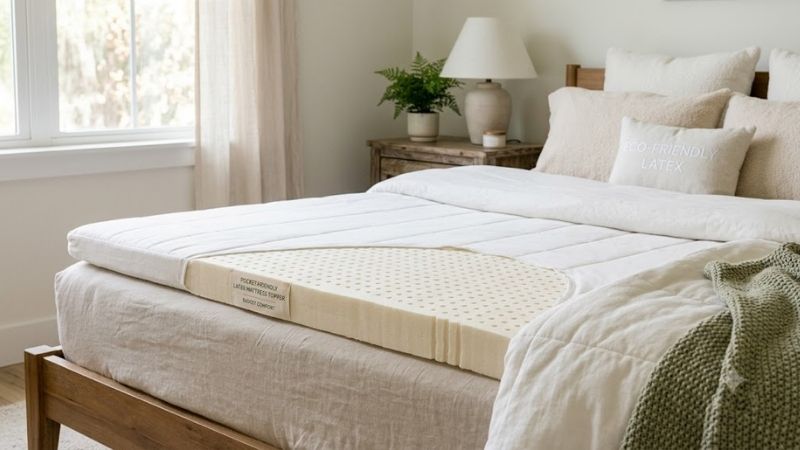
When a Budget Latex Topper Makes Sense
A latex topper is a practical purchase when the mattress underneath remains relatively flat and supportive.
Common situations include:
-
An overly firm mattress that needs additional surface cushioning.
-
A guest-room mattress that feels uncomfortable but remains structurally sound.
-
A mattress that transfers less of the desired responsive sensation than the sleeper prefers.
-
A bedroom where a removable comfort layer is preferable to replacing the entire bed.
-
A sleeper who wants natural latex rather than conventional memory foam.
A topper can also help you adjust an existing mattress without committing to a completely different mattress construction.
When a Mattress Topper Is Not the Right Solution
A latex topper cannot reliably repair a mattress with significant sagging, broken springs, or a deteriorated support core.
Adding soft material above a sagging mattress usually allows the topper to follow the uneven surface underneath. This can leave the underlying support problem unresolved.
Before spending money on a topper, inspect your mattress for permanent impressions, uneven support, damaged edges, and other structural problems.
If the mattress no longer supports your body adequately, replacing it may be a better long-term investment.
How Much Should You Budget for a Latex Mattress Topper?
Latex topper prices depend heavily on bed size, material quality, thickness, cover selection, and manufacturer.
Because prices vary between configurations and retailers, a useful budget comparison should focus on the total cost of the exact topper you intend to purchase.
What Usually Makes a Latex Topper More Expensive?
| Feature | Budget Consideration | Practical Impact |
|---|---|---|
| 1-inch thickness | Uses less latex than thicker versions | Subtle comfort adjustment |
| 2-inch thickness | Often a practical middle ground | More noticeable cushioning |
| 3-inch thickness | Requires more material | Greater change to mattress feel |
| Natural latex | Material quality and processing affect cost | Responsive cushioning |
| Organic certification | May increase cost | Documented compliance with specific standards |
| Removable cover | Can increase the purchase price | Protects foam and may simplify cleaning |
| Larger bed sizes | Require more latex | Higher total material cost |
Thickness is one of the most important cost factors because it directly determines how much foam is used.
A 3-inch topper generally requires substantially more material than a 1-inch version of the same length and width.
That additional latex can create a more substantial comfort adjustment, but it is unnecessary for shoppers who only want a slightly softer sleep surface.
Should You Choose the Cheapest Latex Topper?
Not necessarily.
An inexpensive product may be a poor value if its construction is unclear, its dimensions do not match your mattress, or its firmness is unsuitable for your sleeping position.
Before buying, verify whether the topper contains natural latex, synthetic latex, or a blend. A listing that uses the word “latex” without identifying the construction provides insufficient information for a careful comparison.
Also check return conditions, cover costs, and any fees associated with delivery or exchanges.
The lowest initial price is not always the lowest-risk purchase.
Choosing the Best Budget Latex Mattress Topper Thickness
Thickness determines how strongly a topper changes the feel of your existing mattress. It also affects bed height, sheet compatibility, and total material cost.
For many budget-conscious shoppers, a 2-inch latex topper is a sensible starting point because it can provide noticeable cushioning while preserving much of the underlying mattress’s character.
1-Inch Latex Mattress Topper: Best for Minor Adjustments
A 1-inch latex topper creates a relatively small change in surface comfort.
It can be useful when your mattress already feels close to ideal but needs a little additional cushioning.
Because the layer is thin, the mattress underneath continues to influence most of the overall sleeping experience.
Advantages:
-
Requires less material than thicker toppers of the same construction.
-
Adds relatively little height to the bed.
-
Preserves more of the existing mattress feel.
Limitations:
-
May not provide enough cushioning for pronounced shoulder or hip pressure.
-
Cannot meaningfully correct a mattress that feels excessively firm.
-
Provides little separation from the underlying sleep surface.
Best for: Shoppers with supportive mattresses who want a subtle comfort adjustment.
2-Inch Latex Mattress Topper: Best Balance for Many Buyers
A 2-inch latex mattress topper offers a more substantial comfort layer without changing the bed as dramatically as a thicker topper.
This makes it an appealing middle-ground option for sleepers who want to soften a firm mattress while keeping their budget under control.
A softer version may improve cushioning for side sleepers, while a medium option can provide a more restrained adjustment.
Advantages:
-
More noticeable cushioning than a 1-inch topper.
-
Less material-intensive than a comparable 3-inch model.
-
Works with a wide range of otherwise supportive mattresses.
Limitations:
-
May not provide enough cushioning when the underlying mattress is extremely firm.
-
Still depends heavily on the support characteristics of the mattress below.
Best for: Most shoppers seeking a moderate comfort upgrade without paying for unnecessary thickness.
3-Inch Latex Mattress Topper: Best for Greater Cushioning
A 3-inch latex topper creates a larger change in how a mattress feels.
This can benefit side sleepers who need more room for their shoulders and hips to settle into the comfort layer.
However, thicker toppers should not automatically be considered more comfortable. A very soft 3-inch topper may allow excessive sinkage for certain sleepers, particularly when combined with an already soft mattress.
Advantages:
-
Provides a substantial comfort layer.
-
Can noticeably change an overly firm sleeping surface.
-
Offers greater room for pressure-sensitive areas to compress the foam.
Limitations:
-
Typically costs more than thinner versions.
-
Adds more height to the bed.
-
Can alter support and alignment if firmness is poorly matched.
Best for: Sleepers who need a significant comfort adjustment and have a mattress that remains structurally supportive.
Thickness Comparison Table
| Thickness | Comfort Change | Relative Material Cost | Best Use |
|---|---|---|---|
| 1 inch | Subtle | Lower | Minor surface adjustment |
| 2 inches | Moderate | Medium | Everyday comfort upgrade |
| 3 inches | Significant | Higher | Greater cushioning |
| 4 inches | Substantial | Highest of these options | Major feel adjustment requiring careful firmness matching |
These are general comparisons between otherwise similar latex constructions, not guarantees of comfort or retail pricing.
Dunlop vs. Talalay Latex: Which Is Better on a Budget?
Latex foam used in mattress toppers is commonly produced using either the Dunlop or Talalay manufacturing process.
Both can produce comfortable, responsive sleep surfaces, but their processing methods and available characteristics differ.
Dunlop latex is often the more straightforward budget choice, especially when comparing natural latex products.
Dunlop Latex: A Practical Budget Option
Dunlop latex is manufactured by foaming liquid latex, pouring it into a mold, and curing it.
Depending on its formulation and firmness, the finished material can have a relatively substantial, supportive feel.
Dunlop toppers are available in multiple firmness levels, making them suitable for different sleep preferences.
Advantages:
-
Widely available in natural latex toppers.
-
Responsive and resilient feel.
-
Often competitively priced relative to Talalay alternatives.
-
Available in soft, medium, and firm configurations.
Trade-offs:
-
Some versions feel denser than comparable Talalay products.
-
Firmness and cushioning vary significantly between manufacturers.
A soft Dunlop topper can still provide substantial pressure relief. Buyers should not assume that every Dunlop product is firm.
Talalay Latex: A Different Comfort Experience
Talalay latex uses additional vacuum and freezing steps during production before curing.
The process can create a relatively uniform foam structure and is commonly associated with a buoyant, airy feel.
However, Talalay latex is not automatically softer or cooler than Dunlop latex. Firmness, foam structure, thickness, covers, and the underlying mattress all influence real-world comfort and temperature.
Advantages:
-
Responsive, buoyant sensation.
-
Available in softer comfort configurations.
-
Can provide gentle contouring without a slow memory-foam feel.
Trade-offs:
-
Frequently carries a higher price than comparable Dunlop options.
-
May not justify the additional cost for shoppers who simply need modest cushioning.
Dunlop vs. Talalay Quick Comparison
| Factor | Dunlop Latex | Talalay Latex |
|---|---|---|
| Manufacturing | Foamed and cured in a mold | Additional vacuum and freezing steps |
| Typical feel | Often substantial and resilient | Often airy and buoyant |
| Firmness choices | Multiple options | Multiple options |
| Budget suitability | Frequently favorable | Often more expensive |
| Pressure relief | Depends on firmness and thickness | Depends on firmness and thickness |
| Temperature comfort | Influenced by construction | Influenced by construction |
| Best reason to buy | Practical value | Preference for its particular feel |
For most budget-focused buyers, comparing soft or medium Dunlop latex options before considering more expensive Talalay alternatives is reasonable.
How to Choose Latex Topper Firmness for Your Sleep Position
Choosing the correct firmness is just as important as selecting thickness.
A topper that feels comfortable in a showroom or during a short trial may behave differently after several hours of sleep, especially when paired with your existing mattress.
Side Sleepers: Prioritize Shoulder and Hip Cushioning
Side sleepers typically need enough surface compression to accommodate the shoulders and hips without creating excessive pressure.
A soft latex topper can help when the existing mattress is too firm.
For shoppers who need a moderate improvement, a soft 2-inch option is a sensible starting point. Those who need more pronounced cushioning may prefer a 3-inch version.
However, body weight and mattress firmness can change the outcome significantly.
A soft topper over a soft mattress may allow excessive hip sinkage, while the same topper over a firmer mattress may feel more balanced.
Back Sleepers: Balance Contouring and Support
Back sleepers generally benefit from a surface that accommodates the body’s natural curves without allowing the hips to sink excessively.
Medium latex can be a useful starting point, depending on how firm the underlying mattress feels.
A 2-inch topper may add comfort while allowing the mattress to continue providing most of the support.
If your mattress is already soft, adding thick cushioning may create more sinkage than intended.
Stomach Sleepers: Avoid Excessive Sinkage
Stomach sleepers usually need to limit how deeply their hips and abdomen sink into the bed.
A thick, soft topper can increase the risk of uncomfortable spinal positioning when the mattress underneath already allows substantial compression.
A thinner or firmer latex topper may be more appropriate when only a small surface adjustment is needed.
Some stomach sleepers may be better served by changing the mattress itself rather than adding more cushioning.
Combination Sleepers: Consider Responsiveness
Latex is well suited to sleepers who frequently change positions because it responds quickly when weight shifts.
A medium or moderately soft topper may balance cushioning and ease of movement, depending on body weight and the mattress underneath.
The ideal firmness is the one that remains comfortable across your usual sleeping positions without introducing excessive sinkage.
What to Look for in an Affordable Latex Topper
Beyond thickness and firmness, several purchasing details can determine whether a lower-priced topper represents good value.
Natural Latex vs. Synthetic or Blended Latex
Natural latex foam uses rubber-tree latex as its primary latex component. Synthetic latex and blended formulations use different material compositions.
These distinctions matter because listings may use similar product descriptions for different constructions.
Before purchasing, review the manufacturer’s material disclosure and determine whether the product is described as natural, synthetic, or blended.
Avoid assuming that a product is made entirely from natural latex simply because its listing includes phrases such as “natural feel” or “latex comfort.”
Also distinguish between latex foam and an ordinary polyurethane foam topper marketed as latex-like.
Certifications That May Be Worth Considering
Certifications can provide additional information about material production, chemical testing, and environmental requirements.
Relevant examples include:
-
GOLS (Global Organic Latex Standard): Addresses requirements for qualifying organic latex products and their production.
-
GOTS (Global Organic Textile Standard): Applies to qualifying organic textile materials and manufacturing processes.
-
OEKO-TEX STANDARD 100: Addresses testing for specified harmful substances in certified textile-related materials and products.
-
GREENGUARD Gold: Addresses chemical-emission limits under the certification program.
These certifications do not all measure the same characteristics.
A certified organic cotton cover does not automatically mean the latex foam underneath is certified organic. Likewise, an emissions certification does not establish the mattress topper’s durability or comfort.
Check which product component is certified and whether the certification can be verified.
Mattress Size and Fit
Choose a topper that matches the actual dimensions of your mattress rather than relying exclusively on size labels.
Common nominal US mattress dimensions are:
| Mattress Size | Typical Dimensions |
|---|---|
| Twin | 38 × 75 inches |
| Twin XL | 38 × 80 inches |
| Full | 54 × 75 inches |
| Queen | 60 × 80 inches |
| King | 76 × 80 inches |
| California King | 72 × 84 inches |
Actual finished dimensions may vary by manufacturer.
A topper that extends beyond the mattress edge can shift or become awkward to use, while an undersized topper may leave uncomfortable gaps.
Measure your bed and compare the dimensions with the specific topper listing.
Cover Options and Cleaning Requirements
Some budget latex toppers are sold as bare foam, while others include a fabric cover.
An uncovered topper may cost less and can be placed beneath a fitted sheet and suitable mattress protector.
However, latex foam itself is generally not intended for machine washing.
Cleaning typically involves localized treatment according to the manufacturer’s instructions, avoiding excessive moisture and thoroughly drying the affected area.
A removable, washable cover can simplify routine care, but confirm the washing instructions for the exact fabric.
When comparing costs, consider whether purchasing a separate cover would eliminate the savings offered by an uncovered topper.
Return Policy, Warranty, and Shipping Costs
A lower-priced latex topper is less attractive if you cannot return it after discovering that the firmness is unsuitable.
Review the seller’s policy for:
-
Eligible return periods and conditions.
-
Whether opened or expanded toppers can be returned.
-
Return-shipping expenses.
-
Restocking or exchange fees.
-
Warranty coverage and exclusions.
Do not assume that mattress trial policies also apply to mattress toppers.
Some sellers have different rules for accessories, bare foam products, and custom-size orders.
How to Compare Budget Latex Mattress Toppers Without Overpaying
A consistent comparison process can help you avoid paying more for features that do not meaningfully improve comfort.
Compare Equivalent Sizes and Thicknesses
A Twin 1-inch topper should not be compared directly with a Queen 3-inch topper when evaluating value.
Start by choosing your mattress size and desired thickness, then compare products with similar configurations.
This makes differences in material composition, cover quality, warranty coverage, and price easier to interpret.
Calculate Cost Relative to Material Quantity
For toppers of the same dimensions and construction, a thicker version contains more foam and will generally cost more.
You can estimate material volume using:
Width × Length × Thickness = Foam Volume
For example, a nominal Queen topper measuring 60 × 80 inches contains the following gross rectangular volumes:
| Thickness | Nominal Foam Volume |
|---|---|
| 1 inch | 4,800 cubic inches |
| 2 inches | 9,600 cubic inches |
| 3 inches | 14,400 cubic inches |
Actual foam volume may differ because of perforations, edge tolerances, and other construction details.
Volume does not measure comfort, durability, or material quality. It simply helps explain why thicker latex toppers often cost more.
Decide Whether Optional Upgrades Matter
A more expensive cover, decorative quilting, or premium packaging may not substantially improve sleep comfort.
If the primary goal is to soften a firm mattress, thickness and firmness are usually more important than appearance.
A budget shopper may obtain better value from a well-matched latex core with a basic protective setup than from a premium presentation package.
However, a removable washable cover may justify additional expense for households where easy maintenance is important.
Compare Real Products Using the Same Criteria
The following examples illustrate how to evaluate identifiable latex toppers without relying on fluctuating retail prices.
| Product | Construction and Options | Potential Value | Main Consideration |
|---|---|---|---|
| Sleep On Latex Pure Green Natural Latex Mattress Topper | Natural latex; 1-, 2-, and 3-inch options; multiple firmness levels | Flexible thickness choices, including a thinner budget-oriented option | Cover selection affects total cost |
| Turmerry Latex Mattress Topper | Dunlop latex; multiple thickness and firmness configurations | Broad selection for different sleep needs | Thicker and premium configurations can cost more |
These products are useful reference points for comparing configurations, not a claim that either is the cheapest available. Exact purchase costs, eligibility for returns, and available variants should be confirmed before ordering.
Budget Latex vs. Memory Foam Mattress Toppers
Latex is not always the best material for shoppers with a strict spending limit.
Memory foam is frequently available at lower prices, although its feel and characteristics differ.
| Factor | Latex Topper | Memory Foam Topper |
|---|---|---|
| Response to movement | Typically quick and springy | Often slower and more conforming |
| Sinkage sensation | Usually more buoyant | Often deeper and more embracing |
| Motion absorption | Some movement transfer possible | Often stronger motion absorption |
| Heat retention | Varies by construction | Varies by foam and ventilation |
| Typical initial cost | Often higher | Frequently lower |
| Durability | Quality latex can be highly resilient | Varies substantially with foam quality |
| Best for | Responsive comfort and easy repositioning | Close contouring and motion absorption |
When Latex Is Worth the Extra Cost
Latex may justify a higher purchase price when you particularly value responsiveness, dislike a deeply enveloping feel, or want a material known for good resilience.
It can also be suitable for people who prefer a more buoyant sleep surface.
However, material category alone cannot establish which topper will last longer. Construction quality, use conditions, and foam characteristics matter.
When Memory Foam May Be the Better Budget Choice
A memory foam topper may be preferable when initial cost is the main constraint.
It can also appeal to sleepers who enjoy a close-contouring sensation or want stronger motion absorption.
For someone who specifically dislikes slow foam response, choosing a cheap memory foam topper instead of latex could save money initially but produce an unsatisfactory sleeping experience.
The better choice depends on comfort preference, not material reputation alone.
Common Mistakes When Buying a Cheap Latex Mattress Topper
Buying More Thickness Than Necessary
A thicker topper is not automatically better.
If your mattress needs only a minor adjustment, paying for a 3-inch topper may introduce more sinkage, weight, and bed height than necessary.
Begin with the amount of cushioning your mattress actually needs.
Choosing Firmness Without Considering the Existing Mattress
The same topper can feel different depending on the surface underneath.
A soft latex topper above a firm mattress may provide the desired balance, while the same topper above a soft mattress may permit excessive sinkage.
Evaluate the complete sleep surface rather than treating the topper as an independent mattress.
Assuming All Latex Products Are Identical
Dunlop, Talalay, natural, synthetic, and blended latex constructions should not be treated as interchangeable.
Even within the same material category, products can differ in firmness, density, compression characteristics, and surface feel.
Always compare the manufacturer’s exact configuration.
Ignoring Bed Height and Sheet Fit
A topper increases total bed height.
If your existing mattress is already thick, adding several inches may prevent standard fitted sheets from staying in place.
Measure the mattress and topper together, then choose bedding with an appropriate pocket depth.
Expecting a Topper to Repair a Sagging Mattress
A topper can modify surface comfort, but it cannot restore damaged mattress support components.
Spending money on a comfort layer when the underlying mattress is structurally worn out may only delay a necessary replacement.
How to Maintain a Budget Latex Mattress Topper
Proper care can help preserve comfort and reduce unnecessary replacement costs.
Protect the Topper From Spills and Moisture
Use a mattress protector compatible with the topper and follow the manufacturer’s care instructions.
Liquid can penetrate exposed foam, and excessive moisture may be difficult to remove completely.
If the topper becomes wet, allow it to dry thoroughly according to the manufacturer’s guidance before replacing the bedding.
Avoid Unnecessary Washing
Do not place bare latex foam in a washing machine unless the manufacturer explicitly permits it.
For many natural latex products, spot cleaning is the recommended approach.
Wash removable covers only according to their specific care labels.
Handle Latex Foam Carefully
Latex toppers can be heavy and flexible, particularly in larger sizes and thicker configurations.
When moving one, support the foam rather than pulling aggressively on a small section.
Avoid prolonged direct sunlight and excessive heat where the manufacturer warns against them, because exposure can contribute to material deterioration.
Check for Shifting and Uneven Wear
Periodically inspect the topper for movement, localized compression, and changes in feel.
A correctly sized topper beneath a fitted sheet or compatible protector may remain relatively stable.
If shifting persists, check bed dimensions and follow the manufacturer’s guidance before adding accessories.
Frequently Asked Questions
What Is the Best Thickness for a Budget Latex Mattress Topper?
A 2-inch latex topper is a practical starting point for many sleepers because it offers noticeable cushioning without requiring as much material as a 3-inch version.
Choose 1 inch for a subtle comfort adjustment and consider 3 inches when you need a more significant change.
The correct choice depends on your mattress firmness, body weight, sleep position, and desired cushioning.
Is a Cheap Latex Mattress Topper Still Good Quality?
An affordable latex topper can be a worthwhile purchase if its material composition is clearly disclosed, the dimensions are appropriate, and the firmness matches your needs.
A low price alone does not establish poor quality.
Likewise, premium pricing does not guarantee superior comfort or durability.
Look for transparent specifications, relevant certification details, and reasonable return terms.
Is a Budget Latex Mattress Topper Good for Side Sleepers?
It can be, particularly when the existing mattress feels too firm around the shoulders and hips.
A soft latex topper with enough thickness to permit comfortable pressure relief is often a reasonable option.
However, lightweight sleepers and heavier sleepers may need different combinations of firmness and thickness.
Do Latex Mattress Toppers Sleep Hot?
Latex toppers are often relatively breathable, especially when their construction encourages airflow.
However, temperature comfort also depends on the mattress underneath, fabric covers, waterproof protectors, room temperature, and bedding.
A latex topper should not be assumed to provide active cooling or eliminate nighttime overheating.
Can a Latex Mattress Topper Make a Soft Mattress Firmer?
A firm latex topper may change the immediate surface feel of an overly soft mattress, but it cannot reliably correct inadequate support underneath.
If the existing mattress permits excessive hip sinkage or has visible sagging, a firm topper may not solve the problem.
Assess the mattress condition before buying an additional comfort layer.
How Long Does a Budget Latex Mattress Topper Last?
There is no reliable universal lifespan for budget latex toppers.
Longevity depends on latex formulation, foam quality, thickness, firmness, body weight, frequency of use, and maintenance.
High-quality latex is generally valued for its resilience, but inexpensive construction or unsuitable use conditions can shorten useful life.
A longer warranty should not be interpreted as a guarantee that the topper will maintain the same comfort throughout the warranty period.
Conclusion
A budget latex mattress topper offers a practical way to improve comfort without replacing a supportive mattress. For many buyers, a 2-inch natural Dunlop latex topper provides a sensible balance of cushioning, responsiveness, and material cost. Choose thickness and firmness according to your sleep position and existing mattress, compare equivalent configurations, and avoid paying extra for features you do not need.