Key takeaways
- Manual Recliner (5-Year Investment):
- Initial Purchase Price: $240 to $450
- Electricity Costs: $0
- Maintenance & Repairs: $0 to $20 (occasional silicone lubricant for steel pivot joints)
- Total 5-Year Estimated Cost: $240 to $470
Living with chronic lumbar tightness, sciatica, or mid-back stiffness transforms simple seating decisions into crucial ergonomic choices. When shopping for supportive seating in 2026, comparing a power recliner vs manual recliner for back pain comes down to a balance of spinal biomechanics, precise positioning, physical effort, and household practicalities. Both designs aim to alleviate spinal compression by shifting your body weight off the intervertebral discs, but they achieve this goal through entirely different mechanical methods.
A power recliner relies on one or more electric motors to articulate the headrest, backrest, and footrest independently with the touch of a button. Conversely, a manual recliner uses a pull-lever, push-back mechanism, or external handle that requires leg muscle power and abdominal engagement to extend and close the footrest. For someone navigating acute back inflammation or recovering from spinal surgery, the core strain needed to operate a manual lever can sometimes aggravate the very pain they are trying to fix. However, manual options remain attractive for their portability, independence from wall outlets, lower cost, and simpler construction. Understanding how these mechanical differences impact daily spinal comfort helps narrow down the right seating solution for your living space.
Our top picks

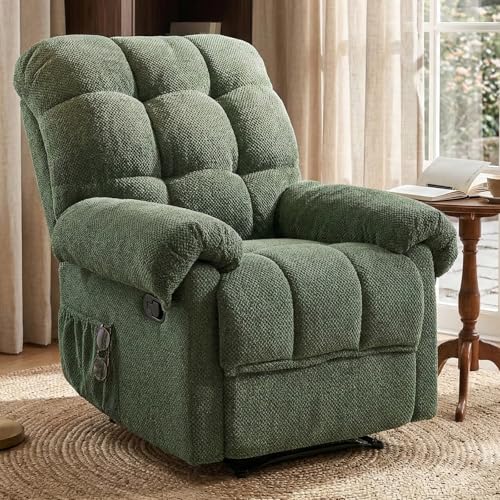
 Power Lift Recliner Chair for Elderly
Power lift helps users rise without straining joints
Built-in massage and lumbar heating add relaxation
Side pockets and cup holders keep items within reach
Cushions need about 72 hours to fully expand
Oversized footprint demands significant living-room space

As an Amazon Associate we earn from qualifying purchases at no extra cost to you.
Quick Verdict
If your primary driver is severe lower back pain, sciatica, limited mobility, or post-surgical recovery, a power recliner is the superior ergonomic choice. Its ability to stop at millimeter-precise angles allows you to fine-tune spinal decompression without forcing your lumbar spine into awkward positions. Features like motorized lift assistance, zero-gravity tilting, and integrated heating elements relieve pressure on lumbar vertebrae without requiring core strength to lock the footrest into place.
A manual recliner for back pain is the better option if you suffer from mild to moderate stiffness, operate on a tighter budget, or need a chair that does not require tethering to a wall outlet. Manual models deliver immediate recline movement, weigh significantly less, and eliminate potential motor repairs. However, closing the footrest using your calves and hamstrings requires a quick core muscle contraction that can trigger sudden spasms in sensitive lower backs.
Side by Side
| Feature Category | Power Recliner | Manual Recliner |
|---|---|---|
| Lumbar & Angle Control | Infinite position locking; micro-adjustments to exact degrees | Fixed preset angles (usually 2 to 3 locked positions) |
| Physical Effort Required | Zero effort; push-button control or wired remote handset | Moderate effort; requires arm pull or core/leg pushing force |
| Integrated Therapies | Heat therapy, vibration/massage, motorized stand assistance | Purely passive mechanical cushioning and frame support |
| Weight & Frame Mass | Heavy (105 lbs to 140 lbs due to motors and steel lift mechanisms) | Lighter (65 lbs to 90 lbs; easier to shift across rooms) |
| Price Range | $270 to $800+ for entry/mid-tier; over $1,200 for commercial healthcare grade | $220 to $500 for quality ergonomic models |
| Power & Wiring Needs | Requires standard 110V wall outlet (or rechargeable lithium battery pack) | 100% cord-free; place anywhere in the room |
| Durability & Maintenance | Higher mechanical complexity; potential motor, switch, or transformer repairs | Simple mechanical springs and steel linkage; minimal mechanical failure points |
| Wall Clearance Needed | 4 to 6 inches for wall-hugger power models; 12+ inches for standard lift frames | 8 to 16 inches back clearance depending on frame sweep angle |
| Resale & Longevity | Holds value well if electronics are intact; electronic parts age faster | Consistent resale value based purely on upholstery condition and frame frame stability |
| Best For | Severe back pain, post-surgery, elderly users, nerve impingement relief | Mild back ache, budget-conscious buyers, rentals, power-outage-prone areas |
Where Power Recliner Wins
The clear advantage of an electric seating setup lies in incremental position control. When suffering from herniated discs, spinal stenosis, or acute muscle strain, shifting your torso back by just two degrees can mean the difference between active nerve pinch and total muscle relief. Power recliners use linear actuators that move smoothly, allowing you to stop the backrest at any angle between 90 degrees upright and full lay-flat positions without jarring your body.
For individuals struggling to rise from a seated position, power lift recliners provide vital assistance. Motorized frames tilt forward and upward, easing you onto your feet without placing load bearing stress on your knees or lower back. Many feature-rich entry points in the market—such as an electric power lift recliner chair sofa with massage and heat or a dedicated power lift recliner chair for elderly users equipped with USB charge ports, cup holders, and side pockets—typically priced around $279.99, pack high-end orthopedic utility into standard living room furniture. The addition of low-voltage (50W to 90W) heating pads inside the backrest relaxes tight lumbar paraspinal muscles, while targeted massage motors stimulate local blood circulation to encourage tissue recovery.
Furthermore, power recliners relieve the physical toll of returning the chair to an upright position. Manual recliners require you to press firmly down with your heels to lock the leg rest into place, an action that directly engages the lower abdomen and psoas muscles. For back pain patients, this sharp movement can cause immediate muscle guarding. Electric controls remove this physical strain entirely, letting the dual or single motor retract the mechanism while you keep your legs relaxed.
Where Manual Recliner for Back Pain Wins
While motorization provides precise control, manual recliners offer distinct functional advantages that appeal to many homeowners. The primary benefit is mechanical simplicity and speed. A manual recliner responds immediately to your physical movement without waiting for a 12-volt motor to cycle slowly through its motion sequence. If you need to answer the door or tend to a child, a manual chair lets you return to a sitting position instantly.
Placement versatility is another key strength. Because manual recliners require no electrical wall connection, you are not forced to line your furniture up against wall outlets or run extension cords across walking paths where they create trip hazards. Lightweight manual frames are much easier to relocate across carpeted or hardwood floors during cleaning or room updates.
From an ergonomic standpoint, high-density foam padding combined with tailored lumbar contours offers excellent passive spinal alignment. A well-designed 36” W comfy manual recliner chair featuring overstuffed padding provides exceptional deep-seat back pain relief for standard living spaces. Available in versatile upholstery choices and budget-friendly price points ranging from $239.99 to $259.99, these models deliver structural lumbar support without the weight, electrical power consumption, or potential electronic repairs associated with motor-driven chairs.
Cost Over 5 Years
Evaluating the long-term ownership cost of a recliner involves accounting for initial retail pricing, routine maintenance, electrical usage, and component repairs over a standard 5-year ownership cycle.
- Manual Recliner (5-Year Investment):
- Initial Purchase Price: $240 to $450
- Electricity Costs: $0
- Maintenance & Repairs: $0 to $20 (occasional silicone lubricant for steel pivot joints)
- Total 5-Year Estimated Cost: $240 to $470
- Power Recliner (5-Year Investment):
- Initial Purchase Price: $280 to $750
- Electricity Costs: $12 to $30 total (calculated at an average 60W motor running 30 minutes daily plus periodic heat usage at standard residential electricity rates)
- Maintenance & Out-of-Warranty Electrical Repairs: $50 to $150 (typical cost for replacement hand controls, power supply transformers, or actuator cables after year 3)
- Total 5-Year Estimated Cost: $342 to $930
While a manual recliner carries a lower financial commitment over five years, the extra $20 to $90 annually required to maintain a power recliner is often a worthwhile investment for users who rely on daily motor-driven spinal decompression and heat therapy to manage chronic pain.
Which One for Your Home
Small Apartment
In compact living rooms under 150 square feet, wall clearance and floor space dictate your choice. A manual recliner with a 36-inch overall frame width offers a compact footprint and can be angled in corners where wall outlets are absent. However, if your budget permits, look for a power “wall-hugger” recliner that sits just 4 to 6 inches away from baseboards, glides forward along its track as it reclines, and prevents the top of the backrest from striking your drywall.
Family with Kids/Pets
Safety is the primary consideration around active pets and young children. Power recliners feature slowly moving motorized scissor frames under heavy load; if a pet wanders beneath an extended leg rest, pushing the return button can trap them before you notice. Many modern power lift chairs include safety lockout switches and under-frame sensors to prevent accidents. Manual recliners snap shut rapidly via internal spring tension, which requires clear line-of-sight visual checks before collapsing the footrest.
Rental Property
For tenants who move every 12 to 24 months, transport weight is a crucial factor. Power lift recliners weigh upwards of 120 pounds due to their steel lift platforms and motor assemblies, making them difficult to navigate up narrow apartment stairwells. A 75-pound manual recliner is vastly easier to disassemble, lift, and load into a moving van without scratching door frames or straining your back during moving day.
Long-Term Home
If you own your home and are setting up a dedicated relaxation space tailored to long-term physical wellness, a power recliner is the clear winner. You can position power outlets directly behind your seating area or run floor outlets beneath your rug. The added utility of integrated heat modules, motorized lumbar extensions, and smooth lift assist provides lasting spine care as your mobility needs change over time.
FAQ
Is a power recliner better for lower back pain than a manual recliner?
Yes, for most individuals with moderate to severe back pain. Power recliners allow you to adjust the backrest and footrest independently to exact angles, stopping at the precise position that relieves nerve pressure. Furthermore, they do not require you to push hard with your calves or core to retract the footrest, preventing painful muscle spasms in your lower back.
Do power recliners use a lot of electricity?
No. Power recliners operate on low voltage through a transformer plugged into a standard 110V household outlet. The motor draws energy only while actively moving (typically 50 to 90 watts during movement). When stationary, idle power consumption is under 1 watt. Even models with continuous heating pads and massage units running for 30 minutes a day add less than $5 to $8 per year to your electric bill.
How far away from the wall does a recliner need to sit?
Standard manual recliners typically require 12 to 18 inches of rear clearance behind the backrest so the chair frame can tilt fully backward without hitting the wall. Power recliners vary by mechanism: traditional lift models require 12 to 16 inches, while specialized power “wall-hugger” recliners require as little as 4 to 6 inches because the seat slides forward on a track as the back tilts backward.
What happens to a power recliner during a power outage?
If electricity cuts out while a power recliner is extended, the chair will stay locked in its current position unless equipped with a backup system. Most modern power recliners include a dual 9-volt battery backup compartment built into the transformer box beneath the seat base. Inserting fresh 9V batteries provides enough temporary emergency power to lower the footrest and return the backrest upright so you can get out safely.