Key takeaways
-
Sunrise simulation: Adjustable from 20 to 40 minutes
-
Color transition: Red to orange to yellow
-
Maximum published light intensity: 300 lux
-
Brightness settings: 20
-
Wake-up sounds: Five
-
Alarm settings: Two
-
FM radio: Included
-
Sunset simulation: Included
-
Display brightness: Automatic adjustment
-
Snooze: Tap-based control
-
Power: AC adapter
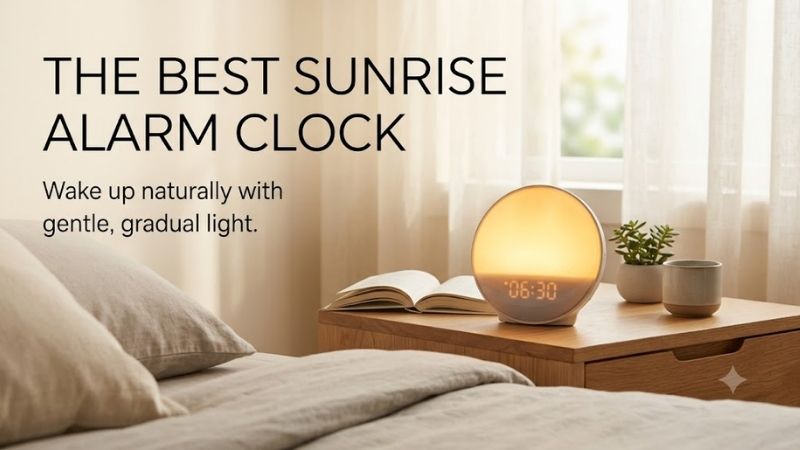
Discover the best sunrise alarm clock for gentler mornings. Compare six wake-up lights by sunrise simulation, brightness, sounds, controls, and value.
The best sunrise alarm clock gradually increases bedroom light before your scheduled wake-up time, creating a more natural transition from darkness to morning. Some models combine light with gentle audio, sunset routines, and multiple alarms, while others focus on a straightforward simulated sunrise. Choosing the right one requires comparing light intensity, color transitions, scheduling options, bedside controls, and how much you actually want to spend.
How a Sunrise Alarm Clock Differs From a Regular Alarm
A traditional alarm usually wakes the sleeper with a sudden sound.
A sunrise alarm begins increasing light before the scheduled alarm time.
The intention is to provide a visual cue that morning is approaching, potentially making awakening feel less abrupt.
However, a sunrise alarm does not guarantee better sleep quality or cure difficulty waking.
Light exposure can influence the body’s circadian timing, but the effectiveness of a particular wake-up light depends on brightness, timing, placement, individual sensitivity, and sleeping habits.
A sunrise alarm clock also should not automatically be treated as a medical-grade light therapy device.
Our Six Sunrise Alarm Clock Choices
| Product | Best For | Sunrise Approach | Main Advantage | Trade-Off |
|---|---|---|---|---|
| Philips SmartSleep HF3520/60 | Overall light simulation | Red-to-orange-to-yellow sunrise | Adjustable sunrise duration | Premium over basic lights |
| Hatch Restore 3 | Complete bedtime routines | App-configured sunrise and sound | Integrated sleep routines | Higher cost and app dependence |
| Lumie Bodyclock Shine 300 | Extensive wake-up customization | Adjustable sunrise and sunset | Wide range of light and sound settings | More involved setup |
| Philips Wake-Up Light HF3505/60 | Simple proven-style design | Yellow sunrise | Straightforward physical device | Limited sound options |
| JALL Sunrise Alarm Clock | Feature-focused value | Color-changing sunrise simulation | Multiple affordable configurations | Specifications vary by model |
| Philips Wake-Up Light HF3500/60 | Minimalist wake-up light | Gradually brightening yellow | Simple 30-minute sunrise | Basic feature set |
The Philips HF3500 and HF3505 are different models within the same product family. Their separate inclusion is useful because their sound and radio features differ.
Philips SmartSleep HF3520/60 — Best Overall Sunrise Alarm Clock
Why This Model Stands Out
The Philips SmartSleep HF3520/60 focuses directly on the wake-up experience.
Rather than treating light as a decorative addition to a conventional alarm, it provides a gradual colored sunrise sequence with adjustable timing.
That makes it particularly relevant for people who want the light simulation itself to be the main feature.
Key Specifications
-
Sunrise simulation: Adjustable from 20 to 40 minutes
-
Color transition: Red to orange to yellow
-
Maximum published light intensity: 300 lux
-
Brightness settings: 20
-
Wake-up sounds: Five
-
Alarm settings: Two
-
FM radio: Included
-
Sunset simulation: Included
-
Display brightness: Automatic adjustment
-
Snooze: Tap-based control
-
Power: AC adapter
Understanding the Color Transition
A significant difference between the HF3520 and basic yellow-light alarms is the progression through warmer colors.
The simulated sunrise begins with a reddish tone, transitions toward orange, and eventually reaches brighter yellow light.
This more closely resembles the visual progression people associate with natural morning light.
However, visual resemblance does not prove that it provides the same physiological effects as outdoor sunlight.
Adjustable Sunrise Duration
The ability to select a 20- to 40-minute sunrise provides meaningful flexibility.
A person who dislikes long periods of increasing light may prefer a shorter duration.
Someone who enjoys a gradual transition may prefer a longer setting.
The appropriate choice depends on sleep sensitivity and morning habits.
Five Wake-Up Sounds
The HF3520 includes five wake-up sound options.
This allows the user to supplement the light with audible notification.
A sound backup is important because some people can sleep through a simulated sunrise, particularly when the room is already bright or their eyes remain covered.
Dual Alarms
Two alarm settings can simplify different wake-up schedules.
For example, one may be used for weekdays and another for a separate routine, depending on the device’s setting capabilities.
Users with highly variable schedules should still consider whether the alarm interface is convenient enough for frequent changes.
Sunset Simulation
The sunset function gradually reduces light.
It can serve as a cue to begin winding down.
However, it does not eliminate the influence of screens, evening activities, caffeine, or inconsistent sleeping schedules.
Potential Drawbacks
The HF3520 is more expensive than basic sunrise alarms.
It also occupies a noticeable amount of nightstand space.
Buyers who only need an inexpensive gradual light may not require its full feature set.
Pros
-
Colored sunrise progression
-
Adjustable sunrise duration
-
20 brightness settings
-
Five wake-up sounds
-
Two alarms
-
Sunset simulation
Cons
-
More expensive than entry-level models
-
Requires bedside space
-
Limited smart-home integration compared with app-based products
Buy If: You want a dedicated sunrise alarm with detailed light controls.
Skip If: You want a simple, inexpensive alarm with minimal settings.
Hatch Restore 3 — Best for Complete Sleep Routines
More Than a Morning Alarm
Hatch Restore 3 is designed to manage both the beginning and end of the sleep period.
It combines sunrise-style awakening, ambient sound, lighting, and programmable routines.
This makes it more relevant to someone trying to build a consistent bedtime routine than to someone who only needs a brighter morning alarm.
Core Features
-
Digital sunrise alarm
-
Gradual wake-up lighting
-
Sleep-oriented sound library
-
Evening wind-down routines
-
Physical controls for frequently used functions
-
Companion app for configuration
-
Optional subscription content and services
Why Evening Features Matter
A sunrise alarm can improve the experience of waking, but morning comfort is influenced by what happened the previous evening.
A predictable wind-down routine may help people create more consistent sleeping habits.
The Restore 3 can combine sound and lighting cues into a scheduled sequence.
For example, a user might prefer soft lighting before bed and a progressively brighter alarm the following morning.
Smart Scheduling
App-assisted configuration is useful when someone wants several settings organized together.
However, app dependence introduces complexity.
People who prefer physical controls may find a conventional Philips wake-up light easier to manage.
Audio Integration
Hatch includes background audio functions in addition to lighting.
This can reduce the need for a separate sound machine.
The combined value is strongest when the buyer would otherwise purchase both products.
Subscription Considerations
Some Hatch experiences may depend on paid content access.
Buyers should distinguish essential built-in functionality from subscription-related features.
A recurring fee can materially change the total cost over several years.
Why It May Not Be the Best Pure Alarm
The Restore 3 offers much more than a wake-up light.
Those features justify its price only when they are used.
Someone who already owns a white noise machine and only wants a simulated sunrise may receive better value from a simpler product.
Pros
-
Combined light and sound routines
-
Configurable wake-up experience
-
Evening wind-down features
-
Useful for consolidated bedside equipment
Cons
-
Premium price
-
App-based setup
-
Potential ongoing subscription expenses
-
More complex than a traditional alarm
Buy If: You want one bedside device for bedtime and morning routines.
Skip If: Your primary requirement is a basic sunrise simulation.
Lumie Bodyclock Shine 300 — Best for Customization
Why Lumie Deserves Consideration
Lumie specializes in light-based products, and the Bodyclock Shine 300 is designed around programmable sunrise and sunset experiences.
It occupies a different position from inexpensive decorative sunrise clocks.
The emphasis is on the range of light settings and wake-up customization.
Key Product Characteristics
The Bodyclock Shine 300 offers adjustable sunrise and sunset simulations, several wake-up sound options, a dimmable clock display, and additional lighting controls.
Its exact current regional specifications and power requirements should be confirmed for US use.
Adjustable Light Duration
A sunrise duration that can be customized over a wider range gives users control over how gradually the light increases.
This may appeal to people who dislike abrupt transitions.
However, a longer sunrise is not necessarily more effective.
The goal is to find a setting that fits the individual’s sleeping environment and schedule.
Wake-Up Sound Options
A range of sounds can supplement the simulated light.
People who want a gentle morning may prefer natural sounds rather than a sharp electronic alarm.
However, sound quality is subjective.
A device offering many recordings does not guarantee that the user will like every one.
Sunset Functionality
A programmable sunset can provide a visual wind-down cue.
It may be useful for people who want the bedroom light to become gradually dimmer before sleep.
The value depends on whether the user actually incorporates it into a consistent routine.
FM Radio
The Shine 300 includes radio functionality in relevant configurations.
This may appeal to listeners who want traditional radio as part of their wake-up routine.
However, radio reception depends on location and local signal conditions.
US Purchasing Considerations
Because Lumie sells products across different regions, US shoppers should confirm power compatibility, warranty support, and the exact model supplied.
Do not assume that a European unit includes a suitable US power adapter.
Pros
-
Adjustable light routines
-
Multiple sound options
-
Sunrise and sunset functionality
-
Dedicated light-oriented design
Cons
-
More settings to manage
-
Regional power compatibility matters
-
Higher cost than basic alarms
Buy If: You want extensive control over sunrise and sunset routines.
Skip If: You prefer a simple clock with one fixed sunrise sequence.
Philips Wake-Up Light HF3505/60 — Best Straightforward Midrange Choice
Why a Simpler Philips Model Can Be Better
The HF3505 offers core sunrise functionality without the more elaborate colored simulation of the HF3520.
For some buyers, this is enough.
A straightforward light that gradually brightens may be preferable to a feature-rich device requiring more setup.
Published Specifications
-
Sunrise simulation: 30 minutes
-
Sunrise color: Yellow progressing to brighter yellow
-
Brightness settings: 10
-
Maximum published brightness: 200 lux
-
Wake-up sounds: Two
-
FM radio: Included
-
Alarm settings: One
-
Snooze: Tap-based, approximately nine minutes
-
Power: AC adapter
How It Compares With HF3520
The HF3505 has fewer brightness settings and fewer wake-up sounds.
It also uses a simpler yellow-light sunrise rather than a red-orange-yellow sequence.
The HF3520 provides more flexibility, but the HF3505 still addresses the main reason someone buys this type of product: gradual light before waking.
Ideal Bedroom Conditions
The HF3505 is most useful when positioned where the sleeper can perceive its changing light.
A lamp hidden behind a large object or placed too far away may have less noticeable impact.
The light should not be expected to overcome very bright daylight entering through uncovered windows.
Physical Controls
A dedicated alarm clock with simple physical controls can be attractive to users who do not want to rely on a smartphone app.
This is especially relevant for people trying to reduce phone use near bedtime.
Main Limitations
The single alarm may be inconvenient for households with different weekday and weekend schedules.
The device also lacks the broader color progression of premium Philips models.
Pros
-
30-minute sunrise
-
Ten brightness levels
-
Two wake-up sounds
-
FM radio
-
Straightforward controls
Cons
-
Single alarm
-
Yellow-only sunrise
-
Fewer customization options
Buy If: You want established sunrise-light functionality without advanced smart features.
Skip If: You need several alarm schedules or a more colorful sunrise sequence.
JALL Sunrise Alarm Clock — Best Feature-Focused Value
Why JALL Appeals to Budget-Minded Buyers
JALL offers sunrise alarm clock configurations that combine gradual lighting, multiple colors, audible alarms, and bedside lamp functionality.
The product family is particularly relevant to shoppers who want several features without paying for a premium smart sleep system.
Product Variations Matter
JALL has sold multiple sunrise-alarm configurations.
Some advertise dual alarms, multiple wake-up sounds, ambient colors, and sleep-sound functionality.
Because the exact controls and feature counts differ, buyers should identify the selected model rather than relying on a general JALL brand description.
Simulated Sunrise
The central feature is a light that gradually brightens before the scheduled wake-up time.
Depending on the configuration, the device may also provide adjustable brightness and colored lighting modes.
These modes serve different purposes.
A decorative colored light is not necessarily part of the sunrise sequence.
Dual-Alarm Convenience
Dual-alarm configurations can be useful when two people wake at different times or when the user maintains different weekday and weekend schedules.
However, not every device supports a fully programmable seven-day calendar.
Check the exact scheduling controls.
Bedside Lamp Function
A sunrise clock may also function as a reading or ambient lamp.
This can reduce the need for another nightstand accessory.
Nevertheless, buyers should not assume its light output is sufficient for every reading or task-lighting requirement.
Potential Limitations
Lower-cost clocks may offer extensive features but simpler interfaces.
Button combinations can be less intuitive than dedicated controls.
Warranty support and current model availability also deserve attention.
Pros
-
Feature-rich configurations
-
Dual alarms in relevant versions
-
Multiple light colors
-
Useful lamp functionality
-
Value-oriented positioning
Cons
-
Model names and specifications vary
-
More controls to learn
-
Not all versions provide the same scheduling features
Buy If: You want multiple alarm and lighting features at a relatively accessible price.
Skip If: You prioritize precisely documented light performance and simple operation.
Philips Wake-Up Light HF3500/60 — Best Minimalist Sunrise Alarm
A Sunrise Clock Without Unnecessary Complexity
The Philips HF3500 is a more basic member of the Wake-Up Light family.
Its value lies in offering a gradual light-based wake-up process with fewer additional features.
Verified Specifications
-
Sunrise duration: 30 minutes
-
Sunrise colors: Yellow to brighter yellow
-
Brightness settings: 10
-
Maximum published light intensity: 200 lux
-
Wake-up sounds: One
-
FM radio: Not included
-
Sunset simulation: Not included
-
Product dimensions: Approximately 7.1 inches high, 7.1 inches wide, and 4.5 inches deep
Why a Basic Model Can Be Preferable
Many buyers do not need a large collection of wake-up sounds.
A consistent 30-minute sunrise may be enough to make the morning alarm feel less abrupt.
The absence of elaborate smart features can also simplify operation.
Light Performance
The HF3500 uses gradually increasing yellow light.
It does not provide the same red-to-orange progression as the HF3520.
That distinction matters to buyers who care about visual realism.
However, a more elaborate color sequence is not necessarily essential for basic wake-up functionality.
Sound Backup
The audible alarm provides a backup to the light.
This is important for people who may sleep through gradual illumination.
A sunrise clock should never be assumed to wake everyone reliably with light alone.
Limitations
The HF3500 provides fewer customization options than other products in this roundup.
It also lacks a sunset routine.
For someone who wants an integrated evening and morning system, another model may offer better value.
Pros
-
Simple 30-minute sunrise
-
Ten brightness settings
-
Compact design
-
Minimal additional features
Cons
-
Limited sound choice
-
No FM radio
-
No sunset simulation
-
Basic yellow-light progression
Buy If: You want a dedicated, straightforward sunrise alarm.
Skip If: You need dual alarms, advanced routines, or multiple sound selections.
How to Choose the Best Sunrise Alarm Clock
Consider Sunrise Duration
Sunrise duration controls how long the light takes to increase before the scheduled wake-up.
Some people prefer a shorter transition.
Others enjoy a more gradual progression.
A customizable device is useful when you are unsure which duration feels best.
Evaluate Maximum Brightness
Manufacturers sometimes report light output in lux.
However, lux depends on measurement distance and conditions.
A published maximum value should not be compared directly across products unless the measurement methods are consistent.
In ordinary use, placement relative to the sleeper can be as important as the advertised specification.
Understand Color Simulation
Basic wake-up lights often progress from dim yellow to bright yellow.
More elaborate devices simulate a reddish or orange dawn before reaching yellow.
This can create a visually gentler sequence.
However, appearance and actual circadian impact are different questions.
Choose Reliable Sound Backup
Some people can sleep through gradual light.
An audible alarm helps ensure the user wakes when needed.
People with important work or school obligations should test the reliability of the device before depending on it exclusively.
Decide Whether You Need Two Alarms
Dual alarms are convenient for different schedules.
A single alarm may be sufficient for someone who wakes at the same time every day.
Consider Bedside Placement
A sunrise lamp needs a suitable location.
A crowded nightstand or an obstruction between the lamp and sleeper can reduce usefulness.
Do not place the device where it creates an electrical or tipping hazard.
Evaluate Power and Backup Features
Some models have limited clock-memory backup features during power interruptions.
That does not necessarily mean the full light alarm will operate without wall power.
Check the manufacturer’s instructions carefully.
Compare Smart Features and Subscriptions
A smartphone-connected alarm may provide additional customization.
However, it can also introduce software dependence and recurring costs.
Buy only the features you expect to use consistently.
Sunrise Alarm Clocks and Circadian Rhythm
Morning light is one of the environmental signals that helps regulate circadian timing.
However, the timing, intensity, duration, and spectral characteristics of light exposure matter.
A bedside sunrise alarm is generally intended to provide a gentler waking experience.
It should not automatically be treated as a substitute for clinically prescribed light therapy.
People with circadian rhythm disorders, bipolar disorder, or medical conditions involving light sensitivity should seek appropriate clinical guidance before using intensive light-based interventions.
Common Mistakes When Using Sunrise Alarms
Setting the Sunrise Too Late
If the light begins only moments before the required wake-up time, the gradual effect may be limited.
Relying on Light Without Testing It
Some sleepers may not notice the changing brightness.
Use an appropriate audible backup, especially when punctuality matters.
Placing the Lamp Too Far Away
A light hidden behind furniture or positioned across a large room may be less noticeable.
Expecting It to Fix Insufficient Sleep
A gentler alarm does not compensate for chronic sleep deprivation.
Consistent sleep timing and adequate sleep opportunity remain important.
Ignoring Power Reliability
Confirm how the device behaves after a power interruption.
A clock-memory backup does not necessarily preserve a working alarm light during an outage.
Frequently Asked Questions
Do Sunrise Alarm Clocks Really Work?
They can make waking feel less abrupt for some people. Effects vary, and they do not guarantee better sleep quality.
How Long Should a Sunrise Alarm Last?
Many products use approximately 20–40 minutes, while some allow longer adjustments. Choose a duration that feels comfortable and fits your schedule.
Are Sunrise Alarms Better Than Phone Alarms?
They offer gradual light in addition to sound, which some people prefer. A phone alarm may still be appropriate as a backup.
Can a Sunrise Clock Help in Winter?
It may provide a consistent light cue on dark mornings, but it should not be assumed to replace outdoor daylight or clinically directed light treatment.
Is a More Expensive Sunrise Clock Worth It?
Premium devices can offer more realistic light transitions, better controls, and integrated routines. The extra cost is worthwhile only if those features matter to you.
Can a Sunrise Alarm Wake Heavy Sleepers?
Some heavy sleepers may still require audible sound or another reliable backup.
Conclusion
The Philips SmartSleep HF3520/60 is a strong overall sunrise alarm clock for buyers who value adjustable light duration, colored sunrise progression, and dependable physical controls. Hatch Restore 3 suits those wanting integrated bedtime routines, while Lumie Bodyclock Shine 300 emphasizes customization. Philips HF3505 and HF3500 provide simpler alternatives, and JALL offers feature-focused value. Choose a model that fits your waking habits, bedside space, and need for audible backup.