Key takeaways
- Standard 110V compatibility with no special wiring
- Low entry cost for trial or home use
- Only two seats limits any serious production
Rotary cake ovens solve a surprisingly narrow problem: they bake a specific category of delicate, rolled, or chimney-style cakes at scale without requiring the operator to monitor each individual piece. If you run a dessert shop, a bakery with a high-volume pastry line, or a coffee counter that wants to add an interactive showpiece, you need equipment that rotates uniformly, maintains consistent heat across multiple chambers, and runs long enough to justify the setup time. The gap between a good unit and a mediocre one shows up in temperature consistency across all rolls, the durability of the heating elements under continuous service, and whether the machine’s capacity actually matches your daily output.
What separates a worthwhile purchase from a regrettable one usually comes down to matching wattage and seat count to your real production needs. A 1500W two-seat machine makes sense for a home enthusiast or a pop-up stand. A 32-tray rack oven serves a wholesale bakery. The commercial chimney cake makers in between occupy a specific niche—high-margin, visually engaging products that customers watch being made. Owner feedback consistently flags poor element longevity, uneven browning across seats, and confusing voltage compatibility as the three most common failure points, so this guide weighs those factors heavily across each pick.
Our top picks


As an Amazon Associate we earn from qualifying purchases at no extra cost to you. Ratings are shown as listed on Amazon.
Quick Picks
| Product | Best for | Price |
|---|---|---|
| BEILOCKERY Electric Chimney Cake Maker (1500W, 2 Seats) | Home users and small pop-ups | $349 |
| Commercial Bakery Oven (32 Tray, Hot Air Convection) | High-volume wholesale bakeries | $7,630 |
| BEILOCKERY 220V Chimney Cake Maker (6000W, 8 Seats) | Dessert shops needing high throughput | $979 |
| BEILOCKERY Commercial 110V (3200W, 8 Seats) | US-based cafés wanting plug compatibility | $839 |
| LQQYJSM Hungarian Cake Pop Roller (3000W, 4 Rollers) | Multi-product shops on a mid budget | $594.99 |
| Electric Rotary Adjustable Cake Applicator (12L Mini) | Hobby bakers and tight kitchens | $178.39 |
| 32-Tray Rotary Rack Oven (Digital Control) | Bakeries needing precise programmable baking | $6,860 |
| BEILOCKERY 220V Double-Layer (6000W, 16 Seats) | Flagship dessert locations with peak demand | $1,379 |
How We Picked
We compared published specifications, listed prices, and aggregate owner feedback across each unit. Four criteria drove our rankings: thermal consistency across all seats or trays (because a unit that browns one roll darker than its neighbor wastes product), wattage-to-capacity ratio (higher is better only if the element count matches), electrical compatibility for your facility’s infrastructure, and reported element lifespan under continuous commercial duty. We also weighed value relative to output, since a $349 machine producing two cakes in a cycle can outperform a $979 unit producing eight if you only sell four per hour.
The 8 Best Rotary Cake Ovens in 2026
BEILOCKERY Electric Chimney Cake Maker Oven Machine (1500W, 2 Seats)
This entry-level unit suits home bakers, market vendors, and anyone testing whether chimney cakes fit their menu before committing to commercial hardware. Two stainless steel roll elements at 1500W produce roughly two cakes per cycle, and the 110V plug means it runs on standard US residential power without an electrician visit. Owners praise the straightforward operation and compact footprint on a countertop. The main limitation is throughput: two seats cannot meet demand beyond a small stall, and the 1500W elements take longer to recover between cycles than higher-wattage alternatives. Skip this if you need more than a handful of cakes per hour or plan to run it eight-plus hours daily without breaks.
- Standard 110V compatibility with no special wiring
- Low entry cost for trial or home use
- Only two seats limits any serious production
Commercial Bakery Oven, 32 Tray Rotary Rack Oven
A 32-tray rotary rack oven with hot air convection targets wholesale bakeries and production facilities that need to bake bread, pastries, and sheet cakes in large batches. The rotary design ensures each tray receives equal exposure to heated air as it circulates through the chamber. Owners report it handles diverse product lines without flavor transfer between batches. The $7,630 price reflects industrial-grade construction and capacity that smaller shops will never fully utilize. This is not a chimney cake machine—it is a general convection oven with a rotating rack. Skip it if your product line is limited to rolled or cone cakes where dedicated elements provide better surface contact.
- 32-tray capacity suits high-volume output
- Hot air convection bakes evenly across all levels
- Not designed for chimney or roll-style products specifically
BEILOCKERY 220V Commercial Chimney Cake Maker (6000W, 8 Seats)
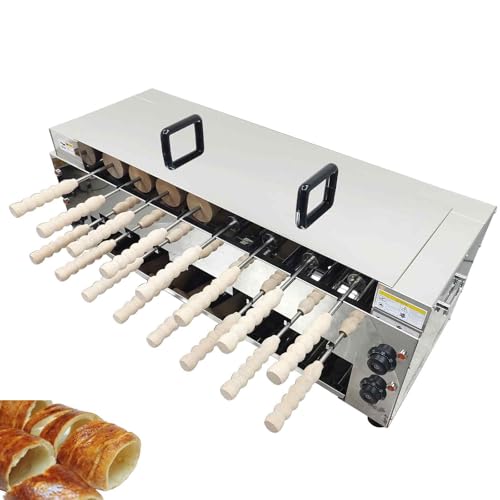
Eight stainless steel roll elements at 6000W make this the workhorse for dessert shops with steady foot traffic. The 220V supply provides enough power to keep all eight rolls baking simultaneously without significant heat drop between cycles. Owners frequently note the visual appeal of eight simultaneous rotations as a sales driver. The unit is physically large and requires dedicated 220V wiring, which adds installation cost. If your shop operates on a standard 110V circuit or your peak demand stays below six cakes per cycle, the 3200W four-seat BEILOCKERY model below delivers similar product with less electrical overhead.
- Eight seats with 6000W provides strong throughput
- All-stainless roll elements for durability
- Requires 220V dedicated circuit and significant floor space
BEILOCKERY Commercial Electric Chimney Cake Maker (3200W, 110V, 8 Seats)
Eight seats on 110V power makes this the most plug-friendly commercial option for US shops that want capacity without electrical renovation. The 3200W spread across 16 roll elements (two per seat) provides adequate but not generous power per chamber, meaning recovery time between batches is noticeable under continuous use. Owners like the flexibility for dessert shops and coffee counters where a dedicated 220V line is unavailable. The tradeoff is that 16 elements at 3200W means each element runs cooler than a 6000W alternative, so browning takes longer. Skip this if you need rapid repeat cycles during peak hours.
- Runs on standard 110V with no electrician needed
- Eight seats for decent batch output
- Lower wattage per element slows cycle times
LQQYJSM Hungarian Cake Pop Roller Machine (3000W, 4 Rollers)
This four-roller machine covers chimney cakes, ice cream cones, and crispy rolls in one unit, making it appealing for shops with a diverse dessert menu but limited counter space. At 3000W across four rollers, power allocation per unit is solid, and owners report even browning across all four positions. The $594.99 price sits comfortably between the two-seat entry model and the larger BEILOCKERY machines. The limitation is capacity: four rollers means four products per cycle, which may bottleneck during rush periods. If your volume justifies a dedicated high-capacity machine, consider the 8-seat BEILOCKERY instead.
- Multi-product versatility (cakes, cones, rolls)
- Good wattage-to-roller ratio for consistent results
- Four rollers cap production below commercial demand levels
Electric Rotary Adjustable Cake Applicator (12L Mini)
At $178.39, this 12-liter mini oven is the most affordable option here, but calling it a “rotary cake oven” stretches the category definition. It is a multifunction toaster-oven hybrid with a rotating spit, capable of baking small cakes and roasting portions. For a home baker wanting an automatic rotating platform for a single cake or a small roast, it delivers surprising utility. For anyone expecting dedicated chimney cake elements or commercial durability, this is the wrong tool entirely. It wins only if your actual need is a compact rotating oven for occasional dessert projects.
- Extremely low price for a rotating oven format
- Multifunction use (toast, bake, roast) in a compact footprint
- Not a dedicated cake roll machine; no chimney elements
32-Tray Commercial Rotary Rack Oven (Digital Temperature Control)
The digital temperature control on this 32-tray oven is the key differentiator against the $7,630 alternative above it. Programmable setpoints and hot air circulation let operators lock in precise profiles for different products without guesswork. Owners running mixed lines (bread one hour, cookies the next) benefit most from repeatability. At $6,860 it also undercuts its sibling by $770, making it the better value in the 32-tray tier. The caveat: digital controllers add failure points compared to simple mechanical dials, and repair requires a technician familiar with the control board.
- Digital control provides repeatable temperature profiles
- Lower price than comparable 32-tray units
- Electronic components add potential repair complexity
BEILOCKERY 220V Double-Layer (6000W, 16 Seats)
Sixteen seats in a double-layer configuration at 6000W makes this the highest-output dedicated chimney cake machine on the list. The stacked design saves floor space relative to spreading 16 rollers across a single tier, which matters in tight retail footprints. Owners at flagship dessert locations report it handles afternoon peaks without queuing. The 220V requirement and $1,379 price tag are non-negotiable commitments. If you run a single shop with moderate traffic, the 8-seat model below costs less and wastes less energy during off-peak hours when you would run half the machine empty.
- 16 seats provide maximum output in a compact footprint
- Double-layer design reduces floor space requirements
- Overpowered for small shops; wasted energy at low volume
Buying Guide
Wattage-to-Seat Ratio Determines Real Output
Divide the machine’s total wattage by the number of seats to get power per element. The 1500W two-seat BEILOCKERY delivers 750W per seat. The 6000W eight-seat delivers 750W per seat. The 3200W eight-seat delivers 400W per seat. Lower per-seat wattage means longer baking cycles and slower recovery between batches. For commercial use, aim for at least 700W per seat to maintain throughput during peak hours. Below 500W per seat, you will consistently fall behind demand.
Voltage Compatibility Is Not Optional
220V machines require a dedicated circuit, often a separate breaker box or a licensed electrician visit costing $150-$400 depending on your building’s existing wiring. If your location already has 220V outlets (common in commercial kitchens), this is irrelevant. If you are in a standard US retail space, the 110V options (the 1500W, 3200W, and the mini oven) are the only realistic choices without infrastructure changes. Factor installation into your total cost, not just the purchase price.
Element Material and Count Affect Longevity
Stainless steel roll elements resist corrosion from sugar and moisture far better than coated alternatives, and all the BEILOCKERY and LQQYJSM units specify stainless construction. Element count also matters: more elements at the same total wattage means each one runs cooler and lasts longer under duty cycle stress. A 3200W machine with 16 elements will outlast a 3000W machine with 4 elements on continuous commercial rotation, even though per-seat power is lower. Replaceable elements reduce long-term operating cost; confirm availability before purchasing.
Our Verdict
The BEILOCKERY 220V 8-seat (6000W, $979) is the top pick for commercial dessert operations. It balances throughput, element quality, and price without the installation overhead of larger units. For budget-conscious home users, the BEILOCKERY 1500W two-seat at $349 is the clear value entry. If you operate a bakery with mixed product lines rather than dedicated cake rolls, the 32-Tray Digital Control oven at $6,860 wins because programmable profiles across 32 trays make it the most versatile unit here.
FAQ
What is a rotary cake oven?
A rotary cake oven uses rotating heating elements shaped like cylinders or cones. Batter is poured or spread over the rotating surface, and as it turns, the heat bakes and browns the product evenly while gravity pulls excess batter away. This creates hollow or rolled cakes like chimney cakes and Kürtőskalács.
Do rotary cake ovens use more electricity than conventional ovens?
Per unit of output, they typically use less because they heat only the product surface rather than an enclosed air cavity. However, commercial units with 6000W running eight hours daily will still generate meaningful energy costs. Calculate watts divided by number of seats to compare efficiency across models.
Can a rotary cake oven bake regular cakes or bread?
Dedicated chimney cake machines cannot bake flat cakes or bread because their geometry only works with cylindrical forms. Rack ovens with hot air convection (like the 32-tray options) are the category crossover products that handle bread, pastry, and sheet cakes. Choose based on whether your product line is exclusively rolled or mixed.
How long do roll elements last under commercial use?
Owner feedback suggests stainless steel elements last several years under normal commercial rotation, with degradation typically appearing as uneven browning before complete failure. The limiting factor is usually mechanical wear on the rotation motor rather than the heating element itself, especially in machines running eight or more hours daily.