Key takeaways
- For one seated person: choose about 50 x 60 inches, at least three settings, a detachable controller, and a two- to four-hour shutoff.
- For tall users or broad recliners: consider 60 x 70 inches, but check that the extra material cannot enter the reclining mechanism.
- For frequent washing: prioritize a detachable controller, reinforced cord connection, smooth fabric, and a clearly stated machine-washable design.
- For pet households: select short-pile or smooth fleece, secure edge binding, and a fabric that tolerates regular lint removal.
- For low energy use: compare wattage, use the lowest comfortable setting, and prefer a timer rather than leaving the blanket continuously powered.
- For evening relaxation: choose a controller with large buttons and an illuminated setting display that is not excessively bright.
The best heated throw blankets are the ones that combine a genuinely useful 50-by-60-inch—or larger—covering with evenly distributed heat, a simple controller, washable construction, and automatic shutoff; the ideal choice depends on whether you need portable warmth, pet-resistant fabric, low energy use, or extra coverage for a sofa.
Best heated throw blankets by situation
| Situation | What to prioritize | Best specification to look for | Trade-off |
|---|---|---|---|
| Small apartment or shared living room | Compact storage and low running cost | 50 x 60 inches, 3–5 heat settings, 2–4 hour shutoff | Less leg coverage than an oversized throw |
| Family with children or pets | Durable, washable fabric and protected controls | Machine-washable shell, detachable controller, low or medium heat setting | Plusher fabrics can collect hair and take longer to dry |
| Renter or office user | Easy portability and a manageable cord | 6–10-foot power cord, lightweight construction, compact controller | Long cords can create a trip hazard if routed across a walkway |
| Back or joint discomfort | Even warmth without pressure points | Low, steady heat; flexible wiring; at least 60 x 70 inches if used over the lap and torso | Heat is for comfort, not treatment of an injury |
| Cold sofa or recliner | Good coverage and secure placement | Oversized 60 x 70-inch throw, elastic straps or a grippy reverse | More fabric and higher wattage may increase energy use |
How large should a heated throw be?
A standard heated throw is usually about 50 x 60 inches. That size covers the lap and torso of one seated adult, but it may leave ankles, shoulders, or the sides of a recliner exposed. An oversized throw around 60 x 70 inches gives better coverage for reading in bed or sharing a sofa, although it is heavier and less convenient to carry between rooms.

Bedsure Heated Blanket Throw Blanket with Preheat Function - Fast Heating Electric Blanket, Soft Flannel Throw with 6 Time Settings(Up to 10H), 6 Heating Settings, Gifts for Grandma (50"x60", Grey)
Included for 'Best Heated Throw Blankets for Warm, Comfortable Lounging' because the listing specifies Fast Heating Electric Blanket and Soft Flannel Throw with 6 Time Settings(Up to 10H), details this guide uses to compare options.
View on Amazon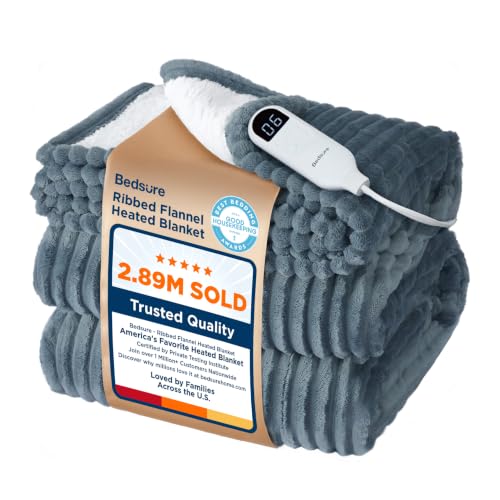
Bedsure GentleSoft Heated Blanket Throw - Soft Ribbed Flannel Electric Blanket, Gifts for Grandma (50x60 inches, Grey)
Included for 'Best Heated Throw Blankets for Warm, Comfortable Lounging' because the listing specifies Soft Ribbed Flannel Electric Blanket and Gifts for Grandma (50x60 inches, details this guide uses to compare options.
View on Amazon
EHEYCIGA Electric Heated Throw Blanket 50"x60", Faux Fur & Sherpa, Grey
Included for 'Best Heated Throw Blankets for Warm, Comfortable Lounging' because the listing specifies Faux Fur & Sherpa and Grey, details this guide uses to compare options.
View on Amazon
Beautyrest Reversible Heated Throw - Plush Sherpa Heating Blanket, Grey
Included for 'Best Heated Throw Blankets for Warm, Comfortable Lounging' because the listing specifies Plush Sherpa Heating Blanket and Grey, details this guide uses to compare options.
View on AmazonMeasure the furniture before buying. A throw used on a 20-inch-high sofa seat generally needs enough length to cover the lap without dragging on the floor. If the sofa seat is 24 inches deep and the back cushion is 26 inches high, a 50-inch throw will cover the seated body but may not reach far down the back. A 60-by-70-inch model offers more flexibility, but keep at least 6 inches of fabric away from a floor vent, heater, or fireplace opening.
For a recliner, check the fully extended footrest. Do not allow the blanket to become trapped in the reclining mechanism. On a desk chair, a 50-by-60-inch throw is typically sufficient; on a bed, a heated throw is best treated as personal lap coverage rather than a replacement for a properly sized heated mattress pad.
Heat settings and temperature control
Look for at least three heat settings, while five to ten settings make it easier to fine-tune warmth. More settings do not automatically mean better heating: the important distinction is whether the blanket changes gradually from gentle warmth to a comfortable high setting without hot patches.
A useful controller should have large, tactile buttons, clear numbers, and a display that can be read without turning on a bright room light. A detachable controller is preferable because it makes washing easier and reduces the chance of damaging the electronics. Some controllers use a rotary dial, which is simple to operate, while digital controllers offer more precise timing. For most lounging, a low or medium setting is adequate after the fabric has warmed for 10–20 minutes.
Choose a controller with an automatic shutoff, ideally adjustable from two to ten hours. A two- or four-hour setting suits an evening on the sofa; a longer setting can be useful for extended reading but should not encourage sleeping under a throw. Automatic shutoff is a backup feature, not permission to leave the blanket unattended.
Fabric softness versus durability
| Fabric or construction | Feel and warmth | Advantages | Limitations |
|---|---|---|---|
| Plush polyester or sherpa-style fleece | Very soft, thick, and insulating | Comfortable for cold rooms; hides some creasing | Can trap pet hair, pill with friction, and take longer to dry |
| Microfleece polyester | Soft but lighter and smoother | Dries faster; easier to fold and transport | Usually less lofty than sherpa-style fabric |
| Flannel or brushed fabric | Warm, familiar, and moderately breathable | Often comfortable directly against clothing or skin | May crease and show wear sooner than dense fleece |
| Reversible, two-texture construction | One smooth side and one plush side | Lets you choose between easy movement and maximum softness | Can be bulkier and harder to fold neatly |
For homes with cats or dogs, a smooth microfleece surface is usually more practical than long-pile sherpa. Claws can catch in loose pile, and hair is harder to remove from deep fibers. A tightly stitched edge binding also matters: the perimeter and the area around the controller connection often show wear before the central fabric does.
Washable construction and long-term care
Confirm that the controller and power cord disconnect completely before washing. “Machine washable” should mean the textile can be washed according to the care label after the electronics are removed—not that the complete blanket can go into water. Use the recommended cycle and detergent, avoid bleach unless explicitly permitted, and dry it only as directed. Never reconnect or use a blanket while it is damp.
Do not fold the blanket sharply over the same line every day. Repeated creasing can stress internal heating wires. Store it loosely rolled or folded in broad sections, without placing heavy furniture or storage boxes on top. Stop using it if you notice exposed wiring, scorch marks, a damaged connector, unusual odor, or heat concentrated in one area.
Cord length, outlet placement, and energy use
A cord around 6–10 feet is practical for most living rooms, but the right length depends on the outlet rather than the room’s square footage. Measure from the outlet to the center of the seating position, then add roughly 2 feet for slack. Keep the cord along the side or rear of the furniture; never run it across a walking route, under a rug, or through a doorway.
Most heated throws use roughly 60–120 watts while actively heating, depending on their size and setting. At 100 watts, using a blanket for four hours consumes about 0.4 kilowatt-hours. At an electricity rate of 20 cents per kilowatt-hour, that is approximately 8 cents of electricity for the session, before accounting for thermostat cycling. Actual consumption is often lower than the maximum rating because the blanket cycles on and off after reaching temperature.
Do not use an extension cord or power strip unless the manufacturer specifically permits it. Plug the blanket directly into a suitable wall outlet, keep the controller away from liquids, and do not use it while folded, bunched, tucked under the body, or covered by heavy objects. Look for recognized electrical safety certification, such as UL or ETL marking where applicable, and follow the product’s instructions.
Which specifications matter most?
- For one seated person: choose about 50 x 60 inches, at least three settings, a detachable controller, and a two- to four-hour shutoff.
- For tall users or broad recliners: consider 60 x 70 inches, but check that the extra material cannot enter the reclining mechanism.
- For frequent washing: prioritize a detachable controller, reinforced cord connection, smooth fabric, and a clearly stated machine-washable design.
- For pet households: select short-pile or smooth fleece, secure edge binding, and a fabric that tolerates regular lint removal.
- For low energy use: compare wattage, use the lowest comfortable setting, and prefer a timer rather than leaving the blanket continuously powered.
- For evening relaxation: choose a controller with large buttons and an illuminated setting display that is not excessively bright.
What to expect to pay
Basic heated throws generally cost about $35–$70. Better-finished models with softer materials, more precise controls, stronger edge binding, or larger dimensions commonly fall around $70–$130. Oversized designs and premium fabrics can cost more. Price should not replace checking the safety certification, warranty terms, washable construction, and controller quality.
Final buying advice
For most people, the best heated throw blanket is a washable 50-by-60-inch or 60-by-70-inch model with five or more useful heat levels, a detachable controller, a 6–10-foot cord, and automatic shutoff. Choose smooth microfleece for easy maintenance, plush fleece for maximum softness, and the larger size only when the extra coverage will not interfere with a recliner, pets, vents, or walkways. The right blanket should add controlled warmth without becoming difficult to clean, store, or use safely.