Key takeaways
- Drawers: Best for toiletries, hair tools, and daily-use items; confirm that plumbing does not consume most of the top drawer.
- Cabinet doors: Better for tall bottles, cleaning supplies, or a plumbing layout that needs open space beneath the sink.
- Open shelves: Easy to access, but expose stored items to dust and bathroom humidity.
- Wall-mounted cabinets: Keep the floor visible and make floor cleaning easier, but require secure attachment to wall framing or an appropriate mounting system.
The best bathroom vanity with a sink is the widest unit that fits your room while leaving usable walking space, matches your plumbing location, and provides enough storage without sacrificing countertop durability. For most bathrooms, a 30- to 36-inch vanity is a practical single-sink choice; compact rooms often need 18 to 24 inches, while larger primary bathrooms can accommodate 48 inches or more.
Quick picks by bathroom and household
| Situation | Best fit | Why it works | Check before buying |
|---|---|---|---|
| Powder room or narrow bath | 18–24-inch wall-mounted or shallow vanity | Leaves more visible floor and walking room | Confirm the basin is deep enough for handwashing and the faucet fits |
| Typical full bathroom | 30–36-inch cabinet with one sink | Balances counter space, storage, and floor clearance | Measure door swings and the distance to the toilet or tub |
| Shared bathroom with limited width | 36–48-inch single-sink vanity with drawers | Offers more organized storage without needing two sinks | Check drawer cutouts around the drain and supply lines |
| Large primary bathroom | 60-inch or wider double-sink vanity | Allows two users to get ready at once | Allow enough counter space between and beside the basins |
| Renters or frequent remodelers | Freestanding vanity with a standard top and accessible plumbing | Usually simpler to replace than a built-in or custom unit | Verify the existing drain and supply locations match |
Choose width by measuring the room, not just the wall
Vanity width is only one part of the fit. Measure the available wall, then account for the door, shower enclosure, toilet, and any drawers that open into the room. A vanity that fits between two walls may still block a door or leave too little space to stand comfortably.

DELUXE LIVING 48" Bathroom Vanity with Sink, Steel Blue, Fully Assembled
Included for 'Best Bathroom Vanities With Sinks' because the listing specifies Steel Blue and Fully Assembled, details this guide uses to compare options.
View on Amazon
LUXOAK 30" Farmhouse Sliding Barn Door Bathroom Vanity with Sink, Brown
Included for 'Best Bathroom Vanities With Sinks' because the listing specifies Brown, details this guide uses to compare options.
View on Amazon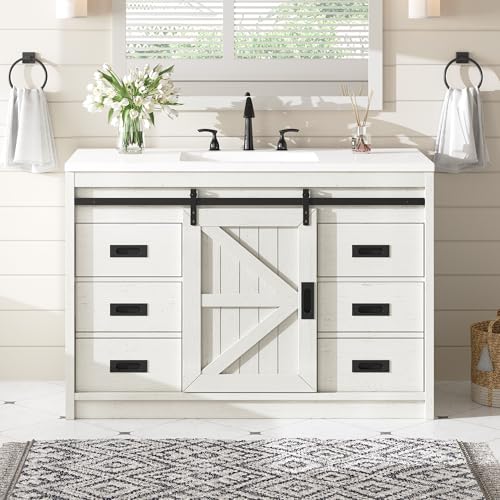
AMERLIFE 48" Farmhouse Freestanding Bathroom Vanity with Sink, Rustic White
Included for 'Best Bathroom Vanities With Sinks' because the listing specifies Rustic White, details this guide uses to compare options.
View on Amazon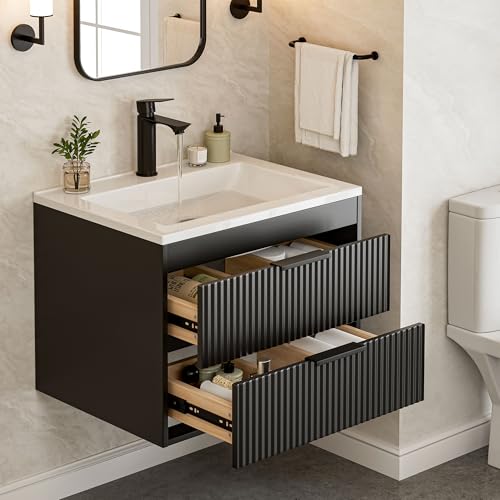
24 Inches Modern MDF Bathroom Vanity with Sink, Wall Mounted Floating Cabinets w/Double Drawers, Black Handles, White Resin Sink Combo Set (Black, 24")
Included for 'Best Bathroom Vanities With Sinks' because the listing specifies Wall Mounted Floating Cabinets w/Double Drawers and Black Handles, details this guide uses to compare options.
View on AmazonAs a planning target, preserve about 30 inches of clear floor space in front of the vanity where possible. Around 21 inches is a common minimum planning allowance, but local codes and accessibility needs may call for more. Check local requirements before remodeling. Also measure depth: many standard cabinets are roughly 18–22 inches deep, while a shallow model can help in a tight bath.
For two sinks, don’t choose by overall width alone. The bowls, faucets, and users need separation. A 60-inch cabinet may fit two compact basins, but a wider unit can provide more comfortable elbow room and counter landing space.
Sink and countertop materials: what holds up best?
| Material | Strengths | Trade-offs | Best for |
|---|---|---|---|
| Vitreous china or porcelain | Nonporous, easy to clean, familiar glossy finish | Can chip or crack from a hard impact; repairs are conspicuous | Everyday family bathrooms |
| Fireclay | Hard, smooth surface with good stain resistance | Heavy; impact damage is possible, and sink dimensions can be less forgiving | Traditional styles and frequent use |
| Solid-surface countertop and basin | Seamless appearance; minor surface marks may be repairable | Can scratch or be damaged by high heat, depending on the product | Integrated sinks and easy-clean designs |
| Quartz countertop | Low porosity and good resistance to everyday staining | Not immune to chips, scratches, or heat damage; seams may be visible | Busy bathrooms that need a low-maintenance top |
| Natural stone | Distinctive natural pattern and a substantial feel | Some stones need sealing and can stain or etch from products | Homeowners willing to follow material-specific care |
A durable top does not compensate for a poorly sealed edge or standing water around the faucet. Look for a backsplash or plan one, and wipe up spills promptly—especially on wood-based cabinets and stone surfaces. For a one-piece integrated sink, inspect how the basin drains and whether the shape leaves enough flat space for soap and toiletries.
Pick a storage layout that works around the plumbing
Drawers make small items easier to find, but the drain trap and supply lines often interrupt the top drawer. A well-designed vanity may use a U-shaped drawer, a false front, or a combination of drawers and doors. Check the interior diagram rather than assuming every drawer is full-depth.
- Drawers: Best for toiletries, hair tools, and daily-use items; confirm that plumbing does not consume most of the top drawer.
- Cabinet doors: Better for tall bottles, cleaning supplies, or a plumbing layout that needs open space beneath the sink.
- Open shelves: Easy to access, but expose stored items to dust and bathroom humidity.
- Wall-mounted cabinets: Keep the floor visible and make floor cleaning easier, but require secure attachment to wall framing or an appropriate mounting system.
Check plumbing, faucet, and assembly before ordering
Measure from the finished floor to the drain center and note the hot- and cold-water supply positions. Compare those measurements with the vanity’s back panel and interior. A cabinet with a solid back may need careful cutouts; moving plumbing can add labor and cost. Make sure the basin’s faucet holes match your faucet: common arrangements include single-hole, widespread, and centerset configurations.
Assembly ranges from a fully assembled cabinet to a flat-packed unit that requires installing the legs, doors, drawers, top, and hardware. Before choosing a model, check whether the countertop and sink arrive attached, whether a faucet and drain are included, and whether the cabinet must be fastened to the wall. An assembled vanity is bulky: measure the narrowest doorway, hallway, stair landing, and turn into the bathroom, not just the bathroom opening. For wall-mounted units, verify the stated load requirements and use the specified anchors or wall framing.
Installation usually involves leveling and securing the cabinet, fitting the top, connecting the faucet and drain, and sealing the backsplash or wall joint. If you are not comfortable with plumbing connections or wall anchoring, include professional installation in the budget. Basic freestanding vanities commonly fall in the $200–$600 range, while wider, double-sink, stone-top, and more substantial-wood options can cost $600–$2,000 or more, before installation.
Which vanity is the best choice?
For a compact room, prioritize shallow depth and a basin that still gives you useful washing space. For a shared family bath, a 30- to 48-inch single-sink cabinet with practical drawers often stores more effectively than a cramped double-sink setup. For a primary bath, consider a wider double vanity only if the room preserves comfortable passage and the plumbing can serve both bowls. In every case, confirm the full dimensions, sink material, drawer clearance, faucet-hole layout, and delivery access before buying.