Our Top Picks
 Family basement, 16–18 ft availableHathaway Merlot 12-Ft Shuffleboard Game Table12-Ft145 x 24 x 31 inches268 PoundsCheck on Amazon
The best shuffleboard tables for home game rooms are Hudson and Champion tables for buyers who want tournament-grade play that lasts decades, Playcraft’s Woodbridge for USA-made quality at a lower price, and Hathaway’s Merlot (12 ft) or Excalibur (9 ft) for families on a budget. Length is the first decision, because a shuffleboard table needs a long, narrow room – and the length you can fit narrows the shortlist faster than any feature.
Start with length: what your room can actually hold
Players stand at the ends of the table, not the sides, so you need clear space beyond each end, plus a walkway along one side. Tables are only about 20–24″ wide, but the room still needs width for people to pass.

VEVOR Shuffleboard Table, 9 ft Shuffleboard for Family Game Rooms, 2 in 1 Shuffleboard and Bowling Combo Game Set, with Scratch-Resistant Playfield, Legs, 8 Pucks, Bowling Set, Wax, and Table Brush
Chosen because it specifies 9 ft Shuffleboard for Family Game Rooms and 2 in 1 Shuffleboard and Bowling Combo Game Set.
View on Amazon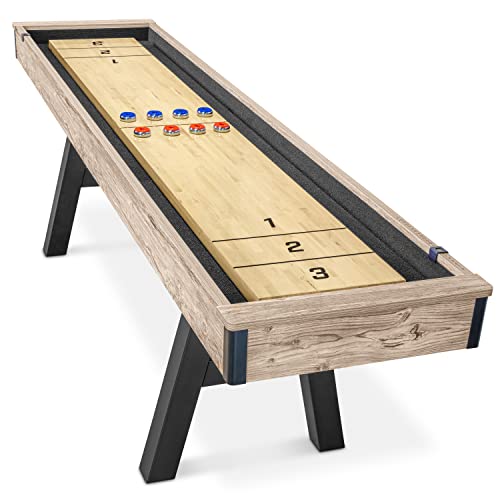
GoSports Premium 9 ft Shuffleboard Table with 8 Pucks, Shuffleboard Wax, and Brush
Chosen because it specifies Shuffleboard Wax and and Brush.
View on AmazonHathaway Merlot 12-Ft Shuffleboard Game Table - Walnut Finish | Lacquer-Coated Playfield, Built-In Scorers, Storage, Climate Adjusters, Leg Levelers, 8 Pucks, Brush, Wax Great for Rec Rooms
Chosen because it specifies Walnut Finish and Lacquer-Coated Playfield.
View on Amazon
VEVOR 9 ft Shuffleboard Table, Scratch-Resistant Playfield for Smooth, Fast Puck Action, Pedestal Legs with Levelers for Optimum Stability, Shuffle Board w/ 8 Pucks, Wax, Brush, for Family Game Room
Chosen because it specifies Scratch-Resistant Playfield for Smooth and Fast Puck Action.
View on Amazon| Table length | Minimum room length | Recommended room width | Typical weight | Feel of play |
|---|---|---|---|---|
| 9 ft | ~13 ft | 7–8 ft | 150–300 lb | Fast, casual, fewer strategic shots |
| 12 ft | ~16 ft | 7–8 ft | 250–450 lb | Good balance for families and parties |
| 14 ft | ~18 ft | 8 ft | 400–550 lb | Closer to bar play |
| 16 ft | ~20 ft | 8 ft | 500–700 lb | Serious home play |
| 22 ft | ~26 ft | 8–9 ft | 800 lb+ | Tournament length |
The rule of thumb is table length plus about 2 ft at each end for players to stand and slide. A typical 13 x 20 ft basement rec room fits a 16 ft table along the long wall; a 12 x 14 ft spare room realistically fits a 9 ft table.
The tables worth shortlisting
Hudson Grand Hudson and Hudson Metro – best overall build
Hudson builds its tables around a 3″ thick butcher-block playfield with a hard polymer finish that resists chips and cracks. The Grand Hudson is the flagship with traditional styling, while the Metro offers a cleaner, modern cabinet. Both come in lengths from 9 ft up to 22 ft and include climate adjusters to keep the surface level and properly crowned. Expect roughly $4,000 to well over $8,000 depending on length and finish.
Champion shuffleboard tables – best for long-term durability
Champion is a made-in-USA brand with solid hardwood cabinets, thick playfields and climate adjusters across most models. Champion tables are known for keeping their play quality for many years, which is why they show up in bars as well as homes. Shorter models such as the 7 ft Bank Shot suit smaller rooms, while longer tables reach tournament length. Prices typically run from about $3,000 to $8,000+.
Playcraft Woodbridge – best value in USA-made tables
The Playcraft Woodbridge offers a solid butcher-block playfield, climate adjusters and furniture-style cabinetry at a lower price than Hudson or Champion. It comes in multiple lengths, with the 12 ft and 16 ft sizes being the most popular for homes. Expect roughly $2,500–$5,000.
Hathaway Merlot 12 ft – best budget 12-footer
The Merlot uses a 1.75″ solid birch butcher-block playfield, a thickness normally seen on more expensive tables, along with climate adjusters and pucks included. It is a sensible step up from entry-level tables without moving into the premium price tier, usually around $1,500–$2,500.
Hathaway Excalibur 9 ft – best for smaller rooms
The Excalibur fits most finished basements and bonus rooms without dominating the space. The cabinet uses engineered wood rather than solid hardwood, so it will not feel as substantial as a premium table, but it plays well for casual games. Prices are commonly around $600–$1,000.
Quick comparison
| Table | Lengths | Playfield | Climate adjusters | Typical price range |
|---|---|---|---|---|
| Hudson Grand Hudson / Metro | 9–22 ft | 3″ butcher block, polymer finish | Yes | $4,000–$8,000+ |
| Champion (various) | 7–22 ft | Thick hardwood, polymer finish | Yes (most models) | $3,000–$8,000+ |
| Playcraft Woodbridge | Multiple, 12 and 16 ft common | Solid butcher block | Yes | $2,500–$5,000 |
| Hathaway Merlot | 12 ft | 1.75″ birch butcher block | Yes | $1,500–$2,500 |
| Hathaway Excalibur | 9 ft | Wood playfield, engineered cabinet | Basic leg levelers | $600–$1,000 |
Features that change how the table plays
Playfield thickness and material
Thicker butcher block (1.75–3″) stays flat longer and resists warping as humidity changes. Thin or finger-jointed playfields on budget tables can develop low spots over time, and pucks start curving unpredictably.
Climate adjusters
Climate adjusters are bolts under the playfield that let you add a slight crown or correct sagging as the wood moves with the seasons. They matter most in basements and homes with big humidity swings between summer and winter. A table without them is fine in a climate-controlled room, but it cannot be tuned if the surface drifts.
Finish and wax
Premium tables use a hard polymer coating over the wood. You play on that coating, sprinkled with shuffleboard powder wax (also called sand). Different speed grades of wax change how far pucks glide; families usually prefer faster wax on shorter tables so pucks reach the scoring zone easily.
Gutters and scoring
Padded gutters keep noise down and protect pucks. Electronic scoring is a nice extra at parties, but an abacus-style scorer is cheaper and never needs batteries.
Decision guide
- Game room under 14 ft long: a 9 ft table such as the Hathaway Excalibur, or a 7 ft Champion if you want premium build in a small space.
- Family basement, 16–18 ft available: a 12 ft Hathaway Merlot for budget, a 12 ft Playcraft Woodbridge for USA-made durability.
- Dedicated entertaining space, 20 ft+: a 16 ft Playcraft or a Hudson or Champion at 16–18 ft.
- Players who want bar or league feel: Hudson or Champion at 20–22 ft.
Delivery, setup and floors
- Weight: A 12 ft table often weighs 300 lb or more, and longer tables exceed 500 lb. Many premium tables include white-glove delivery and setup; ask before ordering, because carrying a butcher-block playfield down basement stairs is a job for a crew.
- Stairs and turns: The playfield ships as one long piece. Measure stairwell turns and landings; a 16 ft playfield may not make a tight 90-degree basement turn.
- Floor: Leveling is critical. Concrete basements are ideal. On suspended wooden floors, place the legs over joists where possible and expect to re-level after the first few weeks.
- Humidity: Aim for a stable 40–55% relative humidity. A dehumidifier in a damp basement protects the investment more than any accessory.
Bottom line
Measure the room before you look at brands: length plus about 4 ft is the space you need. Within that limit, buy the thickest solid playfield with climate adjusters you can afford. Hudson and Champion are the long-term choices, Playcraft gives the most quality per dollar, and Hathaway makes shuffleboard possible for families who want a 9 or 12 ft table without premium pricing.