Key takeaways
- Pro: Four fan speeds and two mist modes offer more control than most units at this price.
- Pro: Timer function eliminates overnight guesswork about running time.
- Con: 1000ml tank runs dry faster than larger competitors, meaning refills interrupt sleep.
A dorm room gets hot, cramped, and loud in equal measure, and the air conditioner you pick has to solve all three without tripping the breaker, filling the room with noise, or costing more than a semester’s worth of meals. The eight products here span from sub-$10 USB coolers to a $400 smart unit that can handle a full apartment, and the gap between a genuinely useful purchase and a frustrating one is surprisingly narrow.
What separates a good dorm air conditioner from a bad one comes down to cooling method (true compressor-based AC versus evaporative), room-size compatibility, noise level at sleep distance, and whether the unit fits your specific dorm setup. A window AC delivers real cold air but needs a window you can open and permission from housing. A portable evaporative cooler works almost anywhere but depends on low humidity to feel effective. This guide compares specs and owner feedback across all eight to help you match the right type to your room.
Our top picks




As an Amazon Associate we earn from qualifying purchases at no extra cost to you.
Quick Picks
| Product | Best for | Price |
|---|---|---|
| Upgraded Cooling Fan 1000ml | Basic personal cooling on a strict budget | $29.99 |
| Personal Evaporative Cooler 1200ML | Desk or car use with ice-enhanced mist | $61.99 |
| GE Window 5,000 BTU | Small dorm rooms up to 150 sq ft with a window | $171.92 |
| PNTCK 3-IN-1 Swamp Cooler | Medium rooms needing a remote and long timer | $119.99 |
| Mini AC with LED Display 1000ML | Nighttime use with ambient lighting | $29.99 |
| 4-in-1 Mini AC USB 1000ml | Lowest possible cost, USB-powered spot cooling | $9.99 |
| GE Window 6,000 BTU | Rooms up to 250 sq ft with digital controls | $190.85 |
| GrowthWing 14,000 BTU Smart WiFi | Large spaces and smart-home integration | $399.99 |
How We Picked
We evaluated each unit on four criteria: cooling type and rated coverage area relative to typical dorm sizes, noise characteristics for sleep-adjacent placement, setup requirements (window access, exhaust venting, power draw) that affect housing compliance, and overall value when comparing price to features like timers, remotes, and water tank capacity. Products that failed on any one of these—too loud for a bed-side position, requiring a window that dorms often prohibit, or drawing too much amperage for shared circuits—were flagged as situational rather than eliminated outright.
The 8 Best Dorm Air Conditioners in 2026
Upgraded Cooling Fan with 1000ml Water Tank
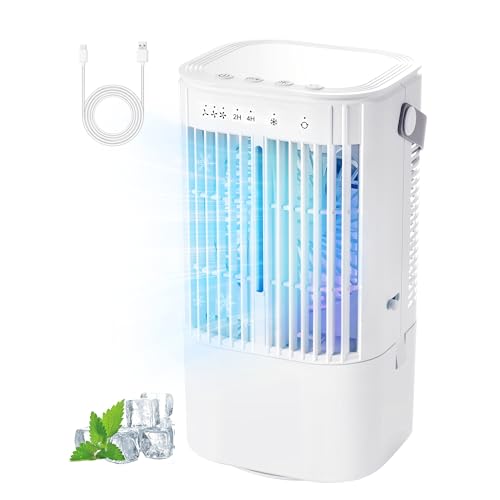
This is a true entry-level evaporative cooler designed for one person sitting within arm’s reach. Owners appreciate the 4-speed fan and dual mist modes for the price, and the ultra-quiet rating makes it tolerable next to a bed. The 2-to-6-hour timer covers a full sleep cycle without manual shutoff.
- Pro: Four fan speeds and two mist modes offer more control than most units at this price.
- Pro: Timer function eliminates overnight guesswork about running time.
- Con: 1000ml tank runs dry faster than larger competitors, meaning refills interrupt sleep.
Skip this if you need to cool anything beyond a desk area or a single pillow zone.
Personal Evaporative Air Cooler 1200ML
The 1200ML tank and ice cooling mist feature push this slightly above basic USB fans. It works on a desk, in a car, or beside a dorm bed, and the Ivory White finish is low-profile. Owner feedback highlights the versatility of three distinct use cases from one small unit.
- Pro: Larger tank than comparable units means longer runtime between refills.
- Pro: Ice cooling mist noticeably drops perceived temperature at short range.
- Con: Car and RV use implies a power adapter may be needed, adding cost and a cable.
Pass on this if your room is above 100 sq ft; it simply cannot move enough air to matter.
GE Window 5,000 BTU
This is the most affordable true compressor AC on the list and the only one that will genuinely drop room temperature in a standard 150 sq ft dorm. Manual controls mean no remote, but easy install kit and two cooling modes keep setup straightforward. GE’s brand reliability shows in owner reports of multi-season durability.
- Pro: Compressor cooling works regardless of ambient humidity, unlike evaporative units.
- Pro: Rated for 150 sq ft, which covers most standard dorm rooms.
- Con: Requires an openable window and housing permission that many dorms restrict.
If your room lacks a compatible window or management forbids them, this entire category is off the table.
PNTCK 3-IN-1 Swamp Cooler
The standout here is the 2.1-gallon water tank and 12-hour timer, which together mean you can fill it Sunday night and forget about it until Monday morning. A remote control adds convenience, and the ice packs boost evaporative output beyond what water alone achieves. It handles bedrooms and small offices without complaint.
- Pro: Largest water tank on this list supports extended unattended operation.
- Pro: Included ice packs enhance cooling effectiveness in dry conditions.
- Con: Bulkier footprint than mini units; tight dorm floors may struggle to accommodate it.
Skip if space is extremely limited or you need something you can tuck under a bed during the day.
Mini AC with LED Display 1000ML
This unit doubles as a humidifier and night-light with seven selectable colors, which appeals to students who want sleep-friendly ambient lighting without a separate lamp. The 4-in-1 claim covers cooling, humidifying, misting, and light functions. The LED display confirms settings at a glance in a dark room.
- Pro: Built-in humidifier helps in dry climates where evaporative cooling alone dries the air further.
- Pro: Seven-color LED replaces a separate night-light, reducing clutter on a nightstand.
- Con: Cooling capacity is minimal; this is a comfort device, not a room-cooling unit.
Do not expect it to lower room temperature meaningfully—use it as a personal comfort aid.
4-in-1 Mini AC USB 1000ml
At under ten dollars, this is the absolute floor price for any unit claiming “air conditioner” in its name. USB power means it runs off a laptop or adapter, and three speeds with an LED light cover basic personal cooling. It is a proof-of-concept purchase: cheap enough to try, disposable enough to replace without regret.
- Pro: USB-powered flexibility lets you run it anywhere a laptop charges.
- Pro: Lowest price point removes all purchase anxiety.
- Con: Cooling effect is limited to direct airflow at very close range, roughly within two feet.
Skip if you genuinely need relief from a stuffy room rather than a breeze on your face while studying.
GE Window 6,000 BTU
Stepping up from the 5,000 BTU model, this unit covers 250 sq ft—enough for larger dorm suites, studio apartments, or shared rooms. Digital controls with a remote, Energy Saver mode, and a 24-hour timer address the main complaints about manual window units. The easy install kit remains included.
- Pro: Remote control and digital display eliminate the need to stand on a bed to adjust settings.
- Pro: Energy Saver mode reduces electric bills, which matters on a student budget.
- Con: Higher price and power draw may exceed what shared dorm circuits comfortably handle.
Check your room’s amperage limit before committing; this unit draws significantly more than any portable evaporative cooler listed.
GrowthWing 14,000 BTU Smart WiFi
This is the only unit that can cool up to 700 sq ft, making it overkill for a dorm but ideal if you are moving into an apartment and want one purchase to last. Smart WiFi with voice control, auto-evaporation (no manual water draining), and quiet operation justify the price for serious cooling needs.
- Pro: Auto-evaporation means no daily bucket-emptying, a common complaint with other portable ACs.
- Pro: WiFi and voice control integrate with smart-home setups for scheduling.
- Con: At $399.99, it costs more than most students spend on an entire semester of supplies.
Skip this if you live in a standard dorm room; you are paying for capacity you cannot use.
Buying Guide
Compressor AC versus Evaporative Cooler
These are fundamentally different technologies. A compressor unit (like the GE window models or GrowthWing) pulls heat from indoor air and exhausts it outside, dropping actual temperature regardless of humidity. An evaporative cooler (most portable units here) blows air through a wet medium, lowering perceived temperature only when humidity is low. In a humid dorm, an evaporative cooler makes the room feel damper rather than cooler. If you live in a dry climate and cannot install a window unit, evaporative works well. Otherwise, prioritize compressor cooling.
Room Size and BTU Matching
Window units are rated in BTUs because compressor cooling capacity scales directly with area. The 5,000 BTU GE covers 150 sq ft; the 6,000 BTU covers 250 sq ft. Portable evaporative units have no BTU rating, so judge them by water tank size and fan speed—bigger tanks sustain longer output, and higher speeds move more air. Undersizing a compressor unit means it runs constantly without reaching set temperature, wasting energy and failing faster.
Power Draw and Housing Rules
Dorm electrical systems often limit per-outlet amperage. A 14,000 BTU portable AC can draw over 12 amps, potentially tripping breakers in older buildings. Even the GE window units pull significant current. Small USB-powered coolers draw under one amp and pose zero risk. Before purchasing any unit above $100, confirm your housing agreement allows window installations and check your circuit’s rated amperage.
Our Verdict
The GE Window 5,000 BTU is the top pick for any dorm that permits window units: it is the cheapest option that delivers measurable, humidity-independent cooling across a standard room. For budget-conscious buyers without window access, the PNTCK 3-IN-1 offers the best balance of tank size, runtime, and convenience features at under $120. If your climate is dry and your room is small, the Personal Evaporative Air Cooler 1200ML edges out the PNTCK on price-per-feature for desk-level cooling.
FAQ
Will an evaporative cooler work in a humid dorm?
Poorly. Evaporative coolers reduce perceived temperature by adding moisture to passing air, so in high-humidity environments the air is already near saturation and the unit delivers little to no cooling benefit. In a humid climate, a compressor-based window unit is the only option that will reliably lower temperature.
Can I use a portable air conditioner without venting?
Not meaningfully. A true portable compressor AC must exhaust hot air outside through a window or wall kit, or it simply recirculates heat back into the room. The evaporative units in this roundup do not require venting, which is why they are popular in dorms, but they also cannot match compressor cooling performance.
How loud are these units at night?
Small USB and mini evaporative fans are generally quiet enough for bedside sleep. Mid-range swamp coolers like the PNTCK produce noticeable airflow sound at higher speeds. Window compressor units generate more low-frequency hum and vibration than any portable evaporative option, which matters if your bed sits directly below the unit.
Do dorms allow window air conditioners?
Policies vary widely. Many older dorms prohibit them entirely due to electrical load and installation concerns, while newer buildings may provide pre-installed units or permit window models with a maintenance request. Always check your housing agreement before purchasing a window unit, because removal obligations and damage deposits can erase any cost savings.