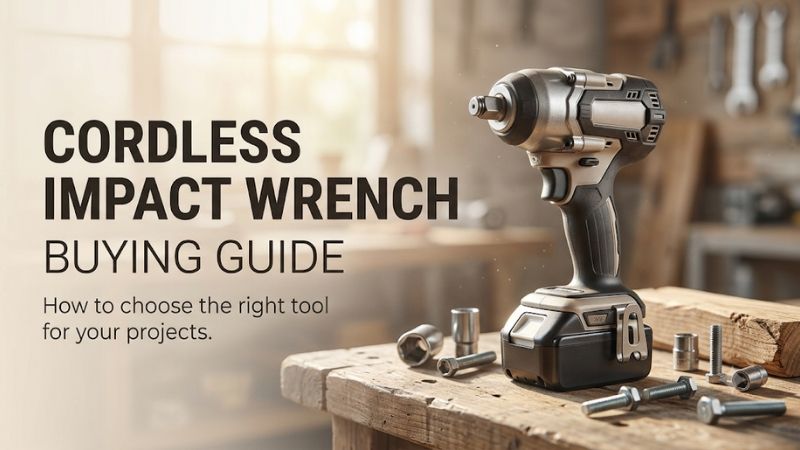
This cordless impact wrench buying guide explains how to choose the right tool for automotive maintenance, DIY projects, and mechanical repairs. Understanding torque ratings, drive sizes, battery compatibility, and working clearance helps you avoid buying an oversized wrench, an underpowered model, or an unnecessarily expensive cordless system.
What Should You Look for in a Cordless Impact Wrench?
The most important considerations are the fasteners you need to work on, the available working space, and the battery platform you prefer.
For many home mechanics, a mid-torque 1/2-inch impact wrench provides a practical balance of removal capability and everyday usability. Compact models suit restricted workspaces, while high-torque equipment is more appropriate for demanding mechanical applications.
An impact wrench should not be selected by its maximum torque rating alone. Speed controls, physical dimensions, anvil configuration, battery performance, and socket compatibility all affect how effectively the tool can be used.
The most suitable wrench is the one that handles your regular jobs safely and efficiently without excessive weight or unnecessary complexity.
Understand the Different Types of Cordless Impact Wrenches
Compact Cordless Impact Wrenches
Compact impact wrenches emphasize manageable dimensions and easier access around closely spaced components. They are particularly useful when working near automotive suspension parts, brackets, smaller machinery, or other areas with limited clearance.
Their shorter housings can reduce interference with surrounding components. However, compact tools often provide less advertised torque than larger models, although capabilities vary substantially.
Buyers should consider a compact wrench when accessibility is the main challenge and the required fastener torque is within the tool’s documented operating capabilities.
Mid-Torque Cordless Impact Wrenches
Mid-torque impact wrenches are frequently a practical choice for home mechanics who perform varied automotive maintenance. They provide greater advertised removal capability than many compact models while remaining more manageable than the largest high-torque wrenches.
This makes them relevant for wheel service, certain suspension repairs, and general mechanical work.
A mid-torque tool does not guarantee success with severely seized fasteners. Nevertheless, its balance of dimensions and output makes it a reasonable starting category for buyers seeking one versatile wrench.
High-Torque Cordless Impact Wrenches
High-torque models prioritize substantial fastening and breakaway capability for larger or more demanding applications. They are commonly considered for heavy automotive repairs, equipment servicing, and stubborn mechanical hardware.
Their additional power comes with practical trade-offs. Larger housings may not fit restricted locations, and heavier tools can contribute to fatigue during prolonged use.
Choose a high-torque wrench when actual workload requirements justify its size, weight, and cost rather than purchasing one simply because it has the highest advertised specification.
Right-Angle Cordless Impact Wrenches
Right-angle impact wrenches position the output drive differently from conventional pistol-grip models. Their shape can help users reach fasteners located beside structural components or in mechanical assemblies with restricted approach angles.
The advantage depends on the exact working geometry. A right-angle tool may provide better access in one direction but still be obstructed by surrounding parts.
Because output capability varies by model, buyers should verify that the wrench offers sufficient torque for the intended fasteners before prioritizing its unusual configuration.
Understand Cordless Impact Wrench Torque Ratings
What Is Fastening Torque?
Fastening torque describes a manufacturer’s stated tightening capability under specified conditions. The advertised maximum may represent output achieved using a particular battery, test fixture, operating mode, or impact duration.
This figure helps identify the general class of a tool, but it is not a calibrated setting for tightening safety-critical fasteners.
The torque applied to an actual joint can vary with battery condition, socket fit, fastener friction, joint stiffness, and operating time.
Use a suitable calibrated torque wrench whenever a final tightening specification must be achieved.
What Is Breakaway Torque?
Breakaway torque, sometimes marketed as nut-busting torque, describes a manufacturer’s stated loosening capability under its test conditions.
It is generally intended to help buyers understand a tool’s ability to remove resistant fasteners rather than establish a precise tightening value.
A wrench with a high advertised breakaway rating may still struggle with damaged threads, severe corrosion, inappropriate sockets, or an unusually difficult joint.
Different manufacturers may use different procedures, so breakaway ratings should not automatically be treated as standardized head-to-head measurements.
Does More Torque Always Mean a Better Tool?
No. More torque can help with demanding fasteners, but it may add weight, bulk, and cost. It can also make a wrench less convenient for smaller mechanical work if suitable low-power controls are unavailable.
A compact or mid-torque model may complete most routine garage tasks more comfortably than a high-torque alternative.
Buyers should prioritize sufficient capability with reasonable control, rather than maximum output without regard to the intended application.
How Much Torque Do You Actually Need?
There is no single torque value suitable for every garage task. Smaller mechanical fasteners may require relatively modest removal capability, while corrosion-affected wheel or suspension hardware can demand substantially more.
The correct starting point is identifying the actual fastener types, required tightening specifications, and likely removal conditions.
Consider using a higher-capability tool or appropriate manual methods when routinely working with difficult fasteners. Do not rely solely on advertised torque figures to predict removal success.
Choose the Correct Drive Size
1/4-Inch Drive Impact Tools
Small drive configurations are associated with lighter fastening applications. However, impact drivers with 1/4-inch hex collets should not be confused with square-drive impact wrenches.
A hex impact driver is primarily designed for compatible driver bits and fastening accessories. Its operating characteristics and attachment system differ from those of a conventional automotive impact wrench.
Buyers working with nuts and bolts should verify whether the tool has the correct square-drive anvil and whether its intended use supports the application.
3/8-Inch Drive Impact Wrenches
A 3/8-inch square-drive impact wrench is a useful option for smaller mechanical hardware and applications where socket size affects access.
It can be more convenient for certain engine, bracket, and equipment maintenance jobs than a larger tool.
However, the actual housing dimensions and torque rating should be checked separately. The drive size does not guarantee a compact body or establish how powerful the wrench is.
1/2-Inch Drive Impact Wrenches
The 1/2-inch square drive is a common choice for automotive impact wrenches, particularly for wheel service and larger mechanical fasteners.
It supports a broad range of impact-rated socket options and is available in compact, mid-torque, and high-torque designs.
For buyers who want one impact wrench to handle a variety of automotive maintenance tasks, a 1/2-inch mid-torque model is often a reasonable place to begin.
3/4-Inch and Larger Drive Impact Wrenches
Larger drive configurations are intended for more demanding fastening applications involving substantial hardware and compatible sockets.
They are generally more relevant to heavy equipment, commercial maintenance, and specialized mechanical work than ordinary household repairs.
Before purchasing, verify the fastener size, manufacturer-recommended equipment, tool output, and required handling characteristics.
Oversized drive equipment is not automatically beneficial for smaller automotive fasteners.
Compare Battery Voltage, Capacity, and Compatibility
Are 18V and 20V Impact Wrenches Different?
Voltage labels require careful interpretation. Some manufacturers describe cordless lithium-ion systems using nominal voltage, while others advertise maximum initial voltage.
For example, certain systems marketed as 20V MAX use a nominal voltage of 18V.
This does not mean the batteries are universally interchangeable or that every tool labeled 20V is identical in electrical design.
Battery compatibility must always be confirmed within the manufacturer’s specified platform.
How Does Battery Capacity Affect Performance?
Battery capacity is commonly expressed in amp-hours. Higher-capacity packs can provide greater energy storage under comparable conditions, potentially extending runtime.
However, amp-hours alone do not establish how much instantaneous power a battery can deliver.
Battery cell design, internal resistance, electrical controls, temperature, and tool compatibility also influence performance.
Some high-torque impact wrenches achieve their highest advertised output only with particular battery packs.
Should You Buy a Bare Tool or Complete Kit?
A bare tool can be economical when you already own compatible batteries and chargers. A complete kit may be more practical when entering a new cordless platform.
Compare the included battery capacity, number of batteries, charger, carrying case, and tool model.
A low bare-tool price can be misleading if the total equipment cost becomes substantially higher than a suitable kit.
Is Battery Platform More Important Than Brand?
For users who already own several cordless tools, platform compatibility can be more valuable than a minor specification advantage.
Sharing batteries and chargers across equipment simplifies storage and reduces the need to purchase redundant accessories.
Nevertheless, platform loyalty should not override important safety, fit, or performance requirements.
Select a different system when your existing platform cannot provide an appropriate tool for the intended workload.
Evaluate Brushless Motors and Speed Controls
Brushless Versus Brushed Motors
Brushless motors use electronic control rather than conventional brushes for commutation. This can provide advantages in efficiency, maintenance requirements, and operating flexibility.
Brushed designs remain capable of performing useful work, particularly where occasional use and purchase cost are major considerations.
Actual tool quality depends on the complete mechanical and electronic design.
Do not assume every brushless wrench is stronger, more durable, or faster than every brushed alternative.
Variable-Speed Triggers
A variable-speed trigger allows the operator to adjust rotational speed through trigger pressure.
This is useful when first engaging a fastener, aligning a socket, or managing the final stage of removal.
The trigger does not directly measure or regulate final fastener torque. Controlled trigger input improves handling but is not a substitute for a torque wrench.
Multiple Power Modes
Selectable operating modes help adapt the tool to different tasks. A lower setting may reduce aggressiveness around smaller fasteners, while higher settings are intended for more demanding removal work.
The number of modes does not automatically indicate better performance.
Check what each mode actually changes, including no-load speed, impact frequency, and any automatic stopping behavior.
Automatic Tightening and Removal Functions
Some impact wrenches incorporate electronic modes intended to reduce rotation after breakaway or limit aggressive initial fastening.
These functions can help control loose fasteners and improve usability in awkward positions.
However, they depend on tool-specific electronic behavior and operating conditions.
Never assume an automatic mode delivers the exact final tightening torque required by a manufacturer.
Choose the Right Anvil and Socket System
Hog-Ring Anvils
A hog-ring anvil uses a retaining ring to secure a compatible impact socket on the square drive.
It is often convenient for users who change sockets frequently during mechanical work.
The actual retention force depends on the design and condition of the ring and socket. Inspect both components regularly and replace damaged parts according to the manufacturer’s instructions.
Detent-Pin Anvils
A detent-pin anvil uses a retention mechanism that engages compatible sockets.
This arrangement can be useful where positive socket retention is desirable, but releasing the socket may require a particular procedure.
Follow the manufacturer’s instructions rather than forcing incompatible sockets onto the tool.
Impact-Rated Sockets
Impact sockets are designed for the loads associated with impact tools. They should be selected according to drive size, fastener dimensions, and intended application.
Ordinary chrome sockets intended for hand tools should not be substituted for impact-rated accessories.
Inspect sockets for cracks, deformation, or excessive wear. A damaged socket can create a serious hazard under impact loading.
Consider Size, Weight, and Ergonomics
Tool Length and Working Access
A short housing can be advantageous when repairing vehicles or machinery with restricted component spacing.
However, tool length alone does not account for the battery, socket, adapter, or available grip clearance.
Measure the working area and consider the complete tool configuration.
A compact impact wrench that comfortably reaches the fastener is often more useful than a stronger wrench that cannot be positioned correctly.
Weight and Operator Fatigue
Heavy impact wrenches can be tiring during overhead work, repeated fastening, or jobs requiring awkward arm positions.
Manufacturer weights may refer to bare tools or configurations with specific batteries.
Compare like-for-like measurements before reaching conclusions about handling.
Consider where the tool’s weight is concentrated and whether you can maintain stable control throughout the task.
Grip Design and Balance
Grip comfort depends on hand size, housing shape, battery placement, and working orientation.
A textured grip can improve handling, but it does not replace correct tool positioning.
Where possible, evaluate the wrench with its intended battery and socket installed.
Pay particular attention to whether the tool can be controlled comfortably during reverse operation and sudden fastener release.
Understand Common Automotive Applications
Changing Wheels and Removing Lug Nuts
An impact wrench can significantly reduce the effort involved in removing properly accessible wheel nuts.
However, successful removal depends on fastener condition, actual resistance, socket fit, and tool output.
When reinstalling wheels, follow the vehicle manufacturer’s tightening sequence and specified torque procedure.
Use an appropriate torque wrench to verify final tightening, and never treat impact duration as a reliable substitute.
Suspension Repairs
Suspension hardware may involve corrosion, substantial fastener loads, and restricted access.
A mid-torque wrench may be suitable for some operations, while heavier work can require additional capability or a different removal method.
Because suspension joints can be safety-critical, use approved procedures and specified replacement hardware where required.
Do not use maximum impact power indiscriminately on damaged, delicate, or unfamiliar assemblies.
Brake Maintenance
Certain brake service operations involve bolts and brackets that may be accessible to an impact wrench.
However, the use of impact tools should be consistent with the vehicle manufacturer’s instructions.
Small fasteners, delicate components, and threaded holes can be damaged by inappropriate impact force.
Controlled hand tools are often preferable for initial installation, with final tightening performed according to the required specifications.
General Garage and DIY Applications
Impact wrenches can assist with machinery maintenance, equipment repair, and other appropriately specified bolted connections.
The suitability of an impact wrench depends on the fastener design, joint requirements, material, and installation procedure.
Some structural anchors and specialized fasteners have restrictions on impact wrench power or installation technique.
Follow the fastener manufacturer’s instructions rather than assuming greater tool power always improves the result.
Common Buying Mistakes to Avoid
Buying Only by Maximum Advertised Torque
Maximum torque numbers can make one wrench appear superior, but they do not provide a complete picture of performance or usability.
Different test methods, battery requirements, and tool dimensions complicate comparisons.
Evaluate the intended workload and available technical evidence rather than relying exclusively on the largest number.
Ignoring the Cost of Batteries and Chargers
A cordless impact wrench requires a compatible power source. Bare-tool pricing may exclude equipment needed for operation.
Compare complete kits, battery capacity, warranty conditions, and existing platform ownership.
For occasional users, the full system cost may be more important than marginal differences in tool specifications.
Purchasing a Tool That Is Too Large
An oversized impact wrench can be difficult to use around suspension components, machinery, and other crowded assemblies.
Before buying, consider the smallest working areas you expect to encounter.
A compact or mid-torque tool may offer greater everyday utility than a high-torque model that is rarely necessary.
Confusing an Impact Driver With an Impact Wrench
Impact drivers typically use a 1/4-inch hex interface for compatible bits and accessories.
Impact wrenches use square-drive anvils intended for sockets and mechanical fasteners.
Although adapters exist for certain uses, they do not automatically provide the retention, mechanical strength, or torque capability of a dedicated impact wrench.
Choose the correct tool category for the application.
Neglecting Safe Tightening Procedures
Impact wrenches are useful for fastening and removal, but their maximum output is not a controlled final torque setting.
Improper tightening can damage threads, deform components, or leave safety-critical joints incorrectly secured.
Use the applicable service procedure and verify final torque with an appropriate calibrated instrument.
Frequently Asked Questions
What size cordless impact wrench is best for beginners?
A mid-torque 1/2-inch impact wrench is a reasonable starting point for many home mechanics. It combines a commonly used automotive socket drive with useful fastening capability. Buyers working mostly on smaller hardware may prefer a compact 3/8-inch model.
Is a cordless impact wrench better than an air impact wrench?
Cordless tools eliminate the need for an air compressor and hose, making them convenient for mobile and home use. Pneumatic tools can be attractive in workshops with established compressed-air systems. The better choice depends on workflow, available equipment, and actual tool performance.
Do cordless impact wrenches need maintenance?
Yes. Keep the housing and vents clean according to the manufacturer’s instructions, inspect the anvil and retention mechanism, and maintain the battery correctly. Remove the battery before adjustments or maintenance.
Can an impact wrench damage bolts?
Yes. Excessive impact force, improper socket engagement, cross-threading, or inappropriate operating settings can damage bolts, nuts, and surrounding components. Use the correct tool and follow specified tightening procedures.
How long do impact wrench batteries last?
Runtime varies with battery capacity, fastener resistance, tool efficiency, operating temperature, and frequency of use. A single advertised amp-hour value does not establish the number of fasteners a wrench can remove under every condition.
Do I need both an impact wrench and a torque wrench?
For automotive and other torque-critical tasks, they serve different purposes. An impact wrench helps turn or remove fasteners quickly, while a calibrated torque wrench is used to verify specified final tightening torque.
Conclusion
This cordless impact wrench buying guide recommends starting with your actual workload, then selecting the appropriate torque class, square-drive size, battery platform, and housing dimensions. A mid-torque 1/2-inch model is a versatile option for many home mechanics, while compact and high-torque tools serve more specialized needs. Always use suitable impact sockets and verify safety-critical final tightening with a calibrated torque wrench.
More from Amazon
Programs that pair well with the guide above. Offers and eligibility are set by Amazon and may change.
Collect the home and kitchen items you want in one registry that guests can shop from.
Create a wedding registrySet up recurring deliveries of everyday items on eligible products. Terms and savings are set by Amazon.
Explore Subscribe & SaveFree shipping on eligible items, Prime Video and more. Eligible new members can start with a free trial.
Start a Prime free trialAudiobooks and podcasts to listen to on the go. Eligible new members can start with a free trial.
Try Audible freeAs an Amazon Associate we earn from qualifying purchases.