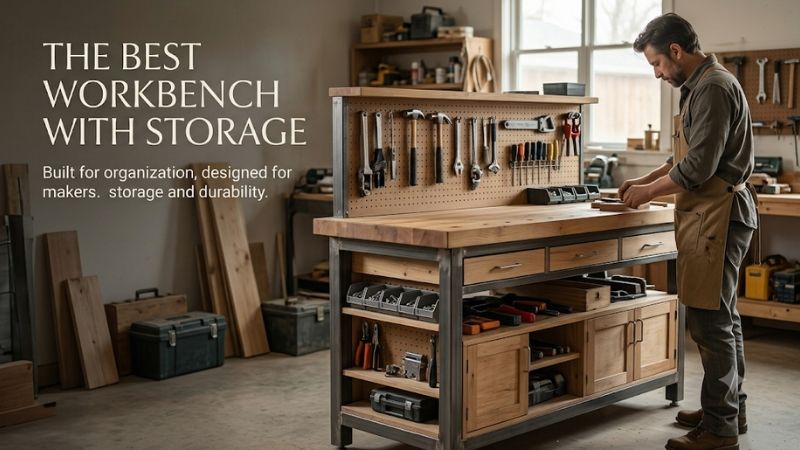
The best workbench with storage keeps the tools you reach for close and leaves enough open surface for the work itself. A shallow rolling cabinet can suit a shared garage, while a lighted station or a hardwood vise bench solves a different problem. These seven options cover everything from small repairs to regular woodworking.
The best workbench with storage for each garage setup
A bench earns its footprint when its storage speeds up your work. Start with the constraint you deal with most often, whether it is a narrow parking aisle, a crowded benchtop, a growing socket collection, or the need to clamp wood securely. Use the table to narrow the field before comparing individual workstations.
| Workbench | Best for | Published size or width | Main storage |
|---|---|---|---|
| Husky H46X18MWC9BLK | General garage repairs and hand-tool organization | 46 × 18 in. footprint | Nine drawers |
| Seville Classics UltraHD UHD20246B | Lighted work and vertical storage | 48 × 24 × 65.5 in. overall | Pegboard, drawer, overhead shelf |
| YUKON 60-in. Hardwood Workbench 58832 | Woodworking and built-in clamping | 60 in. nominal width | Three drawers and lower shelf |
| IKEA BROR 704.943.00 | A shallow fixed station | 33¼? See exact dimensions below | Drawers and bottom shelf |
| Kobalt WB252 | A fixed station with three drawers | Approximately 45 × 24 in. footprint | Three drawers, hooks, overhead storage |
| WEN WB4723T | An affordable workstation with several storage zones | 48 × 25 × 62 in. overall | Two drawers, pegboard, upper and lower shelves |
| YUKON 46-in. Mobile Storage Cabinet 56613 | Rolling storage for a growing mechanic’s tool set | 46 in. nominal width | Nine drawers in two banks |
How the seven workbenches were selected
The rankings use published dimensions, storage layouts, work surfaces, and applicable load ratings. They reflect which model makes sense for a stated job. A short cabinet earns its recommendation through fit, a rolling cabinet through drawer access, and a woodworking bench through how it supports the workpiece.
Start by looking at the kind of storage you actually need. The drawer count matters less than whether a drawer fits your longest socket rails, pry tools, torque wrench case, or measuring equipment. A tall cabinet of shallow drawers may suit a mechanic with hundreds of flat tools. A woodworker with clamps, glue bottles, and stock offcuts may prefer a broad worktop, a few drawers, and open storage nearby.
Also consider the surface you use every day. A pegboard keeps frequently used tools in view. A drawer lets you group related tools and close the workstation at the end of a job. A lower shelf can hold a case that otherwise takes up a third of the worktop. These designs remove different kinds of clutter. The most useful comparison is to picture the exact tools leaving your current surface and give each one a realistic place in the new setup.
Published load figures appear where their scope is clear. A figure for the entire station tells you something different from a worktop limit or a per-drawer rating. This roundup uses the product documentation as its evidence. The recommendations are based on layout and specifications, without claims about measured deflection, long-term wear, or how hard a fully loaded drawer feels to open.
The best workbench with storage models in detail
The models below address seven common garage layouts. Read the reason for each recommendation alongside its main limitation, then compare those details with your tools and your floor plan. A workbench can be well suited to one kind of work and inconvenient for another even when both fit against the same wall.
Husky H46X18MWC9BLK for most home garage repairs
The Husky H46X18MWC9BLK combines a wood work surface with nine drawers in a cabinet that measures 46 inches wide and 18 inches deep. At about 37.1 inches high, it offers a compact standing station for tools such as sockets, combination wrenches, screwdrivers, and pliers that benefit from visible, layered storage.
The shallow depth is especially useful where a cabinet shares a wall with a vehicle. With every drawer closed, the workbench projects 18 inches into the room before accounting for handles or any clearance you choose to leave behind it. It is still necessary to measure drawer travel. A cabinet that fits the parking arrangement when closed can be uncomfortable to use when you need to stand in front of an open lower drawer.
This model includes drawer liners, a push handle, casters with locks, and a power strip. The locking cabinet gives you one way to close up your tool storage after a job. Its roughly 14,000 cubic inches of published storage volume makes sense for accumulated hand tools, but the most useful purchase check is to compare each long or bulky tool with the drawer dimensions. Drawer liners help keep items in place, especially when you roll the cabinet, and separate organizers can make a deep drawer easier to use.
Buy it for routine assembly, maintenance, and a tool set that is outgrowing a single toolbox. Think through a separate stationary surface if your main job involves a bench vise, heavy side loading, or repeated pounding. The casters make the Husky easier to park and reposition. The bench manufacturer’s instructions govern how to secure it and what can be added to the top.
Seville Classics UltraHD UHD20246B for a lighted work station
The Seville Classics UltraHD Lighted Workcenter pairs a 48-by-24-inch footprint with a work light, an overhead shelf, a pegboard, and a wide drawer. Its listed height is 65.5 inches, making this design useful when you have clear wall space and want the tools used for each repair visible directly above the work surface.
The graphite UHD20246B has a 1.5-inch polyurethane-coated wood top. Seville publishes a 500-pound combined rating and identifies separate limits of 295 pounds for the worktop, 60 pounds for the drawer, 45 pounds for the overhead shelf, and 100 pounds for the pegboard. Use the appropriate component limit when planning where an item will go. Place heavy objects in a position and on a component that the manufacturer rates for that use.
The workstation makes particular sense for repairs that involve several small tools and loose parts. You can keep a tape measure, a few drivers, and a pair of pliers on the board, put measuring and marking tools in the drawer, and leave the work surface clear for a component and a parts tray. Its included pegboard hooks give you a starting layout. The shelf is easiest to use for light things you reach for often, provided large objects there do not block your lighting or interfere with the work below.
Measure any low wall cabinet, shelf, or obstruction before ordering. The tall rear structure decides where this bench can fit. There is also only one drawer to divide, so a large socket and wrench collection may be easier to arrange in the Husky or YUKON mobile cabinet. Choose the Seville if the built-in vertical storage solves the clutter you encounter most often.
YUKON 60-in. Hardwood Workbench 58832 for woodworking
The YUKON 58832 is a 60-inch hardwood workbench with three felt-lined drawers, a lower shelf, and a built-in wooden vise. It suits hobbyists who frequently handle boards, make small assemblies, or need a bench that provides clamping and storage together. Its length gives the workpiece and hand tools room to coexist.
The built-in vise is a deciding feature. The manual lists a maximum vise opening of 7¼ inches. Useful opening also depends on the workpiece, any protective pads, and the way you need to position the piece against the jaws. Benchtop pegs give you another way to support suitable stock when working on its face. Think about which end of the bench you will stand at and where a long board will extend before you settle on its location.
The drawers create space for marking tools, chisels stored with suitable edge protection, or small accessory cases. The lower shelf can hold cases and regularly used supplies as allowed by the manual. Harbor Freight publishes a 600-pound combined capacity. That figure covers the workbench as specified and should never be treated as a standalone worktop rating or as evidence that the bench can take any side load you might apply through the vise.
Buy this bench if woodworking is the job that will justify a dedicated workstation. Its top and vise are more relevant to that decision than drawer count. Check the width and location of the available wall before ordering. A 60-inch bench can make a smaller garage awkward if its position blocks access to a door, shelf, or parked vehicle.
IKEA BROR 704.943.00 for shallow fixed work areas
The BROR workbench with drawers, article 704.943.00, is 33½ inches wide, 15¾ inches deep, and 35 inches high. That unusually shallow footprint makes it a candidate for a narrow garage wall, an alcove, or a utility room where a full-depth bench would leave too little standing space in front of the cabinet.
The pine plywood worktop has a listed 132-pound limit, and IKEA publishes 33 pounds per drawer. The model includes a lower shelf, and the drawers have pull-out stops. Its width works for a compact collection of drivers, pliers, tape, bits, and small parts plus a repair project on top. Compare the internal drawer dimensions against the gear you own. A full case, long level, or large socket tray may be easier to store elsewhere.
The short depth is helpful for work with components you can comfortably rotate in a small area. If you plan to assemble cabinet doors, lay out boards across the bench, or set a large tool case on top and open its lid, mock up the 15¾-inch depth first. A cardboard template and the actual object give a clearer answer than the room dimensions alone. The model works well as a focused station for repairs whose workpieces fit the surface.
Check the IKEA article number when shopping. BROR also includes a wider, deeper bench with open shelves. The model described here earns its place on the list for the shallower body and protected drawers. In a single-car garage with a tight parking aisle, those two features can be worth more than greater storage volume.
Kobalt WB252 for a fixed station with three drawers
The Kobalt WB252 gives you a fixed work surface, overhead task lighting, and three drawers in a workstation approximately 45 inches wide and 24 inches deep. Its published working height is 36 inches. The design suits someone who wants to keep the most frequently reached tools visible and divide other supplies among dedicated drawers.
Lowe’s publishes a 100-pound rating for each drawer on this model and lists a light and a magnetic power strip with three receptacles and USB. Use the individual workbench instructions and published drawer limits when placing tools. Heavy drawers are useful when loaded with appropriate items, but fit still matters. A weight rating does little for a long pry bar, a drill case, or a tool tray that meets the inside edge before the drawer fully closes.
The difference between this layout and the one-drawer Seville shows up when several jobs share the bench. You can give measuring and marking tools one drawer, common fasteners and driver bits a second, and machine accessories a third, assuming they fit. On the pegboard or hooks, leave room around frequently used tools so you can replace one without moving its neighbors. An outlet strip and task light are particularly useful when the garage has only general overhead lighting and you do small work at the rear of the surface.
Choose the Kobalt when you want fixed storage, clear separation between drawers, and light at the bench. Measure the whole upright assembly, including its roughly 62.5-inch overall height, when there are shelves or obstacles above it. A nearby outlet also matters if you plan to use the station’s powered features.
WEN WB4723T for affordable all-in-one storage
The WEN WB4723T combines two drawers, upper and lower shelves, a pegboard, a work light, and an outlet assembly. It measures approximately 48 inches wide, 25 inches deep, and 62 inches high. Its mix of storage makes it a practical first workstation when your tools are spread across cases, a shelf, and an old table.
WEN lists a work surface of approximately 47 by 23 inches with a 220-pound capacity and a lower shelf rated for 200 pounds. It lists two 20-by-18-inch drawers. If the fit of a particular organizer is tight, confirm its usable interior clearance before purchasing. Put heavy storage cases where the published rating and layout support their weight, then use the pegboard for smaller tools you can remove without reaching over a project.
A useful way to arrange it is to put hand tools on the board, hardware and measuring tools in the drawers, and cases below. Leave part of the pegboard open until you know which tools genuinely belong there. Filling it on day one can give unfamiliar tools the best positions. The lighting and outlets are part of the workstation. Plan where the supply cord will run and keep the work and drawer paths free of it.
The WEN makes sense if you want several types of storage in one purchase and can accommodate the taller back assembly. Compare its worktop limit with any machine or project you expect to put on it. If your regular work involves clamping at the front edge or installing a permanently mounted accessory, inspect how the surface and frame are built and verify that the manufacturer allows the attachment.
YUKON 46-in. 56613 for rolling mechanic’s tool storage
The black YUKON 56613 is a 46-inch mobile storage cabinet with nine drawers and a wood top. Two drawer banks and deeper bottom drawers combine shallow hand-tool organization with room for bulkier items. It suits a mechanic who needs several distinct areas for tools and values the ability to move the bench between work and parking positions.
Harbor Freight lists approximately 13,200 cubic inches of storage and advertises a 1,200-pound tool-storage load. Read that figure as a storage claim under the product’s stated conditions. It does not establish a limit for an unsupported load at one corner of the wood top or authorize a benchtop attachment. For drawer organization, the separate banks make it natural to put metric and SAE tools on different sides or keep common tools on one side and more specialized gear on the other.
Compared with the Husky, the best reason to choose the YUKON is how well your actual inventory fits its drawer division and the price you can get for the exact configuration. Bring the dimensions of your longest trays and check how the deep drawers fit the cases you plan to keep there. Count the space a case needs to come out of a drawer, including the room your fingers need to lift it.
Choose this YUKON when the majority of your tools can move with the cabinet. Identify a smooth path between its work and parking positions, follow the manufacturer’s directions for moving it, and secure the drawers before rolling. Work with the cabinet appropriately secured once it is in place. Test your garage threshold and floor conditions with the layout in mind before assuming the rolling feature will become part of every project.
Which workbench should you buy for your tools?
Organizing a garage begins with deciding what belongs at this bench and what belongs somewhere else. A large tool cabinet may tempt you to keep every tool within reach. A smaller, focused station is easier to use when the items you reach for on a typical weekend fit in the first place you look.
Match the storage layout to the first five minutes of a job
Think through a repair you do regularly. Picture opening the cabinet, pulling out the tools, setting down the part, and putting aside the fasteners. The best layout makes those movements easy with the project in both hands, the vehicle still inside, or the work surface already partly occupied.
For brake or bicycle accessories, flat tool storage may make the biggest difference. The Husky and YUKON rolling configurations provide several drawers for separating similar tools without stacking them. For small repairs that involve retrieving three or four items from the same area all evening, a vertical station such as the Seville, Kobalt, or WEN can make the common tools more visible. For woodworking, an integrated vise and adequate side clearance may be the main feature that gets used on every session.
Make a simple inventory in three groups. First are the items you use on almost every project. Second are cases and specialty tools that should be close but can be below the surface. Third are supplies you reach for occasionally and can place on an existing shelf. If one affordable model handles the first two groups and lets group three stay where it is, a larger workbench may add little to your day.
It is worth estimating open space after setup. A charger, lamp, fastener organizer, and benchtop vise can consume much more work surface than the product image suggests. Measure the area your project needs after permanent items have taken their space. The published width is only the beginning of the calculation.
Check worktop, drawer, and shelf ratings independently
A high total capacity can make an entire station sound stronger than its actual weakest component. Look for the published limit that applies to the exact place where a machine, tool case, or bin will sit. For an attachment, verify that the manufacturer approves the use and provides suitable instructions.
Evenly distributed weight is different from weight concentrated on machine feet or applied near an edge. A load figure also cannot answer whether a cabinet will rack when you place pressure on a vise. If your main purchase depends on a mounted press, vise, or other accessory, use the directions for that accessory and the workbench together. Where the information leaves the mounting method or reinforcement in doubt, choose a bench designed and documented for the job.
For common home tools, drawer dimensions often matter more than the highest capacity. A rolled-up extension cord may be light but too tall. An organizer full of sockets can be heavy relative to its size. Review the position of frequently used heavy tools and consider how you will lift them out. Storing the heaviest items at an appropriate lower level can make a rolling cabinet easier to manage when done within the manufacturer’s instructions.
Finally, account for the assembly site. Check the path from delivery to the garage, the weight of packages and components, the room you need to assemble the station, and the location of an outlet for lighted designs. A correctly sized bench still becomes a poor fit if you cannot safely bring it in or assemble and place it where it belongs.
Frequently asked questions
For most buyers, storage type and size settle the purchase decision. The final checks are whether the bench works with a parked vehicle, whether its ratings cover the intended work, and whether its drawers fit the tools you already have. These answers address common decisions that remain after a useful shortlist.
Is a workbench with drawers better than one with shelves?
Drawers are useful for small hand tools and accessories you want to sort and protect from ordinary workshop clutter. Shelves accommodate cases, containers, and items you can lift from the front. Choose drawers if retrieving the right item from a mixed box is your recurring problem. Choose shelves if cases are the main things crowding your worktop. A bench with both works when each plays a defined role.
Can a rolling workbench stay in one place permanently?
Yes. Use it as directed with the wheels secured and the cabinet stable during work. Its mobility remains useful if you occasionally need access behind it. Check the product documentation before mounting anything or applying sustained side force. The floors, casters, and intended work determine whether a rolling configuration serves as a good permanent station.
How deep should a workbench be in a garage?
Compare the project and room together. An 18-inch-deep cabinet can be a good fit for work involving hand tools and small parts. A 24-inch-deep workbench adds surface for wider projects and open cases. Measure handles, the installed position, and drawer operation in front of the bench. The correct depth leaves room for both the task and the people using the space.
Will a bench with an included light replace garage lighting?
The included light helps illuminate the work area directly beneath it. General lighting still matters as you carry tools, read labels in lower drawers, and move around the room. If the bench is under a shelf or in a corner, check where your head, hands, and workpieces cast shadows before deciding how much additional task lighting is useful.
Conclusion
Choose the Husky H46X18MWC9BLK for general garage repairs and shallow drawer storage, the Seville UltraHD for a bright vertical workstation, or the YUKON 58832 if clamping wood is central to your work. For a narrow fixed space, start with the BROR 704.943.00 and measure the complete drawer path.
More from Amazon
Programs that pair well with the guide above. Offers and eligibility are set by Amazon and may change.
Collect the home and kitchen items you want in one registry that guests can shop from.
Create a wedding registrySet up recurring deliveries of everyday items on eligible products. Terms and savings are set by Amazon.
Explore Subscribe & SaveFree shipping on eligible items, Prime Video and more. Eligible new members can start with a free trial.
Start a Prime free trialAudiobooks and podcasts to listen to on the go. Eligible new members can start with a free trial.
Try Audible freeAs an Amazon Associate we earn from qualifying purchases.