A ratcheting screwdriver set vs alternatives comparison comes down to how the screw is approached, started, and seated. A ratchet reduces regripping on repeated turns. A fixed driver gives direct feedback, a mini bit ratchet fits shallow gaps, and powered tools save time on jobs with many fasteners.
Ratcheting screwdriver set vs alternatives at a glance
Choose a driver based on the stage that takes the most work. A stuck screw needs a well-seated tip and controlled initial force. A long row of easy screws rewards speed. A screw beneath an overhang may require a shape that lets you work from the side.
| Tool | Best fit | Main trade-off |
|---|---|---|
| Inline ratcheting screwdriver set | Repeated manual turns with straight access | Return resistance can back-drive very loose screws |
| Fixed screwdriver | Precise starting, final adjustments, slim shafts | More regripping on long runs |
| Low-profile bit ratchet | Short overhead room with side access | Requires room for lever sweep and pressure at the head |
| Precision driver | Small screws and narrow wells | Limited leverage for larger fasteners |
| Cordless screwdriver or drill/driver | Many accessible fasteners | Needs room, controlled speed, and an appropriate clutch setting |
| Impact driver | Long or demanding fasteners where impact use is appropriate | Hard to control on small hardware and delicate finishes |
| Torque screwdriver | Assemblies with a specified torque in its range | Requires the right range, bit, and access |
Separate starting, running, and final seating
The tool that starts a screw cleanly can differ from the tool that runs it through ten turns. Separate thread engagement, the middle of the run, and final seating. A manual ratcheting driver can serve several stages when the correct bit fits and the lock is easy to select.
A flat-pack cabinet may have a dozen accessible machine screws. Start each by hand if possible, check that the hardware sits square, then run the fastener while the threads turn freely. A ratchet or a low-speed cordless driver can shorten the middle stage. When the joint draws together, use the method and torque specified for the assembly. Thin wood products and soft inserts can give way quickly at the end of the run.
For removal, the first movement can call for more force than the following turns. Put the tip squarely in the recess and keep pressure along its axis. A fixed or locked driver often gives clear feedback during that first movement. Once the screw breaks free, use the ratchet to advance it without having to reposition the bit after each stroke. If the screw becomes loose enough to follow the return motion, finish by hand where accessible.
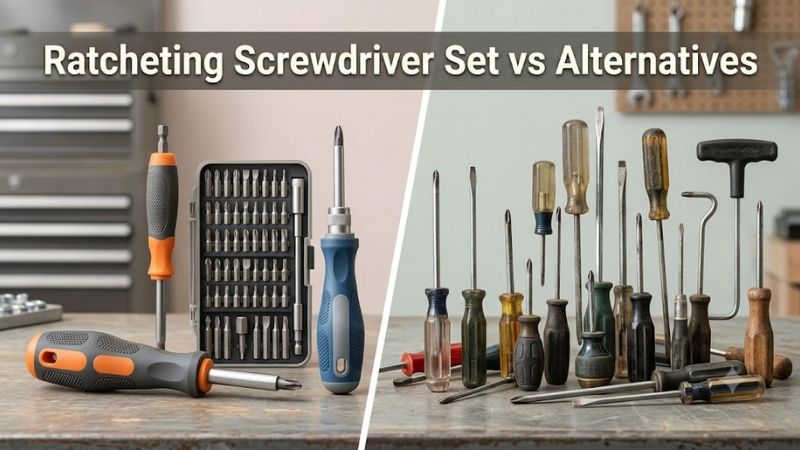
Check the force path and working angle
A straight handle lets you push along the axis of the screw. A lever puts torque beside the screw and changes where you need to hold the bit down. A powered tool adds motor force that can quickly magnify a poor fit. Match the driver to the way your hands can support it.
Phillips and slotted screws can be awkward when the bit is hard to keep square. If the tool comes in at an angle, the tip can lift from the recess. A long handle makes that problem easier to miss if the screw is deep inside a small opening. Use light pressure to confirm the working position before attempting normal force.
A mini ratchet may solve clearance above the screw while needing a free finger near the head to keep it seated. A stubby straight driver can fit in some of the same places with easier axial pressure. Think in terms of complete movement. The appropriate tool has space to enter, work through each stroke, and leave after the screw moves.
How each alternative changes the job
The alternatives differ in speed, access, and feedback. A fixed shaft can reach a deep well. A powered driver reduces repeated wrist movement. A torque screwdriver controls the final setting when the assembly calls for one. Compare a tool against the difficulty that actually slows you down.
Ratcheting set vs fixed screwdriver
A fixed screwdriver has a direct connection from handle to tip. The slim shaft and simple feel can be valuable when a screw is recessed, delicate, or only needs a small adjustment. A ratcheting screwdriver is generally more convenient for repeated turns in a stable position.
Consider tightening a metal latch screw on a door frame. A correctly sized fixed driver is quick to pick up, seat, and turn a quarter rotation. For mounting six hinges, a ratcheting driver can reduce regripping through the middle of each screw’s travel. That time saving depends on a secure fit and enough thread resistance to hold the screw as the handle resets.
A dedicated driver can also have a shaft that is slimmer than an insert holder. A deep screw well may admit a fixed Phillips blade and reject the thicker collar of a multi-bit driver. Conversely, the interchangeable handle earns its place when the same repair moves among different screw sizes. Choose a fixed driver for a frequently used size with special reach or control demands, and a multi-bit ratchet when switching profiles is part of the work.
If you keep both, identify which one you will immediately reach for. Many people can cover routine open screws with a ratchet and reserve one slim fixed driver for a recessed piece of hardware. A large fixed-blade set makes more sense when several profiles need individual shaft lengths.
Ratcheting set vs low-profile bit ratchet
A low-profile bit ratchet puts a short drive head above the screw and the handle beside it. It can reach under a shelf or around a bracket that blocks a long inline handle. Check the installed bit height, the lever arc, and where you will press to keep the bit engaged.
For an underside mounting screw, an inline driver may be blocked before the bit reaches the head. A short direct bit in a side ratchet can fit, assuming there is a way to approach from the side. A mini ratchet with a small nominal sweep helps when the lever cannot travel far. Its useful movement will also reflect the width of your hand and any play in the holder.
The compact arrangement can be slower when a long exposed screw needs many turns. A short lever can also be less comfortable to press into the head. On an open workbench, a straight driver lets you put your palm behind the tip and can be easier to hold square. If you buy a mini ratchet kit with a fixed inline handle, check which handle actually includes the ratchet.
A side ratchet is therefore a useful second tool when one or two recurring locations are physically inaccessible with your normal driver. Choose by the installed geometry with the correct bit, especially if the kit also includes adapters and tall sockets.
Ratcheting set vs precision screwdriver
A precision driver suits small machine screws, narrow recesses, and assemblies that need a light touch. Many kits use smaller bits or dedicated blades. A general ratcheting driver is useful on accessible case screws, while smaller hardware benefits from a tool sized to the recess.
On a computer case, an ordinary Phillips bit can fit a panel screw and leave room to turn it. A small internal screw, such as one deep in a narrow service opening, may call for a precision tip. Access and actual profile determine the choice. Some screws have very shallow heads that can be damaged quickly if a larger driver makes it difficult to feel when the tip starts to climb.
A precision driver with a rotating end cap lets you steady the tool with one finger while turning the shaft. It works well for low resistance and can make thread engagement easier to feel. If a small screw constantly turns backward during a ratchet’s return, this design gives you a direct way to keep progress.
Keep large and small sizes labeled when you work between them. Confirm whether the precision tool takes 4 mm inserts or the specific pieces supplied by its maker. Match the profile and shank before adding an adapter. A tall adapter can undo the reach of a thin shaft.
Ratcheting set vs cordless screwdriver or drill/driver
A cordless screwdriver or drill/driver handles long batches of accessible fasteners with far fewer wrist turns. A manual ratchet offers quick setup and light control on individual repairs. Compare chuck size, speed control, clutch behavior, and how close the tool must work to a finished surface.
For a row of cabinet pulls, a compact cordless tool can spin the screws quickly after you engage the threads. Start with low speed and the lowest useful clutch setting if the tool offers one. Test on scrap or an equivalent joint when practical. Finish delicate parts by hand or use the manufacturer’s specified torque method. A clutch number is a tool setting and may change meaning between tools and materials.
A drill/driver is useful when the same work also calls for making pilot holes. Its body and chuck may require more room behind the screw. An electric screwdriver generally offers a smaller package, depending on the model. Check whether the product includes the controls you need, since cordless screwdrivers vary in speed, clutch behavior, and handle geometry.
For a single repair you can finish in several turns, a manual ratchet can be quicker to retrieve and quieter to run. For repeated furniture assembly, a powered tool can save time while the manual ratchet starts and finishes the tricky screws. Keep the tips organized so both tools use a properly seated bit.
Ratcheting set vs impact driver
An impact driver is mainly useful when a compatible fastener and job benefit from repeated rotational impacts. It can speed heavy fastening. A manual ratcheting screwdriver gives closer control at a small screw, a soft material, or a finished surface where you want a deliberate stop.
Think about driving long construction screws into suitable stock. If the screw and instructions allow it, an impact driver and a suitable impact-rated bit can save time. The advantages are reduced on short appliance covers or small trim hardware. A powered impact can damage a small recess or push a screw past the intended seat before you react.
Check the workpiece as well as the screw. Finished wood, plastic housings, and soft threaded inserts can require a much gentler approach than structural lumber. A normal cordless drill/driver with a clutch offers a middle option for many repetitive jobs. A manual tool is useful for the last turns on assemblies that are easier to feel than see.
Use the tool specified by the hardware maker. An impact driver is a useful purchase for consistently demanding fastening. For occasional hinges and cabinet adjustments, a comfortable manual handle and the right tip address the common jobs directly.
Ratcheting set vs torque screwdriver
A torque screwdriver is useful when the assembly requires a defined torque in a range the tool can measure or control. An ordinary ratchet helps move the screw through repeated turns. Its clicks come from the mechanism indexing. The torque screwdriver provides the measurement or limit.
On a small assembly with a documented tightening specification, check the units and choose a calibrated tool with an appropriate range. Make sure the bit seats fully and the tool fits the available access. Follow the equipment manufacturer’s procedures, including any special requirements for the order of tightening or for rechecking the screw.
The ordinary ratcheting driver can still help run the screw after you start it cleanly. Switch to the specified torque tool when the fastener approaches its seat. Keep both tools tagged if they look similar. Confusing a directional lock with a torque setting can lead to an assembly that feels finished without having met its specification.
Choose a torque screwdriver for repeatable settings when the work requires them. Keep the general ratchet for household jobs where deliberate hand feel is sufficient and the parts manufacturer supplies no specific setting. Some specialty torque tools include their own ratchet or limiting mechanism. Evaluate those features using the exact model’s instructions.
Ratcheting screwdriver set vs alternatives on common jobs
Many repairs benefit from using one tool for access and another for controlled finishing. On furniture, match the recess and check thread alignment. On a bench, favor the tool that keeps light screws moving. In a cabinet, measure the route before choosing a shape.
Furniture assembly and cabinet hardware
Start with the bits listed in the assembly instructions or compare the actual screw heads. Use a manual driver to engage the first threads. On repetitive accessible runs, use a ratchet or a suitable low-speed power driver. Slow down again as the pieces draw together.
If a hinge uses Pozidriv, use the matching tip before deciding whether you need a new driver. If you cannot line up behind a screw because a shelf blocks it, a stubby or side ratchet may make the next turn possible. If the piece is flat-packed, consider whether you can tighten the screw before installing the obstructing panel, where the instructions permit the sequence.
Handle adjustment screws separately from mounting screws. A fixed driver is often enough to make a short alignment correction. A ratchet is more useful on a set of screws that need several turns. Decide from the required motion instead of switching tools midway through every fastener.
Workshop repairs and open bench fastening
An open bench gives enough room to judge grip, backdrag, and bit changes. Use a driver that keeps the screw moving without obscuring the head. A case is convenient when several profiles are involved. A smaller handle matters more as the fasteners get lighter.
Try a practical split between tools. Use the fixed blade to start a tight slotted screw. Move to the ratchet if the screw needs several turns after it comes loose. Save a precision tool for the small recessed fasteners and put each removed screw in a marked tray. Reinstall the screws in their correct places because two visually similar lengths can produce different clearance.
If you are buying a first tool for a household, a ratcheting kit with familiar tips has broad use. Add a fixed or precision driver for recurrent exceptions and a power driver when the quantity of fasteners makes repeated manual turns a real cost.
Decide what belongs in a first household tool kit
A first kit should handle the jobs you can name right now. List an exposed screw, a recessed screw, and a job with many fasteners. Check the actual heads and the space behind each one. Then see whether a ratcheting kit, a few fixed drivers, or a powered tool covers the most work.
Suppose the main tasks are changing kitchen pulls and fitting a small shelving unit. A manual ratchet with the right bits covers a series of easy screws, and a fixed screwdriver can fill the one or two roles where slim reach is important. If the projects include flat-pack furniture every week, a suitable electric driver can save time. If the work centers on a handful of small electronic screws, buy the precision format with the right drive profiles and a narrow working shaft.
A garage with hex nuts may benefit from a compact bit ratchet and socket adapter, provided the stack fits and the fasteners are within the tool’s intended use. For deeper or tightly torqued fasteners, check the appropriate wrench or torque tool. The best first purchase often covers the most frequent use with a comfortable handle and correct bits. Check outlier fasteners individually before paying for a second complete kit.
Account for where the tools will live. An onboard driver keeps common bits together in a small drawer. A labeled case helps on a shared bench with several profiles. If you add a power driver, keep the battery charged and store compatible bits nearby. The choice is easier when you can describe how you will retrieve, use, and put away each tool.
Conclusion
Choose a ratcheting set for repeated manual turns, a fixed or precision driver for direct control, and a mini ratchet when overhead clearance is tight. Use a cordless driver for accessible batches, an impact driver for suitable demanding jobs, and a calibrated torque tool where the assembly specifies a setting.
More from Amazon
Programs that pair well with the guide above. Offers and eligibility are set by Amazon and may change.
Collect the home and kitchen items you want in one registry that guests can shop from.
Create a wedding registrySet up recurring deliveries of everyday items on eligible products. Terms and savings are set by Amazon.
Explore Subscribe & SaveFree shipping on eligible items, Prime Video and more. Eligible new members can start with a free trial.
Start a Prime free trialAudiobooks and podcasts to listen to on the go. Eligible new members can start with a free trial.
Try Audible freeAs an Amazon Associate we earn from qualifying purchases.