Key takeaways
- A sunrise alarm clock is worth considering when you dislike abrupt audible alarms and want a gradual light cue before your scheduled waking time.
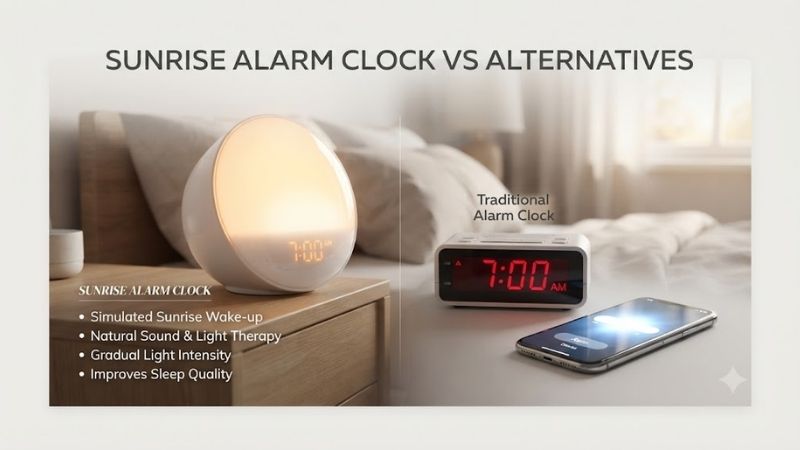
Sunrise alarm clock vs alternatives compares gradual wake-up lighting with traditional alarm sounds, smart bulbs, wearable vibration, and other morning routines. Each approach can help signal wake-up time, but they differ in reliability, light exposure, customization, and cost. This guide explains which option best suits heavy sleepers, early schedules, shared bedrooms, and people who prefer gentler mornings.
Quick Verdict: Is a Sunrise Alarm Clock Worth It?
A sunrise alarm clock is worth considering when you dislike abrupt audible alarms and want a gradual light cue before your scheduled waking time.
The most practical models combine adjustable sunrise brightness with a reliable audible backup. This allows the light to begin the waking process while the sound provides a more definite notification.
However, a sunrise clock is not essential for everyone. A conventional alarm can provide reliable scheduling at lower cost. A smart light bulb may recreate gradual lighting when suitable fixtures and automation already exist. A vibrating alarm or wearable may be more appropriate when one person needs to wake without relying on a bright room-wide light.
For shoppers interested in seasonal mood treatment, a medical light therapy device should not be treated as interchangeable with an ordinary wake-up lamp.
| Wake-up method | Main advantage | Main limitation | Best starting user |
|---|---|---|---|
| Sunrise alarm clock | Gradual light before waking | Light alone may be insufficient | Wants a gentler visual cue |
| Traditional alarm clock | Simple audible notification | Can feel abrupt | Prioritizes straightforward reliability |
| Smartphone alarm | Flexible and already available | Notifications and phone dependence | Wants minimal extra equipment |
| Smart bulb routine | Uses existing room lighting | Requires suitable automation | Already owns smart lighting |
| Vibrating alarm clock | Tactile wake-up cue | Can feel abrupt; setup varies | Prefers vibration |
| Wearable vibration alarm | Personal notification | Requires wearing and charging | Shares a bedroom |
| Light therapy lamp | Provides specified bright-light exposure | Different intended use | Has an appropriate light-therapy plan |
| Natural daylight routine | Uses morning light when available | Depends on season and schedule | Wakes near sunrise |
How Sunrise Alarm Clocks Differ From Ordinary Alarms
A conventional alarm announces the intended wake-up time through sound or vibration.
A sunrise clock begins its main cue earlier by gradually increasing light.
For example, a device set for 7:00 AM might begin illuminating the room at 6:30 AM and reach its chosen final brightness at 7:00 AM.
The intention is to make the transition to waking feel less sudden.
However, it is important to distinguish a pleasant waking experience from a guarantee of improved sleep quality or morning cognitive performance.
Light Is a Biological Signal, Not a Guaranteed Wake-Up Method
Human circadian timing is influenced by light.
The effect depends on when the light is received, how long exposure lasts, its intensity, and its spectral characteristics.
However, a consumer wake-up lamp does not necessarily deliver the same exposure as outdoor daylight or a clinical light therapy device.
People also respond differently to gradual illumination.
Some may wake before the audible alarm. Others may remain asleep until the sound begins.
A product that offers both light and sound generally provides more practical flexibility than a light-only design.
Placement Can Matter as Much as Maximum Brightness
A lamp placed behind furniture may illuminate the room without directing much light toward the sleeper.
A clock positioned close to the pillow may produce a much stronger perceived light cue at a moderate setting.
Therefore, advertised lux values cannot be interpreted meaningfully without considering measurement distance and light distribution.
Two products listing the same maximum lux may deliver different actual exposure at the bed.
Sunrise Alarm Clock vs Traditional Alarm Clock
A traditional digital alarm clock provides a straightforward audible notification.
It may be the better purchase when simplicity and clear alarm operation matter more than gradual light.
Reliability
A conventional alarm does not depend on the user seeing a light source.
That may be an advantage for someone who sleeps with an eye mask or faces away from the nightstand.
However, any electronic alarm can be affected by power issues, settings, or mechanical failure.
Check power-backup behavior rather than assuming a particular category is infallible.
Waking Experience
A sudden sound may feel unpleasant to some sleepers.
A sunrise sequence may provide a more gradual transition, especially in a dark room.
However, some people prefer a simple alarm that does not introduce extra light before the intended time.
The better approach is partly personal preference.
Simplicity and Cost
A conventional alarm typically requires fewer lighting controls and can occupy relatively little space.
For someone who wakes comfortably with a normal alarm, a sunrise clock may add complexity without a meaningful benefit.
Which Is Better?
Choose a conventional alarm for simplicity and familiar sound-based waking.
Choose a sunrise clock when gradual lighting is a specific feature you want to experience.
Sunrise Alarm Clock vs Smartphone Alarm
Smartphones already provide flexible alarm scheduling, making them the most accessible alternative for many people.
They can store multiple wake-up times, different sounds, and recurring schedules.
However, using a phone as an alarm also means keeping a multipurpose device near the bed.
Scheduling Flexibility
A phone can generally support multiple alarms and repeating schedules.
This may be sufficient for someone with a changing work routine.
Many dedicated sunrise clocks offer fewer scheduling options unless they include sophisticated software.
Sleep Environment
Keeping a phone beside the bed may encourage late-night screen use or checking notifications.
A dedicated sunrise clock can reduce the need to interact with a phone during the bedtime and morning routines.
However, purchasing a separate device does not automatically improve sleep habits.
The benefit depends on how the user actually behaves.
Power and Notifications
Phone alarms can be affected by configuration, power state, and software settings.
Similarly, dedicated wake-up lamps have their own power and scheduling limitations.
Understanding the particular device is more useful than declaring one category universally reliable.
Which Is Better?
Choose a smartphone alarm when flexible scheduling and avoiding another purchase are priorities.
Choose a dedicated sunrise clock when you want gradual light and simpler separation from the phone.
Sunrise Alarm Clock vs Smart Light Bulb
A smart light bulb can be programmed to increase brightness gradually.
When the household already uses connected lighting, this may recreate much of the visual experience of a dedicated sunrise clock without adding a separate lamp.
However, smart lighting and sunrise clocks differ in placement, controls, and reliability.
Whole-Room Lighting
A ceiling fixture or bedside smart bulb may illuminate a larger area than a compact wake-up clock.
This can be useful for one person sleeping alone.
In a shared bedroom, however, whole-room illumination may disturb another occupant.
A dedicated lamp positioned closer to one side of the bed may provide more localized light, although reflections still spread through the room.
Automation and Scheduling
Smart bulbs may support gradually increasing brightness through an application or automation platform.
The available features depend on the bulb, hub, and software.
Not every bulb offers a smooth fade over a desired duration.
Some systems require multiple programmed steps or specific connectivity.
Color Temperature
Certain smart bulbs support warm-to-cool color changes.
Others permit only brightness adjustment.
A bulb with RGB capability does not necessarily provide a high-quality sunrise simulation.
Evaluate the exact automation rather than assuming that colored lighting guarantees a realistic dawn.
Reliability
A smart bulb routine can depend on local networking, cloud services, or a hub.
Some automations may continue locally, while others require a connection.
The behavior is system-specific.
For important wake-up times, a separate audible alarm can provide useful redundancy.
Which Is Better?
Choose a smart bulb routine when compatible lighting already exists and you want gradual room illumination.
Choose a dedicated sunrise clock when you prefer an integrated bedside interface and audible backup.
Sunrise Alarm Clock vs Vibrating Alarm Clock
A vibrating alarm provides a tactile notification rather than depending entirely on light or sound.
Some use a vibrating unit placed beneath a mattress or pillow, while others are incorporated into wearable devices.
The mechanism and suitability vary.
Tactile Waking
Vibration may be useful for someone who responds more readily to physical movement than to light.
It can also offer another type of notification for users with specific hearing needs, although exact equipment suitability should be evaluated individually.
A vibrating alarm can feel abrupt, depending on intensity and placement.
Shared Bedroom Considerations
A vibrating device may disturb a partner less than a bright light or loud alarm.
However, vibration can travel through a mattress or bed frame.
It should not be assumed completely private.
Setup and Compatibility
Some vibrating systems require placing a unit beneath the pillow or mattress.
The effectiveness can depend on mattress construction and positioning.
Follow the manufacturer’s instructions and avoid arrangements that introduce unsafe cables or unstable equipment.
Which Is Better?
Choose vibration when a tactile cue is more useful than light.
Choose a sunrise clock when a gradual visual transition is the main preference.
For some sleepers, using a suitable combination of cues may be practical.
Sunrise Alarm Clock vs Wearable Alarm
Wearable devices commonly provide vibration at a programmed time.
Unlike a room-wide alarm, the notification occurs directly on the person wearing the device.
This can be useful for couples or roommates who wake at different times.
Personal Notification
A wrist-worn alarm may be less disruptive to another person than a bright sunrise lamp.
However, its effectiveness depends on the user’s sensitivity to vibration and the device’s settings.
Some people sleep through gentle vibration.
Sleep Comfort
Wearing a watch or other device overnight may be uncomfortable.
A person who dislikes wrist accessories may prefer an alarm that remains on the nightstand.
Battery and Charging
Wearable alarms require enough battery power to remain operational until morning.
This introduces another routine to manage.
Some devices also offer sleep tracking, but tracking does not automatically improve sleep or waking.
Smart Wake-Up Claims
Certain wearables attempt to time alarms based on estimated sleep stages.
These estimates depend on sensors and algorithms rather than direct clinical sleep measurements.
Do not assume a consumer device can precisely identify the ideal moment to wake every person.
Which Is Better?
Choose a wearable when personal vibration and compactness are priorities.
Choose a sunrise alarm when gradual illumination is more appealing than wearing equipment overnight.
Sunrise Alarm Clock vs Light Therapy Lamp
This is one of the most important distinctions because the two products are sometimes discussed as if they serve the same purpose.
A sunrise alarm clock is designed primarily to simulate increasing morning light near wake-up time.
A light therapy device is intended to deliver light exposure according to a specific protocol.
Different Intended Uses
A consumer wake-up clock may help create a more pleasant morning environment.
A clinical light therapy plan may involve a particular intensity, timing, duration, and device configuration.
Those variables cannot be inferred from the word sunrise.
Brightness Ratings Are Not Interchangeable
Some light therapy devices advertise exposure levels such as 10,000 lux at specified distances.
A sunrise clock may advertise a much lower maximum illuminance.
Even when two products list lux values, their measurement conditions and intended use may differ.
A consumer clock should not be treated as a substitute for prescribed therapy simply because it produces bright light.
Medical Considerations
Light therapy may require special caution for people with certain eye conditions, photosensitizing medications, or bipolar disorder.
A clinician can help determine whether and how such treatment is appropriate.
A general-purpose sunrise alarm should not be marketed as a guaranteed treatment for seasonal affective disorder.
Which Is Better?
Choose a sunrise clock for a gradual waking routine.
Use a suitable light therapy device only when it fits an appropriate treatment plan.
Sunrise Alarm Clock vs Natural Morning Light
Natural daylight provides a broad light environment that varies through the morning.
A sunrise clock offers a more predictable scheduled cue when natural daylight is unavailable or insufficient at waking time.
The two are complementary rather than interchangeable.
Early Work Schedules
Someone who wakes at 5:30 AM during winter may have little or no natural daylight available.
A sunrise clock can provide a visual cue before leaving bed.
However, the person may still benefit from suitable natural daylight later in the morning.
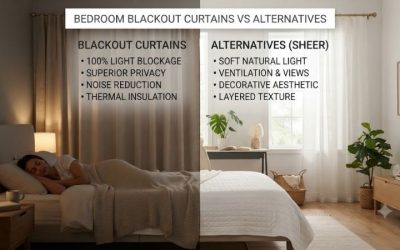
Blackout Curtains
A dark bedroom may make a simulated sunrise more noticeable.
However, using blackout curtains and a wake-up lamp is a convenience choice rather than a guarantee of improved circadian health.
The lamp’s brightness and position still matter.
Seasonal Differences
Daylight availability changes with location and season.
A sunrise clock can provide a consistent schedule despite those changes.
However, it does not reproduce every characteristic of outdoor light.
Which Is Better?
Use natural morning light when it is available and appropriate.
A sunrise clock can supplement the waking routine when darkness or scheduling makes natural sunrise impractical.
What Does Research Say About Sunrise Alarms?
Dawn simulation has been studied as a way to influence waking and sleep inertia, the period of reduced alertness that can follow awakening.
Some findings are encouraging, but the evidence is not uniform.
A small study involving eight adults who reported difficulty waking found improvements in certain measures of alertness and performance after simulated dawn exposure during the final 30 minutes of sleep.
However, a study with such a small sample cannot establish universal effectiveness.
Other research has found more limited results. A study of middle-aged and older adults reported physiological changes during artificial dawn exposure without clear improvements in several post-waking functional measures.
A 2024 study of a combined light, sound, and temperature alarm also found limited overall effects, although responses varied across certain participant characteristics and exposure durations.
What This Means for Buyers
A sunrise alarm can be worth trying because some people enjoy a gradual light cue.
However, the evidence does not justify guaranteeing improved alertness, cognition, mood, or sleep quality for every user.
Choose the device for its practical features and subjective comfort rather than treating it as a proven performance-enhancement tool.
Which Alarm Is Best for Different Sleepers?
| User situation | Strong starting choice | Main reason |
|---|---|---|
| Wants gradual visual waking | Sunrise alarm clock | Increasing light before alarm |
| Wakes reliably with sound | Traditional clock | Simple, direct notification |
| Changes schedule frequently | Smartphone or programmable clock | Flexible alarms |
| Already owns smart bulbs | Lighting automation with sound backup | Uses existing equipment |
| Shares bedroom with different schedule | Wearable vibration | More personal notification |
| Responds better to tactile cues | Vibrating alarm | Does not depend on seeing light |
| Wants a clinical light intervention | Professional light-therapy assessment | Requires proper protocol |
| Wakes near natural sunrise | Daylight routine or conventional alarm | May not need extra light device |
Cost and Long-Term Value Comparison
A basic digital clock usually offers straightforward alarm operation at relatively low cost.
A sunrise clock adds specialized lighting and may also combine a night light, sound machine, or evening routine.
A smart bulb can be economical when compatible lighting hardware is already installed, but a new hub or multiple bulbs may increase the total cost.
Wearables can serve additional purposes, but they require charging and may cost much more than a basic alarm.
Avoid Paying Twice for the Same Feature
If a household already uses connected lighting that supports a dependable gradual fade, a dedicated sunrise lamp may provide limited additional benefit.
Conversely, buying several smart-home components to reproduce one simple wake-up sequence may cost more than purchasing a standalone clock.
Compare the complete system rather than only the individual device price.
Include Subscriptions and Software Requirements
Some premium sleep devices provide sound libraries, routines, or personalization features through paid services.
A low initial price may be less attractive if the desired functionality requires ongoing payment.
Check which basic alarm features continue to work without a subscription or internet connection.
Common Comparison Mistakes
Assuming Sunrise Light Can Replace Every Audible Alarm
Some people sleep through gradual illumination.
A sound or other reliable backup may remain necessary.
Assuming More Lux Means Better Waking
Illuminance depends on measurement distance and placement.
A very bright lamp is not automatically more comfortable or effective.
Treating Smart Lighting as Completely Reliable Without Testing
Automation depends on the particular hardware and software.
Test alarm behavior before relying on it for essential commitments.
Confusing Wake-Up Lamps With Light Therapy Devices
Their intended purposes and exposure characteristics differ.
Medical claims require appropriate evidence and guidance.
Frequently Asked Questions
Is a Sunrise Alarm Clock Better Than a Regular Alarm?
It may feel more pleasant to someone who prefers gradual illumination before waking. However, it is not universally more reliable or effective. A traditional audible alarm remains useful, especially for people who sleep through light.
Can Smart Bulbs Replace a Sunrise Alarm Clock?
Yes, some compatible systems can create gradual brightening routines. However, the quality of the transition and reliability of the schedule depend on the bulb, software, and connectivity. A separate sound alarm may still be important.
Are Vibrating Alarms Better for Couples?
They can provide a more personal wake-up cue and may disturb a partner less than loud sound or room-wide lighting. However, vibration can still be felt through shared bedding, and some users may sleep through it.
Is a Sunrise Alarm the Same as a Light Therapy Lamp?
No. A consumer sunrise alarm simulates gradual waking light. Clinical light therapy involves specific exposure characteristics and medical considerations. The two should not be treated as interchangeable.
Do Sunrise Alarm Clocks Actually Improve Morning Alertness?
Some studies suggest benefits for selected participants, but results are mixed and the evidence does not establish universal improvement. Many people choose these devices because the gradual light feels more pleasant, which is a reasonable preference without claiming medical effectiveness.
Which Option Is Best for Heavy Sleepers?
A reliable audible or suitable vibrating alarm is important when the person does not consistently wake to light. A sunrise clock can provide an additional cue, but should not be the only notification until its effectiveness has been established for that user.
Conclusion
A sunrise alarm clock is the best choice when gradual morning light is the feature you specifically want, while a traditional alarm offers simpler sound-based waking. Smart bulbs can provide similar light routines, and vibrating or wearable alarms may better suit shared bedrooms. Clinical light therapy devices serve a different purpose. Choose according to waking reliability, personal comfort, available equipment, and total cost rather than assuming any one alarm technology improves sleep for everyone.