Key takeaways
-
Confirm that the exact product is intended and compliant for infant sleep.
-
Identify whether it is an attached sleeper, bassinet, crib, portable crib, or play yard.
-
Verify model identity and current recall status.
-
Check the complete exterior footprint.
-
Confirm the appropriate firm, flat, non-inclined mattress.
-
Review approved fitted-sheet requirements.
-
For attached sleepers, verify adult-bed compatibility and all retention hardware.
-
Check the maximum weight and developmental limits.
-
Understand all assembly and locking requirements.
-
Check cleaning and reassembly instructions.
-
Consider whether replacement parts are available.
-
Plan for the child’s next suitable sleep space.
Choosing a sleeping space for a newborn involves more than convenience, appearance, or the amount of bedroom floor space available. Bedside sleepers, freestanding bassinets, mini cribs, standard cribs, and approved portable play yards can all provide separate infant sleeping areas when their exact products meet applicable safety requirements and are used correctly. However, these categories differ in attachment methods, adult-bed compatibility, developmental limits, portability, and long-term cost.
Quick Verdict: Bedside Sleeper or Another Infant Sleep Product?
A true attached bedside sleeper may be a practical option when parents specifically want the baby close to the adult bed and can securely install a compliant product on a compatible bed frame. Its advantage is proximity and the approved access arrangement, not permission for the infant to sleep on the adult mattress.
A freestanding bassinet is often the simpler choice when attachment is unnecessary or the adult bed is incompatible. A mini crib may offer better long-term value when the family wants a relatively compact sleep space that can remain useful beyond the earliest newborn months. A standard crib provides a more conventional longer-term option, while a properly approved play yard can be practical for households prioritizing portability.
No one category is automatically safest in every home. The critical requirement is using an appropriate, compliant product with a firm, flat, non-inclined mattress and following all manufacturer instructions.
| Sleep product | Main advantage | Main limitation | Best starting situation |
|---|---|---|---|
| Attached bedside sleeper | Approved bedside access | Requires compatible adult bed and secure attachment | Parents wanting attached access |
| Freestanding bassinet | Separate sleep space without bed attachment | Usually limited to early infancy | Parents wanting newborn proximity |
| Mini crib | Smaller footprint than many full cribs | Size and product-specific limitations | Compact bedroom with longer-use priority |
| Standard crib | Conventional longer-term sleeping space | Larger floor footprint | Permanent nursery arrangement |
| Approved play yard | Portable multifunction structure | Assembly and mattress rules are critical | Families needing flexible placement |
| Approved portable crib | Travel-oriented infant sleep space | Must be fully assembled as directed | Travel or temporary sleeping areas |
| Adult bed or sofa | Not an appropriate alternative | Entrapment and suffocation risks | Do not use for infant sleep |
| Lounger or nursing pillow | Intended for awake or feeding-related use | Not a safe infant sleep surface | Never substitute for a compliant sleep product |
Understanding What a Bedside Sleeper Actually Is
The term bedside sleeper has a specific meaning in US infant-product safety regulations.
A true bedside sleeper is intended to provide a separate infant sleeping environment while being secured to an adult bed.
It is not simply a conventional bassinet placed close to the mattress.
This distinction matters because the attachment introduces specific hazards that a freestanding bassinet does not have in the same form.
Approved Attachment to the Adult Bed
An attached bedside sleeper must be installed using its required retention hardware and according to the manufacturer’s instructions.
The relationship between the sleeper and adult bed is part of the design.
If the sleeper separates from the mattress or becomes misaligned, hazardous gaps can develop.
This is why a product should never be held in position using improvised straps, furniture, or the assumption that the sleeper’s own weight is sufficient.
Before buying, verify the exact supported mattress height, bed-frame type, and attachment method.
Lowering Side Panels
Some bedside sleepers incorporate a lowering or zip-down side designed for caregiver access.
However, a visible lowering panel does not automatically establish that the product can remain open during infant sleep.
The approved operating configuration depends on the exact model.
A freestanding bassinet with a lowering wall should not be treated as a true attached bedside sleeper unless it is designed and compliant for that use.
Never modify the side barrier to make the infant more accessible.
US Safety Requirements
True bedside sleepers are covered by federal requirements in 16 CFR Part 1222.
The applicable framework incorporates ASTM F2906 requirements, with federal modifications, and includes relevant bassinet provisions.
Important safety topics include secure attachment, separation from the adult bed, product disengagement, and barrier-related hazards.
The specific model’s compliance and installation instructions matter more than marketplace descriptions such as co-sleeper or universal bedside bassinet.
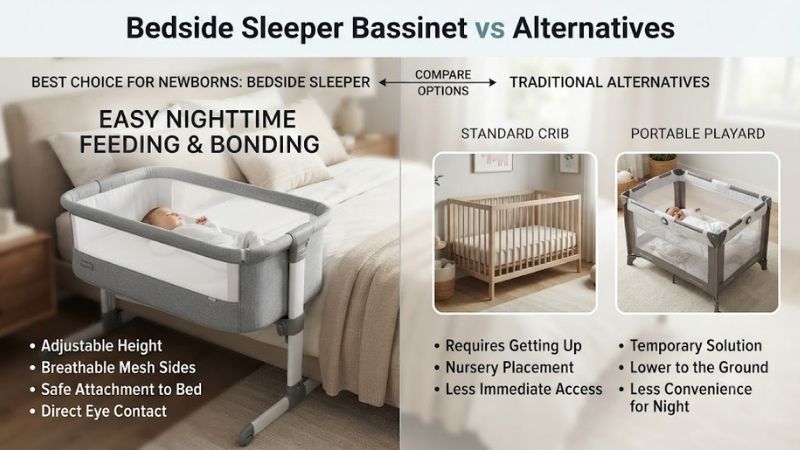
Bedside Sleeper vs Freestanding Bassinet
This is one of the most relevant comparisons for parents preparing a bedroom for a newborn.
Both categories can provide a separate infant sleeping surface near the caregivers.
The main difference is the attachment relationship with the adult bed.
Access and Convenience
An attached bedside sleeper is designed to function next to a compatible adult mattress.
This can make the approved bedside access arrangement convenient for some parents during nighttime care.
A freestanding bassinet may also be positioned nearby, but its walls and frame must remain in their intended configuration.
The convenience difference depends on the specific designs, not merely their product names.
Installation Requirements
An attached sleeper requires the correct retention system.
A freestanding bassinet generally does not require connection to the adult bed.
For parents with unusual platform beds, storage beds, or adjustable frames, a freestanding product may be easier to use appropriately.
However, it still requires stable placement and complete assembly.
Floor Space
An attached sleeper does not necessarily occupy less floor space.
Some models have bases that extend beneath or beside the adult bed.
Freestanding bassinets also vary widely in footprint.
Measure the complete exterior dimensions, including legs and supporting structures, before deciding which option fits.
Safety Comparison
Neither type should be declared universally safer.
A properly used compliant freestanding bassinet may be appropriate when attached installation is impossible.
A compliant attached sleeper may be appropriate when all required connections and alignment conditions are satisfied.
The unsafe choice is a configuration that does not meet the product’s intended installation requirements.
Which Should You Buy?
Choose a true bedside sleeper when approved attachment is important and compatible with the adult bed.
Choose a freestanding bassinet when a separate enclosed sleeping space near the bed is sufficient.
Bedside Sleeper vs Mini Crib
Mini cribs are particularly relevant for apartments, small bedrooms, and families deciding whether to purchase a short-term newborn product.
A mini crib generally occupies less space than a conventional full-size crib, although exact dimensions vary.
Depending on the model and the child’s development, it may remain useful longer than a typical bassinet.
Useful Life
Bassinets are generally intended for early infancy.
Their limitations may include weight and developmental milestones such as the infant’s ability to push up.
A mini crib can potentially serve a later stage, but its own manufacturer limits must be followed.
Do not assume that every mini crib is suitable for the same developmental period.
Mattress and Bedding
A mini crib must use a mattress appropriate for the exact crib.
Do not substitute an adult mattress, foam topper, or loosely fitting mattress.
The sleeping area should remain firm, flat, and free of loose bedding.
Nighttime Access
A mini crib generally does not provide the same attached bedside access as a true bedside sleeper.
Caregivers may need to stand or reach over the crib’s fixed side to lift the infant.
For some households, this is a manageable trade-off in exchange for longer potential use.
Space Efficiency
A mini crib can be suitable for compact bedrooms, but the actual footprint must be compared with furniture and walking paths.
A small label is not enough.
Measure the product’s complete dimensions and confirm that the crib can be used without blocking doors or creating other hazards.
Cost Per Useful Period
A bassinet purchased for the earliest months may need to be replaced relatively soon.
A mini crib may reduce the need for an additional purchase, depending on the child’s growth and the selected model.
However, a premium mini crib is not automatically more economical than a reasonably priced bassinet followed by an appropriate standard crib.
Which Should You Buy?
Choose a bedside sleeper when approved close access during early infancy is a high priority.
Consider a mini crib when compact long-term sleeping space matters more than attached access.
Bedside Sleeper vs Standard Crib
A standard crib is a familiar choice for long-term infant sleep.
It offers a fully enclosed sleeping space designed around crib requirements rather than bedside attachment.
The trade-off is generally a larger floor footprint and less immediate access from the adult mattress.
Longer-Term Use
A standard crib may remain suitable beyond the period when a bassinet must be discontinued, subject to its model-specific restrictions.
Some cribs offer conversion configurations, but those must use approved parts and follow exact instructions.
Convertible marketing does not eliminate the need to evaluate the product’s present crib configuration.
Sleeping Surface
A compliant crib provides a firm, flat sleep surface when used with the correct mattress and fitted sheet.
The baby should still be placed on the back, and soft objects should remain outside the sleep area.
A crib is not safer simply because it is larger if it is assembled incorrectly or used with unsuitable bedding.
Bedroom Space
Full-size cribs occupy more floor area than many bassinets.
However, a bedroom may accommodate a crib if furniture is rearranged.
For families seeking to avoid several product purchases, using an appropriate crib from the beginning may be practical.
Caregiver Access
A crib’s side structure differs from a bedside sleeper’s approved attachment arrangement.
Caregivers typically lift the infant over the crib side.
Some families prefer the convenience of a bassinet during the earliest months, while others are comfortable using a crib immediately.
Which Should You Buy?
Choose a standard crib when longer-term use and available floor space are priorities.
Choose a bedside sleeper when the early-infant access arrangement provides meaningful convenience and the adult bed is compatible.
Bedside Sleeper vs Play Yard
A play yard is a portable structure that may provide an appropriate sleeping environment when the exact product is compliant and intended for infant sleep.
Some models include separate bassinet accessories or raised sleep levels.
Those accessories have their own conditions and developmental limits.
Portability
A play yard can be useful when the family needs a sleeping space in more than one location.
However, portability depends on its folded dimensions, assembled weight, and setup requirements.
A large portable product may still be inconvenient for frequent travel.
Bassinet Accessories
Some play yards include a raised bassinet attachment intended for younger infants.
This component may have a different weight or developmental limit from the main play-yard floor.
Parents must transition out of the accessory when the relevant limit is reached.
Do not continue using the raised platform simply because the baby still fits physically.
Sleep-Surface Requirements
Use only the mattress or pad supplied or specifically approved for the play yard.
Adding a thicker aftermarket mattress can create dangerous gaps or compromise the intended structure.
The infant sleep space should remain firm, flat, and free of loose objects.
Assembly and Locking
A portable play yard must be fully assembled as directed.
Side rails, locks, floor components, and any attachments must be secured correctly.
A product that appears open is not necessarily fully locked.
Which Should You Buy?
Choose a compliant play yard when portability and flexible placement are important.
Choose a bedside sleeper when approved attachment to the adult bed is a specific priority.
Bedside Sleeper vs Portable Travel Bassinet
Portable bassinets and travel cribs are marketed toward families who move between homes or travel frequently.
However, the word portable does not automatically establish that an item is suitable for overnight infant sleep.
Approved Sleeping Products Versus Travel Accessories
Some travel products are compliant bassinets or portable cribs.
Others are loungers, nests, or temporary resting accessories intended only for awake, supervised use.
Their outward appearance can be misleading.
Before purchasing, identify the product’s intended sleeping use and applicable safety requirements.
Assembly Requirements
Portable sleep products may require folding, unfolding, and locking several components.
Every setup must be completed according to the instructions.
A missing support bar or incorrectly engaged lock can compromise the sleeping arrangement.
Mattress and Padding
Travel products sometimes look thinner or firmer than parents expect.
That does not justify adding a household foam pad.
Use only approved components.
Portability Versus Everyday Convenience
A compact travel crib may be convenient to transport but less comfortable for caregivers to access during frequent nighttime feeding.
A stationary bedside sleeper may offer different convenience.
The best choice depends on which activity occurs most often.
Bedside Sleeper vs Adult Bed Sharing
Adult-bed sharing must not be treated as an equivalent infant sleep product.
An adult mattress, pillows, blankets, and surrounding gaps are not designed to create the separate infant environment required by safe sleep recommendations.
The American Academy of Pediatrics recommends room sharing without bed sharing, ideally for at least the first six months.
Why Adult Mattresses Are Different
Adult mattresses may be softer than approved infant sleep surfaces.
They can contain pillow-top layers, gaps, and other features unsuitable for a newborn.
Adult pillows and blankets introduce additional suffocation risks.
Why Close Proximity Does Not Mean Bed Sharing
A bedside sleeper is intended to keep the infant nearby while preserving a separate sleeping space.
Its safety design depends on appropriate barriers, mattress construction, and secure installation.
This is not the same as placing an infant directly on the adult mattress.
Nighttime Feeding
Parents may bring the baby into bed for feeding or comforting while awake.
However, the infant should be returned to the appropriate separate sleep surface before the caregiver goes to sleep.
Families should plan a nighttime routine that makes this return practical and consistent.
Why Positioners Do Not Make Adult Beds Safe
A baby nest, bumper, pillow, or other positioning device does not convert an adult bed into an approved infant sleeping space.
Such products may introduce additional hazards.
Bedside Sleeper vs Baby Lounger or Nursing Pillow
Baby loungers, nursing pillows, and soft nests may appear similar to compact infant sleeping products in marketing photographs.
However, they serve different functions.
A nursing pillow is intended to support feeding-related positioning while the caregiver is awake and attentive.
A lounger may be intended for awake, supervised use.
Neither should be substituted for a compliant infant sleep product.
Soft Surfaces and Suffocation Risk
Many loungers and nursing pillows contain soft padding that can conform around an infant’s face or body.
That is fundamentally different from the firm, flat surface recommended for sleep.
An infant who falls asleep in a lounger or on a nursing pillow should be moved to an appropriate sleeping space.
Why Supervision Does Not Change the Product’s Intended Use
The presence of an adult does not turn a non-sleep product into an approved sleep surface.
A product intended for awake use should not be used as routine overnight bedding.
Marketing Terms to Treat Carefully
Descriptions such as baby nest, cozy sleeper, nap lounger, and portable baby bed may not establish compliance with the applicable infant sleep standards.
The buyer should identify the exact product category and intended use.
Bedside Sleeper vs Inclined Infant Sleeper
Inclined infant sleepers are not appropriate alternatives to firm, flat infant sleep products.
Infants should sleep on a flat, non-inclined surface, and products designed around significant incline can create hazardous positioning.
This is particularly important when parents are concerned about reflux or congestion.
Why Incline Can Be Dangerous
An inclined sleep surface can allow an infant to shift into a position that affects breathing.
Babies have limited ability to reposition themselves when their head or body becomes trapped in an unsafe posture.
Reflux Does Not Justify an Infant Wedge
Adult reflux guidance concerning head-of-bed elevation does not apply to infant sleeping arrangements.
Do not place a wedge, rolled blanket, or other support beneath a bassinet mattress to raise the baby’s head.
Parents concerned about infant reflux should speak with the child’s clinician.
Do Not Confuse Adjustable Height With Mattress Incline
Some bassinets offer height-adjustment settings so the product can be positioned near an adult bed.
That does not mean the infant mattress may be intentionally tilted for sleep.
Follow the manufacturer’s permitted setup and maintain a firm, flat sleeping surface.
Which Product Is Most Practical for a Small Bedroom?
The best choice depends on both floor space and how the household plans to care for the baby at night.
Studio Apartments
A studio apartment may have limited room for a dedicated nursery.
A compact freestanding bassinet or mini crib may be practical, depending on the available floor area.
However, the product must not obstruct essential walking routes, doors, or furniture access.
Bedrooms With Platform Beds
A platform bed may interfere with attached sleeper retention straps.
A freestanding bassinet may be more appropriate when the required attachment cannot be installed.
Do not improvise compatibility.
Bedrooms With Adjustable Beds
An adjustable bed changes mattress geometry.
A true attached sleeper should be considered only when the manufacturer explicitly supports the exact configuration.
A suitable freestanding bassinet or crib may avoid those attachment complications.
Families Planning to Move
A compliant portable crib or play yard may provide greater flexibility.
However, portability comes with the responsibility to assemble the product correctly after each move.
Families Prioritizing Long-Term Value
A mini crib or standard crib may be more economical when the family wants to minimize the number of sleep products purchased over time.
A bassinet’s extra convenience should be weighed against its shorter expected period of use.
Infant Mattress Safety Across All Alternatives
Regardless of the approved product category, the infant’s sleeping surface should be firm, flat, and appropriate for that specific product.
Use the Correct Mattress
A mattress must fit the product as intended.
A mattress that is too small may create hazardous gaps.
A mattress that is too thick or soft may introduce different risks.
Do not choose an aftermarket mattress based solely on matching length and width.
Use Only Appropriate Fitted Sheets
A fitted sheet should fit securely without loose excess fabric.
Do not substitute oversized sheets or add layers to make the surface softer.
Keep the Sleep Space Empty
Loose blankets, pillows, stuffed toys, padded bumpers, and sleep positioners do not belong in the infant sleeping area.
A properly selected wearable sleep garment may provide warmth without introducing loose bedding.
Avoid Weighted Infant Sleep Products
Weighted swaddles, weighted sleepers, and weighted blankets are not appropriate for infant sleep.
Do not use adult weighted bedding or any other weighted object in a bassinet or crib.
Product Lifespan and Developmental Limits
One important difference between a bedside sleeper and larger alternatives is how long the product can be used.
However, the exact endpoint depends on the model.
Bassinet Limits
Bassinets often have relatively low maximum weights and developmental restrictions.
A baby may outgrow the product by reaching a movement milestone before reaching the listed weight limit.
Follow whichever applicable limit is reached first.
Mini Crib and Standard Crib Limits
Cribs may remain appropriate for a longer period, but they also have specific requirements and transitions.
The mattress position may need to be adjusted as the child develops, following the manufacturer’s instructions.
Play Yard Bassinet Attachments
A raised play-yard bassinet attachment may need to be discontinued before the underlying play yard.
Do not assume the accessory and main structure share identical limits.
Plan the Next Sleep Space in Advance
A family choosing a bedside sleeper should account for the next crib or other appropriate sleeping arrangement.
The goal is to avoid continuing use beyond the product’s limits simply because a replacement has not been purchased.
Comparing Total Cost and Long-Term Value
The lowest purchase price does not necessarily represent the best value.
A bassinet used for a short period may require a second major purchase relatively soon.
A mini crib may cost more initially but offer a longer useful period.
A portable play yard may serve several travel or room-placement needs, subject to the manufacturer’s permitted uses.
Illustrative Purchase Scenarios
| Hypothetical arrangement | Main advantage | Financial consideration |
|---|---|---|
| Bedside sleeper followed by crib | Early bedside convenience | Two separate product purchases |
| Freestanding bassinet followed by crib | Simple room sharing | Bassinet has limited useful period |
| Mini crib from newborn stage | Potentially longer use | Check size and developmental limits |
| Standard crib from newborn stage | Conventional long-term option | Requires sufficient room |
| Approved play yard | Portability and flexible placement | Accessories may have separate limits |
These examples describe ownership patterns, not specific products or current prices.
What Premium Features Are Worth Paying For?
Height adjustment, accessible cleaning, reliable locking systems, and practical dimensions may offer meaningful convenience.
Automatic motion, music, lights, and decorative accessories are less important than the approved sleep surface and installation safety.
A premium price should never be treated as evidence that a product is safer than every less expensive compliant alternative.
Buying New vs Secondhand
Secondhand baby products can offer savings, but safety verification is essential.
Verify the Exact Model
Look for the manufacturer, model number, and identifying labels.
Without that information, checking compliance and recalls becomes difficult.
Check Current Recall Status
A product may have been recalled because of a particular structural or safety hazard.
The exact model matters.
Do not rely on general brand reputation.
Confirm All Parts Are Present
Missing retention straps, locks, support components, and hardware can make the product unsafe.
Do not improvise replacements.
Inspect the Mattress and Fabric
Use the approved mattress and properly fitting sheet.
Avoid products with damaged structure, altered side panels, or questionable mattresses.
Avoid Unknown Product History
If the previous owner cannot explain modifications or provide the correct instructions, it may be difficult to establish that the product remains safe.
Saving money should not outweigh those concerns.
A Practical Infant Sleep Product Comparison Checklist
Before buying, check each of the following:
-
Confirm that the exact product is intended and compliant for infant sleep.
-
Identify whether it is an attached sleeper, bassinet, crib, portable crib, or play yard.
-
Verify model identity and current recall status.
-
Check the complete exterior footprint.
-
Confirm the appropriate firm, flat, non-inclined mattress.
-
Review approved fitted-sheet requirements.
-
For attached sleepers, verify adult-bed compatibility and all retention hardware.
-
Check the maximum weight and developmental limits.
-
Understand all assembly and locking requirements.
-
Check cleaning and reassembly instructions.
-
Consider whether replacement parts are available.
-
Plan for the child’s next suitable sleep space.
Common Comparison Mistakes
Assuming Attached Bedside Sleepers Are Always Better
An attached sleeper may provide convenient access, but only when the adult bed and product are compatible.
A compliant freestanding bassinet can be the more appropriate choice when attachment is not possible.
Treating All Portable Baby Products as Sleep-Safe
A travel lounger or baby nest is not necessarily an approved sleeping environment.
Check intended use and applicable product standards.
Adding Comfort Padding
Infant sleep surfaces must be firm and flat.
Do not add an adult pillow, foam topper, or extra blanket to make the bassinet feel softer.
Choosing Based Only on Age or Weight
Developmental milestones may require discontinuing use before the listed maximum weight.
Follow the exact manufacturer’s warnings.
Assuming Mesh Sides Eliminate Suffocation Risks
Mesh panels do not replace back sleeping, a proper mattress, or an empty sleep space.
Safety depends on the entire product and its correct use.
Frequently Asked Questions
Is a Bedside Sleeper Safer Than a Bassinet?
Neither category is automatically safer. A compliant attached bedside sleeper can provide an appropriate separate sleep space when secured to a compatible adult bed. A compliant freestanding bassinet may be more suitable when attachment is impossible. Correct assembly and use are essential in both cases.
Is a Bedside Sleeper Better Than a Mini Crib?
A bedside sleeper may offer more convenient early-infant bedside access. A mini crib may offer a longer useful period in a compact room. The better choice depends on the family’s priorities, the actual product dimensions, and developmental limits.
Can a Newborn Sleep in a Play Yard Overnight?
A compliant play yard intended for infant sleep can provide an appropriate sleeping space when fully assembled and used with its approved mattress or pad. Do not add a thicker aftermarket mattress, pillow, or soft bedding. Follow any separate restrictions for raised bassinet accessories.
Can I Use a Baby Lounger Instead of a Bassinet?
No. A baby lounger or nursing pillow should not substitute for an approved infant sleep surface. If the infant falls asleep in a product not intended for sleep, move the baby to a suitable firm, flat, separate sleeping space.
Should I Choose a Bedside Sleeper for Reflux?
A bedside sleeper is not a treatment for reflux. Infants should sleep on a firm, flat, non-inclined surface. Do not add wedges or intentionally tilt the mattress. Ask the baby’s clinician about persistent reflux or other feeding-related concerns.
What Is the Best Long-Term Value for a Small Nursery?
A compliant mini crib or standard crib may offer longer use than a typical bassinet, depending on the model and child’s development. A bedside sleeper may still be worthwhile when early-infant access provides meaningful convenience. Compare the total sequence of products needed rather than only the initial purchase price.
Conclusion
A bedside sleeper bassinet is worth choosing when approved attachment to a compatible adult bed makes early-infant care more convenient. A freestanding bassinet offers simpler nearby placement, mini and standard cribs can provide longer-term value, and compliant play yards or portable cribs may suit families needing flexibility. Never substitute adult beds, loungers, nursing pillows, or inclined sleepers for a proper infant sleep product. Prioritize verified compliance, correct installation, a firm flat mattress, developmental limits, and a separate empty sleeping space over convenience features or marketing claims.