Key takeaways
-
Allergy-sensitive bedrooms: A tightly constructed allergen-barrier encasement can reduce contact with allergens already present inside a mattress.
-
Homes with children or pets: Waterproof models help protect against accidental spills and moisture exposure.
-
Bed bug prevention and management: Purpose-built encasements can limit bed bug access to the mattress and help simplify inspection.
-
Guest rooms and rental properties: Full coverage helps reduce staining and simplifies routine mattress protection.
-
Expensive mattresses: An appropriately sized encasement can help prevent certain forms of damage that may compromise mattress cleanliness.
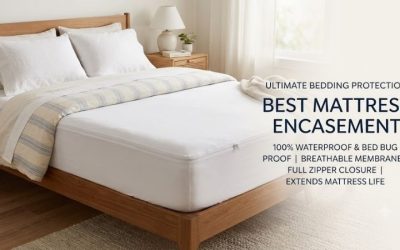
A mattress encasement protects your bed from spills, allergens, dust, and potentially bed bugs, depending on its construction. This mattress encasement buying guide explains how to evaluate waterproof barriers, full-coverage zippers, breathable fabrics, sizing, and maintenance requirements so you can choose dependable protection without sacrificing comfort.
What Is a Mattress Encasement, and Do You Need One?
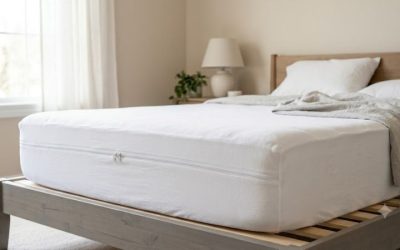
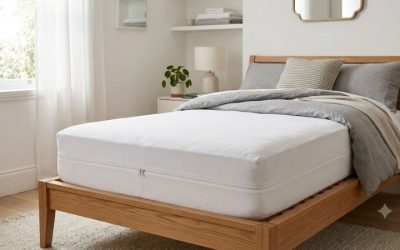
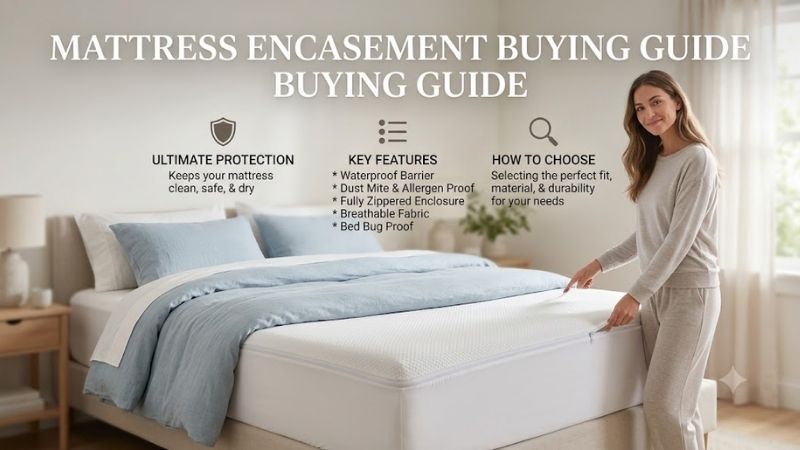
A mattress encasement is a protective cover designed to surround all six sides of a mattress. Unlike a typical fitted mattress protector, which primarily covers the sleeping surface and sometimes the sides, an encasement encloses the top, bottom, and edges.
Most mattress encasements use a long zipper to secure the cover around the mattress. Some incorporate waterproof membranes, allergen-resistant materials, or specialized zipper systems intended to help contain bed bugs.
The right choice depends on what you want to prevent. An encasement designed for accidental spills is not necessarily appropriate for managing bed bugs, and a product marketed as hypoallergenic may not provide a sufficiently effective barrier against dust mite allergens.
When a Mattress Encasement Makes Sense
A full mattress encasement can be particularly useful in households where protecting the entire mattress is more important than covering only the top.
Common situations include:
-
Allergy-sensitive bedrooms: A tightly constructed allergen-barrier encasement can reduce contact with allergens already present inside a mattress.
-
Homes with children or pets: Waterproof models help protect against accidental spills and moisture exposure.
-
Bed bug prevention and management: Purpose-built encasements can limit bed bug access to the mattress and help simplify inspection.
-
Guest rooms and rental properties: Full coverage helps reduce staining and simplifies routine mattress protection.
-
Expensive mattresses: An appropriately sized encasement can help prevent certain forms of damage that may compromise mattress cleanliness.
However, an encasement does not replace cleaning, ventilation, pest management, or proper mattress maintenance.
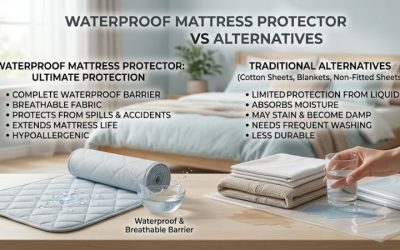
Mattress Encasement vs. Mattress Protector
| Feature | Mattress Encasement | Fitted Mattress Protector |
|---|---|---|
| Coverage | All six sides | Primarily top and sides |
| Installation | Usually zippered | Usually elasticized |
| Spill protection | Depends on waterproof construction | Depends on waterproof construction |
| Bed bug containment | Possible with purpose-built sealed models | Generally unsuitable |
| Allergen barrier | Available in specialized models | Available, but bottom remains uncovered |
| Removal for washing | More involved | Generally easier |
| Best for | Comprehensive mattress coverage | Everyday surface protection |
A fitted protector is usually sufficient when the main concern is occasional surface spills. A full encasement becomes more valuable when the bottom of the mattress also needs protection or when containment is an important requirement.
Types of Mattress Encasements
Waterproof Mattress Encasements
Waterproof encasements use a liquid-resistant barrier, often bonded to a fabric layer, to prevent spills from penetrating the protected surfaces.
Polyurethane-based membranes are common because they can be flexible and thin. However, waterproof coverage differs between products. Some protect all six sides, while others may use a waterproof top panel with less protective material underneath.
For children, pets, and households concerned about nighttime accidents, look for explicitly stated six-sided waterproof protection.
Bed Bug Proof Mattress Encasements
A bed bug encasement is designed to prevent bed bugs from entering or escaping the enclosed mattress when properly installed and maintained.
These products require more than an ordinary zipper. Important characteristics include tightly constructed fabric, a secure zipper closure, reinforced zipper ends, and a design that prevents gaps around the zipper track.
A bed bug encasement can be useful as part of an integrated pest management approach. It does not eliminate an infestation elsewhere in a bedroom, such as in bed frames, furniture, baseboards, or wall openings.
Allergen-Barrier Mattress Encasements
Allergen-barrier encasements are intended to reduce exposure to particles such as dust mite allergens originating within the mattress.
Their effectiveness depends on fabric construction, pore size, seam integrity, and closure design. A tightly woven barrier may be effective without a waterproof membrane, while some waterproof encasements also offer allergen protection.
Buyers should prioritize specific barrier information or credible testing rather than relying only on the words “hypoallergenic” or “allergy-friendly.”
Breathable Fabric Mattress Encasements
Breathable encasements emphasize comfort and airflow rather than maximum liquid resistance.
They may use tightly woven textile fabrics, lightweight knitted surfaces, or moisture-vapor-permeable protective membranes.
A breathable fabric can feel more comfortable in warm bedrooms, although airflow through the cover may be restricted when a waterproof barrier is included.
Breathability and waterproofing are not necessarily mutually exclusive, but the actual balance depends on the membrane and overall construction.
How to Choose the Right Mattress Encasement
1. Choose the Correct Mattress Size and Depth
Size compatibility is the first factor to confirm because an improperly fitted encasement can become difficult to install, bunch beneath sheets, or place unnecessary tension on the zipper.
Standard US mattress dimensions provide a useful starting point.
| Mattress Size | Typical Width × Length |
|---|---|
| Twin | 38 × 75 inches |
| Twin XL | 38 × 80 inches |
| Full | 54 × 75 inches |
| Queen | 60 × 80 inches |
| King | 76 × 80 inches |
| California King | 72 × 84 inches |
These are nominal dimensions. Actual mattress measurements may vary by manufacturer, construction, and manufacturing tolerance.
Mattress depth is especially important because an encasement must accommodate the entire mattress rather than simply stretching over the upper corners.
Measure the mattress from the bottom surface to its highest point, excluding removable bedding and toppers. If the mattress has a pillow top or unusual profile, measure its thickest section.
For example, a queen mattress measuring 60 × 80 × 12 inches requires a queen encasement that explicitly accommodates its actual depth.
Avoid assuming that a product labeled “deep pocket” is suitable. Verify the manufacturer’s specific depth range.
2. Evaluate Waterproof Coverage
Waterproof protection is one of the most commercially important features, but manufacturers do not always describe it consistently.
A product may be marketed as waterproof even if only its upper sleeping surface incorporates a liquid barrier.
For comprehensive protection, examine the construction of all six surfaces and check whether seams, corners, and zipper areas are designed to resist liquid penetration.
A waterproof membrane can protect against many ordinary spills, but this does not mean the cover is guaranteed against every volume of liquid, extended exposure, or laundering-related deterioration.
For households where repeated accidents are expected, ease of washing and drying matters almost as much as initial waterproof performance.
3. Examine Zipper Construction
A mattress encasement relies on its closure to maintain full coverage.
A poorly constructed zipper may separate, catch fabric, or leave an opening that compromises containment.
Look for a zipper that operates smoothly, reinforced stitching where appropriate, and a closure arrangement suited to the protection being advertised.
For bed bug applications, zipper-end protection is particularly important. A small opening near the zipper stop can undermine an otherwise tightly constructed enclosure.
Also consider whether the zipper is accessible when the mattress is installed on the bed frame. Some arrangements make installation and removal significantly more difficult.
4. Compare Fabric Materials
The fabric influences softness, noise, stretch, durability, and maintenance.
| Material | Potential Advantages | Considerations |
|---|---|---|
| Polyester knit | Lightweight, flexible, often easy to care for | Comfort and airflow vary |
| Cotton or cotton-blend fabric | Familiar textile feel and potential moisture absorption | Requires a separate barrier for dependable waterproofing |
| Polyurethane membrane | Flexible liquid barrier | May affect heat and moisture transfer |
| Tightly woven microfiber | Smooth texture and possible fine-particle barrier | Barrier effectiveness depends on verified construction |
| Vinyl-based barrier | Can provide liquid resistance | May feel less flexible or less breathable |
Fabric composition alone does not establish waterproofing, allergen protection, or durability.
A polyester encasement with a properly constructed waterproof laminate may offer more practical spill protection than a thicker cotton encasement without a liquid barrier.
Similarly, a soft textile surface does not establish that the finished product will feel cool when used beneath a fitted sheet.
5. Consider Temperature and Sleeping Comfort
Some waterproof mattress encasements can change how the mattress feels, particularly if the material restricts moisture-vapor transfer or creates friction against bedding.
A thin, flexible membrane generally offers a more discreet profile than a stiff plastic-like barrier. However, a thinner material is not automatically cooler, quieter, or more durable.
Hot sleepers should consider breathable textile surfaces, flexible membranes, moisture management, and the surrounding bedding.
If a mattress uses a specialty cooling surface or other comfort technology, check whether the mattress manufacturer recommends particular protector materials. Any additional layer may influence how that surface performs.
6. Check Noise and Movement
A mattress encasement that rustles when a sleeper changes position can become distracting in a quiet bedroom.
Noise depends on fabric stiffness, membrane composition, fit, and friction between layers.
Descriptions such as “silent” or “noiseless” are difficult to evaluate without credible comparative evidence.
A well-fitted, flexible textile-backed encasement is a sensible starting point for noise-sensitive sleepers. Avoid overly loose covers that wrinkle or create excessive fabric movement.
7. Review Washing and Drying Instructions
Care requirements have a direct effect on the encasement’s long-term usefulness.
Many protective covers can be machine washed, but permitted temperatures, detergents, dryer settings, and laundering frequency vary.
Excessive heat can damage some waterproof membranes, adhesives, or zipper components. Bleach, fabric softeners, or ironing may also be restricted.
Before purchasing, confirm whether the care instructions are practical for your household.
For frequent nighttime accidents, a cover that requires complicated washing or lengthy drying may be inconvenient despite offering adequate protection.
8. Consider Durability and Warranty Terms
Long-term reliability depends on more than fabric thickness.
Potential failure points include zipper teeth, seams, waterproof laminates, and corners that experience repeated stretching.
Look for clearly stated warranty coverage and exclusions, especially regarding waterproof performance, manufacturing defects, and damage caused by incorrect laundering.
A lengthy warranty is not proof of superior performance. The actual coverage terms and the manufacturer’s support procedures matter more than the advertised duration alone.
Mattress Encasement Features Worth Paying For
Not every advertised feature delivers equal value. Some directly improve protection or durability, while others mainly affect convenience or appearance.
Six-Sided Coverage
Six-sided coverage is fundamental to a true mattress encasement. It protects the top, bottom, and four sides rather than leaving the underside exposed.
This feature matters most for allergen containment and bed bug management. It can also help protect the underside of a mattress from dust and incidental contact with surrounding surfaces.
However, full coverage does not automatically mean full waterproof coverage. Verify those claims separately.
Reinforced Zipper Closures
Reinforced closures are especially valuable when an encasement will remain installed for extended periods.
For bed bug applications, prioritize models specifically designed and tested for containment rather than selecting an ordinary zippered cover.
A purpose-built closure can help prevent insects from passing through the zipper area. The entire enclosure must remain intact for the protection to be effective.
Stretchable Side Panels
Stretchable fabric can simplify installation, especially with thick foam mattresses or models with rounded edges.
A modest amount of flexibility helps the cover conform to the mattress without leaving large pockets of loose material.
However, excessive stretching may stress seams or zipper components if the chosen cover is too small.
The manufacturer’s approved mattress depth range should determine sizing rather than relying on fabric elasticity to compensate for an incorrect fit.
Washable Construction
A removable, washable cover offers practical advantages for households managing spills, dust, and general bedroom hygiene.
Look for clear machine-washing instructions and a drying method that works with your available laundry equipment.
The ability to wash the cover does not mean it should be removed frequently. For a mattress involved in bed bug treatment, follow the pest management instructions regarding how long the enclosure must remain installed.
Independent Testing and Certifications
Testing information can help distinguish a documented protective barrier from a loosely described marketing feature.
Look for evidence relevant to the exact claim: liquid penetration testing for waterproofing, allergen-barrier evaluation for allergy protection, and containment testing for bed bug resistance.
Certifications addressing chemical emissions or material safety should not be treated as proof that a cover is waterproof, breathable, or bed bug resistant.
How Much Should You Spend on a Mattress Encasement?
The best buying strategy is to choose the protection level required rather than simply purchasing the thickest or most expensive cover.
Prices vary by mattress size, material, manufacturer, and specialty features. King and California king encasements may cost more than comparable twin sizes because they require additional material.
| Buying Priority | Features to Focus On | Features That May Be Less Important |
|---|---|---|
| Basic protection | Accurate fit, full enclosure, washable fabric | Specialty barrier claims |
| Everyday spill protection | Waterproof membrane, easy laundering, reliable seams | Advanced pest-containment hardware |
| Allergy management | Documented allergen barrier, complete coverage, secure closure | Decorative fabric finishes |
| Bed bug management | Tested containment design, secure zipper end, tear resistance | Extra padding or plush texture |
| Maximum sleeping comfort | Flexible fabric, manageable noise, moisture-vapor transfer | Heavy fabric construction |
Budget Encasements
Lower-cost options can be reasonable for straightforward mattress protection if sizing, zipper quality, and maintenance requirements are clearly documented.
However, a budget encasement should not be assumed suitable for bed bug containment simply because it covers all six sides.
When the main concern is accidental liquid exposure, verified waterproof construction is more important than additional marketing features.
Midrange Encasements
Midrange products may be worth considering when they combine a flexible fabric surface, dependable waterproofing, practical washing instructions, and well-constructed closures.
Pay attention to the exact features rather than assuming a higher price automatically means better protection.
Premium Encasements
Higher-priced encasements may appeal to buyers seeking specialized allergen barriers, documented bed bug containment, or particular textile construction.
A premium price makes the most sense when the product provides independently supported performance or materials that address a specific household need.
For ordinary spill protection, paying extra for specialized pest-management features may offer little practical benefit.
Choosing an Encasement for Different Household Needs
Best Choice for Children and Potty Training
For a child’s mattress, prioritize full waterproof coverage, easy cleaning, secure fit, and a comfortable fabric surface.
An encasement can serve as a protective base layer, while an additional washable fitted protector may make nighttime cleanup easier.
Check the product’s suitability for the particular mattress and sleeping environment. Infant sleep products require special attention: use only appropriately fitted components that comply with the crib or bassinet manufacturer’s instructions and applicable safe-sleep guidance.
Best Choice for Pet Owners
Pet owners should look for a waterproof barrier that protects against accidental urine exposure, spills, and everyday moisture.
A washable textile surface is generally more convenient than a cover requiring specialized maintenance.
If pets regularly sleep on the bed, consider using a removable surface protector above the encasement to reduce how frequently the full cover needs cleaning.
An encasement protects the mattress but does not necessarily resist claw damage. Inspect the cover for punctures or tears.
Best Choice for Allergy-Sensitive Sleepers
A documented allergen-barrier encasement is the more targeted choice for individuals concerned about dust mite allergens.
Scientific practice guidance supports tightly woven microfiber barriers with appropriately small pores, while emphasizing that encasements are generally part of a broader allergen-reduction strategy.
Cleaning other bedding, managing indoor humidity, and addressing additional allergen reservoirs may still be necessary.
An allergen-barrier cover should not be expected to eliminate allergies or replace medical treatment.
Best Choice for Bed Bug Concerns
Choose a purpose-built, tested bed bug encasement with a secure closure, dependable zipper-end protection, and durable fabric.
The US Environmental Protection Agency advises leaving bed bug encasements installed for a year as part of pest management, so durability during extended use is especially important.
A light-colored cover can make signs of bed bug activity easier to detect during inspection. However, an encasement alone will not control insects living elsewhere in a room.
Best Choice for Hot Sleepers
Hot sleepers should prioritize flexible, lightweight constructions with documented breathability or moisture-vapor transmission characteristics where available.
Soft textile surfaces can improve the feel of a protective cover, but cooling claims should be treated cautiously without comparative evidence.
The encasement is only one part of the bedding system. Sheets, comforters, mattress construction, bedroom humidity, and room temperature also affect nighttime comfort.
Best Choice for Guest Rooms and Vacation Rentals
For guest bedrooms, choose an encasement that combines reliable protection with manageable maintenance.
Six-sided waterproofing may be useful where spills or accidents are possible, while a smooth fabric surface helps keep the bed comfortable for different sleepers.
Consider the practicality of laundering the cover and inspecting its zipper and seams between guests.
How to Measure and Install a Mattress Encasement
Even a well-constructed cover may perform poorly if it is installed incorrectly.
Step 1: Measure the Mattress
Measure the width, length, and total depth using a tape measure.
Record the actual dimensions rather than relying entirely on the mattress’s advertised size.
For unusual mattress designs, compare these measurements with the encasement manufacturer’s dimensions and stated fit tolerances.
Step 2: Check the Mattress and Bed Frame
Before installation, inspect the mattress for sharp or damaged components that could puncture the cover.
Check the bed frame for exposed fasteners, rough edges, or other contact points.
If bed bugs are suspected, follow appropriate containment and pest-management procedures before moving bedding or the mattress to avoid spreading insects.
Step 3: Prepare the Encasement
Open the zipper fully according to the manufacturer’s instructions and identify the top and bottom panels.
Avoid pulling aggressively on the zipper stops or stretching the cover beyond its intended dimensions.
If the manufacturer’s instructions recommend two people for installation, follow that guidance.
Step 4: Enclose the Mattress
Carefully position the mattress inside the cover, aligning the corners with the corresponding seams.
Keep the fabric from twisting or bunching beneath the mattress.
Take care when lifting heavy mattresses, especially where space is limited or lifting could cause injury.
Step 5: Close the Zipper Completely
Close the zipper slowly while keeping loose fabric away from its teeth.
If the encasement includes a zipper lock or protective closure, secure it exactly as instructed.
For bed bug containment, carefully inspect the zipper endpoint and surrounding seams for any openings.
Step 6: Inspect the Finished Fit
The cover should lie smoothly without excessive tension, major wrinkles, or obvious gaps.
Check the corners, zipper track, and underside.
If the zipper cannot close without force, the cover may be too small or incompatible with the mattress profile.
Do not modify the zipper or cut the fabric to make an incorrectly sized encasement fit.
Common Mattress Encasement Buying Mistakes
Buying Based Only on Bed Size
A queen label alone does not guarantee compatibility. Mattress thickness and the manufacturer’s fit range also matter.
Two queen mattresses can have similar width and length but substantially different depths.
Confusing Water-Resistant With Waterproof
Water-resistant fabric may repel a small amount of liquid without preventing penetration during extended exposure.
For dependable spill protection, look for explicit waterproof claims covering the intended surfaces.
Assuming Every Zipper Blocks Bed Bugs
An ordinary zipper does not establish bed bug containment. Gaps at the zipper endpoint or between closure components can compromise protection.
Choose a tested, purpose-designed encasement when bed bugs are the concern.
Choosing the Thickest Fabric Automatically
Thicker fabric is not necessarily more breathable, more waterproof, or more effective against allergens.
The protective membrane, weave, seam construction, and closure design generally deserve more attention than thickness alone.
Ignoring Maintenance Instructions
A waterproof encasement can become less effective if its membrane is damaged by unsuitable washing or drying conditions.
Check the care label before purchasing, particularly if frequent laundering is likely.
Using an Encasement to Hide Existing Mattress Problems
A cover cannot repair sagging foam, broken internal supports, persistent odor from unresolved contamination, or an unsafe mattress structure.
If a mattress is severely damaged, contaminated, or affected by continuing moisture problems, it may require professional assessment or replacement rather than merely an additional covering.
Maintaining a Mattress Encasement
How Often Should You Wash It?
There is no universal washing schedule appropriate for every encasement.
For routine hygiene, follow the manufacturer’s recommendations and consider how quickly the cover becomes soiled.
If a removable fitted protector is placed above the encasement, that surface layer can often be laundered more frequently.
For bed bug containment, do not remove the encasement simply for routine washing if doing so would interfere with treatment. Follow the relevant pest-management plan.
How Do You Prevent Damage?
Avoid dragging the enclosed mattress across rough surfaces or exposing the fabric to sharp bed-frame components.
Use only approved wash temperatures and dryer settings. Do not assume that high-heat drying is safe for a waterproof membrane.
Periodically inspect the zipper, corners, and seams for damage.
When Should You Replace It?
Replacement is appropriate when the cover can no longer maintain its intended protective function.
Warning signs include torn fabric, damaged zipper teeth, separated seams, or a visibly compromised waterproof layer.
For specialized allergen or bed bug protection, even a relatively small defect may justify replacement because it can compromise the barrier.
Mattress Encasement Buying Checklist
Before purchasing, use this checklist to confirm the features that matter most.
Purchase readiness
0 of 8 checked
Frequently Asked Questions
Is a Mattress Encasement Better Than a Mattress Protector?
A mattress encasement is better when full six-sided coverage, allergen containment, or bed bug protection is the priority. A fitted protector is often more convenient for routine spill protection because it is easier to remove and wash.
Neither design is universally better. The appropriate choice depends on the hazards you want to address and how frequently you expect to clean the cover.
Can Bed Bugs Get Through a Mattress Encasement?
A properly installed, intact encasement specifically designed and tested for bed bug containment should prevent insects from entering or escaping through the enclosed mattress.
However, damage, zipper gaps, or incorrect installation can compromise the barrier. Bed bugs can also remain in other areas of a bedroom, so the encasement is not a complete infestation treatment.
Do Waterproof Mattress Encasements Make You Sleep Hot?
Some waterproof designs may increase heat or moisture retention, but the effect depends on the material, membrane, construction, bedding, and sleeping environment.
Flexible textile-backed membranes may feel less intrusive than stiff plastic-like materials. Still, claims that an encasement is cooling or completely breathable require supporting evidence.
Can You Put a Mattress Encasement on a Memory Foam Mattress?
Yes, many encasements are suitable for memory foam mattresses when the dimensions, depth, and construction are compatible.
Choose a flexible cover that fits without excessive compression and check the mattress manufacturer’s care and warranty instructions.
Avoid a design that significantly restricts an adjustable mattress’s intended movement if the mattress is used on an adjustable base.
Do You Need to Encase the Box Spring, Too?
If bed bugs are a concern, enclosing both the mattress and box spring may be appropriate because box springs provide additional hiding places.
The box spring generally requires its own correctly sized, purpose-built encasement. A mattress encasement should not be assumed suitable for a box spring unless the manufacturer explicitly permits that use.
For routine spill protection, a separate box spring encasement is often unnecessary.
Can a Mattress Encasement Help With Dust Mite Allergies?
A properly designed allergen-barrier encasement can reduce exposure to dust mite allergens originating inside a mattress.
However, mattress encasements alone may not provide meaningful symptom improvement for everyone. A broader approach involving bedding hygiene, humidity management, and allergen control may also be needed.
Conclusion
The best mattress encasement is one that fits your mattress correctly and provides the specific protection your household needs. Prioritize six-sided construction, accurate depth compatibility, secure zippers, practical cleaning instructions, and documented barrier performance. Choose waterproof coverage for spills, specialized allergen barriers for allergy concerns, and tested containment designs for bed bug management. Paying for the right protective features is more valuable than paying for marketing claims that do not address your actual needs.