Key takeaways
- Boucle, tweed, open-weave linen, or any fabric with visible loops sold as pet-friendly.
- No rub count or fiber content listed; you cannot judge the fabric.
- Cleaning code S or X, meaning solvent-only or vacuum-only, on a chair for a drooling dog.
- Weight capacity under 250 pounds on a chair a person and a dog will share.
- Legs that screw directly into the frame without a metal insert.
- Fixed, non-removable cushions with attached back pillows and deep tufting.
- Chair weight under 30 pounds for a full-size armchair, which usually means a light frame that tips.
- Exposed nail-head trim, decorative buttons, or fringe that a cat can pull loose.
“Pet friendly” on an accent chair listing usually means the fabric wipes clean, and sometimes it means nothing more than the marketing team thought it sounded good. Buyers take the label at face value and end up with a boucle chair whose loops a cat unravels in a week, a light linen chair that shows every paw print, or a chair with a delicate splayed leg that a 70-pound dog knocks over jumping off. The real requirements for a chair that shares a home with animals are specific: a tight or short-pile fabric with no loops, a color and pattern that hide hair, a frame and legs that survive impact, and cushions you can remove and clean. Almost none of that appears in a product title. Here is how to evaluate it yourself.
Decide These 3 Things First
Which animal, and what it does to furniture. Cats scratch and pull loops; dogs shed, drool, dig at cushions, and jump. A chair that survives a cat needs a fabric with zero exposed loops or open weave. A chair that survives a dog needs a stable frame, a wipeable fabric, and a cover that comes off.
Our top picks



As an Amazon Associate we earn from qualifying purchases at no extra cost to you.
Whether the pet is allowed on the chair. If yes, treat it as pet furniture: washable cover, dark or patterned fabric, and a seat height and depth the animal can use safely. If no, the chair still needs to resist scratching from the floor, so arm and skirt fabric matters more than seat fabric.
The colors you already live with. Match the fabric to the pet’s coat. A black cat on a cream chair or a white dog on charcoal means daily lint-rolling; a mid-tone that sits between the coat color and the room’s palette hides most hair.
Fabric
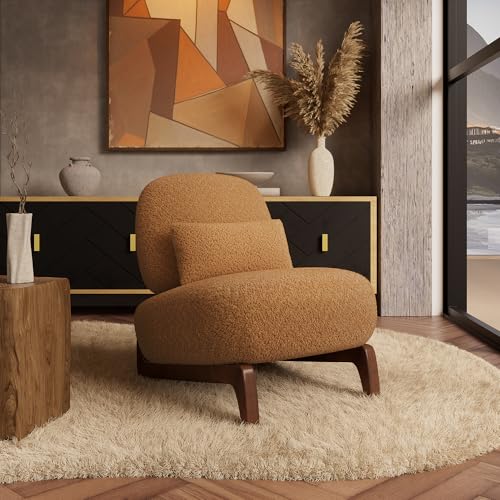
Fabric is the single biggest factor. The best pet fabrics are tight, flat, or short-pile weaves: microfiber and microsuede, performance polyester and solution-dyed acrylic, and short-pile synthetic velvet. All have nothing for a claw to hook and a surface that hair lifts off easily. Look for a rub count of 25,000 double rubs or higher and a fiber content that is at least 80 percent synthetic; natural linen and cotton absorb liquid and show wear. Chenille is borderline: its plush yarns feel great and hide hair well, but they pill under repeated nail contact, so choose a tightly woven chenille and expect to shave pills occasionally. The Modern Oversized Accent Reading Chair at 43 inches wide in green chenille, about $199.99, is an example where the fabric is livable for a dog that does not dig but risky for a scratching cat. Boucle is the fabric to avoid despite its popularity; its looped yarns catch claws instantly. The Morden Fort Boucle Chair, an armless accent chair with a thick cushion marketed as pet-friendly at about $249, illustrates the gap between the label and the fiber; the comfort claim may be fair, but boucle and cats do not mix. Leather and polyurethane faux leather wipe clean and shed no hair, but claws puncture faux leather and scratch real leather, so they suit dogs with trimmed nails better than cats.
Frame and Stability
Dogs jump on and off chairs from the side, which twists the frame. Look for a kiln-dried hardwood or plywood frame with corner blocks, a total chair weight of at least 35 to 45 pounds for a standard accent chair, and a base wider than it is tall so it does not tip. Legs should be solid wood or steel, 4 to 8 inches tall, and bolted through a metal plate rather than screwed into particleboard. Splayed mid-century legs look good but concentrate side loads at the joint; if you like the style, choose a chair with a stretcher bar between the legs or with legs at least 1.5 inches thick. Weight capacity should be 250 pounds or more so a person plus a 60-pound dog does not exceed it. The Christopher Knight Home Pet Friendly Accent Chair with a hidden pet nook and convertible storage stool, with acacia wood legs and a 220-pound capacity at about $202.99, is an example of a design that thinks about the pet as an occupant; its capacity is on the low side for a large adult, which is the kind of number to weigh against your household.
Cushions and Covers
Removable, zippered cushion covers turn a spill into a laundry load instead of a professional cleaning bill. Check that the seat cushion and, ideally, the back cushion unzip, and that the care label allows machine washing on cold rather than dry-clean only. Seat foam should be at least 1.8 pounds per cubic foot; dogs that circle and dig before lying down compress cheap 1.5-pound foam into a permanent bowl within a year. A fiber or down wrap over the foam is comfortable but traps hair and dander, so a foam-only or foam-with-thin-batting cushion is easier to keep clean. Attached back cushions and tufted seats are harder to clean than loose cushions because hair works into the seams and buttons. Slipcovered chairs are the most practical of all; a full slipcover can be washed, replaced, or swapped seasonally.
Size and Shape
If the pet will share the chair, seat depth of 22 to 26 inches and seat width of 22 inches or more between the arms gives room for a person and a medium dog. Oversized chairs of 36 to 44 inches wide are effectively pet-friendly loveseats, but they need a frame to match. Seat height of 17 to 19 inches is comfortable for people and lets a medium dog step up; senior dogs and cats do better with 15 to 17 inches. Arm height of 24 to 27 inches from the floor gives a cat a perch and a dog a headrest; low or armless chairs are easier for pets to climb but offer nothing to lean on. Avoid exposed wood arms if you have a chewer, and avoid nail-head trim and exposed staples that a cat can pick at. The VINGLI Light Brown Upholstered Armchair at about $169.99 is a conventional upholstered armchair whose light color makes it a poor match for a dark-coated pet, even though the enclosed arms and upholstered frame are good for stability.
Price Tiers
Under $200 buys polyester or microfiber upholstery over an engineered-wood frame with fixed cushions; fabric choice is the main thing you can control here, and microfiber is the safest bet. From $200 to $450 you get plywood or hardwood frames, better foam, removable cushion covers, and performance fabrics with stated rub counts. From $450 to $900 slipcovered and performance-velvet chairs with hardwood frames, 2.0-pound foam, and 300-pound capacities appear. Above $900 you are choosing solution-dyed acrylic or top-grain leather on kiln-dried hardwood with replaceable covers sold separately for years.
Warranty and Delivery
Frame warranties of 1 year signal engineered wood; 5 years or more signals hardwood. Fabric warranties almost never cover pet damage, so the fabric’s stated rub count and cleaning code (W for water-based cleaning is what you want) matter more than the warranty. Accent chairs ship in a single 35- to 70-pound box; most require attaching four legs, 10 to 20 minutes. Check that legs screw into threaded metal inserts, because a dog jumping off the chair works loose legs that are screwed straight into wood.
Spec Checklist
| Spec | Budget ($100 to $200) | Mid ($200 to $450) | Premium ($450 to $1,200) |
|---|---|---|---|
| Fabric | Polyester or microfiber, rub count often unlisted | Performance polyester, microsuede, or synthetic velvet, 25,000+ rubs | Solution-dyed acrylic, performance velvet, or top-grain leather, 50,000+ rubs |
| Weave | Flat weave, avoid boucle and open linen | Tight flat or short pile | Tight flat or short pile, stain-treated |
| Frame | Engineered wood or softwood | Plywood or mixed hardwood | Kiln-dried hardwood with corner blocks |
| Legs | Wood or plastic, screwed into board | Solid wood or steel, threaded plate | Solid hardwood or steel, bolted, 1.5 in or thicker |
| Seat foam | 1.5 to 1.8 lb/cu ft | 1.8 to 2.0 lb/cu ft | 2.0 lb/cu ft and up |
| Cushion covers | Fixed | Zippered, some machine washable | Zippered and washable, or full slipcover |
| Weight capacity | 200 to 250 lb | 250 to 300 lb | 300 lb and up |
| Chair weight | 25 to 35 lb | 35 to 55 lb | 50 to 80 lb |
| Cleaning code | Often unlisted | W or W/S | W, with stated stain treatment |
| Warranty | 1 year | 1 to 5 years frame | 5 years to lifetime frame |
Red Flags
- Boucle, tweed, open-weave linen, or any fabric with visible loops sold as pet-friendly.
- No rub count or fiber content listed; you cannot judge the fabric.
- Cleaning code S or X, meaning solvent-only or vacuum-only, on a chair for a drooling dog.
- Weight capacity under 250 pounds on a chair a person and a dog will share.
- Legs that screw directly into the frame without a metal insert.
- Fixed, non-removable cushions with attached back pillows and deep tufting.
- Chair weight under 30 pounds for a full-size armchair, which usually means a light frame that tips.
- Exposed nail-head trim, decorative buttons, or fringe that a cat can pull loose.
FAQ
What is the best fabric for an accent chair with cats?
Microfiber or microsuede, followed by tightly woven performance polyester and short-pile synthetic velvet. All three have no loops for claws to catch and release hair easily. Avoid boucle, chenille with loose yarns, tweed, and any open weave.
Is leather a good choice for a pet-friendly accent chair?
Pigmented top-grain leather is excellent for dogs: it wipes clean, holds no hair, and light scratches buff out. It is a poor choice for cats that scratch, because punctures cannot be buffed. Faux leather peels once a claw breaks the surface and is the weakest option for either animal.
How do I keep pet hair off an accent chair?
Pick a fabric color close to the pet’s coat or a mid-tone pattern, choose a flat weave that hair sits on rather than in, and keep a rubber upholstery brush nearby; a 30-second pass lifts most hair from microfiber or velvet. A washable throw on the seat the pet favors handles the rest.
Do performance fabrics really resist pet stains?
Solution-dyed acrylic and treated performance polyester repel liquids long enough to blot most spills, including urine, if you get to them within a few minutes. They are not proof against a puddle that sits for an hour. In 2026 most performance fabrics state a cleaning code of W and a rub count above 30,000, which together are the practical definition of pet-ready upholstery.