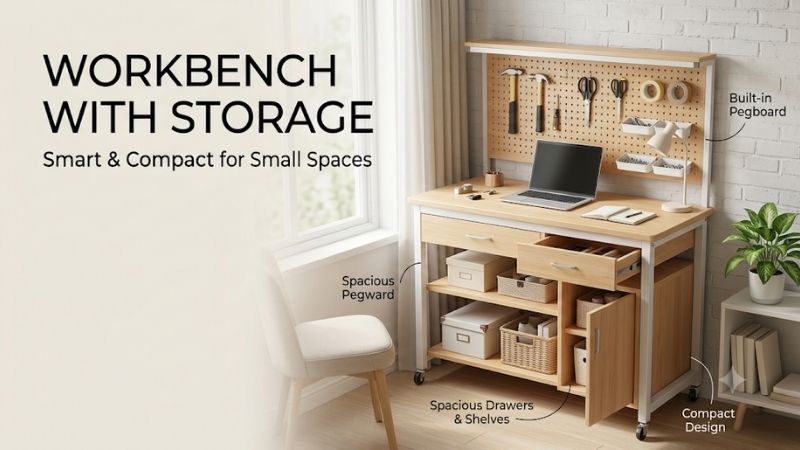
A workbench with storage for small spaces has to fit while you are working, with a drawer open and room for both hands on the project. Start by measuring the space your vehicle, door, or cabinet already uses. Then choose the shallowest bench that can handle your repairs and give your everyday tools a home.
How to size a workbench with storage for small spaces
Measure the room as you use it on a typical day. Take width and depth readings with the car parked, the utility door closed and open, and any cabinets in their normal positions. Record the narrowest point along the route you actually walk. That single measurement can eliminate a bench that otherwise looks ideal.
Draw the bench twice on the floor plan
An empty garage makes almost any bench look easy to place. Your drawing needs two versions of the same workbench, one with the drawers closed and a second with the drawers open and a person working. Use both versions to check access, especially in one-car garages and narrow utility rooms.
For the closed version, draw the outer body and add anything that projects from it, such as handles, feet, casters, and a power cord connection. A bench may need to sit forward of a baseboard or because a wall outlet occupies the normal rear position. That small shift can affect the passage down the side of a car. Measure with the vehicles you use, parked where they normally sit. Consider the mirror, bumper, and door separately because they occupy different areas.
For the open version, add the travel of the deepest drawer. Draw where you would stand to bring out a case with both hands. Repeat for drawers at different heights. A top drawer can sometimes be opened while you stand beside it. A lower drawer that stores heavy objects may require you to stand in front, bend, and lift without twisting around the car. An item technically fits in a drawer when it closes. It fits your room when you can take it back out normally.
As a planning example, imagine 42 inches between a wall and a parked car at the point where the bench will go. A 15¾-inch-deep bench leaves 26¼ inches ahead of its cabinet body before allowing for handles or drawer movement. If an open drawer travels 11 inches beyond that face, roughly 15¼ inches remain beyond the drawer in this simplified sketch. That last number is available for your movement and other clearances. Measure the actual scenario to decide whether it is usable for you.
Measure the workpiece before shopping for depth
A shallow bench improves the walkway only if the surface still supports what you do. Gather a sample from the repairs, assemblies, or service tasks you perform most often. Set the objects on the surface you already use and measure the space taken up once everything is positioned for the job.
Grab a representative item, such as a bicycle component you clean and adjust, a small appliance you repair, or the largest case you expect to open on the bench. Place a tray for screws beside it and leave enough room for the tool you’ll use. Measure the backed-up position of your hands as well as the footprint of the item. A small part can require more work area if a long driver sticks out behind it. The extra space has to be available in front or behind the part.
Try rotating the workpiece so that its long dimension runs in the direction of the bench’s width. This turns a surprising number of depth problems into width problems. If a case lid opens upward and back, check the corner it reaches. A vertical pegboard or rail can consume the area the lid needs even if the product dimensions advertise generous working depth. Make sure your measurement uses the open case when that is the way you work.
For occasional larger projects, consider whether a separate fold-out surface can handle the extra space. Set it up only when you have enough room and choose a model rated for the work. A permanent bench should support routine jobs without extra setup. Bigger tasks that arise a few times a year can have a separate arrangement, provided you have a practical place to use and store it.
Map door swings, utilities, and material paths
A compact bench can fit on an uninterrupted section of wall and still interfere with everything moving past it. Measure the path to the garage entry, the laundry area, cabinets, and any equipment you need to reach. Check the approach to the bench with the largest object you regularly carry.
A workbench close to a door can interfere with the handle or the body of the person opening it even when it clears the closed door perfectly. Take a width reading at several heights if there are projections. Include a look at the vehicle door in the open position. The point at which the cabinet is widest may not be the point at which the car is closest. Handles, bumpers, shelving supports, and trim all count toward the room you lose.
If the work location is next to a utility appliance, preserve the manufacturer’s required access and clearances for that appliance. Leave wall controls and electrical panels properly accessible. Where you depend on a light or charger, plan a cord path that fits the work area. A bench pushed tightly against the wall can make it hard to use an outlet behind it. Drawers and moving cabinets create additional situations where a loose cord can get caught.
Consider long objects even if most of your repairs are small. A slender board, drain part, level, or vehicle trim component has to make the turn into the working area. Use a piece of cardboard or a similarly long, light object to try the move before choosing the location. Moving the station several inches along the wall can preserve work area without requiring a smaller bench.
Storage layouts that fit compact workshops
In a small garage, storage succeeds when you can use it while working within the room you have. Put daily-use items at an easy height and move bulky or occasional items to spots where they can be accessed separately. Compare drawer and shelf arrangements with the actual cases, hand tools, and supplies you expect to store.
Choose shallow drawers for things you need to see
Drawers are a good use of scarce space when the contents can be sorted and found at a glance. Drivers, pliers, wrenches, spare blades in protective storage, and small hardware bins need little vertical clearance. Start with a few shallow drawers when those items create most of the clutter at your current bench.
Look for dimensions inside the drawer and for the height the object needs to pass each part of the opening. A drill stored on its side might fit the floor area but catch its battery on a lip. A tool used every week is a poor match for a tight spot that requires removal of two other items. When space is particularly tight, cut a card to the listed interior dimensions and use it to lay out the items before purchase.
Position daily-use drawers where you can reach them from either side. In a single-car garage, you might be able to stand just to the right of a shallow top drawer while the vehicle is parked. That same position can make it difficult to lift a heavy case out of a deep drawer. If possible, use the deepest drawers for bulky, low-frequency items and avoid overfilling them. Choose compact organizers that leave room for fingers and for returning tools in a hurry.
One real-world size reference is the IKEA BROR 704.943.00, a fixed bench with drawers that is 33½ inches wide and 15¾ inches deep. It is about 35 inches high. Those dimensions are a starting point for a floor mockup. Check how your own tools fit the smaller bench and review the stated per-drawer and worktop limits before deciding.
Use open shelves for cases you can lift out cleanly
An open shelf makes good use of low space when it holds recognizable cases, labeled containers, or items used as a set. You can see their handles and remove them individually. The main measurement is the insertion opening, which can be smaller than the open space inside the frame once supports and braces are included.
Take the tallest item you plan to keep below the bench and check how much room is required to pick it up. A case that is flush with the underside of a frame might go in while empty but be difficult to retrieve when full. Bring handles and latches into the measurement. If the case will slide straight out, leave a clear landing place where you can set it down without blocking a shared walkway.
If someone wants to work sitting down, check the shelf and front crossbar positions first. A shelf close to the floor can still interfere with the user’s ankles, knees, and stool legs. Try sitting in a mock-up at the measured height and depth. If the seated position matters every time, keep the center free underneath or choose a station with offset storage.
Wall shelves above a bench can store light supplies, leaving the lower area open. They have to be placed so they don’t interfere with the work, headroom, or safe access to the items. Map the reach between the bench and shelf while a project is on the worktop. A supply you can reach over an empty bench may be impractical to grab across a project.
Separate frequently used wall tools from stored inventory
A compact wall rail or pegboard works best for tools you take down and put back regularly. In a small station, extending storage upward can reclaim worktop space without making the cabinet deeper. A lightly loaded panel is easier to use than one that requires you to untangle tools from adjacent hooks.
Give the center of the wall to the tools you use most often. Position the seldom-used items away from the easiest reach. If you wear glasses or work on very small parts, check whether the panel creates a dark area under a shelf. A strategically positioned task light can leave more surface free than one with a large base. Measure where its fixture and cord occupy space before finalizing the layout.
Wall material and mounting matter. A suitable wall-mounted system can stay in place while you replace the bench below it. Use the specified mounting hardware and wall support, and verify capacity for your chosen configuration. An integrated pegboard can be convenient in rooms where separate wall mounting is impractical, provided the entire bench has room to fit and is installed according to the manual.
A shallow panel can sit behind a bench without having much effect on floor depth, but it can reduce useful depth on the top when tools hang low. Hang up a sample tool or mock it up with cardboard, then put your usual workpiece on the bench. The two zones should be usable together. Store heavier or pointy equipment in an appropriate secured location, where it won’t get caught as you reach across the bench.
Decide whether the work surface should fold or roll
Folding furniture makes sense when the same floor must serve different purposes and the bench would occupy valuable space between jobs. A rolling station makes sense when you can assign it one place to work and a different place to park. Each design requires enough room to move and use the bench safely.
For a folding bench, measure the back of the leg stance and the width needed to expand it. The folded size tells you where it can be stored. The unfolded footprint tells you whether it can be used in the garage with a vehicle present. An integrated shelf on a folding model is often best used to set down parts during work. Plan for a permanent home for tools and cases during storage and follow the bench’s folding instructions.
For a rolling bench, check the narrowest place along the route, the room available to turn, and any threshold or uneven concrete. Manufacturer instructions on loading, moving, and securing a cabinet matter. The wheeled cabinet also needs an actual parking spot it can reach even when the garage is in normal use. Mark both spots, check the route between them, and think about the projects that require a stable work surface.
Fixed benches have one advantage in tight rooms. Once they fit, your tools remain in the same place and the setup requires few extra steps. That is useful when repairs happen spontaneously and last only a few minutes. If mobility would make a valuable space available for something else every week, the effort involved in moving or unfolding a bench may be worthwhile.
Small-space workbench plans for common garage layouts
A compact bench can make one narrow wall usable or turn a spare corner into a work area. Choose a starting plan that matches the way the room changes over the week. These examples focus on access and daily use so you can adapt the measurements to the layout you already have.
Single-car garage with the car parked most days
A shallow fixed bench on the wall with the best uninterrupted passage is a strong starting point. Use the actual parked car to find the pinch point and open the vehicle door before planning where the most frequently opened workbench drawer will sit. Leave the normal path from the house usable while tools are stored.
Start by identifying a compact working area of the surface. Store tape, frequently used drivers, and small fasteners in an easily reached drawer or organizer. Reserve the farther end for placing workpieces and parts. Keep large tool cases on a nearby lower shelf if they can be reached without forcing you to crouch against the car.
Plan for two kinds of projects. A quick repair should work with the vehicle in the garage if that is one reason you want the bench. Larger seasonal projects may need the car out, and you can judge those based on the extra space available when parked elsewhere. Check both arrangements. A strong permanent layout solves the first one, since that is the situation you encounter more often.
For lighter use, a shallow drawer bench can be paired with an existing wall shelf. A long row of floor cabinets would increase storage but could narrow the full run of the garage. Divide the wall into areas where people need to walk, where doors need to open, and where you actually stand. Place the highest-use tools in the area with the easiest reach.
Utility room or workshop alcove shared with storage
A narrow alcove can make an excellent repair station when the bench stays clear of doorways and utility access. Set a maximum width based on the tightest point and use a drawing to check drawer operation. Leave a reachable place for light, frequently used tools so the surface stays mostly open.
An open section beneath the worktop can change how you use this arrangement. It gives you room to pull up a stool for careful work or stand slightly closer to the top. A small drawer off to one side and a safe wall rail can cover the tools needed for workshop tasks without making every inch below the surface inaccessible.
Watch which objects belong to the utility room and which belong to the bench. A spare household container can take up valuable shelf height. Workshop consumables on top of cabinets can make it hard to reach routine supplies. If people share the room, assign storage by use and visibility. One shallow drawer for common household tools can save trips even if the larger inventory is stored in another room.
Use one of the simplest mockups first. Tape off the planned bench, open every nearby door, then bring two ordinary items into the room and set them down where you would actually work. Take out the tools you would need. If the route requires moving three stored items, reconsider which shelf or drawer has the easiest access before you buy.
Multipurpose garage with room to roll a station out
A rolling station works in a multipurpose garage when it can be moved into a safe working position and then returned to a predictable home. Draw the parked footprint, the working footprint, and the corners it must turn around. Include any parts that extend beyond the cabinet and consider how often you will move it.
Some rolling layouts work because the cabinet starts close to the task. When a homeowner wheels a closed, secured cabinet a short distance from a wall to an unobstructed patch of floor, the work surface becomes accessible on more sides. This extra access can matter more than a wider top. A cabinet that crosses a troublesome threshold or comes too close to a parked vehicle invites people to leave it in whichever position is easiest.
Decide when you need the station available. If you use the garage as a parking area after every repair, deep drawers and cupboards may make it simpler to put everything away promptly. If you are midway through a large project, a separate tray or storage box lets you remove the project from the top before moving the cabinet, when required by the product instructions.
If the garage floor has a noticeable slope, consult the manufacturer’s directions and check that the work position is appropriate. Caster locks are part of the setup. Safe operation also depends on the floor, load, and the kind of force involved in the job. Jobs that require substantial side force may need a dedicated station designed for that use.
Frequently asked questions
A compact bench should be tested with real tools before its dimensions become a purchase decision. Check where the open storage puts your body, how the top serves your most common task, and whether the room still works for other people. These questions address the most common choices where the measurements are close.
Can a bench under 18 inches deep be useful?
Yes, especially for hand-tool repairs, maintenance on small components, or occasional household jobs. Its strongest use is with workpieces that fit comfortably on the surface when you add a small tray and the required tool. Test the depth with your normal setup. If you routinely open deep cases on the bench or need room for the hands and tool behind the work, a slightly deeper model can justify the space.
Should the workbench face a wall or sit sideways?
Facing a wall is usually easier when the priority is conserving floor space. A sideways station can work if it leaves an aisle on both sides and creates access to the end of a long workpiece. Try boarding the footprint with tape and moving the largest item through the room. The better orientation is the one that preserves passage while making the approach to the task comfortable.
What is the most useful upgrade for a tiny workbench?
An appropriate light or a place to store the few tools that repeatedly end up on the surface can improve daily use. Watch why the current top fills up. If you are leaving tools out because their case is hard to reach, a shallow drawer or suitable wall organizer may help more than adding surface width. If working in shadow is the problem, dedicate space to lighting before adding more storage.
How do you test a bench before ordering online?
Measure the installed footprint and recreate it with tape or boxes. Mark a drawer at full extension with a cardboard rectangle, then stand in position and simulate lifting your heaviest common case. Recreate the height with an existing surface or a stable mock-up, then place your actual workpiece and the usual tools. Check the traffic route and nearby doors again before you settle on a model.
Conclusion
For a small garage, buy the shallowest workbench that supports your common projects and still leaves room to open its storage. Tape off the closed and open footprints with the vehicle parked. Check the top with an actual workpiece, then choose drawers, shelves, or a folding design based on how you use that space.
More from Amazon
Programs that pair well with the guide above. Offers and eligibility are set by Amazon and may change.
Collect the home and kitchen items you want in one registry that guests can shop from.
Create a wedding registrySet up recurring deliveries of everyday items on eligible products. Terms and savings are set by Amazon.
Explore Subscribe & SaveFree shipping on eligible items, Prime Video and more. Eligible new members can start with a free trial.
Start a Prime free trialAudiobooks and podcasts to listen to on the go. Eligible new members can start with a free trial.
Try Audible freeAs an Amazon Associate we earn from qualifying purchases.