Our Top Picks
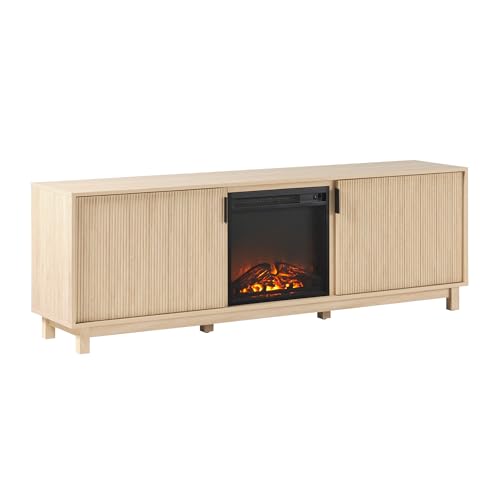 Walker Edison Arundo Reeded TV Stand with Fireplace70" Fireplace15.75 x 70 x 23.75 Inches126 poundsCheck on Amazon
 PRAISUN 70'' Fireplace TV Stand with 48'' Electric70 inch13.8 x 70.9 x 32.3 Inches80.3 PoundsCheck on Amazon
 Decofy 70″ Fluted Fireplace TV Stand for 80″70″ TV Stand with Fireplace15.7 x 70 x 22.8 inchesCheck on Amazon
A TV stand with a fireplace is a media console built around an electric insert that produces flame effects and, on most models, 4,600–5,200 BTU of supplemental heat — enough to take the chill off a 150–400 sq ft living room, not to replace a furnace. If you’re searching for a “tv stand with fire pit,” you’re almost certainly looking for one of these electric units; true fire pits burn propane or wood outdoors and can’t sit under a TV. Below is how to pick the right insert type, match the stand to your screen, and handle the wiring without a tangle behind the console.
Fire pit vs. fireplace insert: the terminology that trips shoppers up
Listings and search results blur these terms constantly, so here’s the practical split. A fire pit is an open, vented flame — gas or wood — that belongs on a patio. A TV stand with fireplace uses a sealed electric firebox: LED flames behind glass, a small heater, and a standard 120V plug. No venting, no gas line, no clearance-to-open-flame issues. Everything in this guide refers to the electric kind, which is the only safe option directly beneath a television.
Walker Edison Arundo Reeded TV Stand with Fireplace & Storage, 70" Fireplace, Coastal Oak
Chosen because it specifies 70" Fireplace and Coastal Oak.
View on Amazon
MXV 80″ Fluted Fireplace TV Stand, Mid Century Modern TV Stand with 36″ Fireplace for TVs Up to 90", Entertainment Center with Sliding Door & Solid Wood Legs, for Living Room, Walnut
Chosen because it specifies Entertainment Center with Sliding Door & Solid Wood Legs and for Living Room.
View on AmazonPRAISUN 70'' Fireplace TV Stand with 48'' Electric Fireplace
Picked as a relevant option in this category.
View on AmazonDecofy 70″ Fluted Fireplace TV Stand for 80″ TVs, Entertainment Center with Fluted Sliding Tambour Doors & Adjustable Shelves, Modern Media TV Console Table for Living Room(Walnut)
Chosen because it specifies Modern Media TV Console Table for Living Room(Walnut).
View on AmazonThe four main form factors
- Standard console: firebox centered, shelving or cabinets on both sides. Widths run 48–80″. The most common style and easiest to cable-manage.
- Corner unit: angled front, typically 44–56″ wide. Fits dead corner space but limits TV size to about 50–55″ and complicates speaker placement.
- Mantel-style: looks like a traditional fireplace surround with a media shelf. Often solid or veneer wood, heavier (120–200 lbs assembled), and the closest thing to a “real” fireplace look.
- Highboy / tall console: 36–42″ tall. Good for bedrooms where you watch from a raised bed, but too high for most living-room seating.
Heating options and realistic BTU coverage
Nearly every insert tops out at 1,500 watts (~5,100 BTU) because that’s the safe limit on a 15-amp household circuit. What differs is how the heat moves and feels.
| Heater type | Wattage | BTU output | Comfortable zone coverage | Noise / feel |
|---|---|---|---|---|
| Fan-forced coil | 750 / 1,500 W | ~5,100 | 150–400 sq ft supplemental | Low fan hum; dries air slightly |
| Infrared quartz | 1,000 / 1,500 W | ~5,100 | 300–600 sq ft supplemental (brand claims up to 1,000) | Near-silent; heat feels “softer,” doesn’t dry air |
| Ceramic forced-air | 750 / 1,500 W | ~5,100 | 150–300 sq ft | Fastest warm-up; noticeable fan |
| Flame-only (no heater) | ~10–40 W | 0 | Ambiance only | Silent; runs year-round |
The honest math: as a room’s only heat source, a 1,500W insert covers roughly 150 sq ft using the standard 10-watts-per-square-foot rule. As supplemental heat alongside central heating — which is how these are designed to be used — it makes a 300–400 sq ft seating area feel noticeably warmer. Infrared models from established insert makers like Dimplex and ClassicFlame (Twin-Star) are worth the premium if your room exceeds 350 sq ft or has high ceilings, because radiant warmth travels farther than blown air.
Running cost at full heat is roughly $0.20–$0.30 per hour at typical U.S. electricity rates; the flame effect alone costs pennies.
Size guide: matching TV width to stand width
TVs are sold by diagonal, but stands are sold by width — and TV width is about 87% of the diagonal. The console should be at least as wide as the TV, and ideally 10–20% wider so the screen doesn’t overhang the edges and the proportions look deliberate.
| TV size (diagonal) | Actual TV width | Minimum stand width | Ideal stand width |
|---|---|---|---|
| 43″ | ~38″ | 42″ | 44–48″ |
| 50″ | ~44″ | 48″ | 52–58″ |
| 55″ | ~48″ | 52″ | 58–65″ |
| 65″ | ~57″ | 60″ | 65–72″ |
| 75″ | ~65″ | 68″ | 72–80″ |
| 85″ | ~74″ | 76″ | 80″+ (or wall-mount above a shorter console) |
Weight limits
A 65″ TV weighs roughly 40–55 lbs; an 85″ model runs 80–110 lbs. Budget engineered-wood consoles are often rated at only 70–100 lbs on the top surface — fine for a 65″, marginal for an 85″. Mantel-style and solid-wood builds frequently carry 150–250 lbs. Always check the listed top-surface rating, not the shelf rating.
Height, heat clearance, and viewing angle
Most fireplace consoles sit 28–34″ tall, which puts a 65″ screen’s center around 44–48″ — slightly above the ~42″ seated eye level considered ideal, but acceptable. Taller than 36″ starts to strain necks. For heat: inserts vent warm air forward from a grille, not upward, which is why TV-over-fireplace works here. Still, keep the TV bottom at least 8–12″ above the heater outlet, maintain a 3 ft clear zone in front of the grille, and leave 2–4″ behind the console for cords and airflow. In a 10×12 ft room, a 60–65″ console along the short wall leaves a comfortable 30–36″ walkway if the sofa sits on the opposite side.
Materials: what you actually trade off
| Build | Typical price range | Pros | Watch out for |
|---|---|---|---|
| Engineered wood (MDF/particleboard + laminate) | $200–$450 | Lightest, cheapest, huge style range | Laminate edges peel first; screw holes wallow out if disassembled; lower weight ratings |
| Veneer over plywood/MDF | $400–$800 | Real-wood look, more stable than laminate | Veneer can’t be sanded/refinished; check edge banding quality |
| Solid wood / mantel-style | $700–$1,500+ | Highest weight capacity, repairable, lasts decades | Heavy (150+ lbs assembled); sensitive to humidity swings |
| Metal frame + wood shelves | $300–$600 | Strong for weight, modern look, easy to move | Can flex/rack if bolts loosen; cold aesthetic next to a “fire” |
Cord management and power: the part listings skip
- The heater needs its own wall outlet. A 1,500W insert draws ~12.5 amps — never run it through a power strip or extension cord, and ideally not on a circuit already feeding a big receiver and gaming PC.
- Separate power from signal. Route the insert’s power cord down one side of the console and HDMI/optical cables down the other through the rear cutouts to avoid interference hum and confusion later.
- Look for: at least two rear cutouts, a center-channel shelf, and a passthrough slot behind the firebox (some consoles put an outlet cubby there). Stick-on raceways along the back leg clean up the drop to the wall.
- Insert controls: most have a remote plus a front-panel button — make sure you can reach the manual controls without pulling the stand out if the remote disappears.
Which setup fits your situation
| Your situation | Pick this | Why |
|---|---|---|
| Renter / small apartment (<300 sq ft living room) | 48–58″ engineered-wood console, fan-forced insert with thermostat | Flat-pack fits any doorway, plugs into existing outlet, leaves with you |
| Kids and pets | Cool-touch glass front, child-lock remote, auto shutoff, low stand (≤30″) | Glass stays warm-not-burning; low height resists tip-overs |
| Large or open-plan room | Infrared insert; treat flames as ambiance and heat as zone-only | No 1,500W unit heats an open floor plan — position it near seating |
| Warm climate | Any console; run flame-only mode | You get the glow year-round for pennies |
| 75″+ TV | 72–80″ console rated ≥150 lbs, or wall-mount TV above a shorter unit | Overhang looks bad; weight ratings get real at this size |
Assembly and ownership realities
Expect one or two flat-pack boxes totaling 80–150 lbs — get them inside before opening, since most carriers drop at the door. Budget 1.5–3 hours with a second person; cam-lock hardware dominates this category. The insert itself is usually pre-assembled and simply slides in (25–35 lbs), so always remove it before moving the console. What wears first: laminate edge banding, cabinet-door hinges, and — after several years — the LED flame module or heater fan. Inserts are modular and replaceable, which is the quiet advantage of this whole category.
FAQ
Can a fireplace TV stand heat a whole room?
Only as sole heat in ~150 sq ft, or as supplemental warmth in 300–400 sq ft. It’s zone heating — effective where you sit, not a furnace replacement.
Is the TV at risk from the heat?
No, provided the heater vents forward (nearly all do) and you keep 8–12″ between the heater grille and the TV bottom. The glass front gets warm but not hot enough to damage electronics.
Can I plug it into a surge protector with my TV?
No. A 1,500W heater on a power strip risks overheating it. Wall outlet for the insert; surge protector for the electronics.
Does it need a chimney or vent?
None. Electric inserts produce no combustion — just plug-in heat and light.