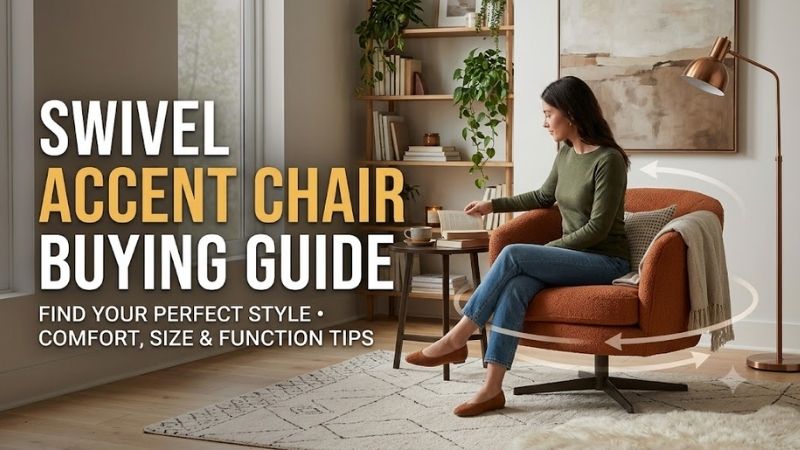
A swivel accent chair buying guide should help you choose seating that looks attractive, feels comfortable, and rotates without interfering with the room. Chair width, usable seat depth, swivel-base construction, backrest support, and upholstery maintenance all influence the purchase. This guide explains how to evaluate those details and avoid common fitting and durability mistakes.
What Is a Swivel Accent Chair?
A swivel accent chair is a decorative or supplemental seating chair designed to rotate around a base or central axis.
Its purpose is to provide a flexible seating direction without requiring the occupant to move the entire chair.
Unlike an ordinary fixed armchair, a swivel model introduces a moving connection between the seat and base.
That mechanism can be useful in living rooms, bedrooms, reading corners, and conversation areas.
However, it adds considerations involving rotation clearance, stability, hardware, and maintenance.
Swivel Accent Chair Versus Office Chair
Both types may rotate, but their intended uses differ.
An office chair is typically designed around task-oriented seating and may include height adjustment, rolling casters, arm adjustments, and other ergonomic features.
A decorative swivel accent chair generally emphasizes appearance and relaxed seating.
It should not automatically be used as a substitute for a properly fitted task chair.
Swivel Accent Chair Versus Recliner
A swivel chair changes the direction the occupant faces.
A recliner changes the occupant’s resting posture by moving the backrest, footrest, or both.
Some specialized chairs provide both functions, but an ordinary swivel accent chair does not necessarily recline.
Make sure the desired movement matches the product’s actual capabilities.
Step 1: Choose the Right Chair Type
| Chair type | Main feature | Strongest use | Limitation |
|---|---|---|---|
| Barrel swivel | Curved wraparound shell | Conversation and casual lounging | Bulky curved back |
| Low lounge swivel | Relaxed sitting position | Decorative reading corner | Low seat height |
| Upright swivel | Higher or more vertical sitting posture | Conversation and occasional work | Less deep-lounge comfort |
| Oversized swivel | Broad seat and substantial cushions | Relaxed living-room use | Large rotation envelope |
| Pedestal swivel | Central base and sculptural form | Modern interiors | Base and floor compatibility matter |
| Adjustable-height swivel | Seat-height movement | Flexible sitting height | More complex mechanism |
| Swivel glider | Rotation plus gliding motion | Specialized relaxation use | Additional movement clearance |
Step 2: Measure the Chair and the Room
Begin by recording the available floor area.
Measure width, depth, and distance from surrounding furniture.
Do not rely solely on product photographs.
Exterior Width
Width influences how much room the chair occupies next to a sofa, table, or wall.
However, a chair with thick upholstered arms may have much less usable seat width than its exterior measurement suggests.
Compare both specifications when available.
Exterior Depth
Depth determines how far the chair projects into the room while facing forward.
For a rotating chair, the geometry matters throughout movement.
A deep barrel back may sweep into nearby furniture when turned.
Height
Overall height influences the chair’s visual presence.
A low chair can keep sightlines relatively open, while a tall backrest can feel more substantial.
However, overall height does not establish seat height.
Those measurements serve different purposes.
Rotation Envelope
The rotating body requires clearance around its widest projecting points.
The exact needed space depends on the position of the swivel axis.
A chair with a base centered beneath the seat can rotate differently from a chair whose back projects substantially beyond the axis.
Step 3: Evaluate Seat Height
Seat height strongly influences everyday comfort.
A low seat can feel inviting for lounging but require greater effort when standing.
A higher seat may make rising more convenient for some users.
However, an excessively high seat can leave shorter occupants without comfortable foot contact.
Why Unloaded Measurements Are Only a Starting Point
Manufacturers generally publish a seat-height specification based on the unloaded product or an established measurement procedure.
The effective height changes when someone sits and the cushion compresses.
A soft cushion may lower the occupant more than a firmer cushion with the same listed height.
That is why a showroom trial can be valuable.
Choosing for Shorter Adults
A chair with a relatively shallow seat and suitable height may support more comfortable upright sitting.
However, a low seat is not automatically better for a shorter person.
Foot contact, backrest position, and ability to stand all matter.
Choosing for Taller Adults
Taller occupants may appreciate deeper seating or higher seat positions, but not universally.
A very deep chair can still create discomfort if the backrest and armrests are poorly positioned.
Choose based on usable dimensions rather than general body-size labels.
Step 4: Compare Seat Depth and Width
Seat depth determines how much space exists between the front of the cushion and the backrest.
A 16.5-inch-deep seat creates a very different experience from a 23.5-inch-deep seat.
Shallow Seats
Shallow seats can suit upright conversation and occasional sitting.
They may also reduce the chair’s exterior depth.
However, they can feel restrictive to someone who prefers curling up or reclining casually.
Deep Seats
Deep seats provide more room to lounge.
However, they may encourage shorter users to sit away from the backrest.
An additional lumbar cushion can sometimes change the feel, but it also changes usable seat depth.
Usable Seat Width
Thick arms reduce the interior seating area.
A chair measuring 30 inches wide may offer a much narrower cushion.
Review the actual seat-width specification when available.
Step 5: Understand Swivel Mechanisms and Bases
The base is one of the most important structural parts of a swivel chair.
It supports the seated load while permitting movement.
Full 360-Degree Swivel
Many accent chairs rotate through 360 degrees.
This is useful when the chair faces multiple directions.
However, full rotation does not establish smoothness, resistance, or mechanical lifespan.
Those characteristics depend on the exact mechanism.
Return Swivel
Some chairs have a return mechanism designed to move the seat toward an original orientation when the occupant leaves.
This can keep a room looking orderly.
However, return-swivel construction should not be assumed unless the manufacturer identifies it.
Metal Pedestal Bases
Metal is commonly used for swivel pedestals.
The base design, bearing, attachment, and floor contact all matter.
A metal pedestal is not automatically better than every star-base construction.
Swivel Glider Mechanisms
A swivel glider adds a separate rocking or sliding motion.
This can provide another comfort experience, but it also increases moving clearance requirements.
Do not purchase a glider solely because it has more motion features.
Step 6: Evaluate Frame and Cushion Construction
Wood Frames
Some chairs use wooden frames or internal components.
Quality depends on joints, material specifications, and engineering.
Solid wood should not be treated as a universal durability guarantee.
Metal Frames
Metal structures may offer different shape and support possibilities.
However, welding, hardware, and connection quality matter.
A metal-frame label alone does not establish a higher weight capacity.
Foam Cushions
Polyurethane foam is common in accent seating.
Density, firmness, and construction influence how the cushion performs.
Do not confuse foam density with firmness.
Inner Springs and Webbing
Some upholstered chairs incorporate inner spring coils, sinuous springs, or webbing.
These structures can influence cushioning and support.
However, one construction type does not guarantee superior comfort without an appropriate comparison.
Step 7: Choose Upholstery According to Daily Use
Polyester Fabric
Polyester upholstery can be available in many textures and price categories.
Its cleaning and abrasion characteristics vary.
The fiber name alone is not a complete performance specification.
Bouclé-Style Upholstery
Bouclé and other looped fabrics create a textured, contemporary appearance.
However, loose or prominent loops can catch on claws or sharp objects.
Buyers with pets should consider actual weave construction.
Corduroy
Corduroy adds ribbed texture and a retro appearance.
It may collect lint or dirt within the pile.
Follow the exact cleaning directions.
Wool Blends
Wool-blend upholstery can provide distinctive texture.
However, some versions require solvent cleaning.
Check whether maintenance fits your household.
Faux Leather
Faux leather may provide an easy-wipe surface under permitted cleaning conditions.
However, coating quality and long-term aging vary considerably.
Do not assume every faux-leather chair is equally durable.
Step 8: Check Weight Capacity and Stability
A chair’s published weight rating specifies a manufacturer’s intended loading limit under its stated conditions.
It does not guarantee that the chair is equally comfortable for every person below the rating.
The seat width, depth, and backrest still need to fit.
Avoid Side Loading
Swivel furniture is intended to support normal seating.
Leaning far over an arm, standing on the seat, or climbing on the back can create unusual forces.
These uses should be avoided.
Keep the Base Properly Assembled
Follow the supplied instructions and use all required hardware.
A missing fastener or improperly mounted swivel can affect safety.
Children and Pets
Children may be tempted to spin chairs rapidly or climb onto them.
Swivel chairs should not be treated as playground equipment.
Keep clear of moving bases and avoid trapping fingers or paws near mechanisms.
Step 9: Evaluate Assembly and Delivery
Some chairs arrive fully assembled, while others require installing the base or backrest.
The packaging and final furniture may have different dimensions.
A chair whose finished width fits through a door may arrive in a larger box.
Review the delivery route, including stairs, hallways, and tight turns.
The buyer should also consider chair weight.
A 70-pound upholstered swivel may be difficult for one person to relocate regularly.
Step 10: Understand Price and Long-Term Value
Entry-level swivel chairs may use simpler foam and fabric constructions.
Midrange models may offer more detailed suspension systems or broader upholstery choices.
Premium designs may emphasize specialized frames, distinctive upholstery, or brand-specific styling.
However, price does not establish comfort or durability.
What Is Worth Paying More For?
Appropriate seat geometry, dependable construction, practical upholstery, and a suitable warranty can justify a higher cost.
What Might Be Unnecessary?
An unusual finish, oversized proportions, or adjustable features may add expense without helping your actual use.
What About Returns?
A chair can look perfect online but feel uncomfortable when used.
Check return conditions, restocking fees, and furniture-delivery restrictions before ordering.
Practical Buying Scenarios
Small Apartment Conversation Corner
Choose a compact chair with a manageable rotation envelope.
A shallow model may be more suitable than a deep lounge chair.
Reading Corner
Prioritize back support, armrest comfort, and seat depth.
A visually attractive chair is not necessarily comfortable for extended reading.
Living Room With Children and Pets
Cleaning practicality and stable construction become important.
Avoid upholstery that requires maintenance your household cannot reasonably perform.
Open-Plan Living Space
A swivel chair can face several directions without being moved.
This may provide genuine functional value compared with a stationary chair.
Bedroom Accent Seating
A compact chair can provide occasional seating or a place to read.
However, the chair should not block wardrobe access or doors.
Common Buying Mistakes
Selecting Style Before Seat Fit
Exterior appearance does not establish sitting comfort.
Ignoring Rotation Clearance
The chair must move without contacting surrounding furniture.
Assuming All Swivel Chairs Have the Same Mechanism
Full-swivel, return-swivel, and swivel-glider designs behave differently.
Treating Fixed Covers as Machine Washable
Care instructions vary by fabric and model.
Confusing Weight Capacity With Seat Size
A chair may meet the load rating while feeling too narrow or deep.
Frequently Asked Questions
What Should I Look for in a Swivel Accent Chair?
Prioritize usable seat dimensions, overall footprint, rotation clearance, stable base construction, upholstery maintenance, and delivery access. Style matters, but it should not override practical fit.
Is a Barrel Swivel Chair Comfortable?
It can be, especially when its curved back and seat geometry match the occupant. Some barrel chairs have low backs or deep cushions that may not suit everyone.
Are Swivel Accent Chairs Durable?
They can be, but durability depends on the frame, bearing mechanism, mounting hardware, cushions, and upholstery. A full-swivel claim does not guarantee long-term performance.
Do Swivel Chairs Scratch Floors?
Floor compatibility depends on the base contact materials and surface conditions. Follow the manufacturer instructions and avoid unsupported pads that make the chair unstable.
Is a Swivel Accent Chair Good for Everyday Use?
Some are appropriate for regular casual seating. However, prolonged desk work or specialized support needs may require a different chair category.
Should I Buy a Chair With a Removable Cover?
It can be useful when frequent cleaning is expected, but only if the cover’s care instructions and replacement availability meet your needs.
Conclusion
A good swivel accent chair balances seating comfort, room clearance, base stability, and upkeep with the desired appearance. Start with usable seat height, width, and depth; then confirm that the complete chair can rotate freely in the room. Examine construction details, upholstery care, weight limits, delivery requirements, and warranty terms. The best chair is the one that remains practical after the novelty of its swivel feature wears off.