Key takeaways
- Identify thermofoil cabinet edges, limit repeated wetting and separate routine cleaning from lifting-cover repairs with an edge-care worksheet.
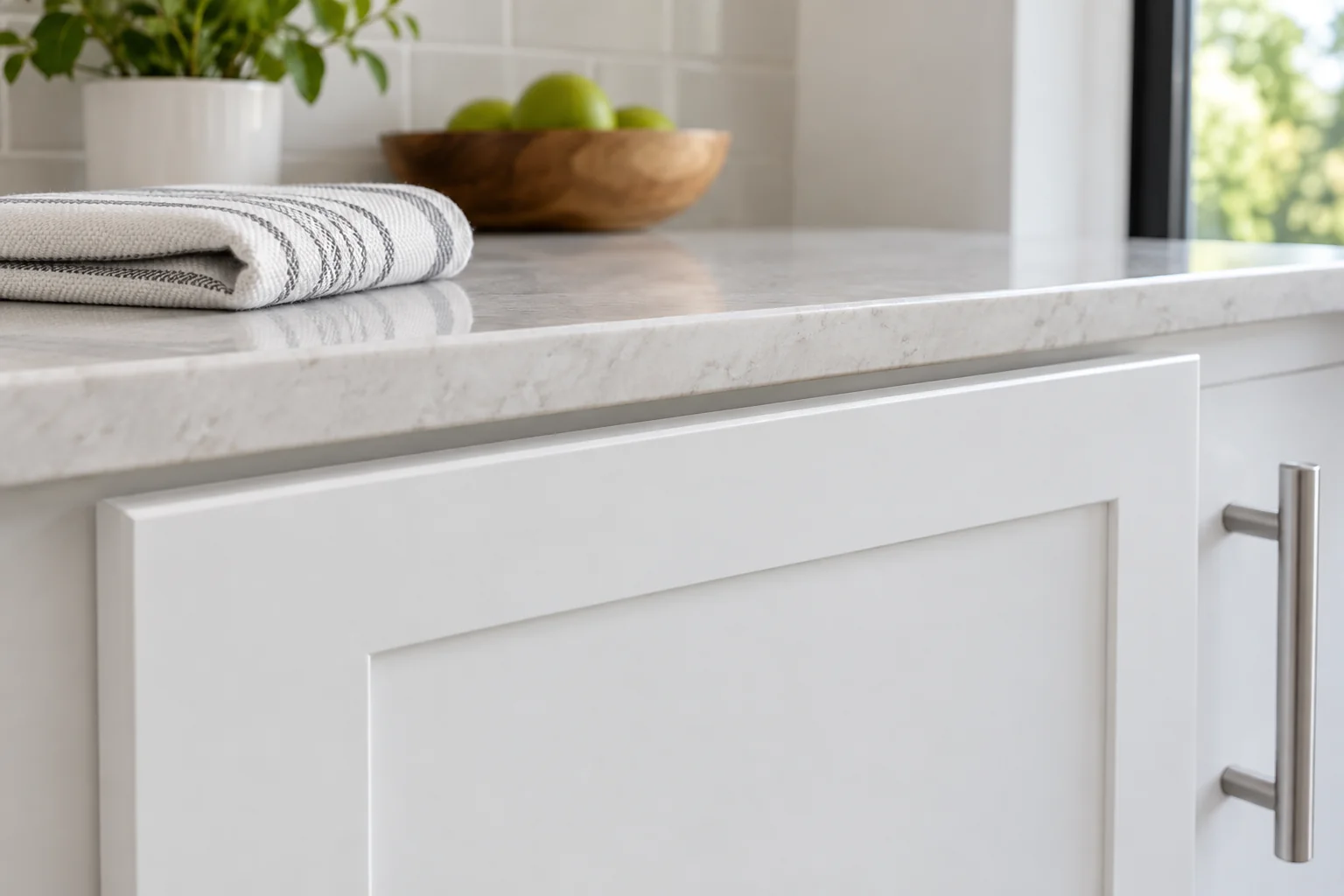
The face and the back edge need different attention
A thermofoil cabinet door can have an easy-to-wipe face while its edges still require careful moisture control. Before cleaning, identify the actual door material and inspect the accessible perimeter. Do not assume a smooth white cabinet is thermofoil, or that a water-resistant-looking face makes every seam suitable for soaking.
The practical goal is to remove ordinary surface soil without repeatedly wetting the back edge, trapping a damp towel against the door or treating a lifting covering as stubborn dirt. Keep cleaning and repair as separate decisions.
Confirm the finish from records
Look for the cabinet order, door-style code, installer paperwork or manufacturer’s label. The same kitchen can contain different materials on doors, end panels, frames and interiors. Record each part you intend to clean, especially near a sink or dishwasher.
The Wellborn installation and care guide makes a useful distinction. Its thermofoil section allows mild soap and water on those surfaces, while the preceding care precautions specifically warn against excessive moisture at thermofoil back edges because prolonged wetness can lead to delamination. The general wood-care sections are not interchangeable with that thermofoil section.
This is an example from a manufacturer document, not a universal cleaning formula. Obtain the applicable instructions for your own cabinet series and finish. If the identification remains uncertain, ask the installer or supplier rather than using an abrasive or solvent to see what lies beneath the surface.
Map where water can linger
With the door stationary and normally accessible, look at the lower edge, handle area, hinge-side perimeter and back edge. Note nearby sources of repeated wetting: sink splashes, a damp towel, cleaning overspray or water that runs down from a counter.
Do not peel a corner or press a tool into a seam to investigate it. A photograph in ordinary light can document a lifted edge or changed appearance without enlarging it. Keep a wider photograph as well so the location is clear.
A normal gap between the door and cabinet is not necessarily a failure of the covering. Describe what you see precisely: for example, “thin covering raised at lower back corner,” rather than declaring that the entire cabinet is water damaged. The manufacturer can assess that observation alongside the material and installation details.
| Location | Observation | Next action |
|---|---|---|
| Door face | Ordinary soil or a changed surface | Use only the finish-approved routine |
| Lower back edge | Dry, recently wet or visibly lifting | Remove the wetting source; ask about damage |
| Handle area | Finger marks and adjacent hardware | Keep hardware care separate |
| Sink-side corner | Repeated splash or counter runoff | Document the route of moisture |
| Cleaning cloth | Clean and prepared as instructed | Do not leave it draped over the door |
| After cleaning | Drying completed; appearance unchanged or changed | Record an unresolved mark without escalating products |
Turn the approved method into a controlled task
Clear the immediate work area so you can clean without knocking a bottle against the door. Prepare the soft cloth and product specified by the maker. Follow its application, removal and drying directions; avoid turning a small cleaning task into a flood of cleaner running over the perimeter.
Work where you can see what you are doing. Keep liquid away from unapproved adjacent materials and any electrical fittings. Do not reach into a hinge mechanism or remove the door merely to gain access unless a separate approved procedure calls for that work.
Afterward, check that no damp cloth remains against the door and no liquid is sitting along an accessible edge. If the routine does not remove the mark, save a photograph and the product details. Repeated soaking, scraping or stronger chemistry is not a sensible substitute for identifying the condition.
Illustrative example: the wet towel is the recurring source
Imagine a confirmed thermofoil sink-base door with a mark on its lower back edge. The owner notices that a wet dish towel is regularly hung over that door. They record the location, stop storing the towel there and use the maker’s permitted surface-cleaning method on the intact accessible area.
The covering at one corner remains visibly lifted after the surface is dry. The owner sends the photographs and cabinet code to the supplier instead of ironing the edge, injecting glue or trying to scrub beneath it. A cleaning routine cannot establish the appropriate repair.
This fictional example does not prove what caused a real cabinet defect. It demonstrates a useful separation: remove an observed source of repeated wetting, clean intact surfaces as approved and ask for assessment of a remaining physical change.
Keep the care plan specific to the cabinet
Store the finish instructions and photos together. If another person cleans the kitchen, identify the door edges as a separate attention point rather than leaving only the name of a general-purpose cleaner.
When a panel is replaced, confirm whether its material or finish differs from the original. Update the record instead of assuming that every matching-looking surface accepts the same product. The aim is a small, repeatable routine that respects the actual covering and its edges without attempting an improvised repair.