Key takeaways
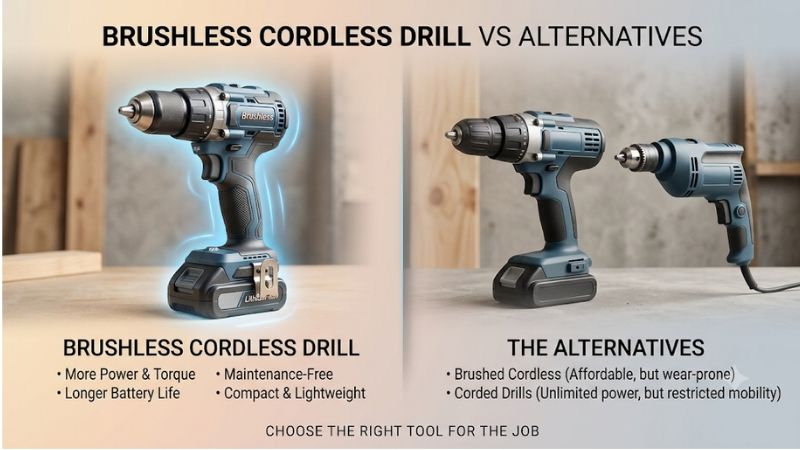
- A brushless cordless drill is a versatile choice for most homeowners because it combines conventional drilling, adjustable screw-driving control, and cordless mobility.
Comparing a brushless cordless drill vs alternatives helps homeowners choose the right equipment for drilling holes, driving screws, assembling furniture, and completing garage projects. Brushed drills, impact drivers, hammer drills, corded drills, and drill presses offer different advantages. Understanding how they differ prevents unnecessary purchases and helps match each tool to its intended application.
Quick Verdict: Which Drilling Tool Is Right for You?
A brushless cordless drill is a versatile choice for most homeowners because it combines conventional drilling, adjustable screw-driving control, and cordless mobility.
However, alternative tools may provide better performance for specific applications.
A brushed cordless drill can be an economical option for occasional use. An impact driver may be more convenient for repetitive screw-driving, while a hammer drill is better suited to appropriate masonry applications.
Corded drills eliminate battery-runtime limitations, and drill presses provide more controlled drilling alignment for suitable workshop projects.
The best tool depends on the material, fastener type, required accuracy, operating environment, and frequency of use.
Quick Comparison Table
| Tool type | Primary advantage | Main limitation | Best application |
|---|---|---|---|
| Brushless cordless drill | Efficiency, mobility, and versatile control | Battery-dependent runtime | General household and workshop use |
| Brushed cordless drill | Often lower initial cost | Brush wear and potentially lower efficiency | Occasional DIY repairs |
| Impact driver | Rotational impacts for compatible fasteners | Less versatile for conventional drilling | Repetitive screw-driving |
| Hammer drill | Percussion-assisted masonry drilling | Additional weight and vibration | Suitable brick and masonry work |
| Corded drill | Continuous electrical power | Requires accessible power outlet | Stationary or prolonged drilling |
| Drill press | Controlled alignment and repeatability | Limited portability | Workshop drilling and precision-oriented work |
Brushless Cordless Drill vs Brushed Cordless Drill
How the Motor Designs Differ
A brushed motor uses carbon brushes and a mechanical commutator to transfer electrical current during rotation.
A brushless motor uses electronic switching to control the motor.
This difference affects efficiency, maintenance requirements, electronic control, and potentially tool design.
Brushless construction eliminates brush wear, but it does not remove all mechanical wear from the tool.
Bearings, gears, switches, and other components still require appropriate operation and maintenance.
Efficiency and Battery Runtime
Brushless designs can improve electrical efficiency by reducing certain mechanical and electrical losses.
This may support longer runtime under comparable operating conditions.
However, battery capacity, motor tuning, material resistance, and user technique strongly influence actual results.
A brushless drill with a small battery is not guaranteed to run longer than a brushed drill using a much larger pack.
Meaningful comparisons require similar batteries and drilling workloads.
Power and Torque
Brushless motor technology can support sophisticated electronic control and substantial output.
However, maximum torque depends on the entire tool design.
A well-designed brushed drill may provide more usable torque than a low-output brushless alternative.
Compare the specific models and manufacturer-supported applications.
Do not rely solely on the word brushless as a performance guarantee.
Maintenance Requirements
Brushed motors contain brushes that eventually wear and may require replacement where servicing is supported.
Brushless motors remove that particular maintenance requirement.
However, both tool types need inspection, cleaning, proper battery care, and suitable accessory handling.
Brushless tools also contain electronic control components that may require professional service if damaged.
Initial Purchase Cost
Brushed cordless drills are often positioned as economical options.
Brushless models may cost more initially because of their motor and electronic control systems.
However, actual market prices vary by brand, package, promotion, and battery configuration.
A discounted brushless kit can sometimes cost less than a comparable brushed package.
Evaluate the complete purchase rather than assuming one technology always has a fixed price advantage.
Which Is Better for Occasional DIY Work?
For occasional repairs, both brushed and brushless drills can be suitable.
A brushed model may offer adequate performance at a lower cost.
A brushless drill becomes attractive when the price difference is modest or when the buyer values electronic control, efficiency, and reduced brush maintenance.
Choose based on the actual product rather than treating motor technology as the only deciding factor.
Brushless Cordless Drill vs Impact Driver
Main Mechanical Differences
A conventional drill/driver provides continuous rotary motion through a chuck that accepts compatible drill bits and driving accessories.
An impact driver normally uses a 1/4-inch hex collet and a rotational impact mechanism that activates under sufficient resistance.
The impact mechanism delivers repeated rotational impulses to help turn resistant fasteners.
These characteristics make the tools suited to different applications.
Which Tool Is Better for Drilling Holes?
A conventional drill is generally preferable for drilling holes requiring control over bit type, speed, and alignment.
Its three-jaw chuck accepts many round-shank accessories.
An impact driver may accept certain hex-shank drilling accessories, but it is not a direct replacement for a conventional drill.
The impact mechanism may be inappropriate for some drilling applications or accessories.
Use the tool recommended for the bit and material.
Which Tool Is Better for Driving Screws?
An impact driver can be particularly convenient for repetitive driving of suitable screws and construction fasteners.
Its rotational impacts may reduce the continuous reaction torque experienced during resistant fastening.
However, its impact action can damage delicate fasteners or materials when used improperly.
A conventional drill with an adjustable clutch is often preferable for furniture assembly, cabinet hardware, and sensitive screw-driving operations.
Which Tool Offers Better Control?
A drill/driver typically provides adjustable clutch settings designed to limit torque transmission during screw-driving.
This can help reduce overdriving in certain materials.
An impact driver relies on different operating characteristics, and its output may be less predictable for delicate final tightening.
Some impact drivers include multiple electronic modes, but these are not necessarily calibrated torque settings.
Choose a conventional drill when controlled fastening is the primary concern.
Which Tool Is Better for Woodworking?
Woodworking often requires both drilling and driving.
A conventional drill is useful for pilot holes, countersinking, and driving screws with adjustable clutch control.
An impact driver can be convenient for repetitive construction-style fastening.
For users performing substantial woodworking, owning both tools may be useful.
For occasional household projects, a conventional drill/driver is usually the more versatile first purchase.
Brushless Cordless Drill vs Hammer Drill
What Is Hammer Drilling?
A hammer drill adds an axial percussion action to conventional rotational drilling.
This action helps a suitable masonry bit penetrate certain brick, block, and concrete materials.
A standard drill/driver does not provide the same percussion mechanism.
However, hammer-drill capability does not automatically make a tool appropriate for every concrete application.
Conventional Drilling Applications
A regular drill/driver is suitable for many wood, metal, plastic, and general household drilling operations.
It can also drive compatible screws using appropriate accessories.
For buyers who rarely work with masonry, a conventional drill may provide sufficient versatility.
Masonry Drilling Applications
A hammer drill can be useful for suitable masonry work when paired with appropriate bits.
However, hard concrete, larger holes, or repetitive demanding applications may require a rotary hammer.
Choose according to the manufacturer’s drilling capacity and the exact material.
Do not assume all hammer drills offer equivalent capability.
Weight and Handling
Hammer-drill mechanisms can add components and potentially increase size or weight.
However, actual dimensions vary considerably by model.
Some compact hammer drills are similar in size to conventional drill/drivers.
Compare the complete tool specifications instead of assuming hammer mode always creates a substantial weight penalty.
Should a Homeowner Buy a Hammer Drill?
A homeowner who regularly installs anchors in appropriate masonry may benefit from hammer-drill capability.
Someone primarily assembling furniture and working with wood or metal may not need it.
Where prices and dimensions are similar, a hammer-drill model may provide useful flexibility.
However, an unnecessary additional feature does not automatically make the product better.
Brushless Cordless Drill vs Corded Drill
Power Source Differences
A cordless drill receives electrical energy from a rechargeable battery.
A corded drill draws power through an electrical connection.
The cordless design provides mobility and avoids the inconvenience of a trailing power cable.
The corded design eliminates the need to stop for battery charging, provided a suitable power supply remains available.
Runtime and Continuous Operation
Cordless runtime depends on battery capacity, workload, temperature, and tool efficiency.
For short household tasks, runtime may not be a significant limitation.
For prolonged repetitive drilling, battery changes or charging may interrupt work.
A corded drill avoids battery depletion but may still require cooling periods and must be operated within its rated duty and thermal limits.
Continuous electrical power does not mean unlimited continuous operation.
Power and Drilling Performance
Cordless drills can provide substantial output, including demanding drilling capability in professional models.
Corded drills may offer useful sustained operation without battery limitations.
However, performance depends on specific motor and gearbox designs.
A corded model is not automatically more powerful than every cordless alternative.
Compare the exact tools under equivalent drilling conditions.
Portability and Access
Cordless drills are useful on ladders, outdoors, and in areas without nearby outlets.
A corded drill may be inconvenient where power cables create tripping or snagging hazards.
However, some corded drills are compact and practical at fixed workbenches.
Consider the operating environment rather than judging solely by power source.
Maintenance and Ownership Costs
Cordless drills require battery care and compatible charging equipment.
Batteries eventually lose capacity and may need replacement.
Corded drills eliminate battery replacement but require inspection of the cord, plug, switches, and other electrical components.
Both require appropriate maintenance.
For occasional users who always work near an outlet, a corded drill may offer economical long-term utility.
Which Is Better for Garage Work?
A cordless drill is often more convenient for general garage maintenance because it can be moved freely around vehicles and equipment.
A corded drill may be useful for stationary workshop operations where a reliable electrical supply is available.
The best choice depends on mobility requirements, available outlets, operating frequency, and the total cost of ownership.
Brushless Cordless Drill vs Drill Press
How a Drill Press Works
A drill press holds a rotating spindle in a stationary machine and moves the cutting tool toward the workpiece along a controlled path.
This provides advantages in drilling alignment, repeatability, and depth control.
A handheld cordless drill relies much more heavily on operator positioning and technique.
The differences become important when creating accurate holes in workshop materials.
Accuracy and Repeatability
A drill press can help produce more consistent hole locations and drilling angles when properly set up.
Its adjustable table, depth stop, and fixed spindle geometry provide greater control than freehand drilling.
However, accuracy still depends on machine quality, bit condition, workpiece positioning, and correct setup.
A drill press is not automatically precise simply because it is stationary.
Portability
A cordless drill is substantially more portable than most drill presses.
It can be brought directly to an installed cabinet, wall, workbench, or other workpiece.
A drill press generally requires the workpiece to be brought to the machine.
Large or permanently installed components may therefore be impractical to drill using a conventional bench-mounted drill press.
Working With Small Parts
A drill press can be particularly useful for repeatable holes in appropriately secured small workpieces.
However, small parts can be hazardous if they are not clamped correctly.
The rotating bit can catch an unsecured workpiece and cause it to spin.
Always use appropriate clamps or fixtures and follow the manufacturer’s operating instructions.
When a Drill Press Is Worth Buying
A drill press becomes attractive when accurate hole alignment, consistent depth, and repeatability are regular requirements.
Examples include certain woodworking, fabrication, and workshop assembly operations.
For general home maintenance and installation work, a handheld cordless drill remains more versatile.
Many homeowners do not need a drill press unless they frequently perform precision-oriented workshop projects.
Brushless Cordless Drill vs Rotary Hammer
Different Percussion Mechanisms
A conventional hammer drill uses a mechanical percussion action while rotating the bit.
A rotary hammer uses a more specialized impact mechanism designed for demanding masonry applications.
This difference can make rotary hammers more effective for certain concrete-drilling tasks.
However, rotary hammers are generally more specialized than conventional drill/drivers.
Concrete and Masonry Applications
For small holes in suitable masonry, a hammer drill may provide adequate capability.
For larger holes or hard concrete, a rotary hammer may be preferable.
The correct choice depends on the material, required hole diameter, depth, and frequency of use.
Consult the tool and accessory manufacturer’s drilling-capacity recommendations.
Tool Size and Weight
Rotary hammers can be larger and heavier than compact drill/drivers.
Their accessory-retention systems also differ from conventional three-jaw chucks.
Some rotary hammers use SDS-type shanks designed for their specific tool interfaces.
Do not assume that ordinary drill bits are directly compatible without a manufacturer-approved arrangement.
Which Tool Is Better for Home Renovation?
For general renovation work involving wood, metal, and household fasteners, a brushless cordless drill is the more versatile tool.
If the project involves significant drilling into concrete, a rotary hammer may be necessary.
Many users benefit from keeping a conventional drill for everyday work and using a rotary hammer only when the material demands it.
Compare the Tools by Common Household Projects
Furniture Assembly
Furniture assembly often requires controlled screw-driving and occasional small pilot holes.
A compact brushless drill is generally suitable because its adjustable clutch helps manage fastening force.
A brushed drill can also perform this work effectively.
An impact driver may be unnecessarily aggressive for delicate fittings, while a drill press is usually impractical for assembled furniture.
Installing Shelves
Shelf installation can involve drywall, wood framing, masonry, or other materials.
A brushless cordless drill works well for many appropriate pilot holes and compatible fasteners.
Masonry installations may require hammer-drilling capability.
Always identify hidden services and follow appropriate anchoring requirements.
The correct tool depends on the wall material and installation method.
Building a Workbench
Workbench construction may involve drilling holes and driving numerous screws.
A conventional drill is useful for pilot holes and controlled fastening.
An impact driver can improve efficiency for repetitive compatible screws.
A drill press may be useful for precise holes in components before assembly.
The best arrangement depends on the design and construction process.
Metal Fabrication
Metal drilling requires suitable cutting bits, correct speed, lubrication where appropriate, and secure workpiece support.
A capable brushless drill can handle many portable metalworking tasks.
A drill press may provide better alignment and repeatability for shop-based fabrication.
An impact driver should not automatically be substituted for a conventional drill.
Drilling Concrete Anchors
Concrete anchors require holes of the correct diameter and depth.
Depending on the material and fastener system, a hammer drill or rotary hammer may be required.
A standard drill/driver may be unsuitable.
Follow the anchor manufacturer’s installation requirements, including cleaning procedures and torque specifications where applicable.
Automotive Maintenance
A brushless drill can be useful for suitable light drilling and fastening tasks around the garage.
However, removing stubborn automotive nuts often requires an impact wrench rather than a drill.
Precision tightening requires a torque wrench.
Do not use a drill/driver as a universal substitute for specialized automotive equipment.
How to Choose the Right Tool
Identify Your Main Application
Start with the operations you perform most frequently.
If you drill holes in different materials and occasionally drive screws, a conventional drill/driver offers strong versatility.
If you primarily drive construction screws, consider an impact driver.
If masonry is the main application, investigate hammer drills and rotary hammers.
If accuracy is more important than portability, consider a drill press.
Consider the Materials You Work With
Different materials require different cutting tools, drilling speeds, and operating techniques.
Wood, metal, masonry, and plastics do not behave identically.
Choose a drill appropriate for the hardest material you regularly encounter, while avoiding excessive size and expense for ordinary tasks.
Evaluate Working Clearance
A conventional drill can be difficult to position inside cabinets or narrow mechanical compartments.
Compact models, right-angle configurations, and offset attachments can improve access.
A larger drill with higher output may be impractical if it cannot approach the workpiece correctly.
Measure the available clearance before purchasing.
Assess Power and Runtime
Cordless drills are convenient, but batteries have finite energy capacity.
Corded equipment avoids battery-runtime limitations but requires a suitable electrical supply.
For occasional home use, cordless convenience often outweighs charging requirements.
For sustained stationary work, corded equipment may remain attractive.
Compare Total Ownership Cost
Cordless tools may require batteries, chargers, replacement packs, and compatible accessories.
Corded tools require suitable electrical access and cable maintenance.
Drill presses require dedicated workspace and appropriate fixtures.
Compare the total equipment needed to perform your intended work safely.
Consider Safety Requirements
High-torque drills can rotate suddenly when accessories bind.
Impact drivers deliver rotational impulses that may damage unsuitable fasteners.
Hammer drills and rotary hammers produce vibration and drilling dust.
Drill presses contain exposed rotating components and require proper workpiece restraint.
Choose tools based on both capability and the hazards associated with their intended applications.
Frequently Asked Questions
Is a brushless cordless drill better than a brushed drill?
A brushless motor can provide efficiency and reduced brush-related maintenance, but the better purchase depends on the specific models, workload, and price. A suitable brushed drill may be entirely adequate for occasional repairs.
Can a brushless drill replace an impact driver?
A conventional drill can drive many screws and handles a wider variety of ordinary drill bits. An impact driver may be more efficient for certain resistant or repetitive fasteners, so the tools are complementary rather than completely interchangeable.
Is a hammer drill more powerful than a regular drill?
Not necessarily. Hammer drilling adds percussion for suitable masonry applications, but overall rotational power depends on the specific model. A conventional high-output drill may have greater rotary capability than a lighter hammer-drill model.
Is a corded drill more reliable than a cordless drill?
Reliability depends on construction, operating conditions, and maintenance. Corded drills eliminate battery-related downtime, while cordless drills provide mobility and avoid trailing power cables.
Do I need a drill press for woodworking?
Not for every project. A handheld drill can handle many woodworking tasks, while a drill press offers advantages for controlled alignment, repeatable holes, and certain workshop operations.
Which drill should a beginner buy first?
A versatile cordless drill/driver with an adjustable clutch, two speed ranges, suitable chuck capacity, and a compatible battery system is a practical first purchase for many homeowners.
Conclusion
When comparing a brushless cordless drill vs alternatives, a conventional brushless drill/driver is usually the most versatile first choice for household drilling and fastening. Choose a brushed drill when basic affordability matters, an impact driver for compatible repetitive screw-driving, a hammer drill or rotary hammer for appropriate masonry work, and a drill press when controlled alignment is essential. The right tool is determined by the task, material, accessibility, and safety requirements rather than motor technology alone.
More from Amazon
Programs that pair well with the guide above. Offers and eligibility are set by Amazon and may change.
Collect the home and kitchen items you want in one registry that guests can shop from.
Create a wedding registrySet up recurring deliveries of everyday items on eligible products. Terms and savings are set by Amazon.
Explore Subscribe & SaveFree shipping on eligible items, Prime Video and more. Eligible new members can start with a free trial.
Start a Prime free trialAudiobooks and podcasts to listen to on the go. Eligible new members can start with a free trial.
Try Audible freeAs an Amazon Associate we earn from qualifying purchases.