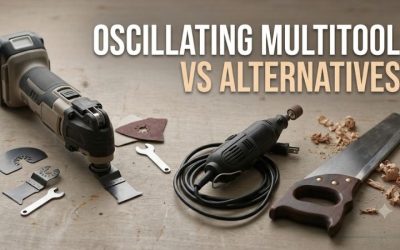
Comparing a compact circular saw vs alternatives helps homeowners choose the right cutting tool for plywood, dimensional lumber, flooring, cabinets, and garage projects. Full-size circular saws, jigsaws, track saws, miter saws, and oscillating multi-tools provide different capabilities. Understanding their cutting methods, accuracy, workspace requirements, and limitations helps prevent unnecessary purchases.
Quick Verdict: Which Cutting Tool Should You Choose?
A compact circular saw is a practical choice for homeowners who need portable straight-cutting capability without the size and weight of a conventional full-size model.
It can handle many everyday woodworking tasks, particularly when cutting depth is sufficient for the intended material.
However, it is not always the most effective tool.
A full-size circular saw offers greater cutting depth for thicker stock. A jigsaw handles curves and irregular shapes more effectively. A track saw provides advantages for guided straight cuts in large panels, while a miter saw is better suited to repeated accurate crosscuts.
An oscillating multi-tool can work in restricted locations where a circular blade and shoe cannot fit.
The most suitable option depends on the material, cut geometry, desired precision, and available workspace.
Quick Comparison Table
| Tool | Main advantage | Primary limitation | Best application |
|---|---|---|---|
| Compact circular saw | Portable straight cutting | Limited depth | Small woodworking projects |
| Full-size circular saw | Greater depth and capacity | More weight and bulk | Construction lumber and general cutting |
| Jigsaw | Curved and irregular cuts | Less ideal for long straight cuts | Cutouts and shaped components |
| Track saw | Guided straight cuts | Greater system cost and setup | Plywood and panel work |
| Miter saw | Repeatable crosscuts and angles | Limited cutting geometry | Trim and board crosscuts |
| Oscillating multi-tool | Access to confined locations | Slow for long cuts | Flush trimming and small cutouts |
Compact Circular Saw vs Full-Size Circular Saw
Blade Size and Cutting Depth
Compact circular saws generally use smaller blades than conventional full-size saws.
A 4-1/2-inch compact model may provide enough depth for standard nominal 2x lumber at 90 degrees.
A conventional 7-1/4-inch circular saw typically provides substantially greater cutting depth.
This difference becomes important when cutting thicker boards, larger structural materials, or making bevel cuts.
A compact saw may be sufficient for many home projects but unsuitable for work requiring deeper blade penetration.

Tool Weight and Handling
Compact saws are often lighter and easier to maneuver.
This can be beneficial in small garages and when performing occasional repairs.
A full-size saw generally requires more operating space, although design and weight vary by model.
The extra size may be justified for demanding cutting applications.
Choose according to actual project requirements rather than assuming smaller always means easier or safer.
Power and Cutting Performance
Both compact and full-size saws are available with different motors and power systems.
A larger saw may offer more capacity for sustained demanding work, but blade diameter alone does not establish motor performance.
Blade quality, gearing, power source, material resistance, and feed rate all matter.
A compact saw can perform very well in appropriately sized material.
However, it should not be forced beyond its documented cutting capabilities.
Accuracy
Both tools can make accurate straight cuts when used correctly.
A suitable guide, stable shoe, sharp blade, and properly supported workpiece are important.
A compact saw does not automatically cut more accurately because it is smaller.
Likewise, a full-size model does not guarantee greater precision.
The cutting setup often influences results more than the basic tool category.
Which Is Better for Homeowners?
A compact saw is practical for users who regularly cut thin panels, shelves, and common lumber within its capacity.
A full-size saw is better when thicker stock and demanding projects are frequent.
Homeowners who need one saw for a broad range of construction tasks may prefer the additional capacity of a conventional 7-1/4-inch model.
Compact Circular Saw vs Jigsaw
Cutting Mechanism
A compact circular saw uses a rotating blade to cut material.
A jigsaw uses a reciprocating blade that moves vertically during operation.
These mechanisms create different cutting characteristics.
Circular saws are generally well suited to straight cuts, while jigsaws are useful for curves and irregular shapes.
Straight Cutting
A compact circular saw can provide efficient straight cutting when paired with a suitable guide.
A jigsaw can also make straight cuts, but its narrow blade may deflect under certain loads.
This can affect cut squareness, particularly in thicker material.
For long straight cuts in plywood or lumber, a circular saw is often more appropriate.
Curved Cutting
A jigsaw is generally better suited to curves and shaped cutouts.
Its narrow blade allows directional changes that are not practical with a circular saw.
A circular saw blade should not be twisted through a curved path.
Doing so can cause binding, damage, or kickback.
Choose a jigsaw for appropriate curved cutting operations.
Internal Cutouts
A jigsaw can be useful for creating internal openings in properly supported material.
The operation may require a starter hole or another approved entry method.
Certain circular saws support manufacturer-approved plunge-cutting procedures, but this does not make them suitable for every internal opening.
A jigsaw or oscillating tool may provide better control for smaller cutouts.
Material Compatibility
Both tools can cut multiple materials when appropriate blades are installed and the manufacturer approves the application.
However, blade designs and operating methods differ.
A jigsaw may be more convenient for intricate cuts in wood, plastics, or compatible metals.
A circular saw is often more efficient for straight cuts through suitable stock.
Which Is Better for DIY?
Choose a compact circular saw when straight cuts dominate.
Choose a jigsaw when curves, shaped components, and irregular openings are common.
Many home woodworkers benefit from owning both because their applications complement one another.
Compact Circular Saw vs Track Saw
What Makes a Track Saw Different?
A track saw is designed to operate along a compatible guide rail.
The guide helps maintain a straight cutting path across the material.
Many track saws also incorporate plunge-cutting mechanisms and blade enclosures suited to their intended applications.
A compact circular saw can often be used with a straightedge, but it does not necessarily provide the same integrated guide system.
Straight-Cut Accuracy
A properly set up track saw can make accurate long cuts in sheet materials.
The rail helps guide the cutting path and reduces dependence on freehand steering.
A compact circular saw can also produce accurate results with suitable guides.
However, the track saw system may offer advantages in repeatability and setup for panel work.
Cutting Large Plywood Sheets
Track saws are particularly useful for breaking down large plywood and engineered panels.
The guide rail can establish the cutting line across the sheet.
A compact circular saw can perform similar cuts when properly supported and guided.
However, limited cutting depth or shorter guide accessories may reduce convenience.
Dust Collection
Many track saw systems are designed with enclosed blade areas and dust-extraction connections.
This can improve dust capture under appropriate conditions.
However, dust extraction effectiveness varies by tool and system.
Compact circular saws may also include dust ports, but their effectiveness depends on the specific design.
Purchase Cost
A track saw system may require a saw, guide rails, connectors, and compatible accessories.
This can increase the initial investment.
A compact circular saw and suitable straightedge may provide adequate capability for occasional projects at a lower total cost.
Compare actual project needs before purchasing a specialized system.
Which Is Better for Cabinet Making?
For frequent cabinet and furniture panel cutting, a track saw can provide advantages in guided accuracy and repeated straight cuts.
A compact circular saw is useful for smaller components and occasional DIY work.
The better choice depends on the required precision, material size, workspace, and budget.
Compact Circular Saw vs Miter Saw
Cutting Orientation
A compact circular saw is moved across or along the material during cutting.
A miter saw generally holds the blade assembly in a stationary machine that moves through a defined cutting path.
This makes the tools suitable for different operations.
A circular saw offers portability and flexibility, while a miter saw provides a dedicated setup for crosscuts and angles.
Crosscutting Boards
A miter saw is particularly convenient for repeated crosscuts in appropriately sized lumber.
Its fence and angle settings can help achieve consistent results.
A compact circular saw can also crosscut boards using suitable guides.
However, repeated identical cuts may require more measuring and setup.
Angled Cuts
Miter saws are designed for controlled miter angles and, depending on the model, bevel cuts.
These features are useful for trim, framing components, and certain furniture parts.
Compact circular saws may provide bevel adjustments but generally require additional guiding for accurately angled crosscuts.
Cutting Long Sheets
A miter saw is not designed to rip large plywood sheets lengthwise.
Its cutting width is limited by its mechanism and model specifications.
A compact circular saw is more versatile for appropriate sheet-material cutting.
Workspace Requirements
A miter saw generally requires a dedicated cutting station or stable mounting arrangement.
It also needs room for the workpiece on both sides.
A compact circular saw is more portable but still requires adequate material support.
For small garages, workspace layout may strongly influence the choice.
Which Is Better for Furniture Projects?
A miter saw is useful for repeated crosscuts and angled components.
A compact circular saw is useful for panels, shelves, and broader straight-cutting operations.
Many woodworking projects involve both types of cuts.
Choose according to the components you make most frequently.
Compact Circular Saw vs Oscillating Multi-Tool
Cutting Mechanism
An oscillating multi-tool moves its accessory through a small side-to-side arc at high frequency.
This allows it to perform certain cuts in confined locations.
A circular saw uses continuous blade rotation and generally cuts much faster along suitable straight paths.
The tools are designed for different cutting requirements.
Flush Cutting
An oscillating multi-tool can be useful for flush trimming near walls, floors, and installed components.
Its blade geometry allows certain cuts that are impractical with a circular saw’s shoe and guard.
A compact circular saw cannot automatically cut flush against an obstruction.
Do not remove its guards to attempt such operations.
Small Cutouts
Oscillating tools are useful for certain small openings and localized trimming.
Their narrow accessories can provide controlled access.
However, cutting long boards with an oscillating tool is generally inefficient compared with a circular saw.
Flooring and Trim Repairs
Oscillating tools are frequently useful for trimming door jambs and performing localized repairs.
Compact circular saws are more appropriate for longer straight cuts in compatible flooring materials.
The correct choice depends on whether the task requires broad cutting or precise localized removal.
Which Is Better for Renovation?
A compact circular saw is suitable for preparing boards and panels.
An oscillating multi-tool is useful for detailed cuts around installed surfaces.
The tools complement one another rather than serving as complete substitutes.
Compact Circular Saw vs Table Saw
Portability
A compact circular saw is portable and can be brought to the workpiece.
A table saw generally requires the material to be moved across a stationary table and blade.
This distinction strongly affects workflow.
For large installed components or work outside a workshop, portability can be advantageous.
Repetitive Rip Cuts
A table saw is useful for repeated rip cuts when properly equipped and operated.
Its fence system can provide consistency.
A compact circular saw can rip boards or panels with a suitable guide, but repetitive setup may require more time.
Cutting Precision
A table saw can provide accurate repeatable cuts when properly adjusted.
However, accuracy still depends on blade condition, fence alignment, workpiece support, and correct technique.
A compact circular saw can also produce accurate cuts with appropriate guides.
Safety Considerations
Both tools can produce kickback and serious injuries.
A table saw introduces specific hazards associated with feeding material past a stationary blade.
A handheld circular saw introduces hazards associated with tool movement, blade binding, and workpiece support.
Neither tool is inherently safe without proper guarding and operating procedures.
Which Is Better for a Small Garage?
A compact circular saw requires less permanent workshop space.
A table saw may be worthwhile when repetitive woodworking operations justify the equipment and storage requirements.
The choice depends on available space, project frequency, and the types of cuts performed.
Compare the Tools by Common DIY Applications
Cutting Plywood for Shelves
A compact circular saw is useful for straight cuts in appropriately supported plywood.
A track saw can provide additional guidance for long accurate panel cuts.
A table saw is valuable for repeated sizing in a suitable workshop.
A jigsaw is preferable for irregular cutouts.
Cutting 2×4 Lumber
A compact circular saw can cut standard nominal 2×4 lumber when its published cutting depth is sufficient.
A full-size saw provides greater capacity for thicker stock.
A miter saw is convenient for repeated crosscuts.
Choose according to cut direction, volume, and precision requirements.
Installing Laminate Flooring
A compact circular saw can make suitable straight cuts with an approved blade.
A jigsaw is useful for irregular shapes.
An oscillating multi-tool can help with appropriate trimming near installed surfaces.
The exact flooring material determines which cutting accessories are suitable.
Installing Baseboards
A miter saw is commonly useful for angled trim cuts.
An oscillating multi-tool can perform localized trimming.
A compact circular saw may be less convenient for repeated precise trim angles.
Building Cabinets
Cabinet work often involves long straight cuts in sheet materials.
A track saw or table saw may provide greater convenience for repeatable panel sizing.
A compact circular saw can still be useful for smaller components and occasional projects.
Repairing Installed Woodwork
A compact circular saw is appropriate when a straight cut can be made safely with adequate clearance and support.
For confined corners or flush trimming, an oscillating multi-tool may be better.
Never force a circular saw into a location that prevents correct guard operation.
How to Choose Between a Compact Circular Saw and Alternatives
Start With the Type of Cut
Identify whether you primarily need straight cuts, curves, repeated crosscuts, flush trimming, or long panel cuts.
A compact circular saw is most suitable for portable straight cutting.
A jigsaw is more appropriate for curves.
A miter saw handles repeated crosscuts.
A track saw specializes in guided panel cuts.
Consider Material Thickness
Maximum cutting depth is essential.
A small saw may be sufficient for thin plywood but unsuitable for thick lumber.
A larger circular saw provides greater depth.
Always check manufacturer specifications for the intended cutting angle.
Evaluate Required Accuracy
For occasional household cuts, a compact circular saw and suitable guide may be sufficient.
For repeated precise panels, a track saw or table saw may offer advantages.
For repeated accurate crosscuts, a miter saw may be more efficient.
Consider Workspace Size
A compact circular saw is portable and easier to store than many stationary woodworking machines.
However, the workpiece still requires proper support.
A small garage may benefit from portable tools and collapsible cutting supports.
Compare Total Ownership Costs
The cost of a cutting system includes the tool, blades, batteries where applicable, guides, dust control, and safety equipment.
A low-priced compact saw may not be economical if specialized blades are expensive.
A higher-cost track saw may be justified for frequent panel cutting.
Choose according to the value delivered by the complete system.
Consider Safety and Skill Requirements
All powered cutting tools require appropriate instruction and safe operating conditions.
A smaller blade does not eliminate kickback risk.
A guide rail does not eliminate hazards associated with moving blades.
A stationary machine does not automatically provide safer operation.
Choose equipment that permits correct control and guarding for the intended task.
Frequently Asked Questions
Is a compact circular saw better than a jigsaw?
For many straight cuts, a compact circular saw is more suitable. A jigsaw is better for curves and irregular shapes. The correct choice depends on the cut geometry.
Can a compact circular saw replace a full-size circular saw?
It can handle many lighter tasks, but its limited cutting depth may prevent it from replacing a full-size saw for thicker materials.
Is a track saw more accurate than a compact circular saw?
A track saw’s guide system can improve consistency on long straight cuts. However, an appropriately guided compact circular saw can also produce accurate results.
Do I need a miter saw if I own a circular saw?
Not necessarily. A circular saw can make many crosscuts, but a miter saw can improve convenience and repeatability for frequent angled trim and board cutting.
Can an oscillating multi-tool replace a circular saw?
Not for most long straight cutting operations. An oscillating tool is better suited to certain confined, localized, or flush-cutting tasks.
Which cutting tool should a beginner buy first?
For general straight cuts in wood and suitable sheet materials, a circular saw with adequate cutting depth is a versatile option. For projects dominated by curves or small cutouts, a jigsaw may be more useful.
Conclusion
When comparing a compact circular saw vs alternatives, choose the compact saw for portable straight cutting in appropriately sized materials. A full-size circular saw offers greater depth, a jigsaw handles curves, a track saw improves guided panel cutting, a miter saw supports repeated crosscuts, and an oscillating multi-tool reaches confined trimming locations. Select equipment according to cutting geometry, material thickness, workspace, and safe operating requirements rather than assuming one saw can perform every task.
More from Amazon
Programs that pair well with the guide above. Offers and eligibility are set by Amazon and may change.
Collect the home and kitchen items you want in one registry that guests can shop from.
Create a wedding registrySet up recurring deliveries of everyday items on eligible products. Terms and savings are set by Amazon.
Explore Subscribe & SaveFree shipping on eligible items, Prime Video and more. Eligible new members can start with a free trial.
Start a Prime free trialAudiobooks and podcasts to listen to on the go. Eligible new members can start with a free trial.
Try Audible freeAs an Amazon Associate we earn from qualifying purchases.