Our Top Picks
The best chairs for sitting all day are the ones that match your seat depth to your thigh length, offer independent lumbar height and firmness adjustment, and use either high-density molded foam (2.2–3.0 lb/ft³) or a properly tensioned mesh that doesn’t bottom out after year one. Past that, everything else — armrests, headrests, tilt tension — is comfort seasoning, not the main dish.
This guide ranks all-day chairs by the three variables that actually predict whether you’ll still be comfortable at hour 8: seat depth range, lumbar adjustability, and how the seat material holds up under sustained load.

Herman Miller Classic Aeron Chair - Size B, Posture Fit
Chosen because it specifies Size B and Posture Fit.
View on Amazon
Herman Miller Aeron Ergonomic Chair - Size B, Graphite
Chosen because it specifies Size B and Graphite.
View on Amazon
GABRYLLY Ergonomic Office Chair, High Back Home Desk Chair with Headrest, Flip-Up Arms, 90-120° Tilt Lock and Wide Cushion, Big and Tall Mesh Chairs for Man Woman, Black Task Chair
Chosen because it specifies High Back Home Desk Chair with Headrest and Flip-Up Arms.
View on Amazon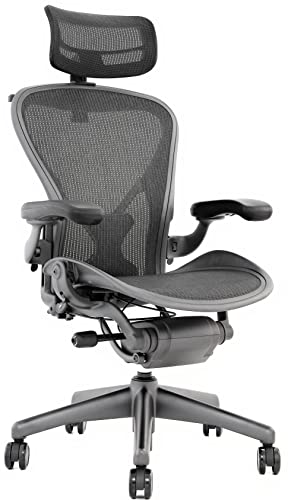
Aeron Chair by Herman Miller - Highly Adjustable Graphite Frame - with PostureFit - Carbon Classic (Medium)
Chosen because it specifies Highly Adjustable Graphite Frame and with PostureFit.
View on AmazonWhy seat depth range matters more than the spec sheet suggests
Most chair listings give you one seat depth number. What you need is the adjustable range, because a fixed depth only fits one body type well. If the front edge of the seat presses into the back of your knees, you’ll slide forward and lose lumbar contact within an hour — which is the single most common cause of “this chair looked great but hurts by afternoon.”
| Seat depth range | Best fit (inseat/thigh length) | Body height guide |
|---|---|---|
| 15–17 in (fixed or narrow slide) | Shorter thighs | Under 5’4″ |
| 16–19 in (standard sliding pan) | Average thigh length | 5’4″–6’0″ |
| 18–21 in (extended slide) | Longer thighs | Over 6’0″ |
Sit down and check for a 2–3 finger gap between the seat edge and the back of your knee. If a chair’s slide range doesn’t get you there, no amount of lumbar tuning will fix the fatigue.
Ranking by lumbar adjustability
Lumbar support falls into four tiers. Higher tiers cost more but matter a lot if you have any history of lower back discomfort.
- Tier 1 — Fixed lumbar bump: Built into the backrest shape, no adjustment. Fine for people whose torso length happens to match the curve; a mismatch for everyone else. Usually found on chairs under $200.
- Tier 2 — Height-adjustable lumbar pad: Slides up/down 2–4 in to sit at your lower back regardless of torso length. This is the minimum tier worth buying for 8-hour use.
- Tier 3 — Height + depth (firmness) adjustable: Pad also moves in/out, letting you dial firmness. Noticeably better for people who shift posture through the day.
- Tier 4 — Dynamic/self-adjusting lumbar mesh: The backrest mesh itself flexes and redistributes as you move, with no manual pad. Best for people who recline frequently and don’t want to re-tune a pad each time.
For all-day sitting, Tier 2 is the floor and Tier 3 is where most well-reviewed ergonomic chairs in the $350–$700 range land. Tier 4 shows up mostly in $700+ chairs and high-end mesh designs.
Foam vs. mesh: pressure distribution after 8-plus hours
This is the trade-off that matters most and gets glossed over in most buying guides.
| Factor | High-density molded foam | Tensioned mesh |
|---|---|---|
| Pressure distribution (hours 1–4) | Excellent — foam conforms and spreads load evenly | Good, but can create pressure lines at sit bones on thinner mesh |
| Pressure distribution (hours 5–8+) | Foam compresses; density under 2.0 lb/ft³ starts to bottom out, increasing pressure on tailbone | Stays consistent — mesh doesn’t compress the way foam does, so pressure map barely changes late in the day |
| Heat/moisture | Retains heat, can feel warm after hours 3+ | Airflow keeps you cooler, better for warm climates or hot offices |
| Long-term durability | 2.2–3.0 lb/ft³ foam holds shape 5–7 years; cheaper 1.5–1.8 lb/ft³ foam sags in 18–24 months | Mesh rarely sags but can stretch or tear at stress points after 5–8 years; harder to “feel” degradation |
| Best for | People under 200 lb who want a plush, cushioned feel | People over 200 lb, hot climates, or anyone prone to overheating while seated |
If you can’t check foam density on a spec sheet, weight is a decent proxy: a seat cushion under 6 lb on a mid-size task chair is usually lower-density foam that will soften faster.
Body-size fit notes
- Under 5’4″ / under 130 lb: Look for seat depth ranges starting at 15 in and seat width around 18–19 in. Oversized “ergonomic” chairs often leave feet dangling and the lumbar pad too high even at its lowest setting.
- Average build (5’5″–6’0″, 140–220 lb): Standard 16–19 in seat depth and Tier 2–3 lumbar covers most needs. This is where the widest chair selection exists.
- Over 6’1″ or over 250 lb: Check the weight rating explicitly — big-and-tall chairs are usually rated 300–400 lb versus 250–275 lb standard, and use reinforced steel frames instead of nylon/glass-composite bases. Seat width should be 20+ in and depth range should extend to at least 20 in.
Warranty length as a durability signal
Warranty terms correlate with how confident a manufacturer is in the gas cylinder, foam, and frame under daily 8-hour use — it’s one of the few durability proxies you can check before buying.
| Warranty length | What it usually signals |
|---|---|
| 1–2 years | Entry-level chair, often lower-density foam and a basic gas cylinder; expect visible wear inside 2 years of daily use |
| 3–5 years | Mid-tier build quality; typically covers frame and mechanism, sometimes excludes foam/upholstery |
| 10–12 years | Common on higher-end ergonomic chairs ($400–$900); usually full coverage on frame, cylinder, and mechanism |
| Lifetime (frame only) | Seen on premium mesh chairs; frame and mechanism covered indefinitely, foam/mesh/casters usually carry a shorter separate term (often 5 years) |
Read the fine print: many “lifetime” warranties only cover the frame, not the part that actually wears first — the seat cushion or mesh weave.
What wears out first
Across chairs used 8+ hours a day, the failure order is fairly consistent:
- Casters — first to degrade on hard floors, typically within 1–3 years; swapping to hooded/rated-for-hardwood casters extends this significantly.
- Gas cylinder — slow sinking (“gas lift creep”) after 3–5 years of heavy use, more common in budget cylinders.
- Seat foam — compression set in low-density foam after 18 months to 3 years; high-density foam lasts 5–7 years.
- Mesh weave — stretches at the point of greatest load (usually under the sit bones) after 5–8 years, rarely fails outright.
- Armrest pads — foam or PU armrest covers crack or peel first among visible components, often within 2 years on PU-coated pads.
Decision matrix: which type fits your situation
| Your situation | Best-suited chair type |
|---|---|
| Back pain or history of lower-back issues | Tier 3+ height/depth lumbar adjustment, foam seat 2.2+ lb/ft³, seat depth slider |
| Hot office or warm climate, tend to overheat | Full mesh back and seat, Tier 3–4 lumbar |
| Over 250 lb or over 6’1″ | Big-and-tall rated chair, 300–400 lb weight rating, steel frame |
| Small frame / under 5’4″ | Compact seat width (18–19 in), depth range starting at 15 in |
| Budget under $250 | Fixed lumbar bump chair with 2+ year warranty; accept it’ll need replacing in 2–3 years |
| Long-term investment, 8+ hrs/day for years | $400–$900 chair with Tier 3+ lumbar, 10+ year warranty, high-density foam or premium mesh |
The short version: match seat depth to your actual thigh length first, then don’t settle for less than height-adjustable lumbar, and treat warranty length as a rough proxy for how long the foam or mesh will hold up under daily 8-hour use.