Key takeaways
- Choose larger, widely spaced wheels if you often cross sidewalks, station platforms, or carpeted floors.
- Check the handle-to-case movement; excessive wobble usually becomes more noticeable when the bag is full.
- Keep the heaviest items low and near the wheel side so the suitcase does not tip while rolling upright.
- Expect wheels to wear first when a case is dragged over curbs, gravel, or rough pavement.
The best Delsey luggage depends on your trip: choose a lightweight Helium Aero or Clavel for frequent flying, a tougher polycarbonate model such as Chatelet Air 2.0 for checked baggage, and a compact carry-on only after comparing its outside dimensions with your airline’s limits.
Quick picks by travel situation
| Travel situation | Best Delsey direction | Why it fits | Watch for |
|---|---|---|---|
| Frequent domestic flights | Helium Aero carry-on | Lightweight hard shell, spinner wheels, and a practical 20–21-inch format | Confirm the airline’s total outside-size limit; wheel housings count |
| Long international trip | Large Chatelet Air 2.0 or Turenne | More organized interiors and durable polycarbonate construction | A fully packed large case can exceed common 50 lb checked-bag limits |
| Business travel | Clavel or a Delsey carry-on with an expansion panel | Lower weight leaves room for a laptop, clothing, and documents | Expansion may make the bag too deep for an overhead bin |
| Premium appearance and organization | Chatelet Air 2.0 | Structured compartments, distinctive styling, and a built-in brake on some versions | Premium features add weight and cost |
| Road trips and occasional use | ABS or ABS-polycarbonate Delsey case | Usually offers a lower purchase price and adequate protection for moderate use | ABS can show scratches or cracks sooner after rough baggage handling |
Best Delsey luggage by suitcase size
Best carry-on: a 20- to 21-inch spinner
A Delsey carry-on is the safest starting point for travelers who want to avoid checked-bag fees and baggage-claim delays. Look for a case no larger than approximately 22 x 14 x 9 inches when your airline uses a strict U.S.-style limit. Some Delsey carry-ons measure about 21 to 22 inches high, but the listed height may or may not include wheels and handles depending on the product page.

DELSEY PARIS Chatelet Air 2.0, 28 Inch Checked Luggage, Chocolate Brown
Included for 'Best Delsey Luggage for Every Trip' because the listing specifies 28 Inch Checked Luggage and Chocolate Brown, details this guide uses to compare options.
View on Amazon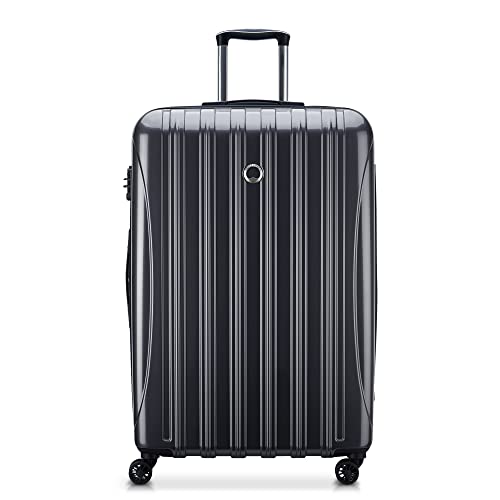
DELSEY PARIS Helium Aero, 28 Inch Checked-Large Luggage, Titanium
Included for 'Best Delsey Luggage for Every Trip' because the listing specifies 28 Inch Checked-Large Luggage and Titanium, details this guide uses to compare options.
View on Amazon
DELSEY PARIS Helium DLX, Rolling Garment Bag with Wheels, Black
Included for 'Best Delsey Luggage for Every Trip' because the listing specifies Rolling Garment Bag with Wheels and Black, details this guide uses to compare options.
View on Amazon
DELSEY PARIS Cruise 3.0, 26 Inch Checked Trunk Luggage, Black
Included for 'Best Delsey Luggage for Every Trip' because the listing specifies 26 Inch Checked Trunk Luggage and Black, details this guide uses to compare options.
View on AmazonThe Helium Aero carry-on is a sensible weight-conscious choice. Its polycarbonate shell, four spinner wheels, and expandable interior suit short trips. The Chatelet Air 2.0 carry-on is more structured and refined, with better built-in organization, but it is typically heavier. For a laptop, shirts, and two or three pairs of shoes, a carry-on in the 35- to 45-liter range is usually easier to control than an expanded case packed to its limit.
Measure the packed bag, not just the empty shell. Expansion commonly adds roughly 1 to 2 inches of depth, which can turn an apparently compliant carry-on into an oversized one.
Best medium suitcase: 24- to 26-inch checked luggage
A medium case is often the most useful compromise. It holds approximately one week of clothing without becoming as difficult to lift as a 28- or 29-inch suitcase. It is a strong pick for couples who prefer one case each, travelers changing hotels frequently, and anyone who wants to remain below a 50 lb checked-bag threshold.
Delsey’s Helium Aero and Turenne lines are worth considering in this size. Choose the lighter model if you will carry the case up stairs or transfer it between trains. Choose the more heavily organized model if compression panels, divided compartments, and wrinkle control matter more than every ounce.
Best large suitcase: 28- to 30-inch checked luggage
A large Delsey case is useful for two-week trips, bulky winter clothing, or family packing, but it creates a weight trap: extra volume makes it easy to exceed airline limits. A 29-inch case weighing around 11 to 13 lb leaves approximately 37 to 39 lb for clothing before reaching a 50 lb allowance.
Large Chatelet Air 2.0 and Helium Aero cases offer this capacity in different styles. The Chatelet prioritizes organization and appearance; Helium Aero generally prioritizes a lighter overall load. If you regularly travel alone, a medium case is often easier to maneuver through doorways, station platforms, and hotel elevators.
Shell material: polycarbonate versus ABS
| Shell type | Practical advantage | Trade-off | Best use |
|---|---|---|---|
| Polycarbonate | Good impact resistance with useful flexibility; often lighter than premium metal cases | Can scuff, and thinner panels may flex under concentrated pressure | Frequent air travel and checked baggage |
| ABS | Usually affordable and light | Less resistant to repeated hard impacts and cold-weather brittleness than polycarbonate | Occasional flights and budget-conscious buying |
| ABS-polycarbonate blend | Balances price, weight, and shell stiffness | Performance varies by panel thickness and construction | General-purpose travel |
| Aluminum or aluminum-frame construction | Rigid, premium feel and strong edge protection | Heavier, more expensive, and vulnerable to dents | Travelers who value structure over low weight |
For most travelers, polycarbonate is the best Delsey luggage shell material. It gives a useful balance between impact resistance and weight. Do not confuse a textured finish with extra structural strength: the frame, corner protection, zipper quality, and wheel attachment often matter more after repeated trips.
Wheel quality and maneuverability
Delsey spinner cases generally use four multidirectional wheels, allowing the suitcase to roll beside you rather than trail behind you. This is convenient in airports but exposes each wheel and housing to more impacts. A two-wheel case can handle rough pavement more confidently, while a four-wheel spinner is easier on smooth floors and in narrow hotel corridors.
- Choose larger, widely spaced wheels if you often cross sidewalks, station platforms, or carpeted floors.
- Check the handle-to-case movement; excessive wobble usually becomes more noticeable when the bag is full.
- Keep the heaviest items low and near the wheel side so the suitcase does not tip while rolling upright.
- Expect wheels to wear first when a case is dragged over curbs, gravel, or rough pavement.
Spinner wheels need roughly 2 to 3 inches of usable clearance beside furniture, walls, and seat rows to turn comfortably. In a small hotel room, a large case can be difficult to rotate if the gap between the bed and wall is under 30 inches. A medium suitcase is easier to pivot, lift onto a luggage rack, and store without blocking the room’s main walking path.
Security features that matter
Many Delsey hard-shell cases include a TSA-approved combination lock, allowing airport security personnel to open the case with an authorized tool without cutting the lock. The lock protects against casual opening; it is not protection against determined theft.
Delsey’s SECURITECH zipper systems are designed with interlocking zipper components intended to be more resistant to forced opening than a conventional zipper. A frame case can provide another style of closure, but it usually weighs more and offers less flexibility when overpacked. Whichever design you choose, use the lock for the main compartment and avoid placing valuables, medication, or irreplaceable documents in checked luggage.
Airline-ready dimensions and weight
| Case category | Useful target dimensions | Typical empty weight | Airline reality |
|---|---|---|---|
| Personal item | About 18 x 14 x 8 inches or smaller | Usually 1.5–4 lb | Must fit under the seat; airline limits vary sharply |
| Carry-on | About 22 x 14 x 9 inches or smaller | About 6–9 lb | Check whether wheels and handles are included in the measurement |
| Medium checked case | Usually 25–28 inches tall | About 8–11 lb | Stay within the airline’s combined linear-inch allowance |
| Large checked case | Usually 28–30 inches tall | About 10–14 lb | Pack by weight, not available volume; 50 lb is a common limit |
Airlines commonly calculate checked-bag size by adding height, width, and depth, often allowing up to 62 linear inches. A case measuring 30 x 20 x 12 inches totals 62 inches before accounting for any unusual protrusions. Policies differ, so verify the exact carrier before buying. If you fly internationally, also check cabin-bag weight limits; a heavy premium carry-on can be compliant in size but rejected for exceeding a 7 kg or 8 kg limit.
Which Delsey should you buy?
Choose the Helium Aero when low weight, a polycarbonate shell, and everyday practicality are the priorities. Choose Chatelet Air 2.0 when organization, distinctive styling, and premium handling justify extra weight and cost. Choose a Turenne or comparable midweight Delsey spinner when you need a durable, understated checked case for frequent travel. Choose an ABS or ABS-blend model when the suitcase will fly only occasionally and keeping the price down matters most.
Before ordering, compare the outside dimensions including wheels, estimate the packed weight, and check the distance you will carry it over uneven ground. Those three details usually determine whether a suitcase feels convenient or becomes a burden after the first connection.