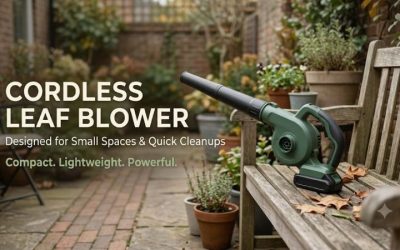
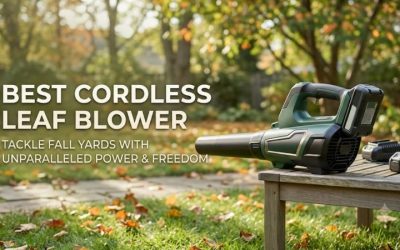
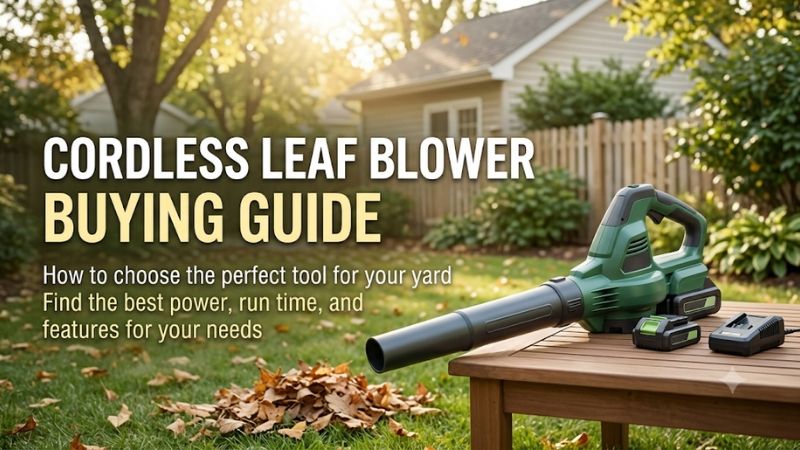
This cordless leaf blower buying guide starts with a driveway, patio, or lawn you want to clear. Measure the area, identify the debris that takes the most effort, and decide where you will collect it. Then compare airflow, battery size, speed control, and working weight for that job instead of shopping by one number.
A cordless leaf blower buying guide that starts with the job
Write down the ordinary cleanup and the hardest job you expect to repeat during the year. One might be five minutes of grass clippings on a driveway. The other might be several stretches of lawn covered in autumn leaves. A useful purchase does the frequent work comfortably and has a realistic way to tackle the difficult part.
Understand the material and surface you need to clear
Loose dry leaves on smooth pavement move easily. Wet leaves can stick to one another or to turf. Debris in rough asphalt, joints, and grass can take more focused air or preliminary hand work. Evaluate the surface that slows you down rather than treating the total square footage of the property as a precise demand for power.
Make a simple inventory of surfaces. A property with a small lawn and a long driveway may need a different blower than an equally large lot with most of the leaves trapped along a wooded yard. Include planting beds, gravel, and corners that need lower, directed airflow. A tool that handles the open part but constantly sends mulch onto the walk can add work.
Decide how you will finish. A blower moves debris to another place. A rake, dustpan, yard bag, or appropriate mulching plan may handle the last stage. Bringing a pile to a nearer collection place can shorten the job enough to make a smaller battery practical. Choosing a final location is inexpensive and can improve the results from almost any blower.
Write a realistic description of the work for your comparison. For instance, “a long concrete driveway that receives dry clippings each week and two short areas where leaves collect,” is clearer than “medium yard.” That description directs you toward equipment that fits your actual use rather than a model chosen from a general category.
Estimate the time you spend blowing, including harder sections
Walk the route and identify where you can move at an ordinary pace. Then mark the places where you slow down, repeat passes, or need higher output. Estimate total trigger time rather than the time you spend filling bags, moving a bin, or setting up. That estimate gives you a starting point for battery and charger comparisons.
Say your cleanup needs about 12 minutes of steady blowing on hard surfaces and another several minutes at a higher setting around a fence line. A manufacturer’s up-to runtime of 45 minutes at the lowest speed does not directly describe that session. Look for mode-specific numbers and the battery used for them. If the seller offers no useful comparable runtime, plan a margin based on the actual work and consider a source with a relevant measured test.
A bigger yard can be easier to clear than a smaller one if the leaves are dry, the wind is favorable, and the route is short. Wet seasonal buildup can make a tiny section of grass the demanding part of the job. Compare the pattern of use so you know whether a spare battery gives you more value than a larger blower.
Check whether the work must be done in one session. A person cleaning briefly after mowing once a week may be able to recharge long before the next outing. A person using the same packs for a mower, trimmer, and blower on one day needs to check the complete battery rotation. That can change the most economical bundle.
Separate regular cleanup from occasional peak work
Most households have a handful of days when the ordinary equipment is put under extra pressure. Decide whether those days justify buying a bigger tool or whether a supplemental method already handles most of the work. Pay for what happens often enough to affect the time, effort, or usefulness of the garage.
For a small yard with one heavy leaf drop, a rake can collect the heaviest patches, leaving a moderate blower to clear the walk. Someone with several trees dropping leaves over a long period may benefit from a stronger cordless model with a spare. Think about how many sessions involve the harder material and how much of each session requires extra output.
Consider weather, too. If fall leaves tend to sit wet on the lawn, the difference in work comes from the damp leaf mats and how much daylight or time you have to move them. A higher-output blower may help in some places. A rake or different collection method may still be the right way to free the leaves. Choose a tool that serves your routine while providing a sensible plan for that exception.
A homeowner who values a quick start might prefer reliably finishing frequent small jobs now and using another tool a few times a year. A household that clears a large shared drive every weekend may decide the extra runtime is central. Both decisions begin with frequency rather than the biggest number on the package.
How to read CFM, MPH, nozzles, and sound claims
Published numbers can narrow a shortlist when you compare their meaning and the conditions under which they were measured. Air volume, airspeed, and blowing force describe different aspects of the air stream. The type of nozzle, the power mode, and the distance to the ground influence the effect you see on debris.
Use CFM to compare how much air a blower moves
CFM means cubic feet per minute. It describes the amount of air moved through the outlet under the stated conditions. A broader stream can be useful on a driveway or lawn where you need to move a front of dry leaves. The usefulness depends on the nozzle and how that air contacts the surface.
Compare two examples. A compact sweeper may publish 100 CFM and a high airspeed through a small outlet. A budget axial blower around 350 CFM may carry a wider strip of loose leaves across a patio even with a lower quoted MPH number. For a wide driveway covered with grass clippings, spread of the air stream can matter more than that highest speed figure.
Use the model’s low and standard performance where available. A large maximum reached briefly in turbo can give an incomplete picture of what you will use for the majority of the route. If a brand does not list outputs by setting, choose based on the blower class, its control range, and credible tests that match your surface.
Look for the conditions in the product literature. Manufacturer CFM and MPH figures are useful within a known configuration. Different brands can report maximum results with different attachments or conventions. Do not assume numerical differences translate directly into a percentage reduction in the time needed to finish your yard.
Use airspeed and nozzle details for stubborn or concentrated debris
MPH describes how quickly the air is moving at a specified point under stated conditions. A focused stream can be helpful along a seam, beside a wall, or when freeing light debris that is caught. A broad open tube can make it easier to sweep a large area, even if the maximum airspeed specification is lower.
Check whether the maximum MPH claim needs a tapered or concentrator nozzle. If the model advertises a high number with an attachment you will rarely use, it may contribute little to ordinary work. Compare which attachments are in the box and if they can be fitted or removed following the instructions. That also affects storage and overall cost.
Some labels also specify blowing force in newtons. Where available, blowing force is another indicator of how the blower’s stream is applied, provided you understand how the manufacturer reports it. Use comparable test conditions if possible. A single number cannot show the relationship between the tool and the corner, lawn, or edge where you will use it.
For a practical check, imagine the two ways you move the nozzle. Across the open property you want a consistent stream along the ground. At a stubborn corner you want a short, controlled pass toward the collection area. Find a combination of controls and attachments that supports both if both are regular jobs.
Interpret sound by checking distance and operating mode
Sound claims can help with a comparison when they describe the same measurement. Look for whether the number is sound pressure at a given distance, sound at the operator position, or declared sound power. Compare like with like, and pay attention to the mode used. The battery format by itself cannot tell you how noticeable a tool will be.
Review the manufacturer’s directions for personal protection and operation. A cordless model has no exhaust at the tool during use, but it still produces sound and can move dust and small particles. On a dense residential lot, a suitable lower setting and reasonable operating times can help the cleanup fit the setting. Verify the local or building rules that actually apply.
Consider the surroundings. Walls and gates change how users and neighbors experience sound. A long steady pass with a lower setting may work well on the same path that a loud high-speed pass would clear. If close quarters are part of the setting, add the blower’s behavior at low speed to the purchase criteria instead of trying to judge by one marketed noise figure.
The possibility of a manual option matters here. A broom can handle a small patio without requiring a battery or a powered tool, and an appropriate collection method is preferable when blowing would spread troublesome dust. A blower earns its place where air can move the actual material efficiently within the space.
Choose the battery, charger, and weight as a system
A blower’s battery platform decides what you can reuse, what the tool weighs as you work, and how long you can go between charges. Compare the exact kit SKU. Count the battery, charger, and any spare you actually need. A high-voltage number alone says little about runtime, and a large pack does not make every cleanup easier.
Compare watt-hours when voltages differ
Amp-hours describe charge capacity, and the voltage is part of how much energy a battery can store. Nominal voltage multiplied by rated amp-hours gives an approximate watt-hour figure. Use a manufacturer’s watt-hour rating when available. Check whether a voltage printed on the front is the maximum listed voltage or the nominal figure.
For illustration, an 18V nominal battery rated at 4.0Ah represents roughly 72 watt-hours. A battery rated at 54V nominal and 4.0Ah represents roughly 216 watt-hours. Those calculations describe the stored-energy scale rather than the minutes of operation you should expect. A blower that uses more power at a particular speed can drain available energy more quickly.
Use watt-hours to compare what comes in packages where the battery labels are substantially different. Compare runtime within each maker’s stated conditions, then match those conditions to the route. A buyer who does mostly short, low-output passes may prefer the lighter pack even if another kit offers more theoretical energy.
Check the manufacturer’s compatibility and performance recommendations. Cross-brand batteries with similar voltage labels are not generally interchangeable. Related brand lines can also be different families. Some performance estimates assume a recommended battery. Higher-priced packs are worth comparing when the tool’s work actually needs their capability.
Read runtime together with the battery and setting used
A useful runtime claim tells you the setting, pack, and condition. Some companies list an average or an “up to” figure across a mix or under a low setting. A high-output pass can use stored energy much more quickly. Do not add two separate maxima together or expect the greatest airflow throughout an advertised low-speed session.
Look for a useful range rather than a single headline. EGO’s documentation for the LB7654, for example, gives different figures for turbo and low with its recommended 5.0Ah battery. That distinction is more helpful than assuming the advertised average lasts at the highest setting. You can compare that idea with any model that gives mode-specific evidence.
Consider what happens if you work until the battery stops, then need another few minutes for cleanup. If that happens frequently, you may benefit from a ready spare or a more efficient route. If it happens only when you attempt peak fall work, combine a rake with the blower or divide the property into two sessions. There is no need to build an expensive battery fleet for an exception unless finishing it quickly matters.
Charger speed can reduce idle time, but compare the real charging claims. A short time to a partial charge is different from a full charge. Temperature and the state of a used pack can affect charging behavior. Follow the manufacturer’s instructions and give the battery and charger a suitable place to operate and be stored.
Compare the weight you actually hold and carry
The weight of the tool before battery installation is useful for catalog comparison. The relevant number for operation is the weight with the specific battery and nozzle you plan to use. Pay attention to balance and grip comfort, especially when you will carry the blower for a long section of driveway or aim around multiple obstacles.
If possible, hold a display in a normal working position using a matching pack size. Notice whether the tube wants to tilt down farther than you prefer and whether the trigger hand remains comfortable. Think about how you operate controls with gloves and whether the grip can be handled by the people who share the tool.
Choose a strap or support only if the manufacturer allows it and the tool is set up for the accessory. An approved strap can make longer work easier for some users. A lighter battery can be a simpler choice when you have an adequate runtime margin. For short jobs, carrying excess pack weight can matter more than maximizing capacity.
Check storage as part of this test. Approximately where will the blower sit, and where can the battery be removed and charged as directed? Confirm whether the tube is removable, the charger is included, and the packs have a suitable place between uses. A complete setup is convenient when it is ready at the point you begin your regular cleanup.
How to compare exact kits before you pay
Bring the buying decision back to the specific work you want to finish. Confirm the exact model, included batteries, charger, and any nozzle that appears in the performance claims. Then price the usable setup, including any spare or approved accessory you will need immediately. Compare equivalent packages for the final decision.
Price what comes in the box and what comes next
A bare-tool price can be the right figure if you already have suitable equipment. Compare that against a kit if you need an extra pack or want a charger dedicated to the garage. Some packages contain a second battery, while a similar listing may use a different capacity or omit the charger. Find the complete parts list.
The extra purchase that matters most to many buyers is the battery the tool needs to work through the whole route. It can be more economical to buy a kit with that battery than to add a separate pack later. On the other hand, if the included pack duplicates what you already own and the tool needs only a few minutes of work, a bare-tool offer can be enough.
Read warranty and seller terms for the exact equipment. Think about how you will get parts or support if a nozzle or charger is missing or fails. Compare authorized sellers and return terms when a product will be shipped. Investing a little time in the model identifier prevents confusion with tool-only listings and packs that look similar.
Choose a route you can use to evaluate the purchase
Before buying, choose a familiar strip of driveway, patio, or lawn with the usual debris. Think through a complete job, including how you will collect the leaves, where the battery can be charged, and what you will do with the difficult corner. That route is more instructive than a demonstration that blows light material on a different surface.
If you have a chance to try the correct model, check the low setting, the highest setting you actually need, and the feel with the intended pack. Make sure the blower moves the debris rather than simply stirring it. Confirm you can keep the air stream away from areas that should remain undisturbed. A demo of this kind can help choose between similar price and output levels.
For the final comparison, prioritize the model that comfortably covers the common task and gives you a workable plan for the heavier one. A good balance of controls, energy, and weight can make the blower more useful over the year than a higher maximum specification that rarely contributes to the work.
Conclusion
Choose a cordless leaf blower by surface, debris, and the time you need at ordinary working speeds. Compare CFM and MPH in the documented configurations, read runtime alongside the battery and mode, and judge weight with the pack installed. Price the complete kit you actually need before you commit to a battery platform.
More from Amazon
Programs that pair well with the guide above. Offers and eligibility are set by Amazon and may change.
Collect the home and kitchen items you want in one registry that guests can shop from.
Create a wedding registrySet up recurring deliveries of everyday items on eligible products. Terms and savings are set by Amazon.
Explore Subscribe & SaveFree shipping on eligible items, Prime Video and more. Eligible new members can start with a free trial.
Start a Prime free trialAudiobooks and podcasts to listen to on the go. Eligible new members can start with a free trial.
Try Audible freeAs an Amazon Associate we earn from qualifying purchases.