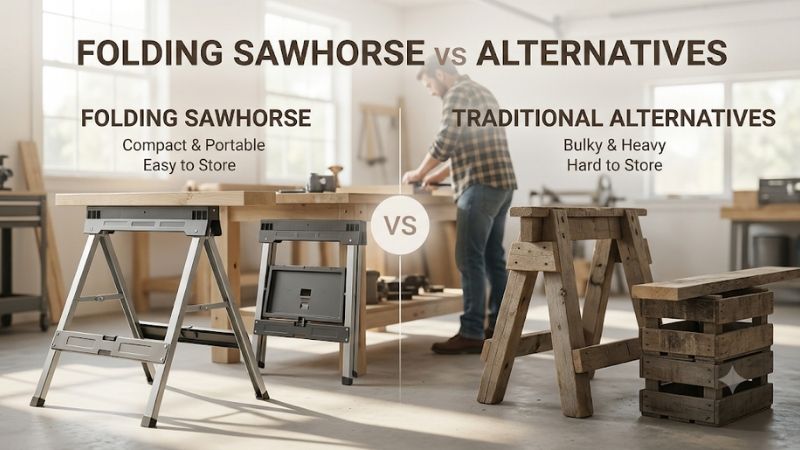
A folding sawhorse vs alternatives comparison starts with what needs support. Choose horses for portable support under long stock, a workbench for clamping or sideways pressure, and the right stand for a stationary saw. Sheet goods may need broader support than a pair of narrow contact lines offers.
Folding sawhorse vs alternatives at a glance
Choose by the shape of the support and the way the work moves. Two folding horses provide separated bearing lines. A bench adds a work surface. A roller supports moving stock, and a purpose-built saw stand attaches to a compatible tool and helps support its material.
| Support | Strongest use | Main trade-off |
|---|---|---|
| Folding sawhorse pair | Portable support for long stock and temporary setups | Requires an appropriate layout for clamping or full sheets |
| Fixed wooden sawhorses | Frequent use at one location and custom height | Take up more storage room |
| Portable clamping bench | Holding narrow pieces and small assemblies | Limited support area |
| Fixed workbench | Repetitive hand-tool work and secure clamping | Occupies dedicated floor space |
| Approved sacrificial panel setup | Broad sheet support for suitable circular or track-saw work | Low working position if used on the floor |
| Roller or outfeed stand | Supplemental support for stock feeding past a tool | Narrow support and sensitive height alignment |
| Dedicated miter saw stand | A compatible saw and repeated cuts on long stock | Designed for a specific tool and setup |
| Portable flat work table | Small assembly, parts layout, and general staging | Fixed surface size |
| Lumber rack or staging cart | Storing or moving stock between operations | Serves storage or transport unless rated for the work setup |
Identify the force your work will put on the support
A static load only describes part of a job. You may also push sideways while planing, tighten a clamp near an edge, or move stock across a tool. Identify those forces along with the weight. A stable surface for paint staging can be a poor choice for heavy hand-tool work.
Consider a narrow board laid flat for paint. You need a clean surface and room to reach its edges. The same board held vertically for planing presents a lever. The support has to resist that sideways pressure and provide a suitable point for a clamp. A purpose-built clamping bench, or a fixed bench with a vise, can make the second arrangement easier to control.
Movement can matter as much as force. Long stock may shift from one support to another during a cut or a tool feed. A sheet may need support on each side of the line to keep it from pinching the blade. Draw the starting position and the ending position. Use the relevant tool manual to decide where support should go.
Separate the work surface from the tool mount
A work surface carries material and leaves room for hands and accessories. A tool mount also has to secure the machine in its approved position. Check what the machine requires before putting it on any bench or stand. Verify compatibility and the weight rating as separate specifications.
A pair under an approved temporary tabletop can support a number of hand tasks. A miter saw can require a specified mounting method, bolt pattern, or compatible brackets. Locking the saw to the correct base gives it a defined position and lets you set its supports to the correct height. Work from the machine’s instructions when selecting that arrangement.
A bench may serve the nearby assembly work even if a dedicated stand carries the saw. Think about material flow between the two. Large pieces need room to land, and the operators need a clear aisle. Setting each surface up for its own task can make it easier to keep the stock moving and to find the tools you need at each stage.
Where each alternative works better
The right alternative solves a clear problem in the typical sawhorse setup. Fixed horses reduce daily deployment, a clamping bench holds small parts, and a broad sacrificial support can carry a full sheet. Compare by the action you need the support to perform before selecting equipment.
Folding sawhorse vs fixed wooden sawhorses
A fixed horse stays ready for work and can be built or purchased at a useful height. It suits a location where the support rarely moves. A folding model earns its space in a shared garage or truck, where the open legs would otherwise occupy room between jobs.
A pair kept beside a permanent workshop can act as a regular support for layout and paint. A stable fixed design with the correct construction can give you a comfortable working height and a replaceable wooden top. Use a suitable documented design or a rated product for the load. Check the support and connections against what you will place on the stand, including the forces associated with the work.
A folding steel or molded option is preferable when the same pair has to travel or share floor space with a vehicle. Check the folded dimensions and where it will go. The portable set needs a deliberate opening and lock check before every use. If it will stay open most of the year and your work needs a dedicated contact surface, the folding mechanism may provide little practical value.
Folding sawhorse vs portable clamping bench
A portable clamping bench gives you a single platform with jaws or a clamping system. It works well for narrow stock, edge work, and small assemblies. A folding pair can support a larger span or a top in an approved configuration, with clamping handled by suitable accessories.
For a small frame, a clamping bench may let you place the part and begin work without bringing two supports into the room. The jaws give you a repeatable holding position. Check the opening and how much of the material can sit between the jaws. Oversized work can create leverage and may need a larger platform or additional support.
A sawhorse pair offers flexible spacing when its instructions and the work allow it. It is convenient for laying out trim or staging doors. If you need a continuous surface, price a compatible topper and any required rails. The portable bench can be simpler for frequent small parts. The pair stays useful for large pieces that need support at more than one point.
Folding sawhorse vs fixed workbench
A fixed bench is useful when the work calls for regular clamping, a vise, or resistance to sideways force. A folding pair is easier to move and store. Consider how often you will set up the work area and whether you need permanent access to a well-supported surface.
Hand-planing an edge or tapping together a joint benefits from a bench that stays in place and can hold the work firmly. A folding pair configured as a temporary table may handle lighter assembly when the instructions allow it. Continuous lateral pressure or a vise mounted at an edge calls for a setup designed to resist those loads.
A permanent bench is also a place for frequently used tools. Its cost includes floor space and a clear aisle. If the garage has to return to parking each evening, mobile support may be the practical purchase. A homeowner with a dedicated corner can keep a small fixed bench and use the folding pair only when larger work extends beyond it.
Folding sawhorse vs full sheet support
A full sheet can need more support than two narrow beams provide, particularly near the cut and along the unsupported edges. An appropriate sacrificial support surface may spread the contact while leaving a blade path under the work. Check the saw’s instructions and the layout.
For certain track-saw or circular-saw cuts, a suitable continuous sacrificial surface can support both pieces as they separate. One example may be a rigid foam panel on a stable, level floor when the saw instructions and materials permit that application. Keep the blade clear of the floor and everything beneath the cutting path, and set depth as directed by the saw manufacturer.
Floor-level work can be physically awkward, especially for repeated full-sheet cuts. A purpose-built cutting table may give the same broad support at a comfortable height. With sawhorses, consider an approved support grid or tabletop setup that matches the saw operation and protects the blade path. Choose by the amount of support the whole cut needs.
Folding sawhorse vs roller stand
A roller stand helps carry an end of stock as it moves. A sawhorse creates a line of support for material sitting in place. A roller’s height and alignment become important because the work rides over it. Follow the main tool manufacturer’s directions for any feed operation.
Suppose you are staging trim by length. Passive support gives the stock a steady place to wait. When moving a long piece through a compatible machine, a correctly placed supplemental stand can help support its weight. Set its height within the tool’s instructions and check how the work moves. A roller positioned too high may lift stock from the intended support surface. An angled roller can steer it.
For a wide panel, consider whether a roller offers the necessary contact width and guidance. A continuous outfeed table may suit repetitive sheet handling better when the machine supports that arrangement. Use the roller where a moving piece needs one planned point of support. Keep the horses for positioning stock or holding it stationary.
Folding sawhorse vs dedicated miter saw stand
A compatible miter saw stand provides a specified mounting system and often supports stock beyond the saw table. A sawhorse is useful beside it for staging long trim or assembling pieces after cutting. Choose the machine support according to the saw and stand instructions.
For repeated trim cuts, the saw stays secured while material rests on correctly aligned support arms. A stop system can be valuable where its instructions allow the cut and material to remain free of binding. Check the connection between the saw and the stand, confirm the arms can support the lengths you use, and verify the cutting motion remains clear.
A temporary platform made with sawhorses can be valuable for other steps in the same project. Mount a saw on such a setup only if its instructions allow that specific mounting method. If you need a consistent station through several rounds of work, price the compatible stand as part of the machine purchase. Use the separate horses where they improve material handling.
Folding sawhorse vs a portable flat work table
A portable work table offers a continuous surface right after setup. It can be convenient for sorting fasteners, making layout marks, and working on small parts. Sawhorses are easier to separate for long material, and can hold a tabletop when the approved arrangement calls for one.
For a repair in a different room each week, a folding table with a suitable surface and rating may be more convenient than moving two stands and a separate topper. A complete table also has a defined work area, so you can check tool reach and clamping space before setting it up. Look for a compatible edge if you need to clamp and verify what the joints are intended to carry.
If you regularly handle long stock, a pair changes its spacing within the limits of the instructions. A small table may need supplemental support at one or both ends. Consider how the material moves from the cutting station to the table and what happens when a long piece reaches past the frame. The purchase decision can come down to whether your primary task needs several separated supports or a continuous surface.
Folding sawhorse vs lumber racks and staging carts
Storage and staging equipment can carry items between jobs or keep them ready while you work. A folding sawhorse supports the operation itself. If the main problem is keeping long boards from covering the floor, compare a rated storage rack or cart before adding another work support.
A horizontal lumber rack addresses where the stock waits. Check the wall structure, mounting instructions, and limits for that exact product. A cart can help bring material across a level shop when it supports the dimensions involved and can be secured or parked appropriately. Use either as a work support only in configurations permitted by the manufacturer.
A pair of horses often makes sense beside either alternative. It gives the work a separate location and can disappear after the job. Label where uncut, cut, and finished pieces go so the same bench stays available. That division can reduce handling in a one-person shop because the work no longer needs to be moved each time a tool is picked up.
Folding sawhorse vs alternatives on common jobs
Use the main operation to choose the first support. A short assembly benefits from steady clamping. A sheet cut needs broad support and a clear blade path. A line of repeated miter cuts favors the correct saw mount and enough space to feed and collect the stock.
Choose a setup for trim and paint
Trim work benefits from raised support at a height where you can move along the piece comfortably. A portable pair can stage several boards. A designated saw stand can handle repetitive cutting when you use a compatible saw. Arrange a place for uncut and finished parts.
For paint, check where the work touches the support and how you will turn it. A clean compatible pad can protect a face when appropriate. Make room for drying pieces away from a clear aisle. A lightweight pair is easier to move between rooms and is often adequate for this type of work within its specified setup.
If the job includes a lot of narrow clamping before painting, the portable bench can serve the preparation while the horses hold finished pieces. Try a setup with one representative length and check each route through the room. Bring the supports that cover the sequence you actually use.
Choose a setup for assemblies that need pressure
Assembly can involve pressing a joint together, clamping near a corner, or reaching below the work. Choose a surface with an appropriate frame and clamping position. Measure how far the piece overhangs and where your hands need to go as the assembly changes shape.
For a small box, a compact clamping bench may give enough room while staying easy to put away. A large cabinet needs a carefully supported surface and space to move around it. A fixed bench or approved pair-and-top setup can give you room to lay out parts before they make up the full piece.
Plan what happens when the project gets taller or heavier. A surface that was comfortable for flat pieces may be awkward once one side stands up. Lowering the support or moving to a different approved fixture can improve reach. Keep clamping and supporting positions deliberate so the work remains steady through the whole task.
Choose the smallest combination that covers repeated work
Most households need a few regular support configurations. Write down how often you cut long stock, use a vise, handle a full sheet, or mount a stationary tool. Add a second support type when it fills a gap you encounter often enough to justify its cost and storage.
A homeowner with no permanent shop may start with a folding pair and a small set of compatible clamps. A person doing precision repairs weekly might favor a clamping bench and borrow a pair for long material. Someone who cuts a full day of trim can put more of the budget into the correct saw stand and keep basic passive supports nearby.
Record what folds away and where it goes. A sawhorse pair and full panel can save floor space but still require a place for the panel. A roller stores compactly but may serve only one step. Choosing a combination by complete use and storage makes it easier to avoid buying items whose functions overlap.
Test the arrangement before developing a permanent layout
The easiest comparison is practical. Put the footprint of each candidate on the floor and trace your path with a lightweight substitute for the material. Then check the access to clamps and room around tools. A quick sketch helps identify which support suits the activity you do most.
Set up the regular cutting and assembly routes in the order you use them. A fixed bench may take space from a sheet path while making routine assembly faster. A fold-away setup may open the room between jobs, with additional time needed each session. Include the storage position for tools, clamps, and the largest topper or rail in the comparison.
If two arrangements both work, use the one with fewer loose parts to fetch for daily jobs. Keep a separate plan for the rare oversized project. Few garages can support every operation in one location with equal convenience, and building the working layout around actual frequency is easier than accumulating equivalent equipment.
Conclusion
Use a folding sawhorse pair for portable support and long stock. Choose a clamping bench for smaller pieces, a fixed bench for regular sideways force, broad support for suitable sheet cuts, and a dedicated stand for a compatible saw. Match the support to the operation and how the material moves.
More from Amazon
Programs that pair well with the guide above. Offers and eligibility are set by Amazon and may change.
Collect the home and kitchen items you want in one registry that guests can shop from.
Create a wedding registrySet up recurring deliveries of everyday items on eligible products. Terms and savings are set by Amazon.
Explore Subscribe & SaveFree shipping on eligible items, Prime Video and more. Eligible new members can start with a free trial.
Start a Prime free trialAudiobooks and podcasts to listen to on the go. Eligible new members can start with a free trial.
Try Audible freeAs an Amazon Associate we earn from qualifying purchases.