Deciding between a workbench with storage vs alternatives starts with the reason your garage is hard to use. If tools pile up on the top, integrated drawers may solve it. If the room has to change from parking to woodworking and back, a separate tool cabinet or folding table may give you more workable space.
Workbench with storage vs alternatives at a glance
The right setup depends on the bottleneck in your current room. A permanent station can make short repairs easier to start. A separate cabinet can hold more tools or let them travel to the work. A folding surface can return floor space after a project. Use the comparison below to identify the trade you would make.
| Setup | Strongest use | Main trade-off | Fit check |
|---|---|---|---|
| Workbench with integrated storage | Frequent repairs at one permanent station | Surface and storage share one location | Open drawers with a real project on the top |
| Plain bench plus wall storage | Clear floor space and tools within visible reach | Depends on suitable wall mounting or support | Check wall, reach, and workpiece clearance |
| Rolling tool cabinet with worktop | Moving sets of hand tools to the job | Movement and workholding depend on the model and floor | Test the parking route and working position |
| Separate shelf or cabinet plus plain bench | Bulky cases and flexible furniture placement | Tools can be farther away from the work | Map carrying distance and shelf access |
| Folding bench or worktable | Rooms that perform multiple jobs | Requires setup and separate long-term storage | Check open leg stance and folded storage |
| Purpose-built DIY bench with storage | Unusual dimensions or specific workholding | Design, assembly, and capacity need verification | Check structure against intended loads and use |
| Height-adjustable bench and side cabinet | Seated and standing work with clear knee space | Two items to fit and budget for | Try the seat and drawer operation together |
Find the part of the current setup that slows you down
Pick one task you perform monthly and trace it from beginning to end. Note where you retrieve tools, set loose parts, adjust the workpiece, and put tools away. The delay might come from a poor surface, a tool you cannot reach, or the repeated need to move something out of the space. Each points to a different setup.
If small repairs take longer because you clear several boxes before beginning, an integrated station can make a difference as soon as those boxes have a better home. If the task would go smoothly with a suitable top but your tools live in good cases, a separate plain bench may be enough. When you do most repairs from the side of a vehicle or in several areas, mobility of the tools may matter more than a large permanent worktop.
Repeat the exercise for the largest project you do often. A homeowner may complete short repairs every week and assemble furniture once each season. Both jobs deserve a plan, but the most common one usually deserves the easiest setup. A permanently wide bench that enables one occasional project can take up space every other day. A portable table that is difficult to deploy can turn each small fix into a larger task.
Identify the one condition your furniture absolutely has to meet. That could be preserving vehicle access, providing suitable approved support for a vise, or fitting a person seated at the bench. Screen every alternative on that condition first. Then compare how much the options cost and how many movements are needed to finish regular work.
Where a workbench with storage works best
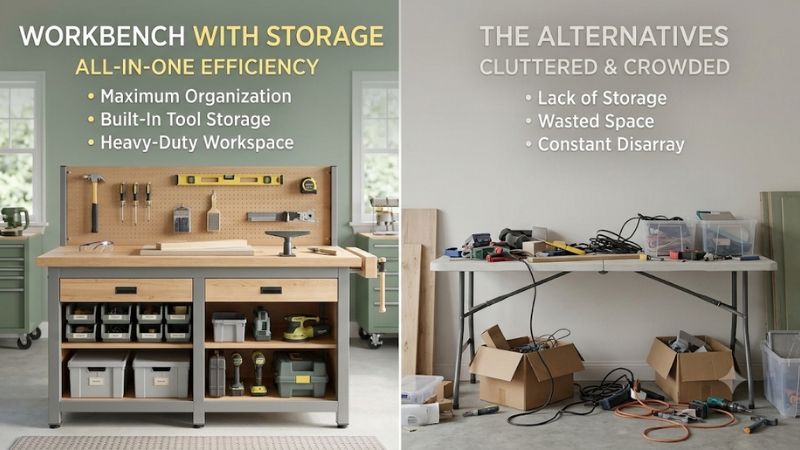
An integrated station works when the work stays in one area and you want tools, parts, and supplies to have assigned places within reach. The combined footprint can be efficient because drawers, shelves, and light sit close to the working surface. Its real advantage shows up when you use that same layout often.
Daily repair tools can live below or behind the work
A combined bench is easy to justify if a few hand tools, a light, and a cleared surface are all you need to start most jobs. You can keep common items in the same locations and return them there while the work is still in front of you. Choose the storage zones that fit the real sizes of those tools.
A typical home repair station might hold screwdrivers, pliers, and a tape measure in a shallow drawer. It might have a removable container for loose fasteners and a shelf for a drill case. Since jobs use the same surface, every storage spot is close enough to put items away as you finish work. That convenience is strongest when a cabinet frame and work surface share the same section of wall.
If you use tall cases and slim hand tools, consider a station with both open and protected storage. Drawers work well when they fit the flat tools and their trays. Shelves are effective for a bulky case you can lift clear of the unit. Integrated pegboard avoids a separate item to fit but makes the complete station taller. Confirm the full height and the section of wall you need before choosing.
Set limits on what belongs at the bench. A large number of tools can be stored elsewhere and still be reasonably close when needed. Keep the common tools close and leave the others in their existing cases if that keeps the work area usable. Overloading the bench with infrequently used items gives away some of the convenience you purchased along with the furniture.
One fixed location can preserve a useful setup
A permanent bench holds the lighting, charging, and tool layout in the same place between tasks. This consistency saves setup steps. It can also make a work area easier to share. Everyone can return common tools to an assigned spot and know where the table is clear for the next project.
Look at the space above and below the surface while the work is underway. Integrated furniture is useful if it leaves the places you reach clear. It can become less flexible if changing the height of a shelf or position of drawers would require replacing the bench. Some stations can be reconfigured within the manufacturer’s options, so check the parts that can be adjusted and the clearances the full unit requires.
Longer-term use includes keeping part of the top free between projects. A permanent bench is often an easy place to drop packages and household supplies. Giving other items a home away from the bench can protect its value as a work area. Choose storage that makes it easy to put back your tools without clearing a path from the project to the drawer or shelf.
If your activity shifts over a few years, think about whether you can add storage nearby. A garage with room for a separate tool cabinet later can start with a smaller station today. An integrated unit that uses the whole wall makes sense when its best features fit what you expect to do with it on a regular basis.
How the main workbench alternatives compare
The alternatives below have different effects on the room, especially when you consider their working footprints. Some reclaim space and others allow you to put storage somewhere more convenient. Compare each with your main daily job, the largest object you need to handle, and the places that have to stay clear.
Plain workbench with wall-mounted tool storage
A plain bench and separate wall storage give you an open area below the top and let you make better use of the wall around it. The arrangement is useful when you want the tools visible and easily reached, or need open knee space under the central work area. The location and installation of the wall system determine how much you can store.
The advantage is separate placement. You might mount suitable rails at an accessible height on one side of the bench, set a light toward the other, and keep the middle open for a large workpiece. That leaves room for a seat, sliding cart, or temporary storage below. Check that the mounting method and wall structure meet the product’s requirements before relying on the storage for tools.
Consider anything you want protected from ordinary dust and clutter. A wall system works well for hand tools that you are happy to have on view. A cabinet on the wall can provide closed storage but requires clearance for the door and an appropriate mounting surface. Placement matters if you have to lean over the top to get to the door handle, especially during work.
This approach works when the tools are manageable to put back and when a permanent wall placement is available. In a rental or a garage wall with restrictions, the ability to install storage as directed can determine whether an integrated frame better serves the job. Compare the full price of the suitable board, rail or cabinet, required mounting materials, and light with that of a combined station.
Rolling tool cabinet with a rated work surface
A rolling cabinet prioritizes moving organized hand tools where they are needed. A compatible, rated top adds a place to lay out parts or perform modest repairs. This alternative makes particular sense when you use the tools around a parked vehicle or want to roll the whole cabinet back into an assigned spot after work.
Measure the route from storage to the job. A narrow working space can allow the cabinet to be parked but leave no room to turn it or open the correct drawer. Include the handles and casters when drawing the path. A sloped floor and a raised threshold need to be considered along with the manufacturer’s directions on moving it safely.
The top earns its place when you can reach it at a comfortable height and use it for the actual task. Small parts, light repair work, or a closed case can fit well. If a job calls for a compatible mounted vise or high side force, find a bench with documented support for that purpose. Check the manufacturer’s instructions even if the cabinet has a substantial published storage load.
The investment also makes more sense if the drawers fit the tool sets you move together. A cabinet with divided drawer banks may be ideal for smaller organizers and accessories. A long flat tray might fit better in a model with a full-width top drawer. Compare your usual tool arrangement with the cabinet and look for wheels, locks, and use instructions compatible with your garage.
Separate shelving or a cabinet beside a plain bench
A separate shelf or cabinet is a good alternative when most items live in cases or when a different section of the room can hold storage without blocking work. You gain the ability to choose a plain surface for your projects and set the storage at a height and distance that works for what you keep there.
Open shelving is convenient for bulky cases with visible handles. A cabinet is helpful when you want to keep things behind doors. Both can be placed where daily traffic leaves enough room to get items out. The downside is extra walking or short carrying trips between the bench and the tools. Inventory the items that must stay close and place them within reach if practical.
This layout can also make a change later less expensive. If you move to a different work surface, your cases can stay on the shelves. If storage expands, its location can change without removing the bench. Price those options against the floor space they require. A 24-inch-deep unit placed beside a shallow table may determine the usable aisle for the whole wall.
Think about empty space too. Two pieces side by side can lead to an awkward gap at the corner or leave a useful section of wall uncovered. In other cases, a small gap gives room to lift a long case or reach an outlet. Draw the exact footprints and measure the route with a large case in your hands before deciding to put the units together or far apart.
Folding bench with permanent tool storage elsewhere
A folding bench solves the problem of needing a work surface only while you work. It can suit a vehicle bay, a shared utility room, or a garage where large projects are occasional. Look at the unfolded dimensions, required setup area, and where the folded unit can be stored without causing a new obstruction.
A portable table can have an included shelf or an accessory tray for a project in progress. Much of your tool collection still needs a permanent home. Compare a complete setup of folding bench plus the storage you already own against the price and dimensions of one permanent station. If you have an open wall shelf and a tool case, the additional cost may be limited to the table. If permanent storage is missing, include it in the budget.
Try simulating the setup each time you expect to use it. Is there a clear route from the storage spot? Can you deploy the legs while the car is in the garage, or would you have to move the car every time? Is the table suitable for your project after it is set up according to the operating instructions? A folding bench that comes out readily can be a good match for small occasional jobs.
Check how you will handle work that is still in progress after a session. A suitable project tray or case can make it easy to pick up where you left off with parts organized. That helps when the surface must be cleared to return the room to other uses. The arrangement is most effective when setup and cleanup are simple and there is a permanent place for everything you fold or move.
DIY workbench with storage sized to the space
A bench you design for your garage can match an awkward width, provide the work height and clearances you want, and put storage exactly where you use it. The effort is justified when a particular fit, job, or layout is difficult to achieve with available products and you have the skills and equipment to complete it safely.
Define the fixed dimensions and structural requirements before pricing materials. Measure workpiece height, shelf openings, knee clearance, and any mounting requirements for equipment. For a vise or benchtop machine, use the maker’s instructions and a design suitable for its loads. If the bench will be anchored or used to support concentrated loads, identify the needed support and get competent help when required.
A custom bench can be efficient if simple shelves meet the storage goal. A bank of drawers adds slides, hardware, finishing work, and a need for accurate assembly. Compare the total including materials, hardware, tools, finishing supplies, delivery or pickup, and the time you have to build it. A purchased bench is often more predictable to price, and the total amount of design and assembly work can be smaller.
The DIY option becomes attractive when dimensions and working position matter enough to drive the design. For example, a recessed wall may offer a useful 45-inch opening with mechanical equipment nearby. Solving that layout with a made-to-fit bench can be worthwhile if it preserves the required clearances and access. If your main goal is ordinary tool storage, compare a simpler fixed bench with shelves before investing in custom drawers.
Adjustable bench with a separate side cabinet
A height-adjustable work surface and a separate side cabinet can suit a room shared by different users. The clear underside gives seated work a place without a center shelf. The cabinet stays nearby, while the task determines the top height. Check the bench’s adjustment process, limits, and room at every height you expect to use.
An adjustable bench can have settings that are simple to select during assembly, or an adjustment mechanism designed for later changes. Consult the product’s instructions on how to adjust it and when loads must be removed. If the bench changes height frequently, the arrangement needs to be convenient under the operating conditions. If you are just trying to find a suitable setup height, a model that takes longer to adjust may suit.
Place the side cabinet where its drawers can open without competing for the seat’s space. Some users prefer the cabinet on their dominant-hand side, but lighting and project location can alter that choice. Try a seated position with boxes at the bench and storage heights. Pull out a mock drawer and reach for an item with the seat in the position you normally use.
This arrangement uses more independent pieces of furniture. Price them together and compare the total space against a bench with offset drawers or other integrated storage. If accessible knee space and clear chair movement are central requirements, the separate units can let you buy each for its specific job and keep useful adjustment room available.
Compare working space and total cost on equal terms
Two setups can have the same listed floor area and still affect a room differently. Draw each in its working position and its stored position. Then compare what happens around it, including drawer travel, chair position, and where a large case can be set down. This is where the differences become useful for the purchase.
Calculate the floor space only after including access
Use dimensions to compare the occupied area first, then add the space for use. A 48-by-24-inch bench occupies eight square feet at the cabinet body. A 46-by-18-inch rolling cabinet occupies 5.75 square feet at the body. Neither number includes people, handles, room for the drawers, or the route a rolling cabinet takes.
Compare where the floor area is lost. The extra depth of an eight-square-foot bench might reduce a walkway where someone passes several times a day. A cabinet that occupies less area can still block access when an open drawer faces a vehicle. Sketch what happens with the door open and the operator standing in a normal position. When possible, put the actual car in place during the test.
For separate storage, combine the footprints that consume floor area and mark storage already present. If you have a suitable shelf against a different wall, a plain bench may add less furniture than a combined unit. If you would buy a new cabinet as well, add the cost and space for moving between the pieces. Tool access is part of the layout even if their footprints do not touch.
For an occasional surface, the folded storage footprint is only one element. Check the maximum space occupied while setting up, the path to carry the unit, and where the tools will be put back. The surface earns the space it takes during work. Permanent storage earns its space by remaining useful when that work surface is stowed.
Compare the cost to finish the job you actually do
Calculate one total for each setup that can already accomplish the job, including any essential light, storage, and installation. Existing equipment can make a separate setup inexpensive. A complete station can be the less expensive choice if you would otherwise buy several independent items and mount or assemble them.
As an example, imagine you already own cases for every tool set and have a suitable shelf available. The new cost may be a plain bench or portable table. If you are starting an empty garage and need work light, drawers, a place for cases, and a surface, an integrated station bundles several required pieces. Check whether the exact features and dimensions are appropriate for your work before treating them as savings.
Give particular attention to the future change you are most likely to make. A future vehicle can change a garage walkway, a move to seated work can reduce the value of a centered drawer bank, and the addition of a machine can put new demands on the surface. Decoupled storage can make some changes easier. Built-in storage earns its cost if you use the characteristic arrangement as your natural starting point.
Record the delivered cost and put a note beside any element still unverified. For instance, the feasibility of wall mounting, the rating for a piece of equipment, or the opening of a tall door can be a purchase requirement. Check those facts before deciding, because comparison of the total price only helps when each setup can be used as intended.
Frequently asked questions
Choose the alternative that preserves the most useful space and keeps your most common tools within an easy routine. When the options are close, test one task with each layout and include the space to put everything away afterward. These questions cover common situations where a separate setup can be as practical as an integrated one.
Is a rolling tool chest enough if it has a wood top?
It can be enough if its top is suitable for the work and the manufacturer’s instructions allow the use you have in mind. Test whether you can open drawers and stand comfortably when you park it in the working position. Verify any equipment mounting requirements independently of the wood surface or published storage capacity.
Does pegboard make a separate cabinet unnecessary?
It can handle a regularly used set of small hand tools when the panel, hooks, and mounting are appropriate. Cases, larger parts, or tools you want to store in protective drawers may still need a place. Hang the tools you use together and count how many other items still need a home before deciding how much cabinet storage to buy.
Which layout makes the most sense for two people?
A shared layout benefits from clear access to daily-use tools and a work height that suits the common tasks. Consider an adjustable surface and separate storage if both people work at different heights. A fixed bench can work equally well when its height suits the projects and the drawer pattern is easy for both people to understand and use.
Is an integrated bench cheaper than building one?
It depends on the materials, time, accessories, and existing tools available to you. A basic custom bench with open shelves can be economical in some garages. Custom drawers or specific mounted accessories can raise the cost. Compare the completed configurations at the size and capacity required for your work, including delivery or material pickup.
Conclusion
Choose a workbench with storage when regular repairs benefit from a permanent surface and easy access to the same tools. Use a rolling cabinet when the tools travel to the job, a folding table when the floor has to clear, or separate storage when you need open knee space, a specific work height, or more room for cases.
More from Amazon
Programs that pair well with the guide above. Offers and eligibility are set by Amazon and may change.
Collect the home and kitchen items you want in one registry that guests can shop from.
Create a wedding registrySet up recurring deliveries of everyday items on eligible products. Terms and savings are set by Amazon.
Explore Subscribe & SaveFree shipping on eligible items, Prime Video and more. Eligible new members can start with a free trial.
Start a Prime free trialAudiobooks and podcasts to listen to on the go. Eligible new members can start with a free trial.
Try Audible freeAs an Amazon Associate we earn from qualifying purchases.