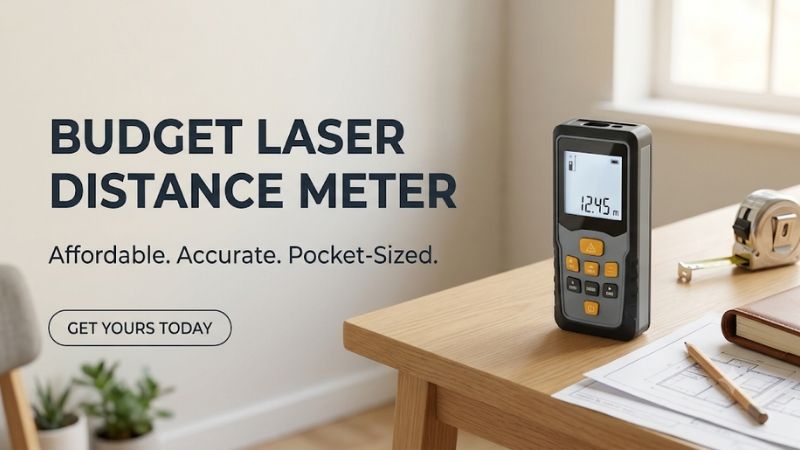
A budget laser distance meter should deliver reliable readings for the jobs you do most, with controls you can learn quickly. The Bosch GLM100-23 is the most versatile value when it lands near $50. Choose a simpler pocket meter for occasional checks or a model with a wheel if you measure along curves.
Which budget laser distance meter is worth the money
About $60 is a reasonable shopping target for these indoor-focused tools, provided the price is measured before tax and shipping and compared without special credit offers. Some picks fit the target regularly and others depend on the listing, local stock, or a temporary discount.
| Model | Published laser range | Value angle | Price evidence or buying trigger |
|---|---|---|---|
| Bosch BLAZE GLM100-23 | 100 ft | Everyday interior value | U.S. offer observed at $49.97 |
| RYOBI ELDM65 | 65 ft | Basic room and rental checks | Manufacturer listing at $41.75 |
| DEWALT Atomic DW055PL | 55 ft | Pocket carry and built-in charging | Retail listing at $42.97 |
| SKIL ME9821-00 | 65 ft | Laser and rolling wheel in one tool | Manufacturer listing at $54.99 |
| Milwaukee 48-22-9801 | 65 ft | Side button and recent-reading memory | Retail offer observed at $59.97 |
| CRAFTSMAN CMHT77638 | 65 ft | Straightforward backlit display | Compare the actual local price |
How the price ceiling was set
A price ceiling lets each recommendation compete against tools with similar jobs and costs. It also exposes trade-offs when a model is only a few dollars cheaper than the Bosch. The figures are snapshots from U.S. listings and are best used as shopping benchmarks.
The $60 target includes the instrument and any items supplied in the standard package. Shipping and taxes can change the final order total, especially when a low listing comes from a seller outside your usual delivery area. The DEWALT and SKIL prices give you a basis for comparing the two. The RYOBI has appeared at different promotional prices. The Milwaukee makes sense when its checkout price fits your target or when you deliberately stretch the budget to get the side shot button. The CRAFTSMAN is a conditional pick because a comparable public cash price was unavailable in the listing reviewed.
At the bottom end, basic distance readings can be enough. Buy near the top of the range when a feature saves time you can identify. A memory function is valuable if you rarely have a free hand for a notebook. A charging system matters if replacing batteries is an annoyance or if the meter has to work on a day when you forgot to charge it. Compare how you would use each tool on a typical job before paying for extra range.
What basic laser measures can handle
A modest laser meter is useful for straight indoor spans with a clear target, a stable start, and a tolerance that suits the task. Common jobs include checking furniture space, estimating floor coverage, and sketching rooms. Most remodelers already own another tool for final marks.
For an apartment inspection, use the meter to check room widths and ceiling height and write each label as you go. A short-range device often reaches the opposite wall easily. Trouble begins if a closet doorway stands open and the beam passes into the room beyond, or if a shelf obscures the face you intended to aim at. A small piece of matte card provides a target when its face can be positioned accurately.
Straight distance covers most of this work. Area mode saves a calculation for a rectangle. A notebook or phone calculator covers that math with any basic meter. Plan how you will capture width, length, and height before deciding that a feature with several button presses deserves a premium. Someone who needs only two numbers to find a rug may value a display with large digits much more.
Six affordable laser distance meters to consider
These models offer different ways to spend roughly the same money. One extends the available indoor span, another is easier to hold from unusual angles, and another adds a wheel. Select the feature you will use each week and compare the seller’s price against the closest alternative.
Bosch BLAZE GLM100-23 for the strongest all-around value
The 100-foot GLM100-23 is the first choice for an occasional remodeler who wants an easy display and more reach than a 55- or 65-foot model. Bosch lists a 6-inch minimum and roughly ±1/16 inch in favorable conditions. The extra reach is useful across long rooms and attached garages.
The meter is useful when you are replacing window treatments in several rooms and also need a hallway or garage measurement. Its display can show larger numerals, and its rounding adjustment helps match the way you record dimensions. Rounding changes how the value is presented. Set an appropriate fraction for the job and cross-check where a supplier requires a particular increment.
A listing around $50 makes the Bosch especially attractive. Compare it against a $35 to $45 alternative if your jobs are limited to a few rooms or if a smaller tool fits your pocket better. The upgrade earns its cost when the display makes note-taking easier, the extra range helps in a long basement, or the control layout works well for whoever will use it most. Confirm the exact GLM100-23 suffix because Bosch sells similar-looking models.
Buy it as an indoor generalist. A tight opening below the published minimum, a need for on-device area calculations, or a specialized outdoor range problem calls for a different workflow. Spend the first session comparing the meter on a dependable known span and taking the same measurement twice with a fresh setup.
RYOBI ELDM65 for occasional home measurements
The RYOBI ELDM65 offers one-button operation, a published 65-foot maximum, and memory for the previous reading. RYOBI advertises accuracy of ±5/64 inch. It suits someone taking basic distances on a room walkthrough who wants to avoid learning several different modes.
For a move, keep a list of door clear widths, interior wall runs, and the space occupied by a radiator or baseboard. Read and label one item at a time. The saved previous reading is useful if you want to compare two readily identifiable spans, such as the wall width and distance between trim. A larger measurement inventory belongs on paper or in a phone note. Create a clear unit convention from the start.
The manufacturer listing at $41.75 and lower observed promotional prices make the RYOBI worth comparing before you pay for a longer-range model. If both tools are offered at similar prices, compare controls and the intended measuring range. Published accuracy fractions are easiest to interpret alongside the conditions for each specification. Consult the manual to see the supported setup and reference behavior.
Choose it for occasional indoor measurements when the price is low. For a busy site where you need a history of several values, decide whether you have a sensible written workflow or whether another meter’s memory is worth extra money. Keep a tape in the same kit for furniture hardware and door stops that make beam placement awkward.
DEWALT Atomic DW055PL for everyday pocket carry
The DEWALT DW055PL is a slim, rechargeable model with a range of up to 55 feet and simple one-button operation. At an observed U.S. retail price of $42.97, it is attractive when the meter will spend most of its time in a pocket instead of a full tool bag.
A maintenance worker checking a storage space may need one wall length and a clear height. A smaller device is handy if you can seat it on a reliable surface and see the readout with the other hand occupied. The short reach rating still covers many residential rooms. It is easy to justify for someone who values the low bulk enough to carry it every day.
Rechargeable power works best with a habit. Charge the meter after a long site day and keep the required cable where the rest of your gear charges. A built-in battery is convenient in an office or truck with a reliable power source. Replaceable batteries make more sense when the tool may sit unused for months and there is no time to wait for a charge. Verify the included charging hardware and port for the package you buy.
Buy it for convenience on short runs, quick room checks, and small tool kits. Compare it against the RYOBI or Bosch if your routine includes longer walls or you care more about readout size and handling. Leave enough of the budget for a good physical tape if you regularly transfer dimensions onto stock.
SKIL ME9821-00 for a laser and measuring wheel
The SKIL ME9821-00 combines a 65-foot laser, area and continuous measuring modes, and a small wheel for rolling over a surface. The manufacturer lists it at $54.99. The wheel is the purchase reason for someone whose project involves frequent approximate travel lengths.
Suppose you are sizing a decorative strip along a broad curved panel face. The laser gives a straight span between endpoints, while the rolling wheel can follow the route you mark along the surface. A rough painted face, a seam, or dust can make the tiny wheel slip or bounce. Start on a shorter path you can verify and practice starting and stopping on clear marks. Use a flexible tape for tight curves where the wheel tracks poorly.
On ordinary indoor jobs, you can use the laser side for straight wall-to-wall distances and its area mode for an unobstructed rectangle. Sketch unusual floor shapes when the calculation depends on more than two dimensions. The modes are useful if you handle both straight and curved measurements often enough to remember which setup you are using.
Choose the SKIL if the wheel replaces a separate purchase or a recurring workaround. If your estimate is primarily a list of lengths measured across clear rooms, the wheel adds a feature you are unlikely to reach for. Keep first-use comparisons with a known length for both modes because the setup risks differ.
Milwaukee 48-22-9801 for awkward holding positions
The Milwaukee 48-22-9801 provides a side shot button, backlighting, and memory for three readings, in a 65-foot model. It makes sense near $60 when its controls matter on the job. A lower-cost model has more appeal if you always measure from open walls.
The side button can be helpful when a nearby shelf or return keeps you from pushing straight down on the face. Press from a position that keeps the meter stable against the start plane. When a press rotates the device, the returned beam may land on the wrong face. A different trigger location can make daily work smoother even though it has no effect on nominal range.
Recent-reading memory helps on jobs that use a simple sequence, such as the left wall, right wall, and width of a freestanding fixture. Learn the order in which the tool stores or displays values before working from its history. Write labels as soon as each dimension has meaning, especially if you move between rooms with similar dimensions and need to reconstruct the sequence later.
The observed $59.97 promotion fits the guide’s shopping target. When it costs more, compare the feature you wanted against a less expensive tool and a change in technique. A model that feels secure in your grip is worth paying a little more for if it reduces repeated shots on every visit.
CRAFTSMAN CMHT77638 for a simple local purchase
The CRAFTSMAN CMHT77638 is a 65-foot model with a backlit display. CRAFTSMAN specifies ±1/8 inch at 30 feet. Consider it when a local price is competitive and you want to handle the exact tool in person before paying. A local exchange can also help if the display is difficult to read in your normal measuring position.
For a homeowner estimating wall use, a readout you can see in a dark closet makes a difference. Use it to find the length available for a coat rack or estimate unfinished drywall. Then place a tape at the height where the fixture meets the wall and determine where the hardware actually goes. The instrument’s listed accuracy and display readability are both relevant. A stable setup and clear intended endpoints remain essential.
Ask to see the model number on the package. Similar CRAFTSMAN tools carry different ranges and features, and store categories can lump several of them together. Check the exact instructions for the reference point, the available units, and included power supplies. If a shop displays a web-only price that differs from local checkout, compare against an available alternative using the same purchase conditions.
Choose this model when it offers a real cash saving or is available urgently. Near the Bosch price, an extra look at the latter’s range and published favorable accuracy is worthwhile. The practical decision is the price you can pay that day, with a body and screen you can use confidently.
How to avoid extra costs on a budget laser distance meter
Low purchase price matters less if the meter wastes visits, hides the fraction you need, or makes the batteries hard to find. Check the real features and package contents before ordering. Then run a short comparison session while you can still exchange a unit that fits poorly.
Read resolution and accuracy separately
Numbers can show more digits than the tool can reliably support under your working conditions. Read the maker’s accuracy statement next to the intended distance, target, and lighting. Compare units consistently and decide whether the job tolerates the expected variation.
For a room estimate, a small difference rarely changes the material order compared with layout and package size. For a tight trim cut, the same difference may be visible. Take the meter into the room to capture a reasonable overall size, and use a properly positioned rule or tape to mark the final location. Check the surfaces, reference, and sight line before trusting a number that will determine a cut.
Check separate conditions, such as a value quoted at 30 feet and a maximum rating quoted under favorable light. The fraction and range may be listed next to one another while applying under different conditions. The model’s manual should tell you which figure applies at the distance you need and whether the tolerance changes over a longer span.
Check the cost of power and the ease of a return
The cheapest checkout can be a poor fit when shipping is high, when a cable is missing, or when replacing a faulty unit means losing a week. A local return option is useful if the display, grip, or short-range behavior determines how often the meter earns its place.
Bring the model into a well-lit room and compare multiple readings at two known distances. Change positions between readings so you can see how easy it is to seat the housing repeatedly. Then reproduce the setup you care about most, such as measuring near the floor while crouched. A low-cost tool with understandable controls is often a better bargain than a temporary deal on a feature you rarely use.
Consider power after storage. Spare cells help if you keep the tool unused until an occasional job. A rechargeable tool helps when it joins a regular charging routine. Confirm which accessories are included and whether you need to carry anything else. Minor extras can be enough to erase a small price advantage.
Use sale prices to compare like with like
A sale only helps if the listed price is available without financing, a membership, or a package you do not need. Compare the exact meter by model number and include delivery and any missing accessories. Keep a second option ready when a promotion ends.
Imagine choosing between a $35 pickup for a basic model and a $50 shipped meter with better reach. If you only need the width of three bedrooms, the basic model and a tape cover the job. If the same meter will also handle shared hallways and a garage, the extra range can justify $15. Write down the real longest shot and identify the surface the beam will hit. An extra 35 feet of published reach matters only if the work includes a clear shot that exceeds the cheaper model’s range.
Take a different approach when the quote includes a battery bundle. Check whether the cells fit the exact instrument and whether you need enough of them to justify the difference. A rechargeable model with a charging cable included may still need an adapter you already own. An inexpensive model can be the better buy even without a promotion when it is available on time and the controls work for the person doing the measuring.
Conclusion
Start with the Bosch GLM100-23 when it is close to $50. Look for a lower RYOBI or CRAFTSMAN price for simple room measurements, choose DEWALT for pocket carry, and spend more on SKIL’s wheel or Milwaukee’s side button when that feature solves a task that comes up regularly.
More from Amazon
Programs that pair well with the guide above. Offers and eligibility are set by Amazon and may change.
Collect the home and kitchen items you want in one registry that guests can shop from.
Create a wedding registrySet up recurring deliveries of everyday items on eligible products. Terms and savings are set by Amazon.
Explore Subscribe & SaveFree shipping on eligible items, Prime Video and more. Eligible new members can start with a free trial.
Start a Prime free trialAudiobooks and podcasts to listen to on the go. Eligible new members can start with a free trial.
Try Audible freeAs an Amazon Associate we earn from qualifying purchases.