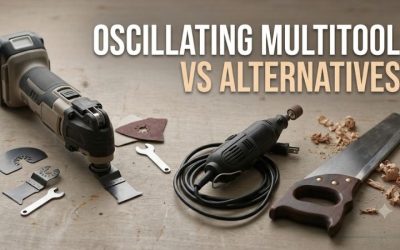
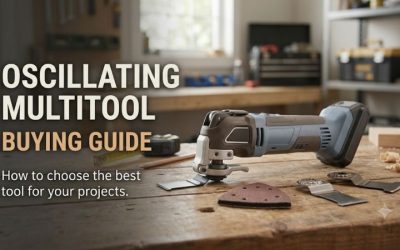
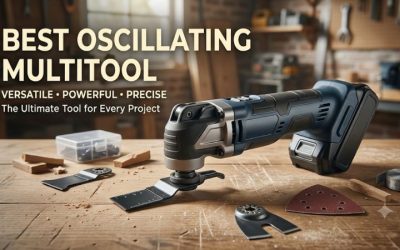
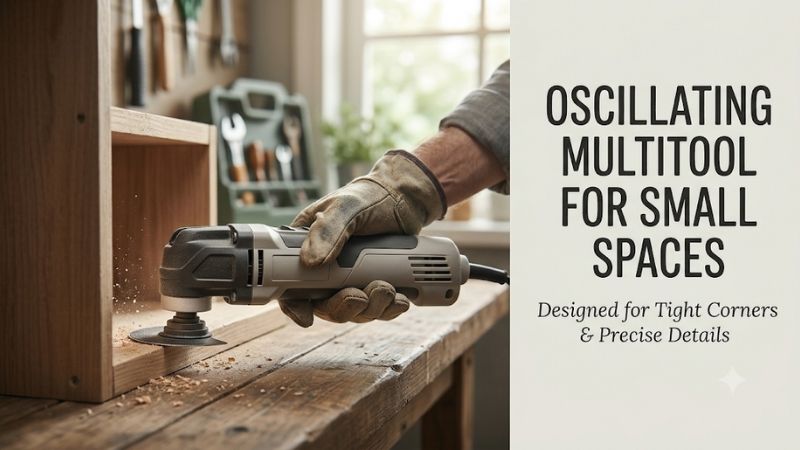
An oscillating multitool for small spaces can handle cutting, sanding, and scraping operations that are difficult with larger power tools. Its narrow accessories and short side-to-side motion make it useful around cabinets, door frames, flooring, and installed fixtures. However, the best choice depends on head dimensions, accessory orientation, battery clearance, vibration, and controlled operation.
Quick Answer: What Makes an Oscillating Multitool Good for Tight Spaces?
The most useful multitool for restricted work has a manageable grip, suitable blade-changing mechanism, adjustable speed, and an accessory interface that allows different working positions.
A compact battery arrangement can improve maneuverability when working inside cabinets or narrow compartments.
However, overall tool length matters less in some applications than head thickness and blade orientation.
A long, narrow tool may reach a recessed fastener or cutting location more effectively than a shorter but bulkier model.
For homeowners performing light remodeling, a compact cordless oscillating tool is often practical because it eliminates the need to manage a power cord around furniture and installed fixtures.
The Milwaukee M12 FUEL 2526-20 is a useful example of a compact cordless configuration, while the Bosch GOP18V-34N and Makita XMT04ZB demonstrate different approaches to ergonomic handling and vibration control.
The correct tool must provide enough clearance for both the accessory and the operator’s hand.
Understand What Makes Tight-Space Work Difficult
Limited Head Clearance
Oscillating tools are frequently used where a conventional saw cannot fit.
However, the head still occupies physical space.
The thickness of the accessory clamp and surrounding housing can prevent the blade from reaching certain recessed locations.
For example, trimming wood directly beside a cabinet wall may require the blade to be mounted at a particular angle.
A tool with a narrow head and multiple accessory orientations can improve accessibility.
However, the installed blade must remain securely retained and approved for the selected position.
Restricted Hand Position
A narrow workspace may provide enough clearance for the tool but insufficient room for the operator’s hand.
This can create awkward wrist positions and reduce control.
The grip should allow the user to maintain stable contact without placing fingers near the accessory.
A slim barrel grip can be useful for detail work, although comfort depends on hand size and the operating angle.
Avoid using a tool in a position that prevents proper control.
Battery Interference
Cordless multitools often have batteries mounted at the rear of the housing.
A large battery pack may interfere with cabinet walls, flooring, or nearby equipment.
Smaller compatible batteries can improve access.
However, reduced capacity may limit runtime or performance depending on the battery system.
Evaluate the complete tool-and-battery configuration rather than relying only on the bare-tool dimensions.
Limited Visibility
Cutting inside cabinets, beneath shelves, or along baseboards can make it difficult to see the work area.
A built-in LED can help illuminate the cutting line.
However, the blade or surrounding material may cast shadows.
Additional lighting is often necessary for accurate operation.
Avoid cutting blindly around concealed components.
Choose the Right Oscillating Multitool Design
Compact 12V Cordless Multitools
Compact 12V-class tools are attractive for light installation work and confined repairs.
The Milwaukee M12 FUEL 2526-20 provides a brushless motor, selectable speed, and a compact battery platform.
Its manufacturer-rated oscillation angle is 3.9 degrees.
This gives it substantial accessory movement for a compact model.
However, a wider angle does not eliminate the need for controlled pressure and suitable blades.
For occasional cabinet repairs and detail cutting, a compact 12V system may provide sufficient capability without the bulk of larger batteries.
Slim 18V-Class Multitools
Some 18V-class oscillating tools use slim housings that improve grip and maneuverability.
The Bosch GOP18V-34N has a redesigned handle and battery orientation intended to reduce interference in certain working positions.
The Makita XMT04ZB also emphasizes a relatively narrow barrel grip.
These designs can be useful when the tool must be held close to a work surface.
However, the battery still affects total length and balance.
Full-Size High-Output Multitools
High-output cordless oscillating tools can provide additional capability for demanding cuts.
The Milwaukee M18 FUEL 2836-20, for example, uses a 4.2-degree oscillation angle and a brushless motor.
This can be valuable when cutting resistant materials.
However, greater cutting aggression may not be necessary for delicate work.
A more powerful tool can also be less convenient when only a small amount of material must be removed.
Corded Oscillating Tools
Corded models avoid battery charging requirements.
They can be economical for stationary work near electrical outlets.
However, the power cord creates an additional object that must be managed in a restricted workspace.
The cord must remain away from the cutting accessory and any moving workpiece.
For confined renovation work involving frequent repositioning, cordless operation may be more convenient.
Accessory Orientation and Blade Positioning
Straight Blade Position
A straight blade position places the accessory in line with the tool.
This is useful for many plunge cuts and forward-facing operations.
However, it may be difficult to use near a wall or inside a narrow compartment.
The tool housing may contact surrounding surfaces before the blade reaches the required location.
Angled Blade Positions
Many oscillating tools allow blades to be installed at different angular positions.
This can improve access around cabinets, pipes, and door frames.
A blade mounted sideways may reach a cutting location that would otherwise be blocked by the tool body.
However, changing the accessory angle also changes the direction of applied force.
Maintain a stable grip and avoid loading the accessory in a way the manufacturer prohibits.
Offset Blades
Offset accessories position the cutting edge away from the attachment interface.
This can be useful for certain flush-cutting operations.
However, offset geometry may introduce additional flex or leverage.
Choose accessories designed for the task and tool.
Never improvise an offset arrangement by bending or modifying a blade.
Narrow Plunge Blades
Narrow plunge blades can create small openings with more localized material removal.
They are useful for certain cabinet repairs, electrical box openings in appropriate material, and small wood cutouts.
However, narrow blades can overheat or deflect if forced.
Use appropriate speed and feed pressure.
Accessory Compatibility in Confined Spaces
Universal-Style Mounting Systems
Some oscillating tools accept a broad range of compatible accessories using universal-style mounting arrangements.
This can offer flexibility when sourcing specialized blades.
However, the term universal does not guarantee compatibility with every accessory manufacturer.
Check the exact mounting pattern and any adapter requirements.
Starlock
Starlock uses a three-dimensional accessory connection intended to improve retention and power transfer.
It can make tool-free blade changes convenient.
However, Starlock accessories require a compatible tool interface.
StarlockPlus
StarlockPlus is designed for a different accessory-capability class within the Starlock family.
Tools supporting StarlockPlus generally accept standard Starlock accessories, but exact compatibility must be confirmed.
For example, the Bosch GOP18V-34N supports Starlock and StarlockPlus.
It does not support StarlockMax.
StarlockMax
StarlockMax accessories are intended for compatible higher-capability tools.
The Makita XMT04ZB supports Starlock, StarlockPlus, and StarlockMax.
However, buyers should not assume that every tool with a Starlock-related interface accepts all three categories.
Why Compatibility Matters
Accessory compatibility affects long-term ownership cost.
A tool that requires specialized blades may be more expensive to operate if the needed accessories are difficult to obtain.
Before purchasing, identify the cutting, scraping, and sanding attachments you expect to use regularly.
Make sure suitable replacements are available.
Speed Control for Precision Work
Low-Speed Operation
Lower oscillation speeds can be useful for delicate scraping, controlled initial cuts, and certain sanding operations.
A reduced speed may help the operator position the accessory before applying greater cutting pressure.
However, the correct speed depends on the material and blade design.
Some accessories perform poorly when operated below their recommended range.
Medium-Speed Operation
Moderate speeds can provide a practical balance for many home maintenance tasks.
They may be appropriate for certain wood cuts and sanding operations.
However, there is no universal medium-speed setting shared across all multitools.
Follow the accessory manufacturer’s recommendations.
High-Speed Operation
Higher OPM can increase the frequency of cutting movement.
This may improve productivity in suitable materials.
However, high speed can also create heat and accelerate accessory wear.
Avoid forcing the blade when cutting resistance increases.
Automatic Speed Functions
Some oscillating tools include automatic speed behavior.
The Milwaukee M18 FUEL 2836-20 incorporates an Auto-Load feature.
This allows a lower starting speed before the tool increases output under load.
Such features can improve handling but are not substitutes for correct positioning and feed pressure.
Choosing the Right Blade for Restricted Repairs
Wood-Cutting Blades
Wood blades are useful for trimming door jambs, cutting cabinet panels, and making localized openings.
Choose tooth geometry according to the material.
A blade intended only for clean wood should not be used on embedded nails or other metal hardware.
Bi-Metal Blades
Bi-metal blades may be suitable for certain mixed-material cutting applications.
For example, a properly rated blade can help cut through wood containing ordinary nails.
However, material thickness and hardness matter.
Do not assume every bi-metal blade can cut hardened steel.
Scraper Blades
Scraper attachments are useful for removing certain adhesives, caulk, and flooring residue.
They can access locations that are difficult to reach with larger manual scrapers.
However, excessive pressure may damage surrounding surfaces.
Use the appropriate blade stiffness and angle.
Triangular Sanding Pads
Triangular sanding pads can reach corners, edges, and narrow surfaces.
They are valuable for preparing trim and removing limited areas of finish.
However, sanding generates dust and may damage nearby surfaces.
Choose appropriate abrasive grit and use suitable dust controls.
Grout-Removal Blades
Specialized grout accessories can remove grout from suitable tile joints.
They must be used carefully to avoid damaging tile edges or underlying surfaces.
The width of the accessory should be appropriate for the grout joint.
Avoid forcing the blade into narrow joints.
Practical Applications in Small Spaces
Undercutting Door Jambs
Door-jamb undercutting is a common oscillating-tool application.
When installing flooring, the jamb may need to be shortened to provide clearance for the new material.
A suitable wood blade can cut horizontally near the floor.
Use the flooring manufacturer’s recommended clearance method and account for underlayment where applicable.
Avoid damaging hidden fasteners.
Trimming Cabinet Toe Kicks
Cabinet toe kicks can be difficult to access with larger cutting tools.
An oscillating multitool can remove small sections of suitable wood or composite material.
However, installed cabinets may contain plumbing, electrical wiring, or structural components.
Inspect the area before cutting.
Working Around Pipes
Oscillating tools can be useful when removing surrounding material near pipes.
However, the moving accessory can damage metal, plastic, or flexible plumbing components.
Do not cut blindly.
Protect nearby services and confirm that the intended operation is appropriate.
Repairing Drywall
A multitool can create controlled drywall openings in accessible locations.
However, hidden wiring, plumbing, and framing may be present.
Determine what lies behind the surface before cutting.
Use a suitable depth and blade.
Removing Adhesive Residue
A scraper attachment may help remove old flooring adhesive or caulk.
However, the substrate can be damaged by aggressive scraping.
Unknown old materials may contain hazardous substances.
Identify the material before disturbing it.
Sanding Inside Corners
Triangular sanding pads can reach areas that round or rectangular sanders may miss.
Use moderate pressure and suitable abrasives.
For large surfaces, a dedicated sander is usually more efficient.
Ergonomics and Operator Comfort
Grip Diameter
A slim grip can improve control during detailed work.
However, comfort varies by operator.
Choose a handle that allows secure control without excessive gripping force.
Weight Distribution
The battery, motor, and head influence balance.
A compact battery may reduce weight at the rear of the tool.
However, the complete configuration must still provide enough runtime for the job.
Vibration
Oscillating tools generate vibration during operation.
Some manufacturers use counterbalance systems or isolated housings to reduce vibration transmission.
These features can improve comfort, but prolonged exposure still requires appropriate management.
Noise
Oscillating tools can produce substantial noise, particularly when cutting metal or hard materials.
Use appropriate hearing protection.
Noise levels depend on the accessory, material, and operating conditions.
Lighting
Integrated LEDs improve visibility in some circumstances.
However, separate work lights may be required.
Never rely on poor visibility when making a cut close to hidden services.
Battery Considerations
Compact Batteries
Smaller batteries can reduce overall size.
This is useful when working inside cabinets or narrow compartments.
However, smaller capacity may reduce runtime.
High-Capacity Batteries
Larger batteries may support prolonged operation.
They can also increase weight and interfere with nearby surfaces.
Choose according to the application.
Existing Battery Systems
A bare tool may be economical when compatible batteries are already available.
However, battery systems are manufacturer-specific.
Check exact compatibility.
Charging and Storage
Follow the manufacturer’s battery charging instructions.
Avoid exposing batteries to inappropriate temperatures or moisture.
Remove damaged batteries from service.
Safety Requirements for Tight-Space Work
Disconnect Power Before Accessory Changes
Remove the battery or unplug the tool before changing blades or performing adjustments.
Do not rely solely on the trigger switch.
Inspect the Work Area
Check for hidden wiring, plumbing, fasteners, and other obstructions.
Do not cut unknown materials blindly.
Secure the Workpiece
A loose workpiece can move unexpectedly.
Use clamps or another suitable fixture.
Never hold small material near the cutting accessory with your free hand.
Control Accessory Heat
Oscillating blades can become hot during cutting.
Allow them to cool before handling.
Use the manufacturer’s approved blade-change procedure.
Avoid Excessive Pressure
Forcing the accessory can increase heat, wear, and loss of control.
Apply steady pressure appropriate to the material.
Use Personal Protective Equipment
Wear appropriate eye protection.
Use hearing and respiratory protection according to the operation.
Additional precautions may be required for hazardous materials.
Common Mistakes When Choosing a Small-Space Multitool
Buying Only by Overall Length
A long but narrow tool may reach some areas better than a shorter, bulky model.
Evaluate head dimensions, blade orientation, and battery clearance.
Ignoring Accessory Orientation
A blade that can be repositioned may solve access problems without requiring a different tool.
Check the available mounting positions.
Choosing Maximum Power for Delicate Work
Aggressive cutting capability is not always desirable around finished surfaces.
Speed control and appropriate blade selection are important.
Overlooking Vibration
Prolonged vibration can reduce comfort and contribute to exposure.
Evaluate handling and manufacturer-documented vibration-control features.
Purchasing Incompatible Accessories
Blade mounting systems vary.
Verify exact compatibility before purchasing replacement blades.
Frequently Asked Questions
What is the best oscillating multitool for tight spaces?
A compact cordless model with adjustable speed, a manageable grip, and multiple blade orientations is often suitable. The Milwaukee M12 FUEL 2526-20 is one relevant example.
Are cordless multitools better for confined areas?
They remove the power cord, which can improve maneuverability. However, battery dimensions still affect clearance.
Can an oscillating multitool cut flush against a wall?
Certain compatible flush-cutting blades can perform appropriate operations close to a surface. Actual clearance depends on the blade and head geometry.
Can a multitool cut behind cabinets?
It may be possible in accessible locations, but hidden services and insufficient working clearance can create hazards. Inspect the area before cutting.
Do smaller multitools have less power?
Not necessarily. Performance depends on motor design, battery, oscillation angle, and accessory. However, compact tools may have different sustained operating capabilities.
Is a right-angle attachment necessary?
Oscillating accessories can often be mounted at different angles, making a separate right-angle attachment unnecessary for many operations. Check the tool’s mounting system.
Conclusion
An oscillating multitool for small spaces should provide appropriate head clearance, adjustable accessory orientation, manageable vibration, and secure blade retention. The Milwaukee M12 FUEL 2526-20 suits compact cordless work, while the Bosch GOP18V-34N and Makita XMT04ZB offer different ergonomic and accessory advantages. Choose according to the actual cutting location, material, and required control rather than relying on tool length alone.
More from Amazon
Programs that pair well with the guide above. Offers and eligibility are set by Amazon and may change.
Collect the home and kitchen items you want in one registry that guests can shop from.
Create a wedding registrySet up recurring deliveries of everyday items on eligible products. Terms and savings are set by Amazon.
Explore Subscribe & SaveFree shipping on eligible items, Prime Video and more. Eligible new members can start with a free trial.
Start a Prime free trialAudiobooks and podcasts to listen to on the go. Eligible new members can start with a free trial.
Try Audible freeAs an Amazon Associate we earn from qualifying purchases.