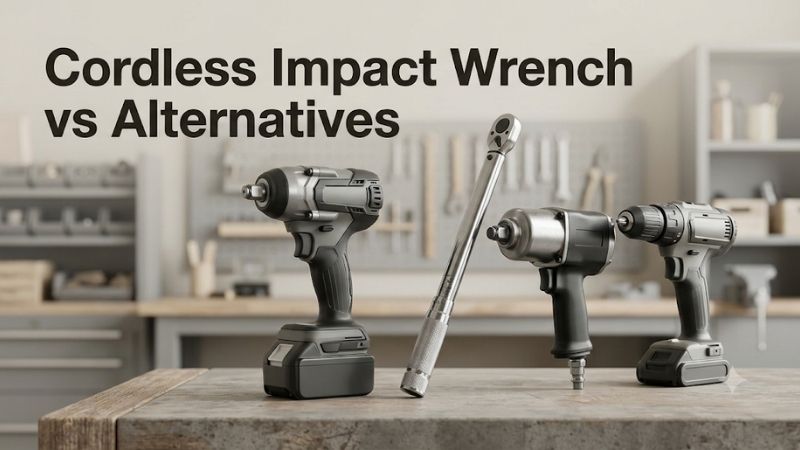
Comparing a cordless impact wrench vs alternatives helps home mechanics choose the right equipment for removing stubborn bolts, servicing vehicles, and completing everyday garage repairs. Impact drivers, cordless ratchets, pneumatic impact wrenches, breaker bars, and torque wrenches serve different purposes, and no single tool is ideal for every fastening task.
Quick Verdict: Which Tool Should You Choose?
A cordless impact wrench is generally the most versatile powered option for homeowners who regularly remove automotive nuts and bolts. It provides impact-based rotational force without requiring an air compressor or a continuous power cord.
However, a cordless ratchet may be more convenient for accessible, lightly loaded fasteners in restricted areas. An impact driver is more appropriate for many screw-driving applications, while a breaker bar offers direct manual leverage for controlled initial loosening.
Pneumatic impact wrenches remain relevant in workshops with established compressed-air equipment, and torque wrenches are essential when accurately tightening fasteners to specified values.
The best approach may involve more than one tool. A home mechanic can use an impact wrench for efficient removal and a calibrated torque wrench for correct final tightening.
Quick Comparison Table
| Tool | Primary Function | Main Advantage | Main Limitation |
|---|---|---|---|
| Cordless impact wrench | Powered nut and bolt removal | Mobility and substantial impact capability | Requires batteries and suitable sockets |
| Impact driver | Driving screws and compatible fasteners | Compact and convenient for screw-driving | Not a direct replacement for an automotive impact wrench |
| Cordless ratchet | Rapid rotation of accessible fasteners | Convenient in some restricted spaces | Generally lower breakaway capability |
| Pneumatic impact wrench | Powered mechanical fastening and removal | Useful in compressed-air workshops | Requires adequate air supply and hose |
| Breaker bar | Manual initial loosening | Direct leverage and simple construction | Requires physical effort and operating clearance |
| Torque wrench | Controlled final tightening | Verifies specified tightening torque | Not primarily intended for fastener removal |
Understand How a Cordless Impact Wrench Works
A cordless impact wrench uses an electric motor and an internal hammer-and-anvil mechanism to deliver repeated rotational impacts.
When a fastener resists rotation, the impact mechanism transfers rotational impulses that help overcome resistance. This makes the tool useful for many automotive and mechanical applications.
Unlike an ordinary drill, the wrench is designed for impact-based fastening and removal using compatible square-drive sockets.
Battery-powered designs allow operation without an air compressor, although output and runtime depend on the tool, battery, and operating conditions.
Why Impact Wrenches Work Well on Resistant Fasteners
Impact mechanisms can deliver brief rotational impulses that help loosen fasteners that resist ordinary continuous rotation.
This is particularly useful when a nut is tightened firmly or affected by moderate corrosion.
However, impact action does not guarantee removal. Severe corrosion, damaged threads, inaccessible fasteners, and unsuitable hardware may require different procedures.
An impact wrench can also damage components when used improperly, so application compatibility must be considered before selecting maximum power.
What Cordless Impact Wrenches Do Best
Cordless impact wrenches are most useful for operations involving repeated nut and bolt removal, especially when powered rotation reduces the physical effort otherwise required.
Common applications include wheel service, suitable suspension hardware, machinery maintenance, and general garage repairs.
Their portability makes them convenient when working outside a fixed workshop or in locations without compressed air.
They are less suitable for delicate screw-driving, precision final tightening, and applications where the manufacturer prohibits impact tools.
Cordless Impact Wrench vs Impact Driver
Main Mechanical Differences
A cordless impact wrench normally uses a square-drive anvil designed to accept compatible sockets. An impact driver usually uses a 1/4-inch hex quick-change collet intended for driver bits and compatible accessories.
Both tools can deliver rotational impacts, but they are designed around different fastening applications.
Impact drivers are commonly used for screws, construction fasteners, and compatible hex-drive accessories. Impact wrenches focus on nuts, bolts, and socket-based mechanical work.
Their specifications should not be compared solely through advertised torque numbers because tool design, output measurement, and intended applications differ.
Which Is Better for Automotive Repairs?
For frequent wheel service and conventional automotive nut-and-bolt work, a cordless impact wrench is generally the more appropriate choice.
Its square drive accepts compatible impact sockets directly, and automotive-focused models provide output ranges suited to mechanical fastening.
An impact driver may be useful for lighter screws, covers, and compatible accessories, but it should not be treated as a universal replacement for an impact wrench.
Using socket adapters does not automatically make an impact driver equivalent to a dedicated socket-drive impact wrench.
Which Is Better for DIY Projects?
For projects dominated by screws, construction hardware, and compatible driver bits, an impact driver is often more convenient.
It is designed for quick bit changes and efficient driving of suitable fasteners.
A cordless impact wrench becomes more useful when the work involves larger nuts, bolts, and mechanical assemblies requiring impact sockets.
Choose an impact driver for screw-focused tasks and an impact wrench for appropriate nut-and-bolt applications.
Cordless Impact Wrench vs Cordless Ratchet
Power and Operating Differences
A cordless ratchet uses a powered mechanism to rotate fasteners through a ratchet-style drive head. Many models are designed primarily to speed up fastener rotation rather than deliver the breakaway force of a conventional impact wrench.
A cordless impact wrench uses repeated rotational impacts, making it better suited to many resistant bolts and nuts.
The comparison is not absolute. Torque capability varies by model, and some specialized ratchets offer more output than basic designs.
Always evaluate manufacturer specifications and intended applications.
Which Tool Is Better for Tight Spaces?
A cordless ratchet can provide better access when a fastener is positioned in a location that accommodates a slim ratchet head but not a pistol-grip wrench.
Examples include certain engine compartments, accessory brackets, and equipment housings.
However, the long body of a ratchet may itself create access problems in some orientations.
An ultra-compact impact wrench may be more effective when the fastener requires greater breakaway capability and sufficient room exists for the socket and tool head.
Should You Own Both?
Owning both can be valuable for mechanics who perform frequent repairs.
An impact wrench can help loosen resistant fasteners, while a cordless ratchet can speed up the removal of accessible fasteners once they turn freely.
For occasional users, however, purchasing two powered tools may be unnecessary.
Start with the tool that matches your most common work rather than assuming every garage requires a complete powered fastening collection.
Cordless Impact Wrench vs Pneumatic Impact Wrench
Power Source and Equipment Requirements
A cordless impact wrench operates using a compatible rechargeable battery. A pneumatic impact wrench relies on compressed air delivered through an appropriate hose and regulator system.
The cordless design is convenient for mobile work because it does not require an external air supply.
Pneumatic equipment can be attractive in established workshops where compressed air is already available for multiple tools.
Neither technology guarantees superior torque. Actual performance depends on the specific wrench and the quality of its power supply.
Performance and Sustained Work
Cordless impact wrench output depends on motor design, electronic controls, battery capability, and operating conditions.
Pneumatic wrench performance depends on air pressure, available airflow, hose restrictions, and the tool itself.
An undersized compressor or restrictive hose can prevent an air-powered wrench from achieving its intended performance.
Similarly, an unsuitable or depleted battery may reduce the effectiveness of a cordless model.
Meaningful performance comparisons require examining complete operating configurations rather than comparing tools in isolation.
Maintenance and Ownership Costs
Cordless tools require battery management, compatible charging equipment, and normal tool maintenance.
Pneumatic systems may involve compressor maintenance, air-system drainage, hose inspection, and lubrication where specified.
If a workshop already has a correctly sized compressed-air system, adding a pneumatic wrench may be economical.
For a homeowner without that infrastructure, a cordless tool can avoid the additional equipment, space, noise, and maintenance associated with a compressor.
Which Is Better for a Home Garage?
A cordless impact wrench is frequently the simpler choice for a typical home garage, particularly where portability and storage space matter.
A pneumatic wrench can be appropriate when the user already owns suitable compressed-air equipment or regularly operates multiple pneumatic tools.
The correct choice depends on total system cost, intended workload, tool access, and maintenance preferences.
Cordless Impact Wrench vs Breaker Bar
Impact Force Versus Manual Leverage
A breaker bar is a long-handled manual tool designed to provide leverage when turning a fastener.
Unlike an impact wrench, it applies torque through direct physical force rather than repeated motor-driven impacts.
Its simplicity can be beneficial because it requires no battery, compressor, or charging equipment.
However, the operator must have sufficient room to move the handle safely and apply controlled force.
Which Is Better for Stubborn Bolts?
An impact wrench may loosen certain resistant fasteners efficiently through repeated rotational impacts.
A breaker bar provides direct manual leverage and can be useful when controlled initial loosening is preferable or when a powered wrench is unavailable.
Neither tool guarantees success with seized hardware.
Corrosion, fastener condition, access, and the risk of damage all influence the appropriate method.
Excessive leverage can break bolts or damage threads, while excessive impact can damage sockets or surrounding components.
Can a Breaker Bar Replace an Impact Wrench?
For occasional repairs, a breaker bar may provide sufficient capability for many fasteners, assuming adequate access and appropriate technique.
It is less convenient when removing numerous fasteners repeatedly.
An impact wrench reduces the manual effort required for many repetitive operations, but it introduces additional equipment requirements and expense.
A cost-conscious garage owner may reasonably start with quality hand tools and add powered equipment when their workload justifies it.
Cordless Impact Wrench vs Torque Wrench
Why These Tools Are Not Interchangeable
An impact wrench is designed to apply rotational impacts for fastening and removal. A torque wrench is designed to indicate or control applied torque according to its mechanism and operating specifications.
These are fundamentally different functions.
An impact wrench’s advertised maximum fastening torque does not mean it can accurately achieve a particular final torque simply by selecting a speed mode.
A calibrated torque wrench is the appropriate tool for verifying many specified tightening operations.
Which Tool Should You Use for Lug Nuts?
An impact wrench can assist with removing wheel fasteners and, where permitted by the vehicle manufacturer, preliminary installation.
Final tightening should follow the vehicle manufacturer’s specified sequence and torque requirements.
A suitable torque wrench should be used to verify that the required final torque has been achieved.
Do not assume that a particular number of impact bursts or a generic automatic stopping mode produces the correct clamping force.
Do You Need Both Tools?
If you perform wheel service or other torque-critical automotive work, the two tools serve complementary purposes.
The impact wrench improves the efficiency of appropriate fastening and removal operations.
The torque wrench provides the controlled final tightening required by the applicable service procedure.
Owning an impact wrench does not eliminate the need for a torque wrench.
Compare the Tools by Common Garage Applications
Removing Car Wheels
A cordless impact wrench is particularly convenient for removing wheel fasteners when the tool has adequate capability and the correct impact sockets are available.
A breaker bar can be a practical manual alternative.
An impact driver or ordinary cordless ratchet should not be assumed to provide sufficient removal capability.
Final wheel installation still requires following the manufacturer’s torque specifications.
Working on Engine Components
Engine repairs often involve fasteners with different sizes, access requirements, and tightening procedures.
A compact impact wrench may be suitable for some operations, while a cordless ratchet or hand tool may provide better control in restricted locations.
An impact driver is more appropriate for compatible screws and driver-bit fasteners.
Avoid impact force around delicate assemblies or where service instructions prohibit its use.
Repairing Suspension Components
Suspension repair may involve heavily loaded fasteners and limited working clearance.
A mid-torque or high-torque impact wrench can be useful for suitable removal operations.
A breaker bar may provide an alternative when direct leverage is appropriate.
Because suspension components can be safety-critical, follow the correct repair procedures, use specified hardware, and verify final tightening accurately.
Assembling Furniture and DIY Equipment
Furniture assembly rarely requires the torque available from an automotive impact wrench.
An ordinary drill-driver, hand screwdriver, or appropriately controlled impact driver is often more suitable for common furniture fasteners.
Excessive impact force can strip threads, damage fastener heads, or crush surrounding materials.
Use the manufacturer’s assembly instructions and select a tool that provides appropriate control.
Maintaining Outdoor Equipment
Outdoor machinery may contain bolts, nuts, screws, and specialized fasteners requiring different tools.
A compact impact wrench can assist with suitable mechanical hardware, while a cordless ratchet may be more convenient for accessible lighter fasteners.
An impact driver can help with compatible screws.
Always inspect the equipment manufacturer’s instructions, especially when working near blades, rotating components, engines, or safety-critical assemblies.
How to Choose Between a Cordless Impact Wrench and Alternatives
Start With Your Most Frequent Tasks
If your regular work involves wheel hardware, automotive nuts, and demanding mechanical fasteners, a cordless impact wrench is worth considering.
If you primarily drive screws, an impact driver may provide more value.
For repetitive removal of smaller accessible bolts, a cordless ratchet could be more convenient.
Choose based on the tasks you actually perform rather than purchasing the tool with the greatest advertised power.
Evaluate Working Space and Access
A powerful impact wrench is ineffective if its housing prevents proper socket alignment.
Consider the distance behind the fastener, clearance around the battery, socket length, and available grip space.
A right-angle impact wrench, compact ratchet, or manual tool may provide access where a conventional impact wrench cannot.
Tool geometry should be evaluated as carefully as torque output.
Consider the Total Equipment Cost
Cordless impact wrenches may require batteries, chargers, and impact sockets.
Pneumatic impact wrenches need an adequate compressed-air system.
Breaker bars and conventional hand tools can have lower equipment requirements but involve greater manual effort.
Compare the complete working system, not simply the purchase price of the individual tool.
Account for Precision and Safety
More power does not always improve fastening quality.
Delicate fasteners, threaded inserts, precision assemblies, and safety-critical joints can be damaged by excessive torque.
Select the tool that delivers an appropriate combination of force, control, and accessibility.
Where a specified final torque is required, use the proper tightening procedure and a calibrated torque wrench.
Frequently Asked Questions
Is an impact wrench more powerful than an impact driver?
Impact wrenches are generally designed for higher-demand socket-based fastening, but the actual output varies by model. Torque values may also be measured differently, so manufacturer ratings should not be compared without understanding their test conditions.
Can I use an impact driver instead of an impact wrench for lug nuts?
An impact driver is not a direct substitute for a dedicated automotive impact wrench. Some may accept suitable socket adapters for specific lighter applications, but that does not guarantee sufficient torque or appropriate retention for wheel service.
Is a breaker bar better for seized bolts?
A breaker bar provides direct leverage and can be useful for controlled initial loosening. An impact wrench provides repeated rotational impacts that may work better in other circumstances. The best method depends on the fastener condition, access, and risk of damage.
Are air impact wrenches stronger than cordless models?
Not necessarily. Both pneumatic and cordless tools are available in different performance classes. Actual output depends on the specific model and its complete power supply configuration.
Can a cordless ratchet replace an impact wrench?
A cordless ratchet can handle many suitable fasteners efficiently, but it generally should not be treated as a replacement for a higher-capability impact wrench when substantial breakaway torque is necessary.
What is the best tool for tightening car lug nuts?
A calibrated torque wrench is the appropriate instrument for verifying specified final tightening torque. An impact wrench may assist with preliminary installation where permitted, but it should not replace the required torque verification.
Conclusion
When comparing a cordless impact wrench vs alternatives, choose the impact wrench for convenient powered removal of suitable automotive nuts and bolts, an impact driver for screw-focused work, a cordless ratchet for accessible lighter fasteners, and a breaker bar for direct manual leverage. Pneumatic wrenches make sense in workshops equipped for compressed air, while a torque wrench remains essential for accurate final tightening. The most effective garage setup combines the right tool for each task rather than expecting one device to perform every function.
More from Amazon
Programs that pair well with the guide above. Offers and eligibility are set by Amazon and may change.
Collect the home and kitchen items you want in one registry that guests can shop from.
Create a wedding registrySet up recurring deliveries of everyday items on eligible products. Terms and savings are set by Amazon.
Explore Subscribe & SaveFree shipping on eligible items, Prime Video and more. Eligible new members can start with a free trial.
Start a Prime free trialAudiobooks and podcasts to listen to on the go. Eligible new members can start with a free trial.
Try Audible freeAs an Amazon Associate we earn from qualifying purchases.