A sofa bed mattress for small spaces must provide enough sleeping comfort while fitting the exact mechanism of a compact sofa. A thicker mattress is not always better because it may prevent the furniture from closing properly. This guide explains how to measure the frame, compare foam options, reduce storage problems, and choose a replacement that works in both room configurations.
Why Small-Space Sofa Mattresses Need Different Planning
A compact sofa bed is intended to perform two functions within one area. During the day, it must work as ordinary seating. At night, it becomes a sleeping surface that may occupy most of the surrounding floor.
The mattress influences both functions. If it is too thick or rigid, the sofa may not close correctly. If it is too thin or compresses excessively, the sleeping surface may feel uncomfortable against the underlying mechanism.
Therefore, successful mattress selection requires balancing comfort with the furniture’s mechanical limits.
The practical challenge becomes greater in a small apartment because there may be no spare place to keep an incompatible mattress, extra topper, or detached bedding.
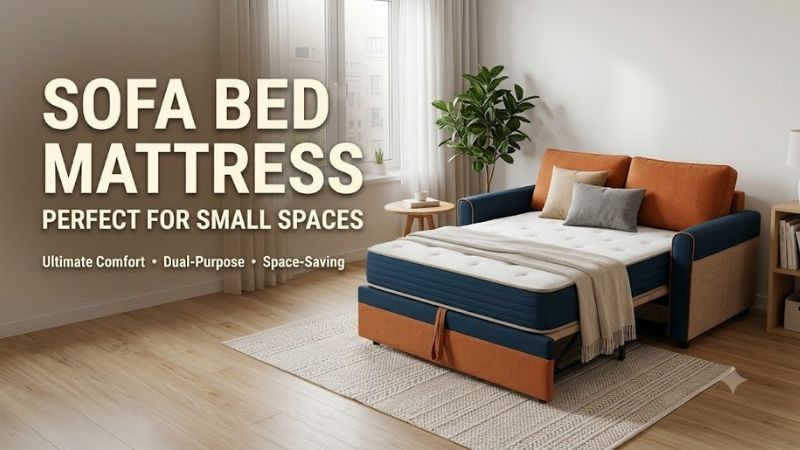
Replacement Mattress Versus Additional Topper
A replacement mattress occupies the space intended for the original sleeper mattress.
A topper is placed above an existing sleeping surface to change its feel.
These are not interchangeable products.
A replacement must satisfy the frame’s dimensions and folding requirements. A topper may be useful only when the sleeper is open and may require separate storage during the day.
For a studio apartment with limited closet space, the need to remove and store a topper every morning can outweigh its comfort benefit.
Fold-Out Sleepers Versus Convertible Sofa Beds
A traditional pull-out sleeper usually contains a mattress that folds into an internal mechanism.
A click-clack or fold-flat sofa may use its original seating cushions as the mattress.
In the second case, there may be no removable mattress to replace.
Buying a conventional sleeper replacement for a sofa that uses integrated cushions can result in a product with no suitable installation location.
Identify the mechanism before shopping.
Measure the Mattress Space Correctly
Accurate measurement is more important than the mattress’s advertised softness or brand reputation.
A mattress can be well constructed and still be completely unsuitable if its width, length, or thickness does not match the frame.
Measure the Open Frame
Open the sofa fully and measure the usable sleeping area from the inside edges of the frame.
Measure the width near the head, center, and foot.
Older mechanisms may contain hardware or narrowing sections that limit the usable space.
Measure the length in the same way, accounting for the actual support arrangement.
Do not assume the old mattress remains dimensionally accurate after years of compression or use.
Confirm Required Thickness
The frame’s folding clearance determines how thick the replacement may be.
Many conventional sofa-bed replacements use four-inch or 4.5-inch profiles, but this is not a universal standard.
Some mechanisms accept five inches or more, while others require thinner constructions.
The safest approach is to identify the original equipment specification or obtain compatibility guidance for the actual model.
Check Unusual Corners
Some sleeper mechanisms require mattresses with angled or cut corners.
A rectangular replacement may interfere with the frame even when its nominal width and length appear correct.
For unusual shapes, a custom supplier may be more appropriate than a standard online listing.
Small-Space Size Comparison
| Mattress category | Example sleeper dimensions | Main buying consideration |
|---|---|---|
| Narrow single | 24 × 72 in | One sleeper; limited width |
| Sofa twin | 35 × 72 in | Compact sleeper frames |
| Wide sofa twin | 38 × 72 in | Verify frame width |
| Sofa full | 52 × 72 in | Narrower than standard full |
| Wide sofa full | 54 × 72 in | Check available width |
| Sofa queen | 58 × 72 in | May not equal standard queen |
| Wide sofa queen | 60 × 72 in | Requires larger support area |
These are examples of sizes offered in one established replacement-mattress range, not universal dimensions for every manufacturer’s sleeper sofa.
A conventional queen mattress measures 60 × 80 inches, illustrating why ordinary mattress-size names cannot establish sleeper compatibility.
Choose Foam Thickness Based on the Mechanism
Three- to Four-Inch Replacements
A relatively thin mattress may be appropriate for older folding mechanisms or compact sleeper chairs.
However, with less material between the body and support frame, foam construction becomes especially important.
A thin mattress that compresses completely beneath the hips may allow uncomfortable contact with bars or other structural components.
Selecting the densest-sounding foam is not a complete answer because density and firmness are different specifications. The correct support depends on material properties and the person using it.
Four- to 4.5-Inch Replacements
These are common configurations among purpose-built sleeper mattress products.
They can provide room for supportive foam and, in certain models, a separate comfort layer.
However, a 4.5-inch replacement must not be forced into a mechanism designed only for a thinner mattress.
An extra half-inch may appear insignificant, but the folded mattress occupies multiple layers inside the sofa structure.
Five-Inch and Thicker Replacements
Thicker mattresses may suit specific modern mechanisms or specially designed sleeper systems.
They should never be treated as universal upgrades.
A five-inch mattress that prevents proper closure is not better than a compatible four-inch model.
Before increasing thickness, confirm the mechanism’s requirements with the sofa or mattress manufacturer.
Memory Foam, Latex, or Conventional Polyurethane Foam?
The material influences the sleeping experience, but no one composition is universally best.
Memory Foam
Memory foam contours gradually under body pressure.
This can create a softer sensation around the shoulders and hips, particularly when combined with a suitable support layer.
However, some people dislike its slow recovery or perceived warmth.
In a shallow sofa mattress, a thick memory-foam top layer can leave less room for the underlying support core.
Evaluate the complete construction rather than choosing by the word memory alone.
Conventional Polyurethane Foam
Polyurethane foam can be manufactured in various densities and firmness levels.
A supportive foam core may offer a straightforward replacement without additional comfort materials.
This can be useful when the mechanism allows very little mattress thickness.
However, a firm core may not provide the preferred contouring for every sleeper, especially someone sleeping on one side.
Latex Foam
Latex generally offers a more responsive sensation than traditional memory foam.
It may suit people who change positions regularly and dislike the feeling of sinking slowly.
However, latex sleeper mattresses tend to occupy higher price categories and must still be constructed for folding.
People with known latex-related concerns should evaluate suitability carefully.
How to Choose for Different Guest Needs
Occasional Overnight Guests
When the sofa bed is used only a few nights per year, a compatible, reasonably supportive foam replacement may be sufficient.
However, infrequent use does not justify buying an unsuitable size or very poor construction.
A mattress stored folded for long periods still needs to maintain its intended shape when reopened.
Frequent Adult Guests
If guests stay several weekends per month, mattress support becomes more important.
A model with clearly documented construction may be a more defensible purchase than one described only as comfortable or luxurious.
Consider body weight, sleeping positions, and whether the sofa frame provides adequate support beneath the mattress.
Taller Guests
Many replacement sofa mattresses are approximately 72 inches long.
That is substantially shorter than a standard queen mattress measuring 80 inches.
For a tall adult, length may be a more serious limitation than softness.
A thicker mattress cannot compensate for inadequate sleeping length.
If the sofa frame is too short, a different sleeper design may be necessary.
Plan the Opened Room Layout
A small-space mattress must fit the sofa, but the entire opened sofa must also fit the room.
Measure the full converted footprint from the wall to the end of the sleeping platform.
Then determine whether nearby furniture can remain accessible.
For example, if a studio has 110 inches of usable room depth and the opened sleeper extends 85 inches, only 25 inches remain along that measurement before accounting for other objects.
This does not automatically establish a safe walking route.
Consider the room’s actual circulation, doorway placement, and ability to move around the bed.
Avoid Creating a Daily Topper Storage Problem
A topper may seem like an inexpensive way to improve a firm sofa-bed mattress.
However, it can create additional tasks every morning.
The topper may need to be removed, rolled or folded according to its instructions, and stored separately.
Memory-foam toppers can be bulky even when relatively thin.
If the apartment has no available closet or storage cabinet, a better-fitting replacement mattress may offer greater everyday convenience.
A topper should not be folded into the sofa unless the manufacturer expressly permits that configuration.
Cleaning and Maintenance in Compact Homes
Small apartments may have limited laundry equipment and drying space.
That makes mattress-care requirements important.
Removable Covers
A removable mattress cover may make surface cleaning easier.
However, removable does not automatically mean machine-washable.
Follow the product-specific instructions.
Foam Cores
Many foam cores are intended for spot cleaning rather than machine washing.
They should not be saturated without explicit manufacturer approval.
Trapped moisture can create odors and deterioration.
Mattress Protectors
An appropriately sized, compatible protector can help reduce soiling.
However, excessively thick padding may interfere with closure if it remains on the mattress when the mechanism folds.
Check the manufacturer’s instructions.
Storage Condition
Do not close the sleeper while the mattress or bedding is damp.
Allow cleaned components to dry fully before storage.
Common Small-Space Buying Mistakes
Buying a Conventional Bedroom Mattress
A regular mattress may be too thick, long, or inflexible for the folding system.
Compatibility comes first.
Choosing a Mattress From the Sofa’s Exterior Width
The sofa arms and frame occupy space that does not belong to the sleeping surface.
Measure the internal frame.
Ignoring Folded Clearance
A mattress that feels comfortable when open may damage the mechanism when forced closed.
Buying an Extra Topper Without Storage Space
A topper is only convenient when its setup and storage fit the household’s routine.
Assuming a Short Mattress Suits Every Adult
Many sofa replacements are shorter than standard bedroom mattresses.
Check actual sleeping length.
Frequently Asked Questions
What Thickness Is Best for a Small Sofa Bed?
The correct thickness is the one supported by the exact folding mechanism. Four- and 4.5-inch replacements are common, but some sofas require less or permit more. Do not increase thickness without checking compatibility.
Can I Put a Regular Twin Mattress in a Sleeper Chair?
Only if the manufacturer specifically supports the mattress’s dimensions, thickness, and construction. A standard twin mattress is generally not interchangeable with a narrow sofa-bed replacement.
Is Memory Foam Good for Small Sofa Beds?
Memory foam can provide contouring comfort when paired with an adequate support core. However, the total mattress thickness must remain compatible with the folding system.
Is a Mattress Topper Better Than a Replacement?
A topper can change the surface feel of an otherwise functional mattress. A replacement is usually more relevant when the original mattress is worn, damaged, or inadequate. A topper cannot repair a faulty support frame.
Can I Store a Foam Topper Inside the Closed Sofa?
Not unless the sofa manufacturer expressly permits it. Additional thickness can interfere with the mechanism and place unnecessary stress on its components.
What Should I Do if the Frame Has an Unusual Shape?
Consider a supplier offering custom dimensions or shaped corners. Measure the frame carefully and confirm the finished mattress geometry before ordering.
Conclusion
The right sofa bed mattress for small spaces provides adequate comfort while fitting the sofa’s exact dimensions and folding clearance. Begin by identifying the mechanism, measuring the interior frame, and checking thickness restrictions. Choose foam construction according to the sleeper’s needs, avoid unnecessary topper-storage problems, and verify that the opened furniture leaves practical room access. A compatible replacement is more valuable than a thicker mattress that cannot be stored safely.