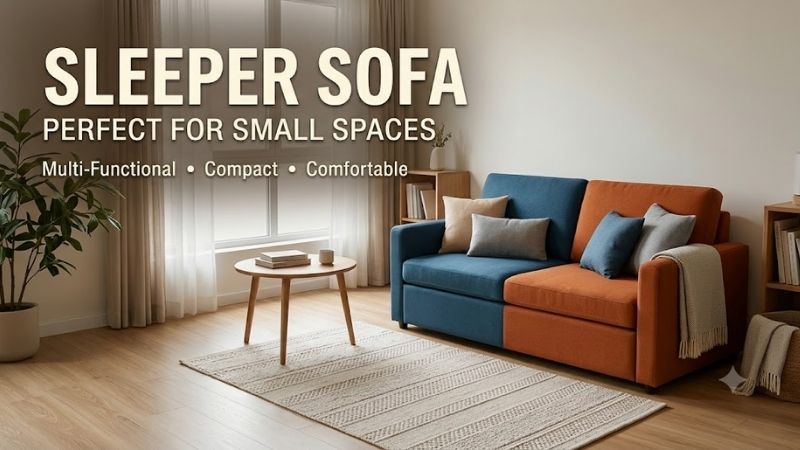
A sleeper sofa for small spaces must work as comfortable seating without making the room unusable when converted into a bed. Compact dimensions alone are not enough: opening clearance, mattress size, cushion storage, and delivery access can determine whether the furniture is practical. This guide explains how to evaluate layouts, mechanisms, and long-term comfort before buying.
Why a Small-Space Sleeper Needs More Careful Planning
A sleeper sofa is one of the most appealing multifunctional furniture purchases for an apartment because it combines seating and sleeping in one location. However, it does not eliminate the space required for a bed. Instead, it allows that space to be reclaimed during the day.
This distinction matters in studios, home offices, and small guest rooms. A compact sofa may appear ideal while closed but require moving the coffee table, desk chair, or other furniture every night. If conversion becomes a lengthy process, the buyer may eventually stop using the sleeper as intended.
The best small-space sleeper therefore balances three requirements: a manageable closed footprint, a usable open sleeping area, and a conversion process that fits everyday life.
Compact Width Is Only One Measurement
Shoppers often focus on the overall width of a sleeper because that determines whether it fits against a wall. Width is important, but depth and bed extension can be more restrictive.
For example, a sofa that measures 72 inches wide and 35 inches deep may be relatively compact when used for sitting. If the sleeping mechanism extends several additional feet, the open configuration can occupy much of the room.
A narrower sofa with a difficult opening arrangement may be less practical than a slightly wider model that opens into an otherwise unused area.
The correct approach is to measure the room in both daytime and nighttime configurations.
Daily Conversion Changes What Counts as Convenient
A sleeper sofa used twice a year does not need the same conversion convenience as one used every evening.
For occasional guests, removing cushions and extending a mechanism may be acceptable. For someone sleeping on the sofa every night, repetitive lifting, pulling, and rearranging can become exhausting.
The frequency of use should therefore influence the mechanism as much as the budget.
If the sofa will serve as the primary bed, the mattress, support structure, and cleaning requirements deserve greater attention than decorative styling.
Compare Sleeper Sofa Designs for Compact Rooms
| Design | Daytime benefit | Main space concern | Ideal starting use |
|---|---|---|---|
| Compact pull-out sofa | Conventional seating | Mattress extends forward | Living room with occasional guests |
| Click-clack futon | Simple conversion | Requires backrest clearance on some models | Studio or student room |
| Fold-flat sleeper | Relatively simple mechanism | Flat surface can occupy large floor area | Multipurpose guest room |
| Slide-out sofa bed | Uses seating structure | Needs forward extension | Everyday convertible furniture |
| Sleeper loveseat | Shorter wall footprint | Limited sleeping width | Narrow rooms |
| Sleeper chair | Very compact seating | Usually sleeps one | Home office |
| Sleeper sectional with storage | Combines several functions | Chaise projects into room | Larger compact apartments |
A smaller sofa is not automatically the best fit. The operating geometry matters.
How to Measure a Room for a Sleeper Sofa
Before selecting a product, identify the wall where it will sit and the area into which it will open.
Measure the room in inches and sketch the locations of doors, wardrobes, windows, outlets, and furniture that cannot easily move.
Then examine whether the sofa can remain usable in both configurations.
Measure the Closed Footprint
Record the complete width and depth, including armrests, legs, and any fixed chaise.
Do not rely only on the seat dimensions.
A sleeper with wide padded arms may use much more wall space than its actual seating capacity suggests.
Likewise, a sectional with a 60-inch chaise projection may obstruct a pathway even when the main sofa fits neatly against the wall.
Measure the Opened Footprint
The full sleeping position is the more important measurement when space is severely limited.
A standard queen mattress measures approximately 60 × 80 inches, but a sleeper’s exterior structure can extend beyond the mattress area.
Some convertible sofas have sleeping surfaces that are not standard mattress dimensions.
Use the manufacturer’s exact open measurements, including the mechanism and any projecting frame sections.
Check Furniture Movement
Imagine the conversion sequence from beginning to end.
Where will the coffee table go? Can the sleeper open without moving a bookcase? Is there room for the person operating the mechanism to stand or pull?
A layout requiring heavy furniture to be relocated every night is rarely ideal for everyday use.
Consider nesting tables or movable lightweight furniture when the room must transform regularly.
Preserve Access to the Room
The sleeper should not obstruct required exits or create unsafe access when opened.
A bed positioned directly against a door may prevent occupants from moving comfortably through the room.
Likewise, an open sleeper must not block access to necessary equipment or create hazardous cable arrangements.
Example: Planning a Sleeper in a 10 × 11-Foot Studio
Imagine a studio sleeping area measuring 120 × 132 inches.
A hypothetical sofa measures 80 inches wide and 36 inches deep when closed.
When converted, suppose its total depth becomes 86 inches.
In the closed position, the sofa leaves 96 inches of room depth beyond its front edge. In the open position, that remaining distance becomes 46 inches, before accounting for other furniture.
This example is only a planning calculation, not a particular product specification.
If a coffee table or desk occupies the open area, the usable clearance becomes smaller.
The buyer must therefore decide where that furniture will move and whether the remaining access is sufficient.
A slightly shorter sleeper with a more suitable conversion mechanism may be a better purchase even when its seating area is less generous.
Sleeper Loveseat vs Full Sleeper Sofa
A loveseat sleeper can be useful when the available wall is too narrow for a conventional three-seat sofa.
However, the shorter daytime width may also mean a narrower sleeping surface.
Sleeper Loveseats
A sleeper loveseat can work well in a home office or guest room where one adult occasionally stays overnight.
Some models open into twin or full-size sleeping arrangements, but actual dimensions vary.
A loveseat should not be assumed to provide a standard full mattress simply because the product title uses that term.
Check the sleeping surface width and length before purchasing.
Full-Width Sleeper Sofas
A longer sofa may seat more people during the day and accommodate a larger sleeping surface.
The trade-off is wall space.
In a narrow studio, choosing a full-width sleeper may force other furniture into awkward positions.
Which Is Better?
Choose the smallest sleeper that provides adequate sleeping dimensions for the intended guests while preserving practical daytime seating.
Do not buy a queen-size sleeper automatically when most guests sleep alone.
Choosing a Conversion Mechanism
The opening mechanism can determine whether a sleeper feels convenient or frustrating.
Different systems use different sequences, and the terms used by retailers are not always consistent.
Traditional Pull-Out Mechanism
A traditional pull-out sleeper stores a mattress within the sofa structure.
The user removes the seat cushions and unfolds the sleeping mechanism.
This design allows the sofa to retain a relatively traditional appearance during the day.
However, the mechanism adds weight, and the mattress may be relatively thin to accommodate folding.
The quality of the frame and mattress support is important, particularly for frequent use.
Click-Clack Mechanism
A click-clack design converts by changing the angle of the backrest and seat.
This can be straightforward, with fewer steps than some traditional pull-outs.
However, some designs need clearance behind the sofa to flatten the backrest.
If the sleeper must be moved away from the wall every night, the mechanism may be inconvenient in a narrow room.
Slide-Out Mechanism
A slide-out design extends part of the seating structure forward.
This can create a larger sleeping surface without storing a separate folding mattress.
However, the resulting bed may use multiple cushion sections, potentially producing noticeable transitions.
The user should evaluate whether the surface feels consistent enough for the intended sleeping frequency.
Fold-Out Foam Design
Some modern sleepers unfold layered foam into a bed.
These designs can be practical when the sofa must be delivered in manageable parts.
However, foam quality and support matter. The number of layers alone does not establish comfort or longevity.
Sleeping Surface: What Size Do You Actually Need?
A sleeper’s sleeping dimensions should be checked independently from its sofa dimensions.
Terms such as twin, full, and queen may describe the intended sleeping category, but the exact convertible surface does not always match a conventional mattress.
| Standard US mattress reference | Width | Length |
|---|---|---|
| Twin | 38 in | 75 in |
| Twin XL | 38 in | 80 in |
| Full | 54 in | 75 in |
| Queen | 60 in | 80 in |
| King | 76 in | 80 in |
These are standard mattress references, not universal sleeper-sofa dimensions.
A sleeper measuring approximately 55 inches wide may offer space similar to a full mattress while differing in length.
The exact usable surface is particularly important for taller adults.
A 75-inch sleeping length may feel restrictive to someone who needs more legroom, especially when pillows occupy the upper portion.
Mattress Comfort for Everyday Versus Occasional Sleep
A sofa used as an occasional guest bed can involve different comfort compromises from one used nightly.
Foam Sleeping Surfaces
Foam is common in fold-out and convertible sofa designs.
Comfort depends on thickness, firmness, layering, and the support beneath the foam.
A high-density foam label does not automatically guarantee comfort, and a soft surface is not necessarily supportive.
If the sleeper will be used frequently, evaluate whether the surface remains comfortable across multiple sleeping positions.
Innerspring Mattresses
Some pull-out sleepers use innerspring mattresses.
Their comfort depends on the spring system, cushioning layers, and mattress thickness.
A thin mattress can permit the sleeper to feel underlying frame components, particularly when the support structure is poorly designed.
Pocket-Spring Constructions
Some convertible designs use pocket springs integrated into the sleeping surface.
This can create a different response from a foam-only design, but the quality and arrangement still matter.
A pocket-spring label should not be treated as proof of superior sleep comfort.
Cushion-Based Sleeping Surfaces
Many affordable sofa beds use the original seat and back cushions to form a flat surface.
This simplifies the mechanism but can introduce seams or changes in firmness.
For occasional guests, that may be acceptable. For everyday use, a dedicated mattress may be preferable if it fits the buyer’s needs and budget.
Storage Features Worth Considering
A sleeper sofa with storage can reduce clutter in a small room.
However, not every storage compartment is equally useful.
Chaise Storage
A sectional with a lifting chaise may hold blankets, sheets, and pillows.
This is valuable when there is no separate linen closet.
However, the chaise increases the permanent sofa footprint, and the compartment needs room to open.
Under-Seat Storage
Some straight convertible sofas use a storage area beneath the seat.
This can offer organization without adding a separate chaise.
However, access may require moving cushions or opening part of the mechanism.
Storage Versus Mattress Quality
Do not choose a sleeper entirely because it includes storage.
If the sleeping surface is unsuitable, the additional compartment cannot compensate.
Consider storage an added benefit after confirming comfort and fit.
Delivery Into Apartments and Older Buildings
Sleeper sofas can be heavy because the frame must support both seating and sleeping.
Traditional pull-out mechanisms may contain metal components that increase weight.
In older buildings, narrow staircases and tight hallway turns can complicate delivery.
Measure the Delivery Route
Check doors, elevators, hallways, stairs, and the entrance to the intended room.
Pay attention to turning spaces rather than measuring only straight openings.
An 80-inch furniture piece may be difficult to rotate through a narrow corridor even when its depth is less than the doorway width.
Consider Modular Delivery
Some sleeper sofas arrive in separate components for assembly.
This can simplify access, but the individual boxes still need to fit through the building.
Review package measurements and weights before ordering.
Assembly and Removal
A sofa that requires extensive assembly may be inconvenient for renters who move regularly.
Check whether the furniture can be disassembled later without damage.
Do not assume every flat-pack sleeper is designed for repeated disassembly.
Upholstery and Cleaning for Multifunctional Rooms
A sleeper sofa may be used for meals, television, working, and sleeping.
This creates significant exposure to spills, skin oils, and daily wear.
Removable Covers
Washable covers can be valuable, but removable upholstery does not always mean machine washable.
Verify instructions for the exact fabric.
Performance Fabrics
Stain-resistant fabrics may reduce certain cleaning difficulties.
However, the performance depends on the specific treatment and material.
Do not assume complete waterproofing.
Cleaning the Mattress
A sleeper with a separate mattress may have a removable cover or other maintenance instructions.
Foam cores and mattress components should not be washed unless expressly permitted.
Hygiene for Guest Use
Clean, correctly sized bedding and regular maintenance are useful when guests sleep on the sofa.
Allow any cleaned components to dry completely before folding them away.
Common Small-Space Buying Mistakes
Buying Based Only on Closed Dimensions
The sofa may fit while closed but become unusable when opened.
Always measure the complete sleeping footprint.
Choosing a Mechanism That Requires Moving Heavy Furniture
A sleeper that requires significant rearrangement every evening may not be practical for daily use.
Plan the full conversion sequence.
Assuming a Sleeper Sectional Saves Space
A chaise can occupy a substantial area permanently.
A straight sleeper and movable ottoman may be more flexible.
Ignoring Mattress Length
Two adults may need a wider sleeping surface, while taller guests also need adequate length.
Check both.
Forgetting the Cushion Storage Problem
Many pull-outs require removing several seat cushions.
Consider where they will be kept during overnight use.
Frequently Asked Questions
What Type of Sleeper Sofa Is Best for a Studio Apartment?
A compact straight sofa with a straightforward conversion mechanism is usually a practical starting point. The best choice depends on the open footprint and whether the bed will be used nightly. A sleeper sectional may work when the room can accommodate its chaise without blocking circulation.
Is a Sleeper Loveseat Big Enough for Two Adults?
Some sleeper loveseats offer two-person sleeping surfaces, but dimensions vary. Check actual width and length rather than relying solely on labels such as full or double.
Are Click-Clack Sofa Beds Good for Everyday Sleeping?
They can be suitable for some users, but comfort depends on the cushioning, support, and intended use. A product that converts easily may still have a firm or segmented surface. Evaluate the actual sleeping function carefully.
Is a Sleeper Sofa Better Than a Murphy Bed for Small Spaces?
A sleeper sofa provides seating during the day, while a Murphy bed may offer a more conventional mattress. The better choice depends on room layout, wall installation, mattress comfort, and whether permanent mounting is possible.
Do Sleeper Sofas Damage Floors?
Furniture movement and mechanisms can create wear if used improperly. Protect suitable flooring according to the manufacturer’s guidance, and avoid dragging heavy furniture during conversion.
Can I Add a Mattress Topper to a Sleeper Sofa?
A compatible topper may change comfort, but it should not interfere with the mechanism or be folded into a sleeper that is not designed to accommodate it. Follow the sofa manufacturer’s instructions and remove incompatible bedding before closing.
Conclusion
The best sleeper sofa for small spaces balances a compact daytime footprint with a usable, accessible sleeping arrangement. Measure both configurations, compare the actual bed dimensions, and choose a mechanism that suits how frequently the sleeper will be opened. Consider a narrow loveseat for occasional guests, a suitable queen sleeper when two adults need accommodation, and storage features only when they remain easy to access. Practical fit matters more than the word compact in a product listing.c